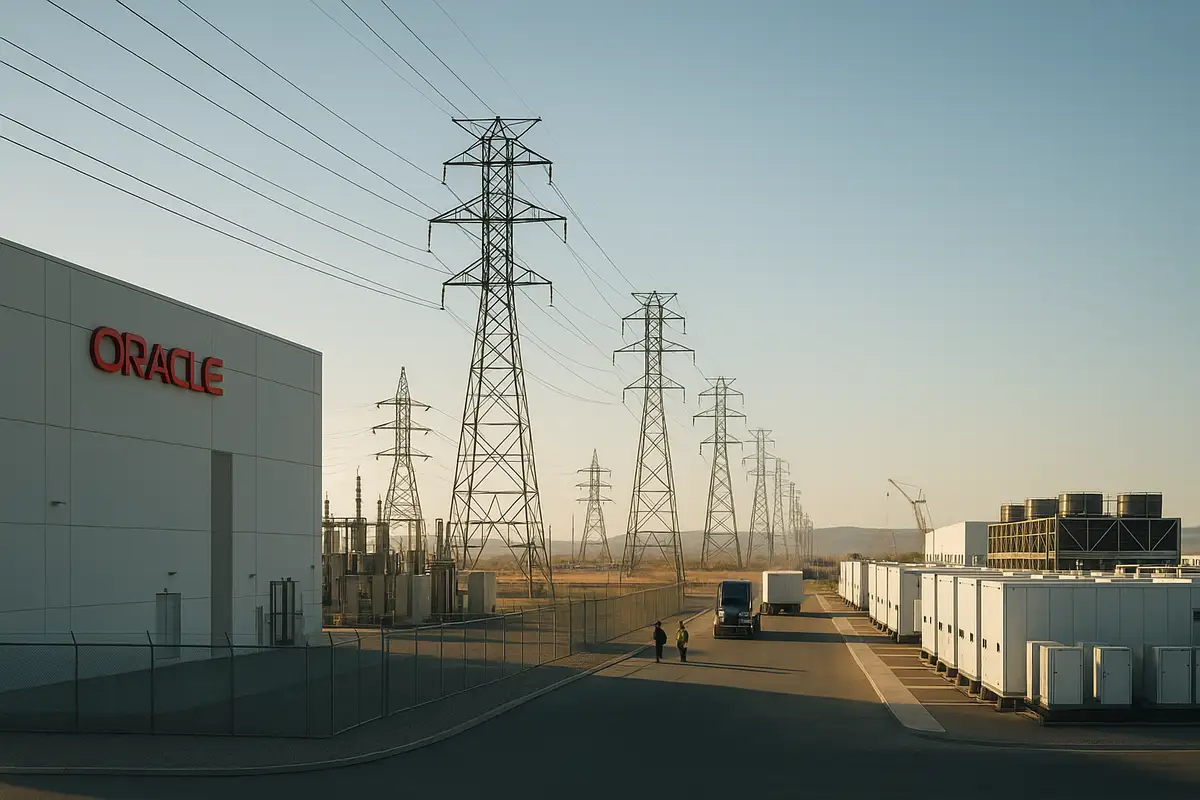
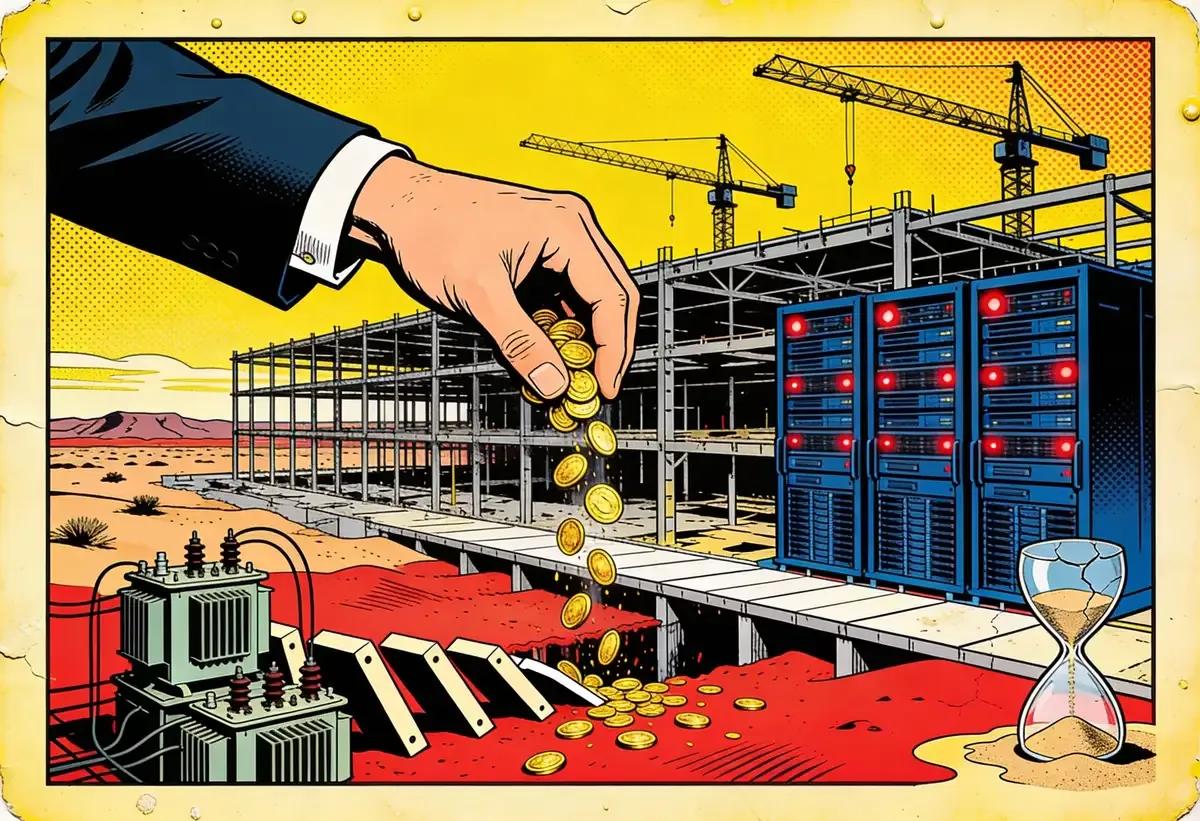
Oracle's response to Bloomberg's reporting on OpenAI data center delays deserves close reading. The company didn't say there were no delays. It said there were "no delays to any sites required to meet our contractual commitments."
That's a narrower claim. In corporate communications, the gap between what companies say and what they don't say often contains the actual story.
Bloomberg reported completion dates slipping from 2027 to 2028 across several facilities Oracle is building for OpenAI's Stargate project. Electrical transformers with eighteen-month lead times. Concrete trucks queued behind Microsoft's Wisconsin site. Skilled welders demanding $200 an hour because Amazon is hiring down the road. The physical world refusing to bend to PowerPoint timelines. Oracle's stock dropped another 4% on the news, adding to the 15% crater from earlier in the week when earnings revealed costs growing faster than revenue.
But the denial's careful construction suggests something more troubling than a scheduling dispute. Oracle appears to be distinguishing between what it must deliver under contract and what it had publicly suggested it would deliver. Those might be very different things.
The Breakdown
• Oracle denied delays to "contractual commitments" but not public timelines—a distinction suggesting the 2027-to-2028 slip is real
• OpenAI can exit the deal after five years while Oracle holds fifteen-year property leases, creating asymmetric risk exposure
• Credit default swap prices on Oracle debt hit five-year highs, signaling bond markets see dangers equity investors haven't priced
• Microsoft passed on a similar OpenAI infrastructure deal in 2024, a decision that now looks prescient rather than timid
Microsoft's Refusal Looks Different Now
Six months ago, when reports emerged that Microsoft had passed on a similar infrastructure deal with OpenAI, Wall Street called Nadella timid. Maybe even foolish. Oracle was seizing the opportunity Microsoft lacked the vision to pursue.
That looks naive now.
Microsoft CEO Nadella explained the decision in October with unusual directness. "Sometimes Sam is saying, 'Hey, can you build me a dedicated multigigawatt data center in one location for training?'" Nadella told a podcast. "Makes sense from an OpenAI perspective." But for Microsoft Azure? "Doesn't make sense."
Nadella understood what Oracle's current predicament illustrates: building custom infrastructure for a single customer means one side bets the rent money while the other side bets a coupon. Microsoft already had skin in the game as OpenAI's original cloud partner. Adding more exposure to a company losing billions annually, whose products haven't demonstrated they can generate returns justifying the investment, looked less like opportunity and more like a trap.
Oracle's free cash flow went negative in 2024 for the first time since 1992. That's not a typo. The company that spent three decades generating reliable cash is now bleeding money to build data centers for a startup.
The Contract's Hidden Asymmetry
OpenAI's contract with Oracle includes an option to "recommit or walk away" after approximately five years. Oracle's leases on the properties where it's building these data centers run fifteen years.
OpenAI gets optionality. Oracle gets obligation. If demand for AI compute continues growing at current rates, OpenAI benefits from locked-in capacity. If demand softens, or if OpenAI develops its own infrastructure, or if the company's revenue growth stalls, Oracle is left holding extraordinarily expensive real estate with limited alternative uses.
This isn't theoretical. OpenAI has already announced deals with Amazon, AMD, Broadcom, and CoreWeave since signing with Oracle. The company has discussed building its own data centers. Every new partnership dilutes Oracle's strategic position while Oracle's financial exposure remains fixed.
KeyBanc analyst Jackson Ader captured the dynamic: "You've seen an inverse correlation between OpenAI's commitments and Oracle's stock price. As the amount of spend grows at OpenAI, the value of each commitment goes down."
More partners means more alternatives. More alternatives means less leverage. Oracle's $300 billion contract might not be worth $300 billion.
Credit Markets Have Already Decided
Equity investors buy stories about transformation. Credit investors buy insurance against things going wrong.
The credit default swap market has rendered its verdict. The cost of insuring Oracle's debt against default surged to five-year highs this week and continued climbing Friday. CDS traders, who made fortunes betting against housing in 2007 and 2008, are now accumulating positions against a company Wall Street was celebrating three months ago.
Sign up for Implicator.ai
Strategic AI news from San Francisco. Clear reporting on power, money, and policy. Delivered daily at 6am PST.
No spam. Unsubscribe anytime.
Credit markets often lead equity markets. Bond investors have access to the same information as stock analysts but different incentives. They don't benefit from upside. They just want to avoid catastrophe. When credit spreads widen while management insists everything is fine, one of them is wrong.
Oracle's $70 billion in projected free cash flow losses through the end of the decade assumes everything goes right. Data centers built on time. OpenAI's revenue doubling annually. Demand for AI compute never normalizing. No competitor undercutting Oracle's pricing. The exit clause in OpenAI's contract never exercised.
That's a lot of assumptions for a company whose bonds are flashing warning signals.
The Disease Is Systemic
Labor shortages are the symptom. Every hyperscaler is building data centers simultaneously, and they're all hiring from the same pool of workers in Texas and the Southwest. Amazon, Microsoft, Google, Meta, xAI. They're bidding against each other for welders, electricians, concrete. For electrical transformers that can't be manufactured faster regardless of price. Microsoft spent $40 million on concrete alone for a single Wisconsin facility over six months. Land near substations with available grid capacity has become genuinely scarce.
Oracle isn't uniquely affected by these constraints. But Oracle has committed more aggressively than rivals to a single customer whose long-term viability remains unproven. When bottlenecks hit everyone, the company with the least flexibility suffers most.
Trump's tariffs added an estimated $6 billion in costs across the AI data center buildout. Some utilities have waitlists stretching years for new grid connections. Oracle has resorted to running entire facilities on gas generators at one Texas campus. More than a billion dollars annually in fuel costs. Desperate measures for desperate timelines.
Safra Catz, Oracle's CEO until 2025, had starved the cloud infrastructure division for years. She understood that chasing hyperscaler economics meant lower margins and brutal capital requirements. She preferred milking Oracle's existing database business where customers were locked in and switching costs kept them paying. The board sidelined her anyway, promoting cloud infrastructure chief Clay Magouyrk to co-CEO with a compensation package $150 million richer than his counterpart's.
That was January. Now it's December, and the company is parsing the difference between "delays" and "contractual commitments."
The Bellwether Cracks
Oracle's market capitalization briefly made Larry Ellison the world's richest person in September. For a few hours, the 81-year-old founder of a database company was worth more than Elon Musk. The stock had added $250 billion in value on news of the OpenAI deal.
Since then, Oracle shares have given back everything. Up just 13% for the year, all of it gains accumulated before the AI spending became real. The company that was supposed to prove AI infrastructure was a legitimate business has instead become a barometer for investor anxiety about the whole sector.
D.A. Davidson analyst Gil Luria offered three scenarios for how the OpenAI contract plays out: Oracle reduces forecasts but salvages some work. OpenAI collapses and the contract evaporates. Or, his words, "OpenAI achieves super-intelligence, spends $1.4T, none of us have to ever work again, and Oracle is fine."
Luria meant it as dark humor. But the scenarios bracket the actual debate. Current AI valuations depend on outcomes that keep receding. Cancer cures, eliminated job categories, maybe artificial general intelligence. Three years ago, some predictions had 2025 timelines. Now the goalposts sit at 2027, 2028, later. The infrastructure spending hasn't moved with them.
OpenAI has 800 million users. Impressive. But even a product that popular can't generate returns sufficient to justify $300 billion in infrastructure. Not without something genuinely new emerging from all that compute. And "something genuinely new" is not a business plan.
Oracle's slip from 2027 to 2028 isn't a scheduling hiccup. It's the sound of an $80 billion bet colliding with transformer lead times and union overtime rules and the physical limits of how fast humans can pour concrete. The company's carefully worded denial doesn't dispute the delay. It just tries to define away the consequences. That's not confidence. That's damage control.
Why This Matters
- For AI infrastructure investors: Oracle's fifteen-year lease obligations against OpenAI's five-year exit option isn't unique to this deal. Similar structures exist across the sector. Credit default swap pricing has noticed what equity valuations haven't.
- For enterprise technology buyers: Data center capacity constraints may resolve faster than current pricing assumes. Companies signing long-term AI compute contracts now could find themselves locked into above-market rates within two years.
- For OpenAI competitors: Construction delays extend the window before Stargate reaches promised scale. Anthropic, Google, and others have more runway than they did last week.
❓ Frequently Asked Questions
Q: What are credit default swaps, and why are traders buying them on Oracle?
A: Credit default swaps are insurance contracts that pay out if a company can't repay its debt. Traders buy them to either hedge existing positions or bet against a company. Oracle's CDS prices hit five-year highs this week, meaning bond investors see elevated default risk. These traders famously profited by betting against mortgage-backed securities before the 2008 crash.
Q: What exactly is the Stargate project?
A: Stargate is a joint AI infrastructure venture announced in January 2025 by Oracle, OpenAI, and SoftBank. The project aims to build data centers across the US capable of housing two million AI accelerators and consuming 4.5 gigawatts of power—more than all Chicago homes combined. Trump hosted the announcement at the White House on his second day back in office.
Q: What happens to Oracle if OpenAI walks away after five years?
A: Oracle would be stuck with fifteen-year property leases on data centers built specifically for AI workloads. These facilities cost tens of billions to construct and have limited alternative uses. Oracle would need to find new tenants for highly specialized infrastructure in what could be an oversupplied market—or absorb the losses on its own balance sheet.
Q: Why are AI data center construction costs so extreme right now?
A: Every major tech company is building simultaneously, competing for the same workers, materials, and grid connections. Microsoft spent $40 million on concrete alone for one Wisconsin facility. Electrical transformers have eighteen-month lead times. Skilled welders command $200/hour. Trump's tariffs added an estimated $6 billion industry-wide. Some utilities have multi-year waitlists for new power connections.
Q: Who is Safra Catz and why did Oracle sideline her?
A: Catz served as Oracle's CEO from 2019 to 2025 and was known for financial discipline. She resisted aggressive cloud infrastructure spending, preferring to protect margins on Oracle's profitable database business. The board replaced her with Clay Magouyrk, whose compensation package was $150 million higher than his co-CEO counterpart—a clear signal of Oracle's new AI-first priorities.
 Maria Garcia
 Marcus Schuler
 Marcus Schuler