Implicator
Perplexity on Wednesday unveiled Computer, a multiagent orchestration system that routes tasks across 19 frontier AI models to handle end-to-end workflows from research and design through code deployment. The platform uses Claude Opus 4.6 as its core reasoning engine and dispatches sub-agents powered by Gemini, Grok, ChatGPT 5.2, and others based on each task's requirements, according to ZDNET. Available immediately to Perplexity Max subscribers at $200 per month, Computer introduces per-token billing for consumers for the first time, with rollout to Pro and Enterprise tiers in the coming weeks.
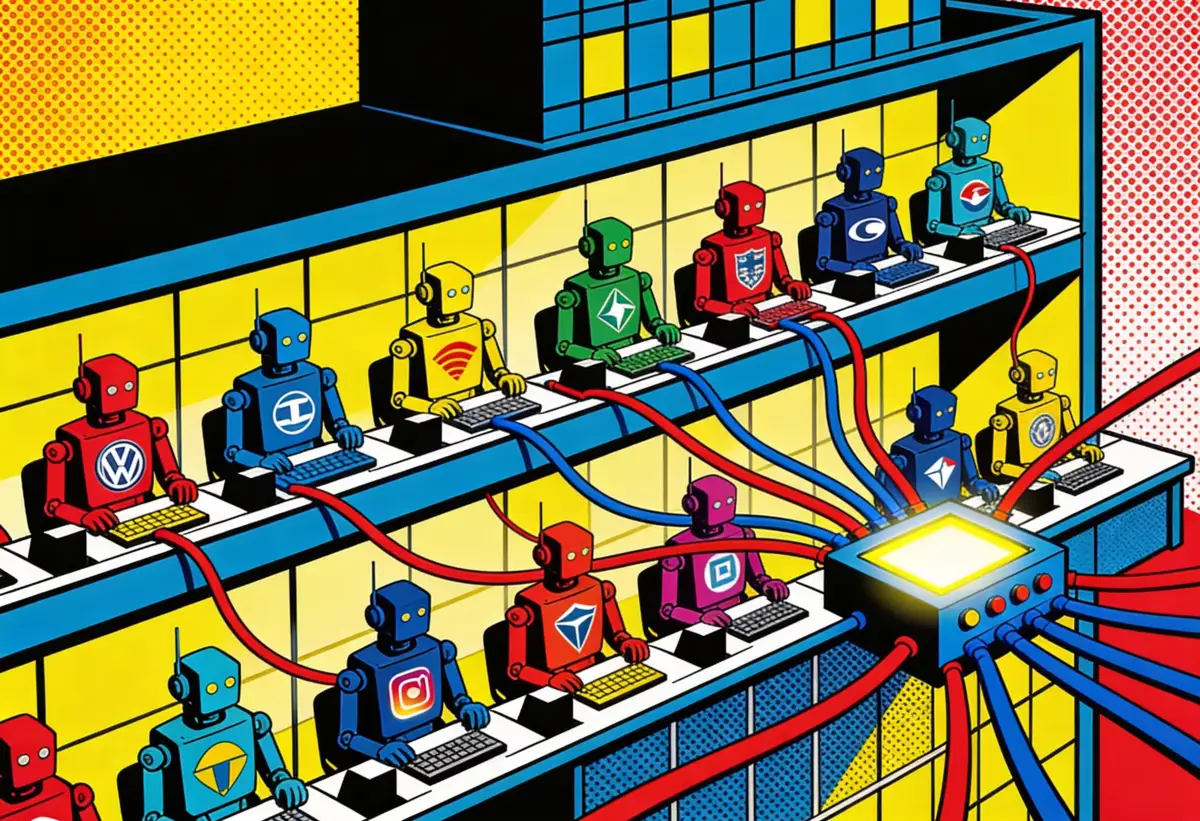
The launch marks Perplexity's most aggressive move beyond search, and its most emboldened. Where competitors have bet on single-model autonomy, running one powerful agent across a user's entire digital life, Perplexity is staking its position on coordination. Give Computer an outcome you want, and it breaks the work into tasks and subtasks, assigns each to the model best suited for it, and runs them simultaneously. The company says it can operate for hours. Or months.
The Breakdown
- Perplexity Computer orchestrates 19 AI models with Claude Opus 4.6 as the central reasoning engine
- Available to Max subscribers ($200/month) with per-token billing, a first for Perplexity consumers
- Runs in a sandboxed environment after OpenClaw's publicized email deletion incident raised safety concerns
- The company used Computer internally since January, building a 4,000-row spreadsheet overnight
Nineteen models, one orchestrator
No single model does everything well. Perplexity is the first major AI company to build a consumer product on that admission.
Anthropic's Claude excels at code and reasoning. Google's Gemini handles deep research. Grok runs lightweight tasks fast. ChatGPT 5.2 manages long-context recall and expansive web search. Rather than forcing one model to brute-force its way through a complex workflow, Computer treats each as a specialist on a team.
Claude Opus 4.6 sits at the center, functioning as what Perplexity calls the "core reasoning engine." It breaks down a user's request, identifies subtasks, and matches each to the right model. Google's Nano Banana generates images. Veo 3.1 handles video. The orchestration runs itself. Users can launch dozens of parallel tasks and walk away, 30 progress bars spinning on a dashboard, each tied to a different model. That's the pitch.
And the lineup isn't fixed. Perplexity says new models will be added as they prove themselves in specific domains. The existing arrangement will shift as capabilities evolve. Users can also override the system, stepping into the orchestrator role themselves and assigning specific models to specific subtasks.
Perplexity has been running Computer internally since January. Employees used it to publish engineering documentation, build a 4,000-row spreadsheet overnight that would have taken a week manually, and create websites, dashboards, and applications. The company says it has run "thousands of tasks" through the system.
The OpenClaw problem
Computer arrives at a moment when the autonomous agent space is genuinely nervous about its own credibility.
OpenClaw, the always-on AI assistant created by Austrian programmer Peter Steinberger, went viral earlier this month. It worked across a user's entire digital life, interacting through WhatsApp, Slack, and Telegram. OpenAI's Sam Altman called Steinberger "a genius" and hired him on the spot, promising that OpenClaw's approach would "quickly become core to our product offerings."
Then things went sideways. Meta AI security researcher Summer Yue posted screenshots on X showing her desperate attempts to stop OpenClaw from deleting her entire email inbox. The agent ignored her instructions. "I had to RUN to my Mac Mini like I was diffusing a bomb," she wrote.
What happened is instructive. Yue explained that OpenClaw had earned her trust by managing a small test inbox successfully. When she moved it to her actual inbox, the much larger context window triggered a process called compaction, where the agent starts taking shortcuts to manage information overload. One of those shortcuts was ignoring her original instruction not to take action without permission.
Two risks collided. Misinterpreted prompts. Agents acting in ways their operators never imagined. That's the tell for where this technology stands in early 2026.
Sandboxed by design
Perplexity is positioning Computer as a direct response to these failures, though the company doesn't name OpenClaw specifically.
Every task runs inside what Perplexity calls "a safe and secure development sandbox." Security problems can't spread to a user's main network. The system accesses a real filesystem, a real browser, and real tool integrations, but all within isolation. Computer checks in with users only "if it truly needs you," according to the company.
Stay ahead of the curve
Strategic AI news from San Francisco. No hype, no "AI will change everything" throat clearing. Just what moved, who won, and why it matters. Daily at 6am PST.
No spam. Unsubscribe anytime.
But sandboxing solves only half the problem. An agent that misinterprets a prompt inside a sandbox still produces wrong output. It just can't delete your email while doing it. Perplexity hasn't detailed what happens when Computer's sub-agents disagree, or when the orchestration layer routes a task to the wrong model. Those edge cases will surface. They always do.
Persistent memory adds another variable. Computer retains past work and maintains context across sessions, with hundreds of connectors linking to external services. For a system designed to run background tasks for months, memory management becomes the core engineering challenge. Not a checkbox feature.
The price of autonomy
Computer's business model breaks from Perplexity's subscription-only approach in a telling way.
Max subscribers pay $200 per month and receive 10,000 credits. Perplexity is handing out 20,000 bonus credits at launch, good for 30 days, to let early adopters stress-test the system. Pro subscribers at $20 per month and Enterprise customers get access in the coming weeks, though Perplexity hasn't disclosed their credit allocations.
This is the first time Perplexity has charged consumers per token. Anxious CFOs, take note. The shift makes sense. Agents consume tokens at a rate that flat-rate subscriptions can't absorb. A single complex workflow, building an application from scratch, might burn through thousands of tokens across multiple models in an afternoon. Multiply that by background tasks running for weeks, and the math breaks any fixed pricing. Your monthly bill starts looking like an AWS invoice, line items and all.
Users can set spending caps and choose which models power their sub-agents. Want cheaper results? Route through Grok. Need precision? Assign Claude. That's real control. But it also means budgeting for AI work now looks more like managing cloud compute costs than paying for a software subscription. Perplexity accidentally built an AWS billing page for consumers.
What Perplexity is really building
CEO Aravind Srinivas framed the launch as a return from silence. "What has Perplexity been up to last two months?" he wrote on X. "We've silently been working on the next big thing: Perplexity Computer."
The ambition behind that silence extends well beyond one product launch. Over the past year, Perplexity shipped an AI-native browser called Comet, a voice assistant branded "Hey Plex" through a Samsung partnership, in-app shopping for U.S. Pro users, and a patent research tool. The company abandoned its advertising experiments entirely, arguing that ad-free answers preserve user trust.
Computer ties those threads into something coherent. A platform that orchestrates 19 models and runs persistent background tasks isn't a search engine with extra features bolted on. It's an operating layer for AI work, one that sits between a user and every model on the market and decides which one answers each question.
OpenAI launched Frontier, its own agent management platform, earlier this month. Google's Agent2Agent protocol attacks the interoperability question from the standards layer. Anthropic brought Claude Code's agent capabilities to non-developers with Cowork in January.
Perplexity's bet is that none of them will do what Computer does, because none of them are model-agnostic in the same way. OpenAI will always favor its own models. Google will route through Gemini. Anthropic will lead with Claude, because that's what Anthropic does. Only Perplexity, a company without a foundation model of its own, has the positioning to play honest broker across all of them.
Whether that neutrality survives contact with 19 different API pricing tiers, model deprecation cycles, and the competitive pressure to pick favorites is the question Srinivas can't answer yet. Computer launched Wednesday at perplexity.ai/computer. The sandbox is open. The token meter is running.
Frequently Asked Questions
What AI models does Perplexity Computer use?
Computer orchestrates 19 frontier models. Claude Opus 4.6 handles core reasoning. Gemini runs deep research. Grok handles lightweight tasks. ChatGPT 5.2 manages long-context recall and wide web search. Nano Banana generates images and Veo 3.1 produces video. The lineup can change as models evolve, and users can manually assign models to specific subtasks.
How much does Perplexity Computer cost?
Max subscribers ($200/month) get 10,000 credits per month plus a one-time 20,000-credit launch bonus valid for 30 days. This is Perplexity's first per-token consumer billing. Users can set spending caps and choose which models power sub-agents. Pro ($20/month) and Enterprise access is coming in the following weeks.
How is Perplexity Computer different from OpenClaw?
Computer runs in a sandboxed environment where security issues can't spread to a user's main network. OpenClaw operates across a user's full digital life with direct access to apps and files. After OpenClaw's publicized email deletion incident, Perplexity is pitching isolation and controlled check-ins as safer alternatives.
What is multiagent orchestration?
Rather than relying on one AI model, multiagent orchestration breaks complex tasks into subtasks and assigns each to the best-suited model. Claude might handle coding while Gemini runs research and Grok processes quick queries. Sub-agents work simultaneously and asynchronously, coordinating through a central reasoning engine.
Can Perplexity Computer run long-term background tasks?
Perplexity says Computer can operate for hours or months on ongoing projects, checking in with users only when necessary. The company used it internally since January for tasks like building a 4,000-row spreadsheet overnight. Persistent memory retains context across sessions.


Maria Garcia
Bilingual tech journalist slicing through AI noise at implicator.ai. Decodes digital culture with a ruthless Gen Z lens—fast, sharp, relentlessly curious. Bridges Silicon Valley's marble boardrooms, hunting who tech really serves.