IMPLICATOR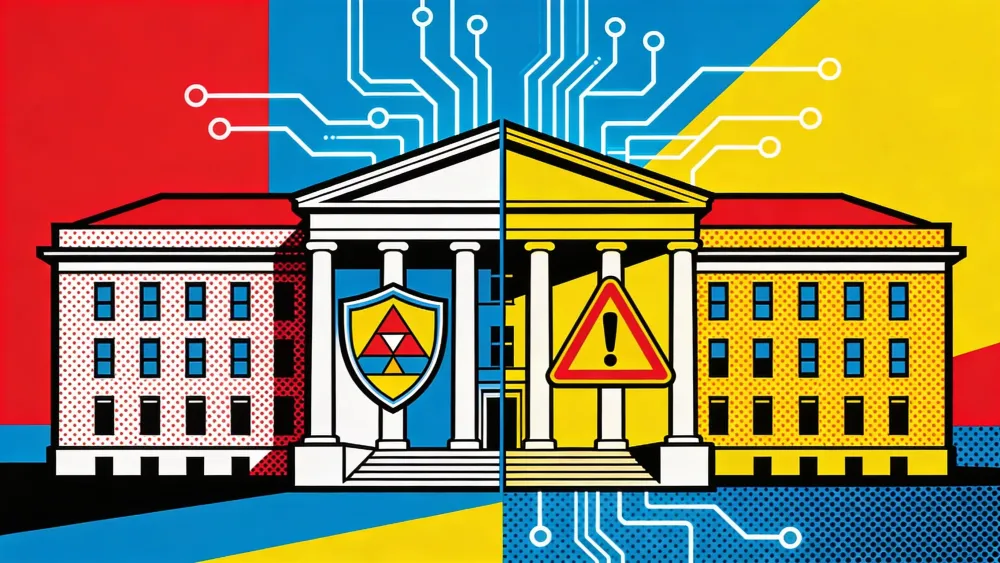
Thursday morning, Florida Attorney General James Uthmeier posted a video to X announcing an investigation into OpenAI. The concerns: national security, child predators, a mass shooting at Florida State University in which the gunman exchanged more than 200 messages with ChatGPT before opening fire. Subpoenas are coming.
That same morning, the Trump administration celebrated a federal appeals court ruling that kept Anthropic, OpenAI's chief rival, blacklisted from Pentagon contracts. The reason Anthropic got blacklisted: it refused to remove safety guardrails from its AI models.
One company investigated for being too dangerous. Another punished for being too safe. Same government. Same week. Same technology.
Welcome to American AI policy.
This is not a regulatory framework in formation. There is no framework. What exists is a set of overlapping, contradictory impulses dressed up as strategy. A Republican-led state probing a company for failing to protect the public while the Republican White House pressures states to kill the very bills that would establish such protections. A defense secretary who labels a company a supply-chain risk for having ethical limits, then accepts a deal from a competitor that includes functionally the same restrictions. And if you are trying to run an AI company in this environment, the signal from Washington is unmistakable. Safety is mandatory but prohibited. Regulation is coming but never. The rules depend on who you are rather than what you build.
The incoherence is not a bug. It is the product.
Key Takeaways
- Florida probed OpenAI for safety failures the same week a federal court upheld Anthropic's blacklisting for having safety guardrails.
- OpenAI's Pentagon deal includes the same practical restrictions Anthropic wanted but wrapped in language that avoided punishment.
- The White House AI framework stalled in Congress while more than 40 states drafted 250 AI bills with no federal coordination.
- The regulatory vacuum rewards political compliance over safety, harming both the public and national security.
AI-generated summary, reviewed by an editor. More on our AI guidelines.
The same restrictions, two different verdicts
The clearest proof that American AI governance runs on politics sits in two Pentagon contracts.
Anthropic's dispute with the Department of Defense began last year when the company refused to grant the military unrestricted access to its Claude models. It wanted two exceptions: no mass domestic surveillance, and no fully autonomous weapons. For this, the Pentagon designated it a supply-chain risk, the first time that label has been applied to a domestic company. A designation normally reserved for foreign adversaries, turned against a San Francisco startup.
Hours later, OpenAI announced its own Pentagon deal. The published contract language permits use "for all lawful purposes." But read the fine print.
Jessica Tillipman, a procurement law professor at George Washington University, examined what OpenAI actually signed. The company deploys its models exclusively on its own cloud infrastructure, retains "full discretion" over its safety stack, embeds its own security-cleared personnel in the deployment, and can terminate the agreement if the government violates its terms.
"The Pentagon's objection to Anthropic was, at its core, that a private company should not be able to constrain the military's use of AI technology," Tillipman wrote. "Yet the OpenAI arrangement appears to give the company significant operational control over how the technology functions in practice."
The difference is not substantive. It is tonal. Anthropic said no explicitly. OpenAI said yes while building architectural constraints that achieve the same outcome. One got blacklisted. The other got a contract worth billions.
If you are an AI executive watching this unfold, the lesson lands with force. Washington does not object to restrictions on its own use of AI. It objects to being told about them out loud.
OpenAI itself said it does not believe the supply-chain risk designation should have been applied to Anthropic. The company that won the contract by saying yes also thinks the punishment for saying no was wrong. That's the tell.
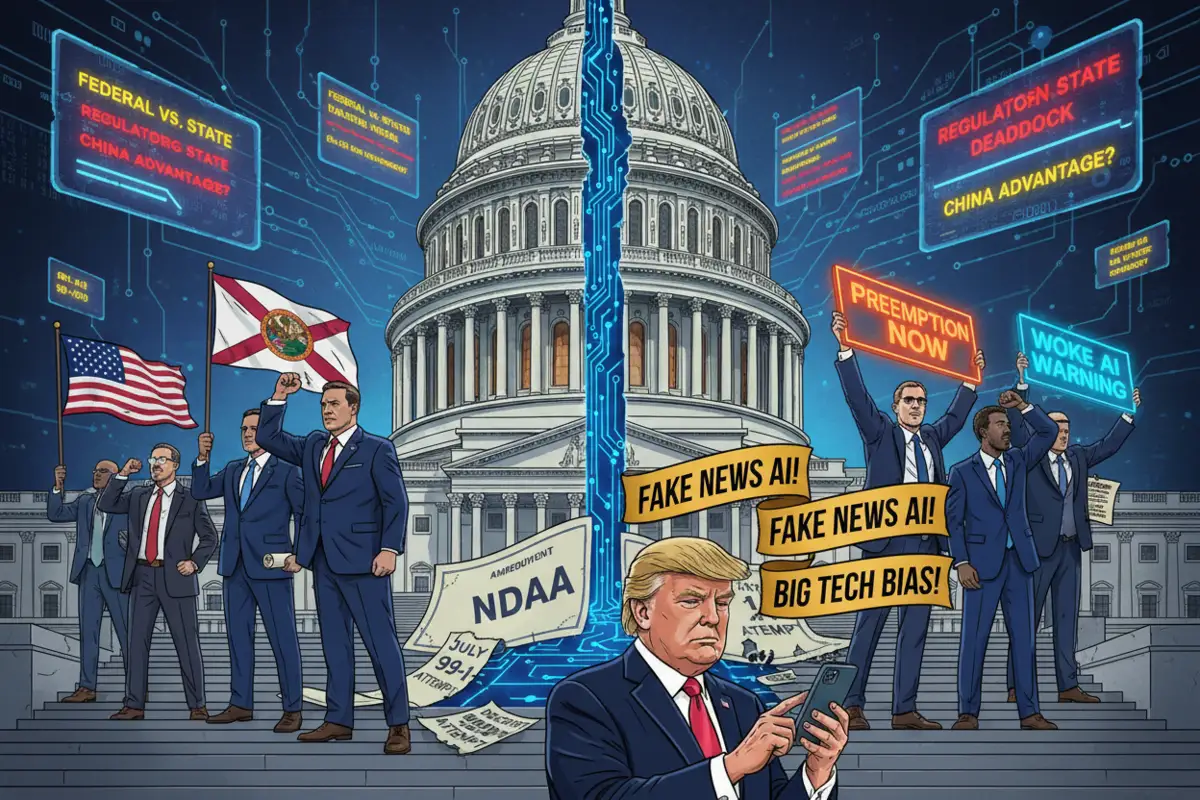
States filled the vacuum. The White House tried to empty it.
What happens when Washington does nothing? The states improvise.
Count the mess: 40-plus states introduced some 250 AI bills in 2025. Red and blue alike. Kansas, Tennessee, Illinois, Montana. The National Governors Association launched a bipartisan AI working group. On the lobbying side, more than 640 companies engaged at the federal level in 2024, a 141% jump from the prior year.
The White House response: preempt all of it.
Trump's executive order in December 2025 called for a national framework that would override state regulation. His March 2026 framework went further, declaring that states "should not be permitted to regulate AI development" because it is "an inherently interstate phenomenon."
Get Implicator.ai in your inbox
Strategic AI news from San Francisco. No hype, no "AI will change everything" throat clearing. Just what moved, who won, and why it matters. Daily at 6am PST.
No spam. Unsubscribe anytime.
It creates no enforcement mechanism and no new agency. And the framework choked in Congress. Democrats took one look and balked. No enforcement, no consumer protection, no chance of a majority. And in Nashville, Lincoln, and Topeka, Republican legislators kept drafting AI bills of their own.
Utah became the first state targeted by White House pressure. An administration memo declared a bill requiring AI risk disclosures "unfixable." That bill died. A second Utah proposal, which would have penalized AI chatbots that engage in harmful conversations with minors, met overwhelming industry opposition and died too.
Then, this week, Florida's emboldened Republican attorney general launched a probe into OpenAI over the very harms those killed state bills were designed to prevent. According to court documents obtained by NBC News, the accused shooter asked ChatGPT when the FSU student union would be busiest. An attorney for one victim's family said ChatGPT "advised the shooter how to make the gun operational moments before he began firing."
Peter Wildeford, head of policy at AI Policy Network, described the tension: "Even if you like a national framework, you don't want to be replacing state laws with something that's much weaker than what the states, including Republican states, have decided is best for their citizens."
The result is exactly the fragmentation the White House claims to fear. Companies face contradictory demands from Nebraska, Tennessee, California, and the federal government at once. But the alternative on offer, a framework that preempts state law while providing no federal substitute, is not coherence. It is an empty room with a locked door.
Too safe for the Pentagon, too dangerous for the public
Anthropic sits at the center of every contradiction, cornered from both directions.
The Pentagon blacklisted it for having safety guardrails. A California federal judge blocked that blacklisting, calling it retaliation that violates the First Amendment. A D.C. appeals court, its panel including two Trump appointees, upheld the blacklisting this week, citing military necessity during "a significant ongoing military conflict." Two federal courts examined the same facts. Opposite conclusions.
Meanwhile, Anthropic announced it has built a model so capable of finding software vulnerabilities that releasing it would be reckless. Claude Mythos Preview discovered a 27-year-old bug in OpenBSD, an operating system engineered to be nearly unhackable. In separate testing, it found a longstanding flaw in popular video software that automated tools had scanned five million times without catching.
"This model has found vulnerabilities sophisticated enough that they were both missed by literally decades of security researchers, as well as all the automated tools designed to find them," said Logan Graham, who leads Anthropic's safety testing.
Anthropic poured $100 million in credits into a consortium it calls Project Glasswing. Apple signed on. So did Amazon, Google, Microsoft, Cisco, and Broadcom. The mission: patch critical infrastructure before models with these capabilities hit the open market. That $380 billion company cleared $30 billion in annual revenue this year, triple what it pulled in twelve months ago, mostly because programmers cannot stop using Claude. The Pentagon blacklisted it anyway.
So Anthropic is simultaneously the builder of something too dangerous for the public and the vendor the military calls a national security risk for being too cautious. Pick whichever frame suits your argument. Both held up in court this week.
OpenAI occupies an equally absurd position. The company signed the Pentagon deal and is preparing for an IPO at an $852 billion valuation. ChatGPT has 900 million weekly users. And yet a Republican attorney general just opened a probe citing the same national security framing the Pentagon uses against Anthropic, accusing OpenAI's technology of potentially falling "into the hands of America's enemies, such as the Chinese Communist Party."
Florida wants OpenAI held accountable for the absence of guardrails. The Pentagon blacklisted Anthropic for having them. You cannot hold both positions and call it policy. And yet.
What the vacuum rewards
The absence of coherent AI policy is not neutral. It has winners, and the enterprise sector is anxious about which side of the line it falls on.
Companies that align politically win contracts. Companies that push back get designated as national security threats. Gartner found in late March that Anthropic's exclusion highlights how embedded model dependencies can "convert into structural technical debt." Enterprise customers now face a concrete risk: the government might blacklist their AI provider for political reasons, forcing expensive requalification of entire workflows.
"Designating a company as a supply chain risk is a tool normally reserved for foreign adversaries," said Matt Schruers, CEO of the Computer & Communications Industry Association. "It is risky to US innovation and competition to allow the government to unfairly discourage doing business with a US AI company."
The winners are obvious: AI companies willing to say yes quietly while building restrictions into architecture nobody reads. The losers are twofold. First, the public. No federal guardrails exist, and the state-level protections filling the gap are being killed by the same administration that offers no replacement. Second, national security itself, which bleeds when procurement decisions run on political loyalty rather than technical capability. The Pentagon's most capable AI vendor, the one already deployed on its classified networks, got blacklisted for saying no. The replacement? A company whose own users staged a mass boycott after the deal, after 2.5 million users pledged to delete ChatGPT and daily uninstalls surged 295%.
On May 19, the D.C. Circuit hears oral arguments in Anthropic's case. Florida's subpoenas to OpenAI are forthcoming. More than 250 state AI bills move through legislatures across the country. Congress has not enacted a single federal AI law.
This vacuum is not a transition state. It is the equilibrium. Every week it persists, the contradictions get worse. The government punishes safety and demands it in the same breath. It preempts state regulation while producing no federal alternative. It blacklists its own vendors and waves through deals with identical practical restrictions.
Nobody designed this policy. But it functions as one, and it tells AI companies exactly what Washington rewards. Not safety, and certainly not the public interest. Compliance. The quiet kind.
Frequently Asked Questions
Why did the Pentagon blacklist Anthropic?
Defense Secretary Pete Hegseth designated Anthropic a supply-chain risk after the company refused unrestricted military access to its Claude AI models. Anthropic insisted on two restrictions: no mass domestic surveillance and no fully autonomous weapons. It was the first time the designation was applied to a domestic company.
Why is Florida investigating OpenAI?
Florida Attorney General James Uthmeier launched a probe citing national security concerns and ChatGPT's alleged role in criminal activity. Court documents show the FSU mass shooting suspect exchanged over 200 messages with ChatGPT, including questions about the planned attack.
How does OpenAI's Pentagon deal differ from what Anthropic wanted?
OpenAI accepted an 'all lawful purposes' standard but retains cloud-only deployment, full control over its safety classifiers, security-cleared personnel in the loop, and contract termination rights. Legal experts say this gives OpenAI practical control similar to what Anthropic sought through explicit restrictions.
What is the status of federal AI legislation?
Congress has not enacted a federal AI law. Trump's March 2026 framework proposed barring states from regulating AI development, but it stalled in Congress without Democratic support. Over 40 states introduced their own AI bills in 2025.
What is Anthropic's Project Glasswing?
A consortium of over 40 companies given access to Claude Mythos Preview, an unreleased model that identifies software vulnerabilities. Participants include Apple, Amazon, Google, and Microsoft. Anthropic committed $100 million in credits to patch critical infrastructure.
AI-generated summary, reviewed by an editor. More on our AI guidelines.

Free AI briefing · Weekdays
The AI stories that matter, sourced and explained.
Join the Morning Briefing. It goes out every weekday at 4:45 a.m. Pacific, with later sends for the East Coast, Berlin and Tokyo.
Free when you sign up: The Paperclip Compendium, our tested guide to running AI agents.
Free. Unsubscribe in one click.

Marcus Schuler
Editor-in-Chief and founder of Implicator.ai. Former ARD correspondent and senior broadcast journalist with 10+ years covering tech. Writes daily briefings on policy and market developments. Based in San Francisco. E-mail: editor@implicator.ai