IMPLICATOR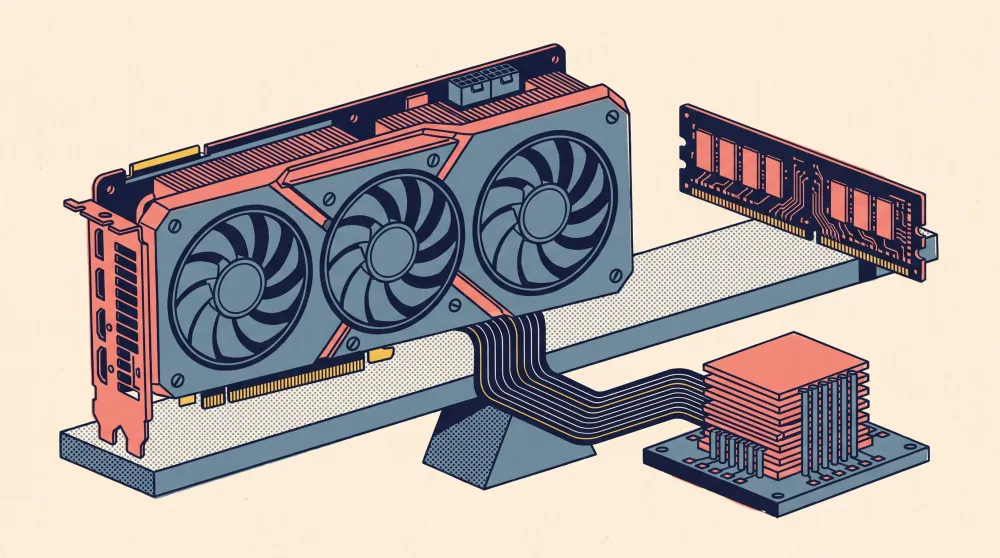
When Allan Witt loaded a local AI model, the hardware specialist needed more graphics memory than Nvidia's top consumer card, the 32 GB RTX 5090, provides. Witt, co-founder and editor in chief of Hardware Corner, ran the test on an RTX Pro 6000 with 96 GB of graphics memory.
The additional 64 GB cannot plausibly explain the $14,001 difference between Nvidia's two official prices.
“Memory prices” covers four bills: ordinary DRAM chips, finished RAM modules, GDDR or HBM attached to a processor, and the completed card or computer. The base case has ordinary RAM stabilizing before it falls, staying high through much of 2027, then finding broad relief in 2028. High-memory GPU prices may resist that cycle because buyers also pay for software compatibility, scarce supply, professional service and a product tier with few substitutes.
The Price Clock
- The base case keeps ordinary RAM expensive through much of 2027, then puts mainstream DDR5 20% to 45% below its cycle peak in 2028 and 2029.
- GDDR7 component costs could fall 15% to 35% from their peak by 2028 and 2029, but high-memory graphics-card prices may not fall by the same amount.
- Nvidia's official prices put a 32 GB RTX 5090 at $1,999 and a 96 GB RTX Pro 6000 at $16,000, while the estimated cost of the extra memory packages is only $640 to $960.
- On an equal-bit basis, Micron says HBM3E requires about three times the DDR5 wafer supply and HBM4E more than four times.
AI-generated summary, reviewed by an editor. More on our AI guidelines.
What became expensive
On Aug. 20, 2026, Nvidia listed the 32 GB RTX 5090 at $1,999 and the 96 GB RTX Pro 6000 at $16,000. Both were out of stock. Current observations put RTX 5090 street prices at roughly $4,300 to $4,700 in August, based on one $4,298 listing and a $4,699 median across one retailer's listings. That is an observed range, not a universal price.
Ordinary desktop memory occupies another market. An Aug. 17 retail snapshot found selected 32 GB DDR5 kits around $392 to $394, one 64 GB DDR5-6000 kit at $849 and one 128 GB kit at $3,399. Tracker averages were higher. These dated listings are not an industry index, and their baskets vary by brand, speed and availability. Older DDR4 can cost more when suppliers retire it faster than existing machines stop needing it.
The PC-memory chip shock
DDR5 16-gigabit spot price in dollars per chip, January 2023 through Aug. 20, 2026. Monthly observations through July; the final point is the Aug. 20 session average.
Source: TrendForce DataTrack, published Aug. 3, 2026, and TrendForce's Aug. 20 spot table. One 16Gb chip stores 2GB; this is the underlying chip price, not the price of a finished DIMM.
VRAM prices: the next three years
| Period | Base-case projection |
|---|---|
| Late 2026 | In the base case, GDDR7 rises another 5% to 20% from August. Finished cards can move further. |
| 2027 | GDDR7 ranges from flat to 20% higher, while HBM4 remains tighter. |
| 2028 and 2029 | GDDR7 component costs fall 15% to 35% from the peak. Premium card stickers may stay high. |
GDDR6 prices broke higher late in 2025
GDDR6 8-gigabit spot price in dollars per chip. The dashed line connects a June 2023 observation, quarter-end snapshots from late 2024 through mid-2026 and the Aug. 10, 2026 session average.
Source: DRAMeXchange and TrendForce observations, June 9, 2023 through Aug. 10, 2026; quarter-end archive series compiled by 3DCenter on Aug. 2, 2026. One 8Gb chip stores 1GB. These are spot component prices, not the retail price per gigabyte of a graphics card; missing periods are not observed data.
Why 96 GB costs so much
The official comparison adds $14,001 for 64 GB of visible memory, or $218.77 for each added gigabyte. An independent estimate puts GDDR7 components at $10 to $15 per GB. On that basis, the extra packages would cost about $640 to $960. The estimate is not Nvidia's bill of materials, and no audited product-level bill is public.
The professional card carries more than memory. It uses a fuller GPU, error-correcting memory, a different board and thermal design, longer validation and lifecycle work, enterprise drivers, application certification, support and channel services. Those costs are real. They still do not account plausibly for the full gap. Part of the price buys access to one 96 GB pool that works with CUDA and can hold a job that otherwise must be split, reduced or moved to the cloud.
The alternatives show why the premium persists. AMD launched a 48 GB Radeon Pro W7900 at up to $3,999 in 2023. High-end Mac Studio configurations offer far larger unified-memory pools. Neither replaces Nvidia for every application because capacity is not bandwidth, and many production tools still depend on CUDA or certified professional drivers.
A 2026 dossier estimate for a B200-like accelerator with 192 GB of HBM puts memory at roughly 31% to 58% of manufacturing cost and 6% to 12% of customer selling price. Both denominators are estimates, and private HBM contracts may define package boundaries differently.
What AI changed in the factory
High-bandwidth memory, or HBM, consists of short stacks of memory placed beside an AI processor. Thousands of connections move data to the chip far faster than ordinary system RAM can. Making those stacks requires extra silicon, vertical connections, thinning, bonding, testing and difficult packaging beside a large accelerator.
Micron's 2024 and 2025 equal-bit capacity ratios put the production burden at about three times the DDR5 wafer supply for HBM3E and more than four times for HBM4E. That does not mean every physical HBM stack consumes three or four identical wafers. It compares the supply needed to deliver the same number of memory bits, and the ratio can differ by supplier, process and yield.
FREE WEEKDAY MORNING BRIEFING
Get the Price Signal
The Implicator Morning Briefing filters the AI news cycle to the stories worth your attention and explains their consequences. From San Francisco, every weekday at 4:45 a.m. Pacific, 7:45 a.m. Eastern.
About five minutes. No hype. No spam.
The connection to a desktop module is indirect but real. An HBM packaging line cannot make a DIMM. The same memory companies still decide how to allocate DRAM wafers, engineers, cleanrooms and investment between higher-value AI products and ordinary chips. Long customer agreements also make speculative commodity expansion less attractive.
History cuts against any claim that the cycle is gone. Memory prices fell after the 2017 boom. In early 2019, forecasts called for first-quarter PC DRAM prices to fall about 20% and server DRAM about 30%, followed by further declines. Micron's 2023 revenue and gross margin fell sharply after the 2022 downturn. AI contracts may lengthen the present cycle, but inventories, new capacity and weaker demand can still reverse it.
Regular RAM prices: the next three years
| Period | Base-case projection |
|---|---|
| Late 2026 | Prices are still rising, but more slowly. TrendForce forecasts conventional DRAM to increase 13% to 18% in the third quarter from the second, far below the first-half pace. |
| 2027 | The base case is a peak or high plateau as new output meets demand already waiting for it. |
| 2028 and 2029 | Mainstream DDR5 falls 20% to 45% from the cycle peak, while remaining above the exceptional 2025 lows. |
Jean Philippe Bouchard of IDC said, “We're not seeing any relief to the memory shortage situation before the end of 2027.”
Former Samsung semiconductor chief Kye-hyun Kyung offered a lower-price case: a turn in late 2027 or early 2028, based on an unconfirmed English translation of a Korean speech. The unlinked percentage ranges are base-case projections, not Bouchard's or Kyung's quotations or forecasts.
The three-year price clock
Late 2026 is more likely to bring deceleration than a decline. PC and phone buyers are resisting higher system prices, which can curb orders before it produces excess stock. Graphics cards can move faster if retail supply improves because today's street premium includes scarcity and channel margin. A card returning toward its official price would not prove that GDDR7 became cheaper.
Know someone who'd find this useful? ✉️ Email it to a friend in one click, or they can subscribe free here.
The decisive year is 2027. Micron's first Idaho wafer output, Tongluo expansion shipments and Singapore HBM packaging ramp overlap with SK hynix's M15X/Yongin capacity, Samsung's HBM4 ramp and added advanced-packaging capacity. Qualification takes time, packaging remains tight, and much of the early supply already has intended customers. The base case is therefore a volatile plateau.
By 2028 and 2029, the base case puts DDR5 20% to 45% below its cycle peak, though still above the exceptional lows of 2025. GDDR7 components sit 15% to 35% below their peak. Neither forecast promises the same percentage decline for a finished graphics card. A 96 GB Nvidia card below $5,000 by 2029 is not the base case. It needs stronger competition, a liquid used market or the lower-price supply path.
Four indicators will show which case is arriving: DRAM spot prices staying below contract prices, rising supplier inventory, shorter packaging lead times and falling rental rates for comparable cloud GPUs. For companies, cost per token or per unit of useful work can fall before the invoice for the newest accelerator does.
Buying on separate clocks
Consumers who need 32 GB or 64 GB now should compare a fixed basket of kits instead of waiting for a general crash. Anyone considering 96 GB for local AI should test the exact model, context and software first. A cheaper card that cannot load the job is not a substitute.
Small and midsize companies can rent uncertain or bursty workloads, then buy when steady use, privacy, latency and resale value make ownership cheaper. Cloud service is not automatically the lower-cost choice. Large companies must price memory together with accelerators, networking, power and service because the useful unit is a working system, not a memory chip.
The open question for the next three years is whether buyers first see cheaper memory, or simply more useful work from every expensive byte.
Frequently Asked Questions
When are ordinary RAM prices likely to fall?
The base case is a peak or high plateau in 2027, followed by broader relief in 2028. Mainstream DDR5 could fall 20% to 45% from the cycle peak by 2028 and 2029, while remaining above the unusually low prices seen in 2025.
Will high-VRAM graphics cards get cheaper at the same time?
Not necessarily. GDDR7 component costs could decline before finished card prices do. Scarcity, CUDA compatibility, professional support, certification, board design and product segmentation can keep 48 GB and 96 GB cards disproportionately expensive even when memory chips become cheaper.
Why does HBM consume so much capacity?
HBM stacks memory beside an AI processor and adds vertical connections, thinning, bonding, testing and advanced packaging. Micron's equal-bit comparison says HBM3E needs about three times the DDR5 wafer supply and HBM4E more than four times, although the ratio varies by supplier, process and yield.
Should a small business buy or rent GPUs?
Renting can suit uncertain or bursty workloads. Buying can make more sense when use is steady and privacy, latency and resale value matter. The right comparison includes the accelerator, memory, networking, power and service, not only the graphics card's purchase price.
AI-generated summary, reviewed by an editor. More on our AI guidelines.

Free AI briefing · Weekdays
The AI stories that matter, sourced and explained.
Join the Morning Briefing. It goes out every weekday at 4:45 a.m. Pacific, with later sends for the East Coast, Berlin and Tokyo.
Free when you sign up: The Paperclip Compendium, our tested guide to running AI agents.
Free. Unsubscribe in one click.

Marcus Schuler
Editor-in-Chief and founder of Implicator.ai. Former ARD correspondent and senior broadcast journalist with 10+ years covering tech. Writes daily briefings on policy and market developments. Based in San Francisco. E-mail: editor@implicator.ai