IMPLICATOR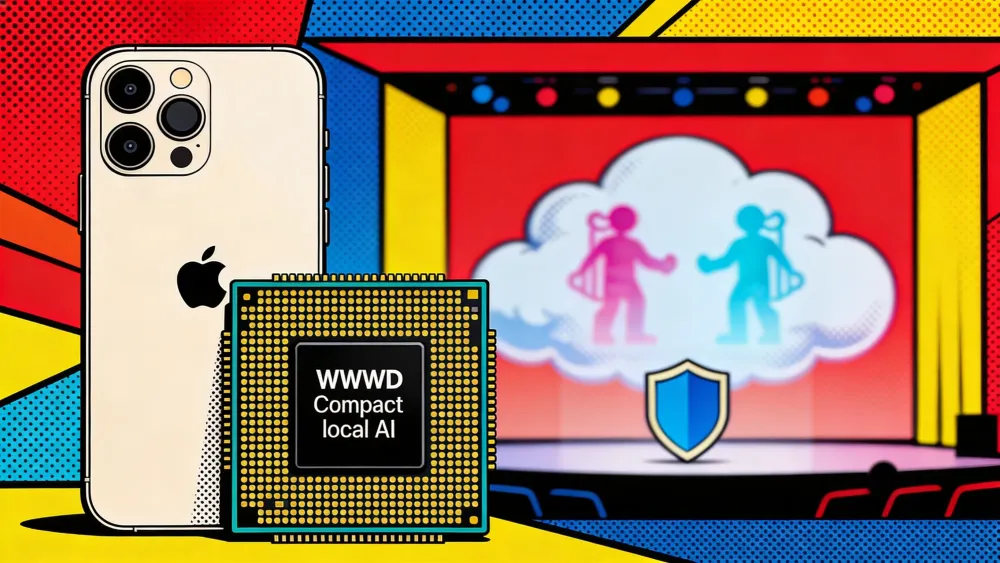
Apple has the pieces for a June 8 WWDC keynote pitch around local AI as an advantage rooted in its own chips, according to recent reporting on iOS 27 and its Google deal. The company has told developers the event will include "AI advancements," while reports from Bloomberg and The Information point to a rebuilt Siri, Gemini-derived models and deeper on-device processing.
The thesis is narrower than Apple's usual privacy pitch: Google supplies the teacher model, while Apple says Apple Intelligence will continue to run on devices and Private Cloud Compute. The pitch is that Apple can keep more of the interface and privacy boundary under its own control. It is also a harder one to prove on stage.
Key Takeaways
- Apple is expected to frame WWDC AI around local processing and Apple silicon.
- Reports say Gemini access lets Apple distill smaller models for on-device tasks.
- Apple’s own 3B local model leaves a chatbot gap that Gemini may fill.
- June 8 developer sessions should show how routing actually works.
AI-generated summary, reviewed by an editor. More on our AI guidelines.
The teacher model is the starting point
The clearest new claim comes from The Information, as summarized by 9to5Mac and MacRumors: Apple did not merely buy Gemini answers for Siri. "Apple has complete access to the Gemini model in its own data center facilities," 9to5Mac quoted the report as saying. "Apple can use that access to produce smaller models that power specific tasks or are small enough to run directly on Apple devices."
MacRumors described the mechanism this way: "Apple can feed the answers and reasoning information that it gets from Gemini to train smaller, cheaper models." The same report said those models can learn Gemini's internal computations and deliver Gemini-like performance with less computing power. The operational detail changes the deal. Apple is buying access to a teacher model and may use it to train smaller Apple-controlled models, including some that can run locally.
The caveat sits in the same reporting. MacRumors also reported that Gemini is tuned for chatbot and coding work, which "doesn't always meet Apple's needs."
Silicon makes the license matter
Apple's hardware argument is stronger than its model argument. Computerworld cited Apple's installed base at 2.5 billion active devices, while the same piece put R&D at 10.3% of revenue in the second quarter, up from 7.6% in the prior quarter and 34% higher in dollars than a year earlier. Those numbers support a less fatalistic reading of the Gemini deal, a way to feed a distribution machine rather than merely replace failed models.
Apple's own machine-learning report gives the technical version. Its latest public foundation-model update, from 2025, says the models are "optimized to run efficiently on Apple silicon" and include "a compact, approximately 3-billion-parameter model" alongside a server model for Private Cloud Compute. Cook put the same claim more broadly: "What truly sets Apple apart is how Apple Intelligence is woven into the core of our platforms, powered by Apple Silicon, and designed from the ground up to deliver intelligence that is fast, personal, and private. This is not AI as a standalone feature, but AI as an essential intuitive part of the experience across our devices."
The report then gets more specific: the on-device model uses a two-block architecture with a 5:3 depth ratio, and key-value cache sharing cuts KV-cache memory use by 37.5%.
Follow the AI platform shift
Strategic AI news from San Francisco. No hype, no "AI will change everything" throat clearing. Just what moved, who won, and why it matters. Daily at 6am PST.
No spam. Unsubscribe anytime.
That is the piece Apple can claim as its own. Gemini may improve the model. Apple silicon helps decide where the model can run.
The platform move is choice without ceding control
Bloomberg's iOS 27 reporting, echoed by MacRumors and 9to5Mac, points to a new Siri app, a Search or Ask interface and a system called Extensions. The renders, 9to5Mac wrote, were "based on information viewed by Bloomberg and people with knowledge of the company's plans." In Apple's test wording, according to 9to5Mac, Extensions "allow you to access generative AI capabilities from installed apps on demand, through Apple Intelligence features such as Siri, Writing Tools, Image Playground and more."
That phrasing matters because it keeps the App Store and Apple Intelligence at the center. Users could choose Gemini, Claude or other outside models through installed apps, while Apple Intelligence surfaces would sit between users and outside models. Bloomberg's recreated images place that choice behind an Apple interface: Search or Ask opens from the top center of the iPhone, built "for getting things done or searching by typing," and a drop-down menu can route some work to outside agents.
For Apple, the near-term control point is the Extensions framework shown in iOS 27 test builds.
Siri is the test Apple cannot avoid
Apple's own record supplies the caveat. At WWDC 2024, the company showed Siri features that could understand personal context and on-screen content; those features were delayed, as MacRumors and Bloomberg have noted. CNN reported in January that the Google agreement could accelerate the new assistant after that delay, and Bloomberg has reported that Apple was expected to pay around $1 billion a year for Gemini access.
The company's January statement with Google tried to put a cleaner frame on the dependency. "After careful evaluation, Apple determined that Google's AI technology provides the most capable foundation for Apple Foundation Models," the companies said. The same statement added: "Apple Intelligence will continue to run on Apple devices and Private Cloud Compute, while maintaining Apple's industry-leading privacy standards."
Apple's 2025 technical report also draws a limit around its local model. The roughly 3-billion-parameter model "is not designed to be a chatbot for general world knowledge," Apple wrote, even as it said developers can use it for "summarization, entity extraction, text understanding, refinement, short dialog, generating creative content, and more." That sentence helps explain the gap Gemini is meant to fill. Apple says the Platforms State of the Union will follow the keynote at 1 p.m. PDT and cover new features, APIs and technologies. That is the next place to watch for whether local AI becomes an engineering feature.
Frequently Asked Questions
What is Gemini distillation?
Distillation trains a smaller model from a larger one. Reports say Apple can use Gemini access to create smaller task models, including some designed to run locally.
Is Apple outsourcing Siri to Google?
Apple and Google announced a multi-year collaboration for future Apple Foundation Models. Apple says Apple Intelligence will still run on devices and Private Cloud Compute.
What is Apple expected to show at WWDC?
Reports point to a rebuilt Siri, a Search or Ask interface, a Siri app, Extensions for outside AI models, and more Apple Intelligence features.
Why does Apple silicon matter for local AI?
Apple’s public model notes tie on-device AI to Apple silicon, a compact 3B model, compression work, and memory reductions that lower inference cost.
What should developers watch after the keynote?
The Platforms State of the Union and developer sessions should clarify which features run locally, which need Private Cloud Compute, and how Extensions expose outside models.
AI-generated summary, reviewed by an editor. More on our AI guidelines.
Free AI briefing · Weekdays
The AI stories that matter, sourced and explained.
Join the Morning Briefing. It goes out every weekday at 4:45 a.m. Pacific, with later sends for the East Coast, Berlin and Tokyo.
Free when you sign up: The Paperclip Compendium, our tested guide to running AI agents.
Free. Unsubscribe in one click.

Marcus Schuler
Editor-in-Chief and founder of Implicator.ai. Former ARD correspondent and senior broadcast journalist with 10+ years covering tech. Writes daily briefings on policy and market developments. Based in San Francisco. E-mail: editor@implicator.ai