IMPLICATOR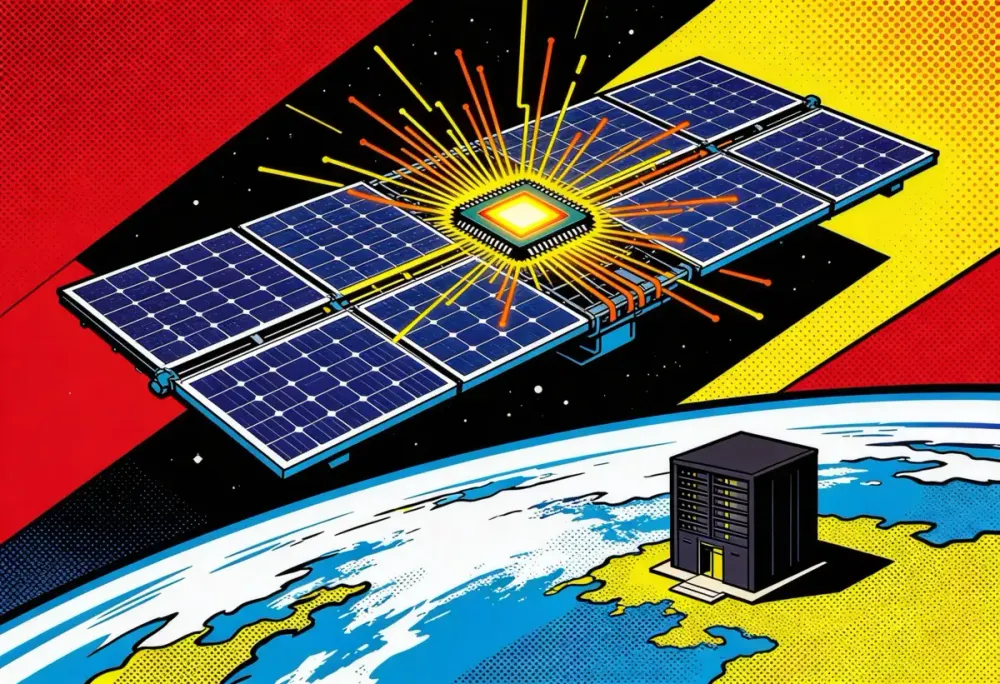
SpaceX needs a story worth one trillion dollars, and on Friday evening it filed one with the Federal Communications Commission.
The company is preparing what could become the largest technology IPO in history. It is in merger talks with xAI, Elon Musk's AI venture. And it just asked the U.S. government for permission to launch one million satellites into low Earth orbit, not for internet service, not for Earth observation, but for computing. Artificial intelligence computing, powered by sunlight, cooled by the vacuum of space.
The eight-page application describes a "SpaceX Orbital Data Center System." Each satellite cluster would sit in narrow orbital shells between 500 and 2,000 kilometers up, spaced 50 kilometers apart, connected to the existing Starlink network through laser links. Water-guzzling cooling systems on the ground give way to radiative cooling in orbit. Power grids give way to solar panels that collect energy more than 99 percent of the time in sun-synchronous orbits, unfiltered by atmosphere.
"Orbital data centers are the most efficient way to meet the accelerating demand for AI computing power," SpaceX wrote in the filing, bolding the sentence for emphasis.
Then the company reached for the cosmic. SpaceX called it "a first step towards becoming a Kardashev II-level civilization." That is a reference to a Soviet astronomer's 1960s classification system for hypothetical alien societies, the kind of thing you encounter in college physics textbooks and Elon Musk's FCC filings. We use about 18 terawatts as a species. The sun puts out 384 trillion. SpaceX wants to start closing the gap.
Musk responded on X early Saturday morning: "I thought we'd start small and work our way up."
A filing shaped like an investor deck
Satellite industry analyst Tim Farrar was blunt. "This filing seems quite rushed and to be very early stage," he told PCMag. But Farrar saw through the regulatory packaging to the financial logic underneath. "SpaceX can't spend the $50B that the IPO is supposed to raise on its existing Starlink and Starship efforts, whereas xAI sorely needs as much money as possible to keep up with rivals."
The Breakdown
• SpaceX filed with the FCC to launch one million orbital data center satellites, the largest constellation ever proposed
• The filing contains no hardware specs, no mass details, and asks to waive standard deployment timelines
• Analyst Tim Farrar calls the filing "rushed" and says it serves to justify SpaceX's planned $50 billion IPO
• Competitors include Nvidia-backed Starcloud (first GPU in orbit), Google's Project Suncatcher, Blue Origin's TeraWave, and China's Space Cloud
That framing matters more than anything in the filing itself. SpaceX is anxious about justifying a trillion-dollar valuation to public-market investors accustomed to asking hard questions about capital allocation. xAI is bleeding cash trying to keep pace with OpenAI and Google. A merger would combine SpaceX's launch infrastructure with xAI's compute-hungry models, and the orbital data center filing gives investors a destination for the money: not just more rockets, but a new category of infrastructure.
Reuters reported the SpaceX-xAI merger discussions on Thursday. The FCC filing landed Friday night. Bloomberg added that SpaceX is also weighing a combination with Tesla. Every piece feeds the same narrative: Musk is consolidating his empire around AI, and space is where the capital goes.
But a pitch is not a product. SpaceX asked the FCC to waive standard deployment milestones, which normally require half a constellation operational within six years and full deployment within nine. The filing provided no specifics on satellite mass, hardware design, or cost per unit. It said only that SpaceX "plans to design and operate different versions of satellite hardware to optimize operations across orbital shells."
If you are looking for engineering detail in this document, you will not find it. What you will find is a claim on the future, stamped and filed.
Join 10,000+ AI professionals
Strategic AI news from San Francisco. No hype, no "AI will change everything" throat clearing. Just what moved, who won, and why it matters. Daily at 6am PST.
No spam. Unsubscribe anytime.
What happens to hardware above the atmosphere
SpaceX's math sounds clean on paper. Launch one million tonnes of satellite hardware per year, generating 100 kilowatts of compute power per tonne, and you add 100 gigawatts of AI capacity annually. "Freed from the constraints of terrestrial deployment, within a few years the lowest cost to generate AI compute will be space," the filing reads.
Engineers who have spent careers putting hardware into orbit see it differently. And if you are wondering why SpaceX asked to waive those deployment milestones, this section is your answer.
Start with radiation. Up there, high-energy protons punch through silicon gate oxides all day long, flipping bits, wrecking voltage thresholds, slowly cooking the logic out of a chip. A processor that runs for years inside a temperature-controlled warehouse in Iowa might last months in low Earth orbit without heavy shielding. Shielding means lead, tungsten, polyethylene layers packed around every board, and every gram of shielding is a gram of payload that Starship has to lift against gravity at roughly $200 per kilogram even at projected costs. The weight adds up fast.
Space debris presents a constant, physical threat. SpaceX recently had to lower 4,400 Starlink satellites to 480 kilometers after a Chinese satellite made an unannounced maneuver near one of its birds in December. A paint fleck at orbital velocity carries the kinetic energy of a bullet. The company launched its Stargaze collision-tracking system this week in response, using star trackers on its nearly 9,600 Starlink satellites to spot nearby objects. "Their star trackers aren't telescopes," one government expert told Breaking Defense. The system covers low LEO only.
And then maintenance. A server dies in a ground-based facility, some technician walks down a cold aisle, pulls the blade, slots in a fresh one. Takes five minutes. A satellite dies at 1,500 kilometers and nobody is coming to fix it. It just drifts, dead weight on its last trajectory, with five years of planned operational life cut short. SpaceX talks about replacing failed units at scale, which really means launching new hardware on a treadmill that never stops, burning fuel and cash the entire time.
Deutsche Bank expects the first small-scale orbital data center tests in 2027 or 2028. Google's own analysis for its Project Suncatcher initiative concluded that space-based data centers would become cheaper than terrestrial ones by 2035. Not 2028. Not "within two years, maybe three at the latest," as Musk told the crowd at Davos.
A land grab above the atmosphere
Think of low Earth orbit the way you would think of spectrum or seabed mining rights: a finite resource that rewards those who file first and build second. Every company racing to put compute in space is staking territory in a domain where possession, or at least regulatory approval, creates its own momentum.
Nvidia-backed Starcloud launched the first H100 GPU into space last month aboard a Falcon 9. That single chip, the most powerful AI processor ever placed in orbit, is running Google's open-source Gemma model as a proof of concept. Starcloud wants to build a modular "hypercluster" delivering five gigawatts. Jeff Bezos predicted "giant gigawatt data centers" in orbit within 10 to 20 years. Blue Origin responded with TeraWave, a satellite optical communications system supporting six terabits per second. Musk fired back, claiming future Starlink laser links would beat that number.
Google is building Project Suncatcher to put Tensor Processing Units into orbit, with a prototype launch planned for 2027. Former Google CEO Eric Schmidt acquired rocket company Relativity Space specifically to put data centers in orbit. The money is real. The timelines are long.
China feels the squeeze of its own limitations. CASC, the country's main space contractor, dropped a five-year plan just two days before SpaceX's filing, promising "gigawatt-class space digital-intelligence infrastructure" and a so-called "Space Cloud" that would put computing, storage, and bandwidth in orbit by 2030. CASC has also staked claims at the International Telecommunication Union for two megaconstellations, 200,000 satellites combined. Impressive on paper. But Beijing still has not recovered a single reusable rocket booster. CASC's Long March 12A test failed last December. SpaceX's Falcon 9, by contrast, has turned reusable launches into weekly routine. China has ambition and institutional will. It does not yet have the vehicle.
Daily at 6am PST
Don't miss tomorrow's analysis
No breathless headlines. No "everything is changing" filler. Just who moved, what broke, and why it matters.
Free. No spam. Unsubscribe anytime.
On the ground, the pressure is just as real. Look at the numbers from Global Energy Monitor: more than 97 gigawatts of gas-fired power capacity in the U.S. pipeline got tagged for data center use in 2025, compared to just four gigawatts a year earlier. That is a twenty-four-fold jump in twelve months. Grids are buckling under the load. Aquifers are running low from cooling demand. Towns are fighting back against the prospect of a hundred-megawatt humming box showing up next door. Space offers a story that solves all three problems at once. Free energy, passive cooling, no neighbors to complain.
What a million satellites actually means
One million is not a realistic number. Everyone involved knows this. SpaceX sought FCC approval for 42,000 Starlink satellites before deployment began and currently operates around 9,500. Last year the company requested 22,000 next-generation systems and received a partial license for 7,500. Filing big and negotiating down is standard practice in satellite regulation.
But the scale of the ask signals where SpaceX wants to plant its flag. The whole orbital data center concept rests on Starship, and Starship is not ready. Eleven test flights since 2023. Three of the five in 2025 blew up. The last two made it to orbit and dropped test payloads, but SpaceX has not reused a single booster yet, and reusability is the entire economic argument for putting servers in space. The company had promised third-generation Starlink satellites riding on Starship by mid-2026. With no booster recovery to date, you can do the math on that timeline yourself.
For context, consider what Amazon is experiencing in the same regulatory orbit. In the same week SpaceX filed for a million orbital data centers, Amazon asked the FCC for a 24-month extension on its Leo satellite internet constellation because it cannot get rockets fast enough. Amazon has sunk at least ten billion dollars into Kuiper, launched 150 satellites since April, and now finds itself publicly admitting that it is "producing satellites considerably faster than others can launch them." That is not a boast. Amazon is stuck buying rides from SpaceX, its main rival in satellite internet, while simultaneously begging the FCC for a two-year extension. Embarrassing does not begin to cover it. And the rocket shortage is not a SpaceX problem. It is an everybody problem, which makes the breezy confidence of a filing that promises one million of anything in orbit feel disconnected from the actual state of the launch industry.
That gap, between what gets filed and what gets built, is the whole story here. Musk is filing for a civilization that can capture the power of a star while his most advanced rocket has yet to reuse a single booster. The FCC application is not a blueprint. It is a claim staked in regulatory ground, reserving orbital shells and spectrum for a future that does not exist yet.
What does exist: one Nvidia H100 GPU, floating 550 kilometers above the Earth, training an AI model on borrowed sunlight. That single chip is the entire proof of concept for an industry promising hundreds of gigawatts. The distance between one GPU and one million satellites is not measured in years. It is measured in solved problems, each one harder than the last.
Frequently Asked Questions
Q: What is a Kardashev II civilization?
A: A classification from Soviet astronomer Nikolai Kardashev's 1964 scale. A Type II civilization can harness the entire energy output of its star. Humanity currently uses about 18 terawatts. The sun produces 384 trillion. SpaceX referenced this scale in its FCC filing to describe the ambition behind its orbital data center proposal.
Q: Why would AI data centers work better in space than on the ground?
A: Advocates cite three advantages: near-constant solar power without atmospheric interference, radiative cooling that eliminates water-intensive ground systems, and no competition for strained power grids. Critics counter that cosmic radiation degrades chips, space debris threatens hardware, and failed satellites cannot be repaired.
Q: Has anyone actually put computing hardware into orbit?
A: Yes. Nvidia-backed Starcloud launched an H100 GPU into orbit on a Falcon 9 in late 2025. The chip is running Google's open-source Gemma AI model as a proof of concept. Google also plans to launch Tensor Processing Units via its Project Suncatcher initiative with Planet Labs around 2027.
Q: When could orbital data centers become commercially viable?
A: Deutsche Bank expects the first small-scale tests in 2027 or 2028. Google's analysis for Project Suncatcher estimates space-based data centers become cheaper than terrestrial ones by 2035. Musk claims two to three years, but Starship has not yet demonstrated the booster reusability that makes the economics work.
Q: How does China's space data center plan compare to SpaceX?
A: China's CASC published plans for "gigawatt-class space digital-intelligence infrastructure" by 2030 and filed for 200,000 satellites at the ITU. But China has not recovered a reusable rocket booster, which is essential for affordable launches. SpaceX's Falcon 9 already performs reusable launches routinely.




Marcus Schuler
Editor-in-Chief and founder of Implicator.ai. Former ARD correspondent and senior broadcast journalist with 10+ years covering tech. Writes daily briefings on policy and market developments. Based in San Francisco. E-mail: editor@implicator.ai