IMPLICATOR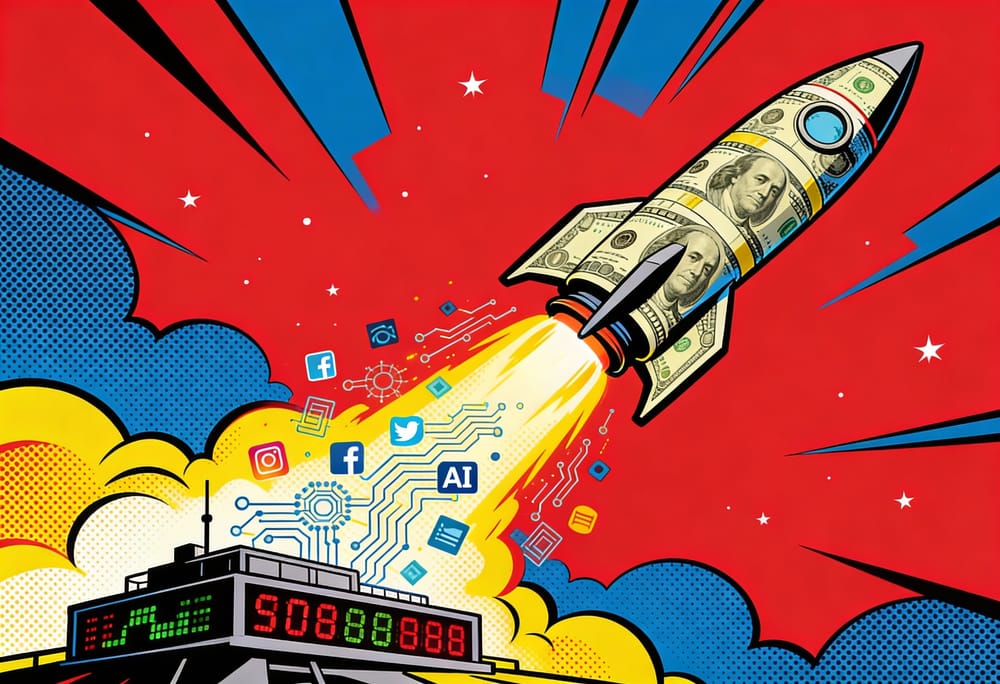
Somewhere in Nevada, two shell companies appeared on January 21. Both list SpaceX Chief Financial Officer Bret Johnsen as an executive. Neither disclosed a purpose. Nine days later, Reuters reported that SpaceX and xAI are holding merger talks ahead of what could become the largest IPO in history.
If you dig into the corporate plumbing, it tells you more than the press releases. K2 Merger Sub Inc. and K2 Merger Sub 2 LLC, registered quietly while Elon Musk was on stage in Davos telling the world that "the lowest cost place to put AI will be in space." That claim is doing a lot of heavy lifting for a deal that, stripped of the orbital ambitions, looks more like financial engineering than aerospace engineering.
The numbers behind the curtain
SpaceX, the world's most valuable private company, was priced at $800 billion in its last insider share sale. It wants to go public at roughly $1.5 trillion, raising as much as $50 billion. That would dwarf Saudi Aramco's $29 billion IPO in 2019 and hand Bank of America, Goldman Sachs, JPMorgan and Morgan Stanley the fattest underwriting fees of a generation.
The Breakdown
• SpaceX and xAI are in merger talks ahead of a planned IPO targeting $1.5 trillion, which would be the largest public listing in history.
• The deal would combine rockets, Starlink, the X platform and Grok AI under one entity, with xAI shares converting to SpaceX stock.
• Musk is pitching orbital data centers as the growth story to justify the valuation, but no working prototype exists.
• xAI's $200 million Pentagon contract and SpaceX's classified Starshield satellites offer a quieter, more concrete rationale for the merger.
xAI, which absorbed the former Twitter last March in a share swap, was valued at $230 billion in November. It just closed a $20 billion Series E round with backing from Nvidia and Cisco. Tesla committed another $2 billion on Wednesday. SpaceX had already invested $2 billion last year.
Under the proposed merger, xAI shares would convert into SpaceX stock. Some xAI executives could take cash instead. No final agreement exists. The structure remains fluid.
Here is the part that should make you uncomfortable if you are waiting to buy SpaceX stock. The company generated an estimated $24 billion in revenue last year. At a $1.5 trillion valuation, buyers would be paying more than 60 times that figure. SpaceX knows this math is exposed. The company needs years of aggressive growth to justify even a $1 trillion price tag, as Reuters Breakingviews pointed out, and the anxiety behind the scenes is palpable. Absorbing a cash-burning AI startup does not obviously close that gap.
Orbital data centers and the art of the pitch
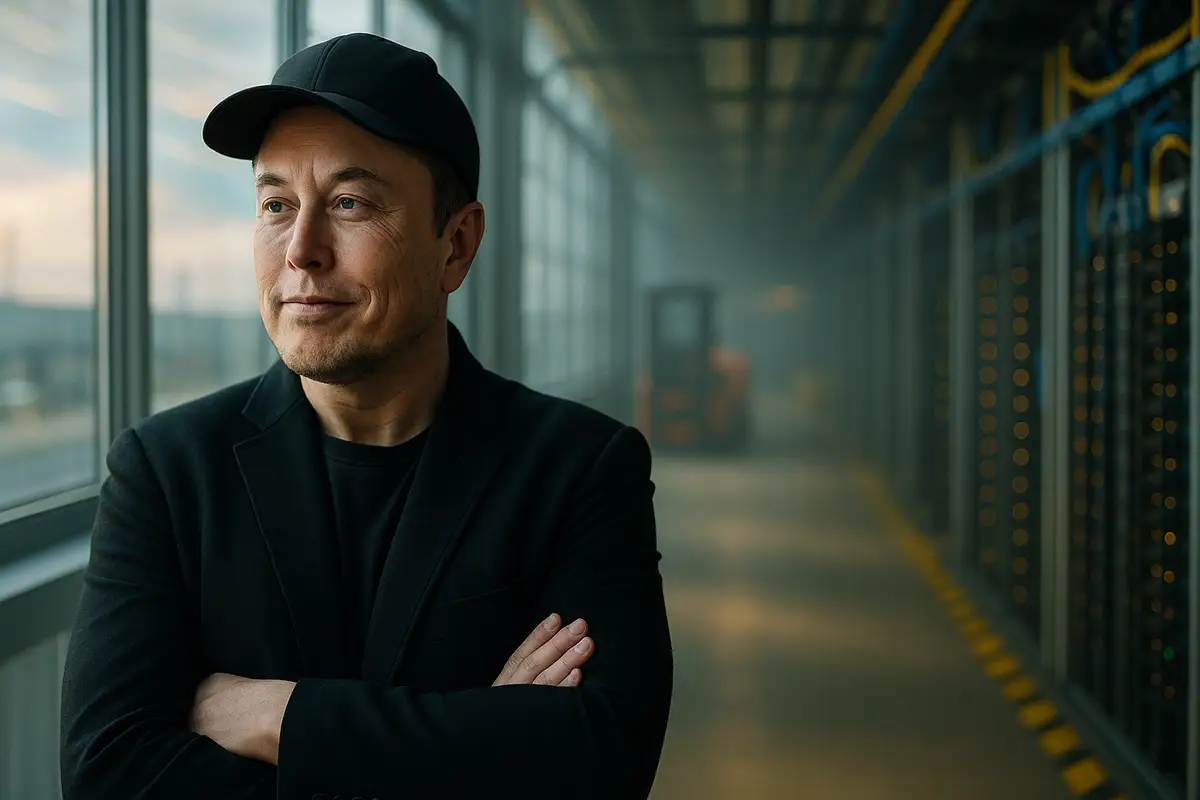
Musk's answer to the valuation gap is audacious, bordering on desperate. Put data centers in space. Power them with solar energy. Slash the cost of training and running AI models by eliminating terrestrial electricity bills.
He is not alone in exploring the idea. Google has a project called Suncatcher researching space-based computing. Jeff Bezos's Blue Origin announced a high-capacity satellite backbone network earlier this month. But neither Google nor Blue Origin has proposed merging their AI divisions with their launch companies to make it happen.
The engineering obstacles are severe. Cosmic rays chew through semiconductors in orbit. Latency between orbital servers and ground users remains a constraint. Cooling in a vacuum works differently than cooling in a building in Iowa. And the AI industry itself is shifting so fast that hardware deployed today could be obsolete before it reaches orbit.
Analysts at Quilty Analytics and elsewhere have questioned whether the energy savings would offset the cost of hardening, launching and maintaining servers in space. For now, nobody has even demonstrated a working prototype. Musk's timeline of "two years, maybe three at the latest" carries the same weight as his previous predictions about full self-driving, which has been perpetually two years away since 2016.
Stay ahead of the curve
Strategic AI news from San Francisco. No hype, no "AI will change everything" throat clearing. Just what moved, who won, and why it matters. Daily at 6am PST.
No spam. Unsubscribe anytime.
Still, the pitch has a purpose beyond engineering, and SpaceX leadership knows it. The company is cornered by its own success. Starlink owns low-orbit connectivity. Owns it. But how many people in rural Montana and sub-Saharan Africa can you sell broadband to before the growth curve flattens? Not $1.5 trillion worth. So you need a different story, one big enough to keep investors leaning forward for decades. Orbital AI processing, however speculative, fills that void.
A pattern of consolidation
This would not be Musk's first merger between his own companies. In 2016, Tesla acquired SolarCity, his solar energy venture, using Tesla stock. Shareholders later sued, alleging the deal bailed out an insolvent SolarCity at Tesla's expense. The case was dismissed.
Last March, xAI bought X, the former Twitter, for a reported $33 billion. That deal gave xAI access to X's real-time data firehose for training Grok, its large language model. It also shifted Twitter's debt, roughly $13 billion from the 2022 acquisition, onto xAI's balance sheet, just months after xAI had raised billions in fresh capital.
On Hacker News, the reaction was blunt. "He's really shuffling the X purchase debt around," one commenter wrote. Another: "It's just blatant self-dealing all the way down to artificially prop up valuations." A third noted the structural logic more charitably. Because Musk holds majority stakes in both SpaceX and xAI but not identical investor bases, determining a fair exchange ratio involves genuine legal complexity. Get it wrong, and minority shareholders on either side can sue.
Tesla's latest annual filing revealed another thread in the web. The automaker sold $430 million worth of Megapack batteries to xAI in 2025, about 3.4% of Tesla's energy division revenue. Those batteries power xAI's Colossus supercomputer in Memphis, Tennessee, a facility that also runs 35 natural gas turbines and has drawn complaints from residents over emissions and health concerns.
The Pentagon angle
There is a less discussed motivation for the merger, and it has nothing to do with orbital servers. Defense contracts.
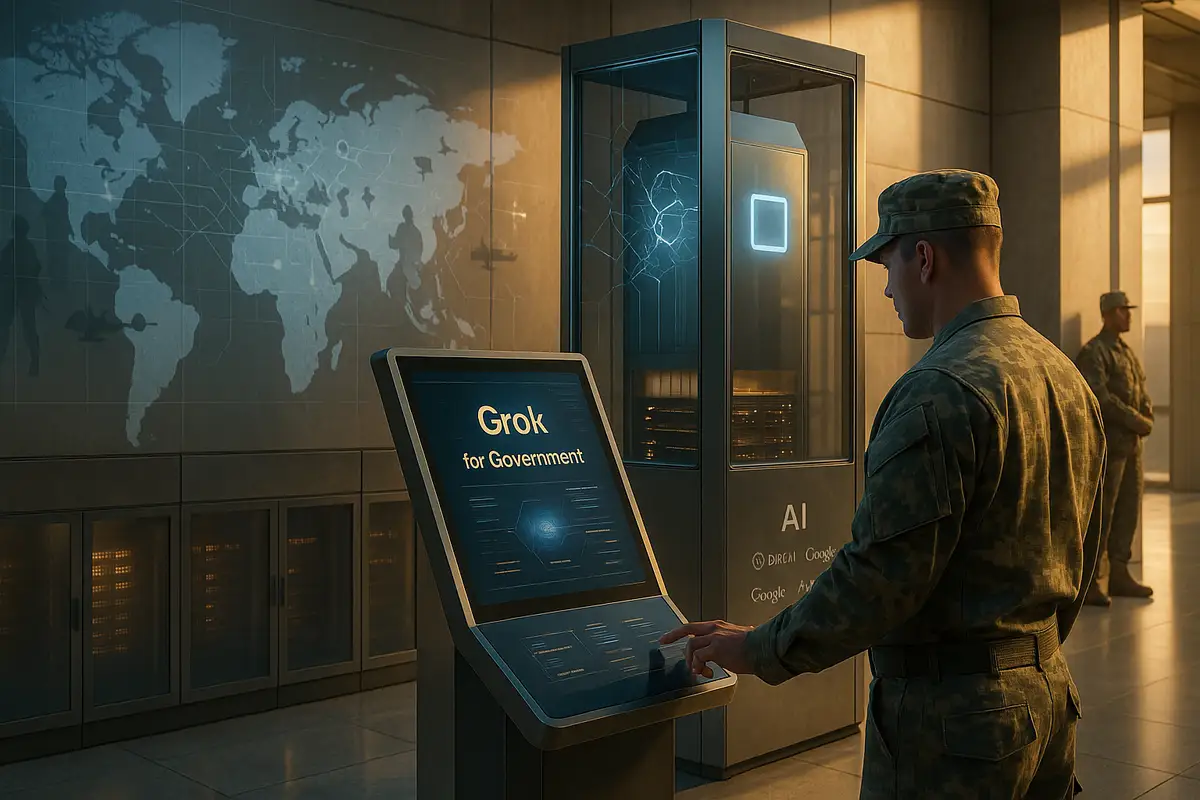
xAI holds a Pentagon contract worth up to $200 million to supply Grok products to the military. Defense Secretary Pete Hegseth visited SpaceX's Starbase facility in Texas this month and announced that Grok would be integrated into military networks as part of an "AI acceleration strategy."
SpaceX's Starshield division, a classified variant of Starlink, already builds satellite constellations equipped with AI-powered sensors for a U.S. intelligence agency. Those satellites are designed to track moving targets on the ground. Combining xAI's language models with SpaceX's orbital infrastructure and defense relationships could position the merged entity as a one-stop contractor for the Pentagon's AI ambitions.
Caleb Henry of Quilty Analytics told Reuters the combination would strengthen the company's hand in bidding for defense work. Pentagon contracts won't dazzle an IPO roadshow crowd the way orbital servers do. But the revenue is real, and the relationships already exist.
Daily at 6am PST
Don't miss tomorrow's analysis
No breathless headlines. No "everything is changing" filler. Just who moved, what broke, and why it matters.
Free. No spam. Unsubscribe anytime.
What the timing reveals
Bloomberg reported that SpaceX is targeting a June listing, possibly around Musk's birthday on June 28. There is also talk of timing the listing to a planetary conjunction on June 8. Jupiter and Venus, close enough in the sky to fit behind your thumb held at arm's length, for the first time in three years.
Celestial alignments as IPO timing. That detail says something about how SpaceX operates under Musk's personal gravity. Bankers are nervous. A June timeline is tight. The company still needs to file an S-1 with the SEC, organize a global roadshow and work through markets rattled by tariff threats and interest rate uncertainty.
Polymarket, the prediction platform, put the odds of a SpaceX-xAI merger by mid-year at 48%. A Tesla-xAI merger sat at 16%. Bloomberg separately reported that some investors are pushing for SpaceX to merge with Tesla instead, which would create a conglomerate spanning electric vehicles, rockets, satellites, social media and AI.
Ross Gerber, CEO of Gerber Kawasaki Wealth and Investment Management, which holds stakes in both Tesla and xAI, offered the most candid assessment of the whole affair. "It's like a bunch of overvalued companies merging together into one big overvalued mess run by Elon," he said. "But it's a pure play now. You want to invest in Elon? Here you go."
That might be the most honest description of what is actually being sold. Not orbital computing. Not AI supremacy. Not defense contracts. Access to the Musk premium, the persistent gap between what his companies earn and what investors will pay for the promise that Elon Musk will figure it out.
Whether that premium survives contact with public markets, quarterly earnings calls and SEC disclosure requirements is the question nobody in the sock-puppet boardroom wants to answer. SpaceX's Falcon 9 has landed 400 times. Its stock, so far, has never had to.
Frequently Asked Questions
Q: What is the proposed SpaceX-xAI merger structure?
A: xAI shares would convert into SpaceX stock in a share swap. Two shell entities, K2 Merger Sub Inc. and K2 Merger Sub 2 LLC, were registered in Nevada on January 21 to facilitate the deal. Some xAI executives may take cash instead of SpaceX shares. No final agreement has been signed.
Q: How much would SpaceX raise in its IPO?
A: SpaceX is targeting up to $50 billion at a valuation of roughly $1.5 trillion, which would surpass Saudi Aramco's $29 billion IPO in 2019 as the largest listing ever. Bank of America, Goldman Sachs, JPMorgan and Morgan Stanley are expected to lead the offering.
Q: What are orbital data centers and why does Musk want them?
A: Musk proposes putting AI data centers in Earth orbit, powered by solar energy, to cut electricity costs for training and running AI models. The concept faces major obstacles including cosmic radiation, latency and the cost of launching hardware. Google and Blue Origin are also researching the idea.
Q: Why are critics calling this financial engineering?
A: Musk has a pattern of merging his own companies. Tesla bought SolarCity in 2016. xAI absorbed Twitter/X in 2025. SpaceX and Tesla have both invested $2 billion each in xAI. Critics argue these deals shuffle debt and prop up valuations rather than create operational synergy.
Q: What is SpaceX's Starshield program?
A: Starshield is a classified variant of Starlink built for national security. Under contract with a U.S. intelligence agency, it operates hundreds of satellites with AI-powered sensors designed to track moving targets on the ground. It already uses AI for automated orbital maneuvers.
Related Stories

Marcus Schuler
Editor-in-Chief and founder of Implicator.ai. Former ARD correspondent and senior broadcast journalist with 10+ years covering tech. Writes daily briefings on policy and market developments. Based in San Francisco. E-mail: editor@implicator.ai