IMPLICATOR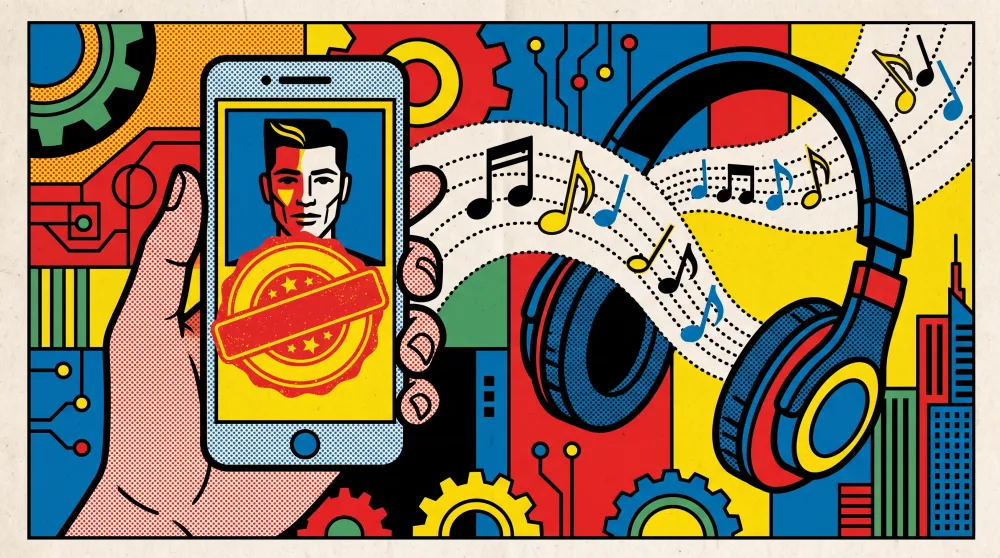
Spotify announced Tuesday, Aug. 11, 2026, that an AI Persona badge will begin appearing on some artist profiles in mid-September, with those accounts removed from recommendations by default. The label will cover profiles whose names and imagery may be generated and do not represent real people. Music from labeled accounts will remain available, but Spotify’s editorial and algorithmic systems will not serve it unless listeners follow the artist.
Enlly Blue, an AI persona launched by songwriter Thong Viet, had just under 168,700 Spotify followers when Spotify announced the badge, with the total still rising. By then, “Through My Soul” had been streamed more than 29 million times and was still gaining streams; an estimate derived from that total put earnings above $145,000. Between September and December 2025, Sienna Rose released 10 albums and placed three songs on Spotify’s Viral 50 before questions surfaced about whether the artist was created with AI.
What Changed
- Spotify will place an AI Persona badge on artist profiles whose identities appear AI-generated starting mid-September, and keep their music out of editorial and algorithmic recommendations by default unless a listener follows the account.
- Artists can self-disclose through Spotify for Artists. Spotify will also apply the badge itself using human reviewers and AI investigative tools, and artists labeled after a review are notified and may appeal.
- The badge covers the artist's public identity, not how the music was made. AI Credits and SongDNA separately disclose the role of AI in producing a track.
- Spotify has disclosed neither the audience threshold that decides which profiles get reviewed nor how many profiles it expects to label.
AI-generated summary, reviewed by an editor. More on our AI guidelines.
At Deezer, fully AI-generated tracks accounted for more than half of daily uploads in June 2026, close to 90,000 a day. That was up from 75,000 a day, or 44% of uploads, in April 2026.
Artists can now identify their profiles as AI Personas through Spotify for Artists. Spotify will also use human reviewers and “AI investigative tools” to examine a public identity that “appears to represent photorealistic AI-generated identities.” When listeners tap a badge, they will see whether the artist disclosed the identity or Spotify applied the label after review. Spotify said, “This badge is about the artist’s public identity, not about how the music was made.” AI Credits and SongDNA separately disclose the role of AI in making a track.
The badge will appear first on mobile, on profile banners and About sections, in Search, and beside tracks in playlists. Artists whose profiles Spotify labels after review will be notified and may self-disclose or appeal. Spotify plans to let listeners report suspected AI Personas in the coming months. “Listeners have been clear in telling us that they don’t like seeing an artist profile that seems human, only to find out that the persona is AI-generated,” Spotify said.
Get Implicator.ai in your inbox
Strategic AI news from San Francisco. No hype, no "AI will change everything" throat clearing. Just what moved, who won, and why it matters. Daily at 6am PST.
No spam. Unsubscribe anytime.
The review starts with profiles that meet “defined audience thresholds,” which Spotify says will cover the vast majority of artist pages users visit, but the company has disclosed neither the threshold nor the number of profiles it expects to label. Hundreds of thousands of profiles already carry its human-focused Verified by Spotify badge, covering more than 99% of artists that listeners actively search for.
Know someone who'd find this useful? ✉️ Email it to a friend in one click, or they can subscribe free here.
Spotify already offers an AI DJ and Prompted Playlists, and it introduced a conversational assistant in July 2026. Licensing deals with Universal Music Group and Merlin will let premium subscribers buy an add-on for creating AI remixes and covers from participating artists’ music. The arrangements are designed to direct revenue to participating artists.
In July 2026, Lorde objected after Spotify’s About the Song feature gave false information about her track “Current Affairs” from the album Virgin. A Spotify spokesperson acknowledged the mistake and said the feature remained in beta.
Spotify said, “We tune our algorithms to highlight authentic human artists and, based on available signals, strive to not include spam, slop, or low-effort content in our recommendations.” Stuart Dredge of Music Ally wrote, “It’s unclear how long this tuning has been going on, and of course it’s extremely hard for outsiders to gauge how successful Spotify’s striving is on this front.”
Frequently Asked Questions
When does the AI Persona badge start appearing?
Badges begin appearing on artist profiles in mid-September 2026. Artists have been able to identify their own profiles as AI Personas through Spotify for Artists since the August 11, 2026 announcement.
What happens to music from a labeled profile?
The music remains available on Spotify, but the company's editorial and algorithmic systems will not serve it. Labeled accounts are excluded from personalized recommendations by default unless a listener follows the artist.
Does the badge mean the music itself was made with AI?
No. Spotify said the badge is about the artist's public identity, not about how the music was made. Its AI Credits and SongDNA features separately disclose the role of AI in producing a track.
How does Spotify decide which profiles get the badge?
Artists can self-disclose. Spotify also uses human reviewers and AI investigative tools to examine a public identity that appears to represent photorealistic AI-generated identities. The review starts with profiles meeting audience thresholds Spotify has not disclosed.
Can an artist contest the label?
Yes. Artists whose profiles Spotify labels after a review are notified and may either self-disclose or appeal. Spotify also plans to let listeners report suspected AI Personas in the coming months.
AI-generated summary, reviewed by an editor. More on our AI guidelines.



Marcus Schuler
Editor-in-Chief and founder of Implicator.ai. Former ARD correspondent and senior broadcast journalist with 10+ years covering tech. Writes daily briefings on policy and market developments. Based in San Francisco. E-mail: editor@implicator.ai