IMPLICATOR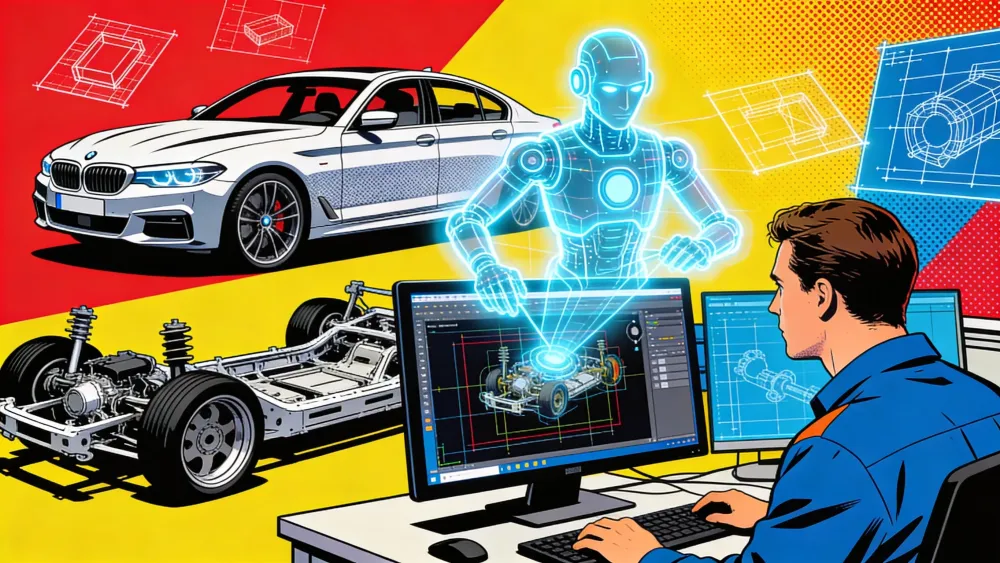
Bremen-based Synera GmbH said Tuesday it raised a $40 million Series B led by European growth investor Revaia, pushing total funding to $58.1 million for its agentic AI platform used by BMW, Airbus and NASA product development teams. The round, which Synera reported as €35 million, includes Capgemini through ISAI Cap Venture, a €6 million check from UVC Partners' growth fund, plus return commitments from BMW iVentures, Cherry Ventures, Venture Stars and Spark Capital. Axios Pro reporter Chris Metinko broke the news in an exclusive interview with CEO Moritz Maier.
The company, founded in 2018 as ELISE by Maier, Sebastian Möller-Lafore and Daniel Siegel, sells software that deploys teams of AI agents across the engineering stack. Those agents connect into more than 80 computer-aided design and simulation tools, from Altair and Autodesk to Hexagon, PTC and Siemens, orchestrating the steps that turn a product brief into a manufacturable part. The whole platform runs on-premises. Customer drawings and tolerances never leave the factory.
Key Takeaways
- Bremen-based Synera raised a $40 million Series B led by Revaia, bringing total funding to $58.1 million for its agentic AI platform serving 60 enterprise customers across 15 countries.
- BMW iVentures, Cherry Ventures, Venture Stars, Spark Capital and UVC Partners all returned, with Capgemini joining through ISAI Cap Venture and UVC contributing €6 million from its growth fund.
- The platform connects AI agents into 80+ CAD and simulation tools including Altair, Autodesk, Hexagon, PTC and Siemens, runs on-premises, and serves NASA, Airbus, BMW, Volvo Trucks and Hyundai.
- Synera doubled annual recurring revenue in 2025, with 60% of new business tied to its agentic AI offering, and plans to expand across the U.S., APAC, Europe and France.
AI-generated summary, reviewed by an editor. More on our AI guidelines.
Revaia's first German bet
For Revaia, this is the fund's first investment in Germany. Partner Jérémie Falzone, who works out of Munich, said Synera "represents a new category of enterprise software where AI agents can operate as part of the organization itself." That's marketing language, but the money tells a different story. Revaia usually writes growth checks into companies pushing toward exit readiness, not early commercialization. Leading a Series B into a Bremen-headquartered deep-tech company is a call that European industrial AI has hit an inflection.
BMW's role is worth dwelling on. BMW iVentures seeded Synera back when it was still called ELISE, shipping beta software into MAN, Ariane Group and Brose. Julien Hohenstein, who runs AI at BMW, said in the announcement that Synera is "meaningfully reducing workload for our engineers while unlocking new innovation potential." Read the sentence twice. BMW is a customer. BMW is an investor. BMW is the reference account that every potential buyer in Munich or Stuttgart will call before signing.
What the platform actually does
Think "JARVIS for engineers." That's how Synera describes it, and the analogy lands closer than most vendor pitches usually do. The agents don't just suggest edits. They run simulations. They query knowledge bases. They push geometry changes into CAD tools and wire the outputs into whatever manufacturing system the factory floor is running. Synera claims over 100,000 engineering workflows are already encoded into the platform. Sixty enterprise customers across fifteen countries have deployed it.
Who those customers are matters. NASA runs Synera. So does Airbus. BMW too, along with Volvo Trucks. Then Brose, L'Oréal, Miele, STIHL, ARRK Engineering, and Hyundai. That's a tier-one manufacturing roster, not a pilot program. Synera also released hard numbers from specific deployments. Frost & Sullivan, which gave the company its 2025 Global Transformational Innovation Leadership award for AI Agents in Engineering, reported that a BMW engagement extended robot operating life, cut production time and lowered carbon dioxide emissions by 60%. At Hyundai, the platform's visual programming drove a bionic lightweight design process that Frost & Sullivan said delivered 47% weight reduction and 80% shorter development time. Those figures are the company's own telling, through its award submission. Treat them as vendor case studies, not independent audits.
The hole in the manufacturing AI story
Synera is stepping into a market with a very visible gap. According to the 2025 Gartner CIO and Technology Executive Survey, only 41% of AI and GenAI prototypes in manufacturing reach production. The investment is going in. The production systems aren't coming out. Manufacturing CIOs are stuck between board pressure to deploy generative AI and legacy CAx environments that don't speak model-friendly data formats.
Get Implicator.ai in your inbox
Strategic AI news from San Francisco. No hype, no "AI will change everything" throat clearing. Just what moved, who won, and why it matters. Daily at 6am PST.
No spam. Unsubscribe anytime.
That stuck feeling explains why on-premises keeps showing up in the Synera pitch. Aerospace and defense customers cannot send IP through a third-party cloud. Regulated automakers face the same constraint. A platform that sits inside the customer's firewall, talks to the tools already installed there, and orchestrates agents across them is exactly the gap-filler most manufacturing AI pilots have been missing.
Synera told investors that its annual recurring revenue doubled in 2025, with 60% of new business driven by its agentic AI offering. The company also said new money will fund expansion across the U.S., Asia-Pacific and Europe, with a dedicated French team joining existing operations in Bremen and Boston.
The wave behind the check
The $40 million arrives during a much larger capital shift into AI for hardware engineering. Last year, two companies committed roughly $8 billion to putting physics-aware AI into CAD and manufacturing, led by a stealth Jeff Bezos project called Prometheus and a $2 billion NVIDIA stake in Synopsys. NVIDIA has since tied Cadence, Dassault Systèmes, PTC, Siemens and Synopsys into its Nemotron and Omniverse stacks, feeding agentic AI straight into the design platforms manufacturers already use. Bain's 2026 Industrial Automation Executive Survey pegs the upside from AI-enabled automation at as much as $70 billion in new market value by 2030. That's the size of the pot every agentic AI vendor is chasing.
Synera's pitch threads through that crowd with a different claim. The engineer already owns the tools. The data is already sitting on internal servers. The workflow is already running, just slowly and with too many handoffs. What's missing is a host the agents can live inside without forcing IT to rip anything out. Bremen, not Silicon Valley. On-premises, not cloud. A platform where NASA can deploy without opening a single outbound port.
What happens next depends on whether those 60 enterprise customers turn into 600, and whether the production-gap Gartner keeps measuring gets meaningfully narrower. Maier's bet is that engineers keep their CAD seats, keep their PLM logins, and quietly hand the grunt work to something else entirely.
Frequently Asked Questions
How much did Synera raise and who led the round?
Synera raised a $40 million Series B (€35 million), led by European growth investor Revaia. This is Revaia's first German investment. Capgemini joined through ISAI Cap Venture, and UVC Partners committed €6 million from its growth fund. BMW iVentures, Cherry Ventures, Venture Stars and Spark Capital all returned from prior rounds. Total funding now stands at $58.1 million.
What does Synera's platform actually do?
Synera deploys teams of AI agents that orchestrate engineering workflows across more than 80 CAD and simulation tools, from Altair and Autodesk to Hexagon, PTC and Siemens. The agents run simulations, query knowledge bases, push geometry changes into CAD, and wire outputs into manufacturing systems. The platform runs on-premises, so customer design data stays inside their own infrastructure.
Who are Synera's main customers?
Synera has 60 enterprise customers across 15 countries. Named accounts include NASA, Airbus, BMW, Volvo Trucks, Brose, L'Oréal, Miele, STIHL, ARRK Engineering and Hyundai. BMW is particularly notable: it's a customer, an investor through BMW iVentures since the company's seed round, and a public reference account.
Why does on-premises deployment matter for this market?
Aerospace, defense and automotive customers can't send engineering IP through third-party clouds due to regulatory and competitive concerns. Gartner data shows only 41% of manufacturing AI prototypes reach production, partly because legacy CAx environments don't connect cleanly to cloud AI platforms. Synera's on-premises architecture closes that gap by running agents inside the customer's firewall.
When was Synera founded and by whom?
Synera was founded in 2018 in Bremen, Germany by Dr. Moritz Maier, Sebastian Möller-Lafore, and Daniel Siegel. The company was originally called ELISE. Its early seed round included BMW i Ventures, Cherry Ventures, UVC Partners and Venture Stars. Synera now has offices in Bremen and Boston, with plans to open a dedicated team in France.
AI-generated summary, reviewed by an editor. More on our AI guidelines.




Marcus Schuler
Editor-in-Chief and founder of Implicator.ai. Former ARD correspondent and senior broadcast journalist with 10+ years covering tech. Writes daily briefings on policy and market developments. Based in San Francisco. E-mail: editor@implicator.ai