IMPLICATOR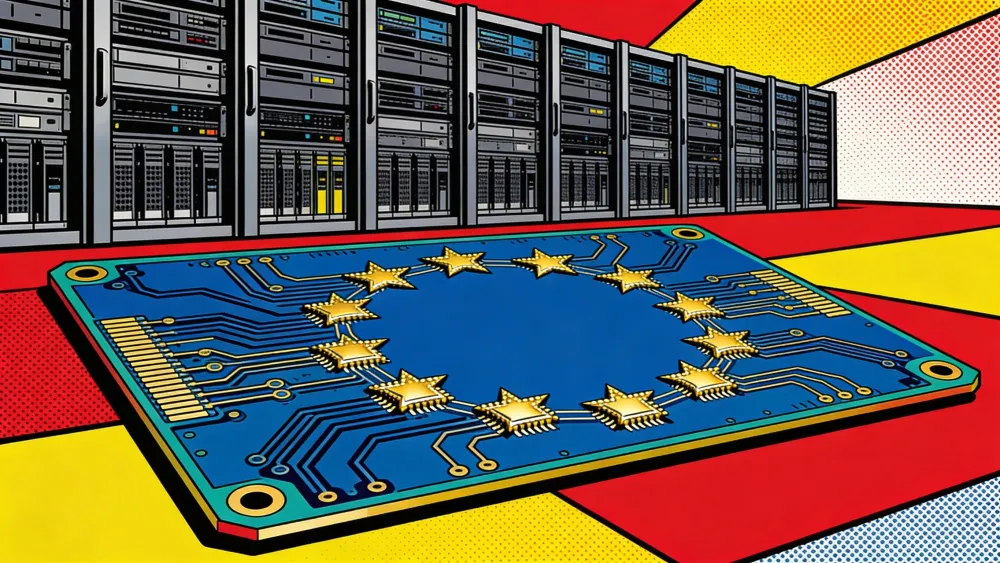
A revised Chips Act due June 3 would let the European Commission override chipmakers' supply contracts during a shortage, according to a draft seen by the Financial Times. It anchors a tech-sovereignty package meant to cut Europe's reliance on American and Asian technology.
In a shortage, the draft would let the Commission "force semiconductor manufacturers to prioritise orders for crisis-critical products, overriding existing contracts." It could also fine companies up to €300,000 for withholding information about their supply-chain capacity, and buy chips centrally for member states, the FT reported. Europe makes under 10% of the world's chips; Taiwan supplies more than 90% of the advanced ones.
Key Takeaways
- The EU's revised Chips Act, due June 3, would let Brussels override chipmakers' contracts during shortages and fine firms for withholding supply data.
- A new Cloud Act would bar US platforms from sensitive government data, where Amazon, Microsoft, and Google hold close to 70% of Europe's cloud market.
- The Netherlands blocked Kyndryl's purchase of DigiD supplier Solvinity, its first such veto, citing US data-access law.
- The same week, 68% of European firms reported keeping or expanding China supply chains as Brussels moved to exempt a sanctioned Chinese chipmaker.
AI-generated summary, reviewed by an editor. More on our AI guidelines.
The chip law
This is the bloc's second attempt. The 2023 Chips Act subsidized new fabs to lift Europe's share of global production to 20% by 2030, but an April audit found it will reach barely half that, near the 10% the bloc already holds, after Intel scrapped two planned plants in Germany. "While the initial Chips Act has been predominantly supply-driven, the Chips Act 2.0 places greater emphasis on demand-side measures," the new draft reads, according to Euronews.
The revised draft leans on "demand accelerators," offtake agreements, and public procurement to push governments toward European-made chips, Reuters reported. The Commission estimates the chip ecosystem needs €120 billion in public and private investment by 2035, with about €30 billion of that for one advanced foundry.
Get Implicator.ai in your inbox
Strategic AI news from San Francisco. No hype, no "AI will change everything" throat clearing. Just what moved, who won, and why it matters. Daily at 6am PST.
No spam. Unsubscribe anytime.
The cloud rules
A second measure, the Cloud and AI Development Act, would bar EU governments from putting sensitive health, finance, and judicial data on American cloud platforms. Amazon, Microsoft, and Google together hold close to 70% of Europe's cloud market.
Brussels cites a US law as the risk. The CLOUD Act of 2018 lets American authorities compel US-based providers to hand over data they hold regardless of where it is stored. "No US company can guarantee that the US government will never access your data," Christoph Strnadl, chief technology officer of the European cloud-standards group Gaia-X, told Tech Times. Alba Ribera Martínez, editor-in-chief of the Stanford Computational Antitrust project, told The Economic Times the bloc trails the United States by "a €1 trillion investment gap" on cloud infrastructure.
The Dutch precedent
Days before the package, the Netherlands blocked IBM spinoff Kyndryl from buying Solvinity, which runs the platform behind DigiD, the national identity system that recorded more than 550 million logins in 2024. State Secretary Willemijn Aerdts said the investment-screening bureau had advised blocking the deal as a possible risk to the public interest. It was the first acquisition the bureau has blocked since it was created in 2020.
The Commission's own sovereign-cloud procurement has drawn criticism. In April it awarded part of a €180 million contract to a consortium using S3NS, a joint venture that Thales controls and that runs on Google Cloud infrastructure. Francisco Mingorance, secretary general of the cloud trade group CISPE, called recognizing it as sovereign "clearly an own goal" that "threatens to institutionalize sovereignty washing at the highest levels."
China dependence
The package lands as European reliance on China deepens. A European Union Chamber of Commerce survey released this week found 68% of European companies keeping or expanding supply chains in mainland China, against 7% moving elsewhere. "We don't see sort of de-risking becoming a theme," said Jens Eskelund, the chamber's president, in comments to CNBC.
The Commission also moved this month to propose temporarily exempting a sanctioned Chinese chipmaker from EU restrictions, so European car plants would not run short of power semiconductors after last year's Nexperia disruption. EU industry chief Stéphane Séjourné has urged companies to diversify. "Do not make 100% of your supplies in one country," he told businesses after meeting trade ministers, warning the Commission might "have to move to the next step."
Séjourné takes his case to fellow commissioners on Friday. EU tech chief Henna Virkkunen presents the Chips Act and Cloud Act texts on June 3, alongside the bloc's first legal definition of digital sovereignty.
Frequently Asked Questions
What is in the EU's tech-sovereignty package?
Two main laws. A revised Chips Act giving Brussels emergency powers to reprioritize chip orders and override contracts during shortages, plus a Cloud and AI Development Act restricting US cloud providers from holding sensitive government data. The texts are due June 3, alongside the EU's first legal definition of "digital sovereignty."
When does the EU publish the Chips Act 2.0?
The Commission, led by tech chief Henna Virkkunen, is set to present the revised Chips Act and the Cloud and AI Development Act on June 3, 2026. The drafts remain subject to change before publication.
Why did the Netherlands block the Kyndryl-Solvinity deal?
Solvinity runs the platform behind DigiD, the Dutch national login system. The investment-screening bureau concluded a US owner could be compelled under the CLOUD Act to expose Dutch identity data, and recommended a block, the first the bureau has issued since it was created in 2020.
What is "sovereignty washing"?
The term, used by cloud trade group CISPE, describes US tech firms presenting European subsidiaries as "sovereign" while remaining subject to US law. The EU's own €180 million sovereign-cloud tender drew criticism for including S3NS, a Thales-controlled venture that runs on Google Cloud infrastructure.
Does Europe make its own chips?
Barely at the leading edge. The bloc produces under 10% of the world's semiconductors and depends on Taiwan for more than 90% of advanced chips. Its 2023 goal of a 20% global share by 2030 is on track to reach about half that, per an April audit.
AI-generated summary, reviewed by an editor. More on our AI guidelines.


Marcus Schuler
Editor-in-Chief and founder of Implicator.ai. Former ARD correspondent and senior broadcast journalist with 10+ years covering tech. Writes daily briefings on policy and market developments. Based in San Francisco. E-mail: editor@implicator.ai