IMPLICATOR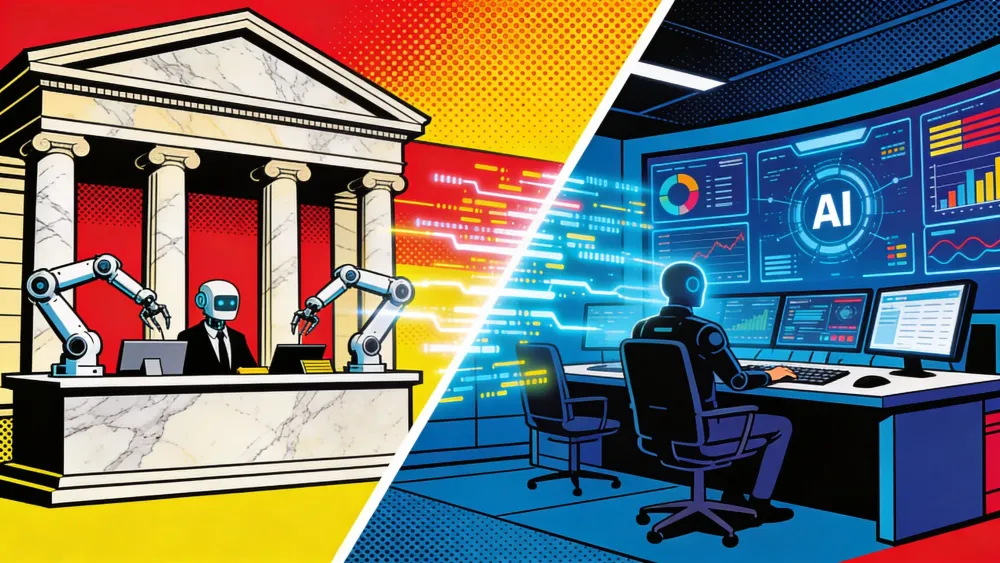
The US banking industry spent two years telling investors and regulators that AI would augment human work, not replace it. The numbers from the first quarter of 2026 have ended that conversation.
The six largest Wall Street banks cut 15,000 jobs in the first three months of 2026 while posting combined profits of $47 billion, an 18 percent jump year over year, the New York Times reported April 21. JPMorgan Chase now runs more than 500 AI use cases in production and has moved its $2 billion annual AI budget out of the discretionary innovation category and into core infrastructure, alongside data centers and payment systems, as the bank's own crypto.news coverage confirmed last week. Citi's restructuring plan to cut 20,000 jobs is more than 80 percent complete, and CEO Jane Fraser wrote in a January 2026 memo that "AI and further process simplification" would mean "some roles will change, new ones will emerge and others will no longer be required." Goldman Sachs CEO David Solomon said AI is doing 95 percent of the work on IPO prospectuses. Block cut 40 percent of its workforce in February 2026 and then posted 27 percent gross profit growth the next quarter.
The augmentation story is over. Q1 of 2026 shows AI taking out banking jobs at scale, not adding work alongside them. What is open is who keeps the value once the cost line drops: the incumbents with the capital, the data and the 1990s plumbing, or the fintech challengers running on AI-native stacks and smaller balance sheets.
The rest of this piece works through the two architectures, the bottleneck that decides between them, and the financial signals to watch before the next earnings cycle confirms it.
Key Takeaways
- JPMorgan's $19.8B technology budget powers 500 AI production use cases, but Q1 2026's 15,000 industry-wide job cuts confirm the incumbent AI factory is primarily a cost-takeout engine, not a revenue machine
- Ramp hit $1.4B ARR raising at $40B-plus, Mercury produced $650M revenue on 800 employees at $812.5K per head, and Block grew gross profit 27% after cutting 40% of staff — the fintech AI-native stack generates unit economics incumbents cannot replicate
- The Synapse ledger reconciliation crisis exposed $65-95M in unaccounted customer funds, killed the BaaS 1.0 model, and triggered a charter rush with Mercury, Revolut, Nubank, and Upstart all seeking OCC approval in 2026
- The FIS-Anthropic agentic banking partnership may bring AI to thousands of community banks but also introduces correlated failure risk via shared architecture that existing regulatory frameworks were not designed to detect
AI-generated summary, reviewed by an editor. More on our AI guidelines.
The Scarce Resource Is No Longer Capital. It Is AI-Native Infrastructure.
The bottleneck framing that dominated fintech analysis through 2024 was straightforward: incumbents have more money, so they win. JPMorgan's $19.8 billion annual technology budget dwarfs the entire revenue base of most community banks. The bank employs more than 60,000 technologists. It has reclassified AI spending as permanent infrastructure, as crypto.news documented last week, treating the $2 billion annual AI line as non-negotiable as cybersecurity. Bank of America spent roughly $13 billion on technology in 2025 and plans 10 percent more in 2026. Citi runs approximately $12 billion annually.
If capital alone decided the outcome, the article would end here. But the fintech side is producing economic results that capital alone cannot explain.
Mercury generated $650 million in annualized revenue in 2025 with approximately 800 employees. That is roughly $812,500 in revenue per employee. The company has been GAAP profitable for three consecutive years. Its $20 billion deposit base, if it were a chartered bank, would make it a top-100 US bank by deposits. Mercury's Net Promoter Score of 75 compares to a financial services industry average of 34.
Ramp crossed $1 billion in annualized revenue in August 2025 and reached $1.4 billion ARR by Q1 2026, doubling in roughly one year. The company is now in talks to raise $750 million at more than $40 billion pre-money valuation, TechCrunch reported May 7, approximately six months after hitting $32 billion. Ramp shipped more than 300 AI product innovations in 2025 alone. Its AI agents now handle 85 percent of transaction reviews automatically with 99 percent policy enforcement accuracy, and 60 percent of invoices are auto-created.
Block cut 40 percent of its workforce, approximately 4,000 people, in February 2026. CEO Jack Dorsey framed this explicitly as an AI-led restructuring, stating that "AI became more central to how Block operates and what we build for customers." In Q1 2026, Block reported $2.91 billion in gross profit, up 27 percent from the year-earlier period, on $6.06 billion in revenue, up approximately 5 percent. Cash App gross profit hit $1.91 billion, up 38.3 percent. The company deployed Moneybot, its AI financial management tool, across all of Cash App and Managerbot, its AI-native operating layer, to more than 1 million Square sellers.
Stripe processed $1.4 trillion in payment volume in 2024, up 38 percent, on approximately 8,000 employees after cutting 14 percent of staff in 2022 and 300 more in early 2025. The company is valued at $91.5 billion. Its machine learning fraud detection system, Radar, benefits from a transaction dataset spanning millions of merchants.
The pattern is consistent. The fintechs that are winning are not winning because they have more money. They are winning because they have infrastructure that was built for AI from inception, not bolted onto a legacy core. Every function is API-accessible from day one. The cost structure is software margins, not branch-network margins. The organizational design is flat engineering teams, not hierarchical banking divisions with compliance layers between every decision.
The scarce resource in US banking is no longer capital or distribution. It is the ability to deploy AI natively into every operational surface, not as a layer on top of a core banking system that was designed in the 1990s.
Back-Office Cost Takeout: The Incumbent AI Factory Is Real but Narrow
The incumbent banks have produced genuinely impressive AI deployment numbers. The question is where they apply.
JPMorgan's LLM Suite, which won American Banker's Innovation of the Year award in 2025, is now used daily by more than 230,000 employees, as crypto.news reported. The bank runs anti-money laundering machine learning systems that have cut false positives by 95 percent. Its investment banking division uses LLM Suite to generate five-page presentation decks in 30 seconds, work that previously took junior analysts hours. Chief Analytics Officer Derek Waldron told McKinsey in October 2025 that AI-attributed benefits have grown 30 to 40 percent year over year since inception and that just under half of JPMorgan employees use gen AI tools every single day.
Goldman Sachs' Developer Copilot was the first AI tool deployed at scale and is used by thousands of engineers daily. CIO Marco Argenti built the GS AI Platform as a multi-model foundation that individual tools plug into: GS AI Assistant, Banker Copilot, Translate AI, Legend AI Query. Argenti has explicitly stated he does not want to rely on a single vendor. Solomon told investors that AI is handling 95 percent of IPO prospectus work and that the bank's developer productivity has improved 3 to 4 times.
Bank of America CEO Brian Moynihan said AI coding tools have taken 30 percent out of the coding stream for introducing new products, saving approximately 2,000 full-time equivalent positions. Digital connections with customers reached 1.4 billion and save approximately 11,000 FT equivalents. Wells Fargo CEO Charles Scharf reported that generative AI tools have made engineers 30 to 35 percent more productive.
The cumulative deployment is real. It is also narrow. Every quantified, attributable AI gain disclosed by the major banks falls into three categories: software engineering productivity, contact center deflection, and back-office document processing. Front-office claims about AI-driven advisory, underwriting, and revenue generation are either recent announcements, small pilots, or self-measured with no independent verification.
Morgan Stanley's AI @ Morgan Stanley Assistant has achieved 98 percent adoption among financial advisor teams, and the Debrief tool saves approximately 30 minutes per meeting, facts confirmed by the bank's CAO. The 30 to 40 percent reduction in administrative workload and 25 percent increase in client handling capacity claims are case study reporting, not audited financial metrics.
Dimon told Bloomberg TV in October 2025 that JPMorgan finds approximately $2 billion in annual cost savings from the $2 billion AI spend. No audit firm, academic study, or regulatory examination has independently validated any of the major banks' AI productivity claims.
The incumbent AI factory is real, but it is an efficiency engine, not a revenue engine. The banks are using AI to take cost out of existing operations faster than anyone expected. They have not yet demonstrated that AI changes the revenue trajectory for any major business line.
The Fintech AI-Native Stack: Why Ramp, Mercury, and Block Produce Different Economics
The fintech challengers are deploying AI into a fundamentally different operating model. The differences are not a matter of technology adoption speed. They are architectural.
The infrastructure gap is the most durable difference. Mercury, Ramp, and Stripe have no legacy core banking systems. Every function is accessible via API. When Mercury launched its MCP server in March 2026, allowing customers to connect banking data to AI agents via the Model Context Protocol, it was building on an architecture where machine-accessible data was the default, not a retrofit project. When Mercury acquired Central, an AI-native payroll platform, in April 2026, the integration required connecting two API-first systems.
The product velocity gap is measurable. Ramp shipped more than 300 AI innovations in a single year. The company went from corporate cards in 2019 to bill pay in 2021, procurement and travel in 2024, and treasury in 2025. Mercury went from business checking to full financial operating system -- bill pay, invoicing, expense management, payroll -- in approximately 18 months. No incumbent bank ships product at this cadence. JPMorgan's LLM Suite is genuinely impressive, but it is an internal tool bolted onto a bank that processes trillions in daily transactions through core systems that predate the iPhone.
The unit economics gap is the most consequential for long-term competition. Mercury's 800 employees serve more than 200,000 businesses at $812,500 revenue per employee. The company has no branches, no physical infrastructure overhead, and no legacy system maintenance budget. Revenue is approximately 90 percent from interest on deposits, 10 percent from interchange and SaaS subscriptions. Ramp's multiproduct strategy is shifting revenue from pure interchange toward higher-margin SaaS subscriptions at $15 per user per month for Ramp Plus. Block's $2.91 billion quarterly gross profit after cutting 4,000 people is the clearest expression of AI-driven operational efficiency in US financial services.
The AI deployment model is fundamentally different. Ramp's AI agents replace human reviewers, not assist them, handling 85 percent of transaction reviews with 99 percent policy enforcement accuracy. Mercury's agentic banking through the MCP server and CLI lets customers query banking data and execute financial operations through AI agents without opening a dashboard. Rather than a chatbot layered on top of a bank, the platform makes the AI the interface itself.
The risk to this model is that the incumbents are not standing still. JPMorgan's $2 billion annual AI budget buys something. Goldman Sachs' multi-model GS AI Platform is architecturally sophisticated. Capital One acquired Brex for $5.15 billion in Q1 2026, signaling that incumbent acquisition is a live path to absorbing fintech capabilities. The question is whether the fintechs can compound their AI-native advantage into a durable moat before the incumbents close the gap through spending and acquisition.
The fintech AI-native stack is producing unit economics that the incumbent cost structure cannot replicate. The question is whether that lead compounds faster than the incumbents' spending closes the gap.
The Synapse Collapse and the Charter Rush: The BaaS Model Died and the Banks Are Reforming
The most consequential regulatory event for US fintech in the past two years was not a rulemaking or a piece of legislation. It was the collapse of Synapse Financial Technologies in April 2024.
Synapse was a BaaS middleware provider that sat between fintechs like Yotta, Juno, and Copper and their sponsor bank, Evolve Bank and Trust. The company maintained an independent ledger of customer funds. Evolve maintained its own ledger of the same funds, and no real-time reconciliation mechanism existed between them. There was no independent source of truth and no regulatory framework requiring one. When Synapse filed for Chapter 11, approximately $85 million in customer funds was caught in the gap between the two ledgers, according to the CFPB, which identified a shortfall of $65 to $95 million against customer claims. End users lost access to their money.
The regulatory response was structural. The FDIC proposed a "Synapse rule" in October 2024 requiring banks, not middleware providers, to maintain the authoritative ledger of customer funds, with real-time reconciliation. The FDIC and OCC issued updated BaaS guidance requiring banks to maintain full oversight and control of all money flows managed through fintech collaborations. Evolve Bank was hit with a consent order from its primary federal regulator, and its BaaS fee revenue dropped from $12.3 million per quarter in Q3 2024 to approximately $7 million per quarter in Q3 2025. Blue Ridge Bank was ordered by the OCC to obtain non-objection before adding new fintech clients and subsequently wound down its BaaS division. Solid Financial Technologies, a BaaS middleware that raised $81 million, filed for Chapter 11 liquidation in early 2025 after failing to sign any new clients. The CFPB allocated $46 million from its Civil Penalty Fund to reimburse Synapse victims in December 2025.
The BaaS 1.0 model, in which a middleware provider maintained the operational ledger between fintechs and sponsor banks, is dead. The model that replaces it is bifurcating. Either fintechs pursue their own charters, or they rely on a shrinking universe of sponsor banks that invested in compliance and ledger infrastructure before the collapse.
The charter pipeline is filling at an unprecedented rate. Mercury received conditional OCC approval for a de novo national bank charter in April 2026, American Banker reported, permitting the company to incorporate Zelle, expand lending, and build its own payments infrastructure. Revolut, which serves more than 70 million customers in 40-plus markets, applied for a US charter in March 2026. Nubank, the Brazilian neobank with 127 million Latin American customers, received conditional OCC approval in January 2026. The AI-powered lender Upstart applied for a de novo charter in March 2026. The OCC under Comptroller Jonathan Gould approved 11 fintech and crypto charters in 83 days, with a stated target of 120-day turnaround on new applications. Erebor Bank, backed by Peter Thiel and Palmer Luckey, claimed the first de novo bank charter granted in four years in February 2026.
The charter conversions, if they proceed at this pace, create a new tier of full-service digital banks with direct FDIC insurance, Federal Reserve access, and lending funded by their own deposits. Mercury at $20 billion in deposits, if it were already chartered, would be a top-100 US bank by deposit size. The timeline from application to approval appears to be 12 to 18 months for fintechs with clean applications, placing the first conversions in late 2026 to early 2027.
The Synapse collapse ended the era of lightweight BaaS and accelerated the charter rush. The structural question for the next 24 months is whether charter conversions create a new tier of full-service digital banks that compete directly with incumbents on deposit funding and lending economics.
Get Implicator.ai in your inbox
Strategic AI news from San Francisco. No hype, no "AI will change everything" throat clearing. Just what moved, who won, and why it matters. Daily at 6am PST.
No spam. Unsubscribe anytime.
Vendor Concentration: The FIS-Anthropic Agent Layer and the Model Monoculture Risk
The regulatory spotlight on AI vendor concentration in banking intensified sharply in April 2026. On April 7, Treasury Secretary Scott Bessent and Federal Reserve Chair Jerome Powell summoned major bank CEOs to an urgent meeting to address cybersecurity threats posed by Anthropic's Claude Mythos model, which can identify and exploit security vulnerabilities across operating systems and web browsers at scale. This was the first documented instance of principals-level regulators convening bank CEOs specifically about an AI model's risk implications. JPMorgan CEO Jamie Dimon, at an Anthropic-hosted event on May 6, called on Anthropic CEO Dario Amodei to release more details on Mythos so that institutions could assess and mitigate the risks. Fed Vice Chair for Supervision Michelle Bowman stated at a May 1 FSOC roundtable that "the existing risk-management framework may not be the right fit to assess AI" and that the Fed, OCC, and FDIC recently amended model risk management guidance to clarify it does not apply to generative or agentic AI.
While the Mythos emergency meeting captured headlines, the more durable structural concern is the emerging vendor concentration at the agent layer. In May 2026, FIS, the core banking system of record for thousands of US financial institutions, announced a partnership with Anthropic to bring agentic AI to banking. The first product is a Financial Crimes AI Agent that compresses AML investigations from days to minutes, with BMO and Amalgamated Bank as first deployers and broader availability planned for H2 2026. The roadmap spans credit decisioning, deposit retention, customer onboarding, and fraud prevention. FIS is running the platform, Anthropic is providing the Claude reasoning engine, and the client bank's data stays within FIS-controlled infrastructure. Every agent decision is traceable and auditable.
This is the most significant vendor-level development for AI in banking outside the money-center institutions because it creates a path for community and regional banks to deploy AI without building it. It also creates a new concentration risk. If the FIS-Anthropic agent platform becomes the industry standard for AML, credit, and onboarding across thousands of banks, a vulnerability in Claude or a disruption in FIS infrastructure could affect the entire sector simultaneously.
The money-center banks are not exposed to this specific risk because they build their own platforms. JPMorgan's LLM Suite, Goldman's GS AI Platform, and Citi's Stylus Workspaces are proprietary, multi-model systems that can swap providers without retraining staff. But the academic and regulatory community has been flagging the broader risk of model monoculture in financial services. A March 2026 preprint specifically warned of systemic AI convergence as a structural vulnerability. The Bank of England's Financial Policy Committee set out AI adoption financial stability risks in April 2025. The FSB published a stocktake on AI financial stability implications in November 2024. Senator Elizabeth Warren and colleagues pressed the FSOC in January 2026 to investigate financial stability risks of an "AI debt bubble."
SR 11-7, the Fed and OCC's 2011 model risk management guidance adopted by the FDIC in 2017, requires independent validation, ongoing monitoring, and documentation detailed enough that unfamiliar parties can understand model operation. These requirements apply to AI models, but as Bowman acknowledged, the existing framework may not fit. The gap between the speed of AI deployment in banking and the speed of regulatory adaptation is widening.
The vendor concentration risk shifts from single-provider failure to shared-architecture failure. If a single platform like the FIS-Anthropic agent layer reaches industry-standard status across thousands of banks, a vulnerability in Claude or a disruption in FIS infrastructure introduces correlated failure modes that existing regulatory frameworks were not designed to detect.
The Jobs Calculus: Headcount Is the Signal. Revenue Per Employee Is the Arbitrage.
The Q1 2026 headcount numbers from the six largest banks represent roughly 15,000 positions eliminated out of a combined workforce of approximately 1.1 million. That is less than 2 percent. The EY survey of 240 financial services CEOs found that 60 percent believe AI will maintain or increase headcount in 2026, while only 28 percent predicted a drop. On these numbers, the "AI will augment, not replace" narrative still appears to hold.
But headcount reduction is the wrong metric. The right metric is what the banks do with the productivity gains they have already disclosed.
JPMorgan reports 10 to 20 percent efficiency gains for engineering teams using AI coding assistants. Bank of America reports 30 percent taken out of the coding stream, equivalent to approximately 2,000 FT equivalents. Wells Fargo reports 30 to 35 percent gains. Citi's automated code reviews have been used more than 1 million times, creating approximately 100,000 hours of weekly developer capacity. Goldman Sachs reports 3 to 4 times developer productivity improvement.
If these numbers are directionally correct, and the banks are not cutting engineering headcount proportionally, they are redirecting engineers from maintenance and basic development to higher-value work. That is the redeployment narrative that Dimon and Moynihan have emphasized. But if the gains compound, and the banks' own stated productivity improvements hold, the redeployment math reaches a limit. There are only so many high-value engineering problems to redirect people toward.
JPMorgan's Waldron acknowledged precisely this tension in his October 2025 McKinsey interview: "an hour saved here and three hours there may increase individual productivity, but in end-to-end processes these snips often just shift bottlenecks." JPMorgan CFO Jeremy Barnum said the bank is "resisting head count growth where possible." Citi's outgoing CFO Mark Mason said he expects headcount to "continue to trend down." Goldman Sachs announced it will "constrain head count growth through the end of the year, in addition to a limited reduction in roles."
The banks that are cutting (Citi, Goldman) and the banks that are redeploying (JPMorgan, BofA) may converge on the same outcome over different timelines. The Stanford research analyzing ADP data found that early-career workers aged 22 to 25 in AI-exposed occupations saw a 6 percent employment decline from late 2022 to July 2025. The New York Times reported that recent Citi layoffs included employees in the bank's "AI Champions and Accelerators" program, people whose role was persuading colleagues to adopt AI.
The long-term employment calculus is not about whether AI eliminates jobs in banking. It will. The question is whether the jobs that remain generate higher revenue per employee, and whether the institutions that adopt AI fastest capture a disproportionate share of that revenue. The fintech numbers -- Mercury at $812,500 revenue per employee, Block growing gross profit 27 percent after cutting 40 percent of staff -- suggest that AI-native operations produce economics that resemble software companies, not banks.
The banks that are cutting headcount and the banks that are redeploying are heading to the same place. The variable is how much time it takes to get there. The fintechs already operate at software-company unit economics. The incumbents are still operating as banks that have deployed AI tools.
The Counterargument: Incumbent Capital and Regulatory Standing Are Real Moats
The most obvious argument for the incumbent advantage is that fintech unit economics, however impressive, do not survive the shift from growth-phase financial services app to regulated depository institution.
The evidence for this position is not hypothetical. Varo Bank, the first de novo consumer fintech bank charter awarded in 2020, lost $91 million in 2025 on $211 million in deposits, approximately $30 per customer. The company required a $123 million lifeline in February 2026 after years of sustained operating losses that have consumed the bulk of the more than $1 billion in cumulative investment it has raised. Chime, which reported roughly 22 million customers at its June 2025 IPO and $1.67 billion in 2024 revenue, generates approximately 75 percent of its revenue from interchange and fee-based income tied to debit card transactions, KBW analysts noted. If Durbin Amendment interchange caps are extended or the Credit Card Competition Act passes, Chime's revenue model faces direct compression. Mercury generates approximately 90 percent of its $650 million revenue from interest on deposits. If rates fall 200 to 300 basis points, that revenue compresses proportionally unless Mercury expands SaaS and interchange income faster than deposits reprice.
The regulatory case for the incumbents is just as concrete. They already carry FDIC insurance, Fed access, and the compliance plumbing for fair lending, AML, and capital adequacy. Any fintech that chases a charter is volunteering for the same burden. Mercury's April conditional OCC nod is meaningful, but it is not yet a final charter. Once full national-bank supervision kicks in, the margin advantage of running on a partner bank starts to erode.
The Capital One acquisition of Brex for $5.15 billion in Q1 2026 is instructive. Brex built a strong corporate card and spend management platform, expanded into software with Empower, and reportedly burned $17 million per month in Q4 2023 before cutting costs. The company chose acquisition rather than an independent path to bank charter or IPO. For every Ramp and Mercury that is scaling toward independence, there is a Brex that opted for consolidation.
We do not think the incumbent advantage argument decides the outcome, however, for two reasons. First, the unit economics of the fintech AI-native stack, even after accounting for charter overhead, appear to be structurally superior to the incumbent branch-and-legacy model. Mercury's 800 employees serving 200,000 businesses at $812,500 revenue per employee is not achievable within a branch-based model regardless of AI deployment. Second, the fintech charter pipeline is filling now, with conditional approvals accelerating, which means that by late 2026 or early 2027 the regulatory parity argument may no longer separate the two categories.
The incumbent advantages in capital and regulatory standing are real but eroding. The fintech advantages in infrastructure and unit economics are real but have not been tested through a full rate cycle and regulatory conversion. The next 24 months will determine which advantage compounds faster.
The Implicator Fintech Unit Economics Tracker
We have compiled a comparison framework across five dimensions that determine outcomes in this market: revenue per employee, AI deployment density, charter standing, revenue model durability, and product velocity. Here is the scorecard as of Q1 2026.
Mercury sits at the top of the revenue-per-employee table at roughly $812,500. Block trails because Square's hardware and seller operations still drag the average down, even after the workforce cut. The big banks do not publish this figure, but you can back it out: JPMorgan reported $179 billion in revenue in 2025 against roughly 310,000 employees, or about $577,000 per head. The dollar figures do not line up cleanly. Mercury has no branches, no wholesale lending, no capital markets desk. JPMorgan books spread lending, trading and investment banking that the fintechs do not touch. What the spread does show is a different operating shape — software economics on one side, bank economics on the other — and AI is closing the gap from both directions as it works into the incumbent cost base.
AI deployment density favors the fintechs by velocity if not by absolute investment. Ramp's 300-plus AI innovations in a single year and Block's 40 percent workforce reduction followed by 27 percent gross profit growth suggest fintechs deploy AI as their operating model, not as a cost-saving initiative within an existing model. JPMorgan's 500 production AI use cases and $2 billion annual AI spend are larger in absolute terms but smaller relative to the institution's size and complexity. The fintechs are smaller, faster, and structurally built for AI integration. The incumbents are larger, richer, and structurally built for stability.
Charter and regulatory standing is the incumbent advantage, and it has been since the National Bank Act of 1863. That advantage is eroding as the OCC approves fintech charters at record pace. If Mercury, Revolut, and Nubank all receive full charters by mid-2027, the regulatory parity gap closes for the first time in US banking history.
Revenue model durability poses challenges on both sides. The incumbent banks are heavily exposed to net interest margin compression in a falling-rate environment, just as Mercury and Chime are. JPMorgan's $2 billion AI spend finding $2 billion in cost savings is a compelling operational narrative, but the core revenue remains spread-based lending and capital markets fees, not AI software margins. The fintechs that diversify revenue toward SaaS -- Ramp's Plus offering, Mercury's financial operations tools -- are building higher-margin streams that are less rate-sensitive than pure interchange or deposit interest.
Product velocity belongs to the fintechs by an order of magnitude. The 18-month timeline from Mercury entering business checking to offering a full financial operating system, or Ramp going from corporate cards to treasury in six years, has no incumbent analog. The incumbent banks measure product cycles in years, and their most significant AI deployments remain internal tools, not customer-facing products that generate new revenue.
The Implicator Fintech Unit Economics Tracker shows the fintechs leading on the dimensions where compounding matters most: revenue per employee, AI deployment density, and product velocity. The incumbents lead on charter standing and absolute scale. The convergence point is late 2026 to early 2027, when the first wave of charter conversions should complete.
The Verdict: Three Paths and the One That Compounds
The evidence assembled from 12 source articles, two deep research briefs covering more than 100 primary sources, and the full Q1 2026 earnings cycle points to a banking market that is bifurcating, not converging. The incumbents are building AI factories that take cost out of existing operations. The fintechs are building AI-native operating systems that produce different unit economics entirely.
The structural question is whether the two architectures merge, and if so, which way the bend goes. The FIS-Anthropic partnership may push agentic AI into thousands of community banks that could not build it on their own, bending the incumbent architecture toward the fintech model. Charter conversions may pull Mercury, Revolut, and Nubank inside the full regulatory framework, bending the fintech architecture toward the incumbent model. Capital One's acquisition of Brex shows a third path: incumbent absorption of fintech capabilities through M&A.
Our read: the fintech AI-native stack compounds faster than the incumbent cost-takeout engine, but the gap closes from both ends. The fintechs that take a charter and keep software margins win the cycle. The incumbents that move beyond engineering productivity into front-office revenue creation hold the line. The ones that do neither lose share quietly over the next 24 months. The five signals below are how to track which way each side goes.
What to Watch
Five specific signals will indicate which direction this market is heading in the next 6 to 12 months.
Start with Mercury. The conditional OCC nod from April still has to convert to a final charter, and if it does and the company begins operating as Mercury Bank by mid-2027, the fintech-to-bank conversion thesis stops being a thesis. A chartered Mercury sitting on $20 billion in deposits competes head-on with mid-tier banks for funding cost and lending margins.
The Ramp tell is different. Watch the Q2 SaaS mix. If Ramp Plus at $15 per seat per month is moving beyond the early-adopter base, the company has a margin profile that holds up when rates move. If it is not, interchange still runs the model, and the $40 billion valuation rides on the same fee economics the rest of fintech is trying to escape.
The FIS-Anthropic Financial Crimes AI Agent goes live in H2 2026 with BMO and Amalgamated Bank as first deployers. Community bank adoption data from the first quarter of general availability will show whether the vendor agent layer becomes the standard AI delivery mechanism for smaller banks or remains a niche product for early adopters with the compliance resources to manage it.
Q2 2026 bank headcount disclosures will indicate whether the 15,000-job reduction in Q1 was a one-time efficiency exercise or the beginning of a structural trend. The banks that emphasized redeployment -- JPMorgan and Bank of America -- face the sharpest test: if headcount stays flat while productivity compounds, the gap between the "augment" narrative and the "replace" reality narrows to zero.
The next state attorney general enforcement action against an AI lending model will set the enforcement baseline. The Massachusetts $2.5 million Earnest settlement in July 2025 proved that existing ECOA and UDAP statutes are sufficient to challenge biased AI underwriting without new AI-specific legislation. The next action, whether against a fintech or an incumbent, determines how aggressively banks disclose AI-driven credit decisions in an environment where federal enforcement has retreated and state enforcement is escalating.
Frequently Asked Questions
Are AI coding tools really saving banks 30% on engineering time?
Bank of America CEO Brian Moynihan and Wells Fargo CEO Charles Scharf both reported 30-35% engineer productivity gains from AI coding tools. JPMorgan reports 10-20%, Goldman reports 3-4x developer productivity improvement. These are self-reported, unaudited figures.
Why did Synapse collapse and what changed because of it?
Synapse maintained a separate customer funds ledger from its partner bank Evolve, with no real-time reconciliation. When it went bankrupt in April 2024, $65-95M in customer funds was trapped between the two ledgers. The FDIC proposed rules requiring banks to hold the authoritative ledger, multiple BaaS providers shut down, and fintechs accelerated charter applications to bring ledger control in-house.
Is fintech growth sustainable if interest rates fall?
Mercury generates 90% of revenue from deposit interest, Chime depends on interchange for 75% of revenue. Both face compression if rates fall or interchange caps extend. Ramp's shift toward SaaS subscriptions and Mercury's expansion into financial operations tools represent diversification away from rate-sensitive and interchange-dependent revenue.
Are bank charters the endgame for fintechs?
Mercury conditionally approved April 2026, Nubank conditional January 2026, Revolut and Upstart applied March 2026. The OCC approved 11 fintech/crypto charters in 83 days. A charter gives fintechs FDIC insurance, Fed access, and the ability to fund loans with deposits, closing the structural gap with incumbents. It also brings full regulatory burden.
What does the FIS-Anthropic partnership mean for community banks?
FIS, the core banking system for thousands of US institutions, partnered with Anthropic in May 2026 to deliver agentic AI through its platform. The Financial Crimes AI Agent compresses AML investigations from days to minutes, with BMO and Amalgamated Bank as first deployers and H2 2026 availability planned. For community banks that cannot build AI internally, this creates a vendor-supplied path.
AI-generated summary, reviewed by an editor. More on our AI guidelines.


Sources & Further Reading
Reporting & Research
- Job Cuts Driven by A.I. Are Rising on Wall Street
- How Big Wall Street Banks, From JPMorgan to Citi, Are Using AI
- Inside the Dashboards JPMorgan Is Using to Track Engineers' AI Use
- Banking's Biggest Names Are Talking About Mythos
- JPMorgan Makes AI Core Infrastructure Spending
- Ramp in Talks to Hit $40B+ Valuation
- Fintechs Asking for, and Receiving, Bank Charters in 2026
- How JPMorgan's CIO Is Reshaping Work With a $19.8B Budget
Research Briefs
- Implicator Deep Research: How AI Is Reshaping US Banking
- Implicator Deep Research: Fintech Newcomers and the US Banking Market

Marcus Schuler
Editor-in-Chief and founder of Implicator.ai. Former ARD correspondent and senior broadcast journalist with 10+ years covering tech. Writes daily briefings on policy and market developments. Based in San Francisco. E-mail: editor@implicator.ai