IMPLICATOR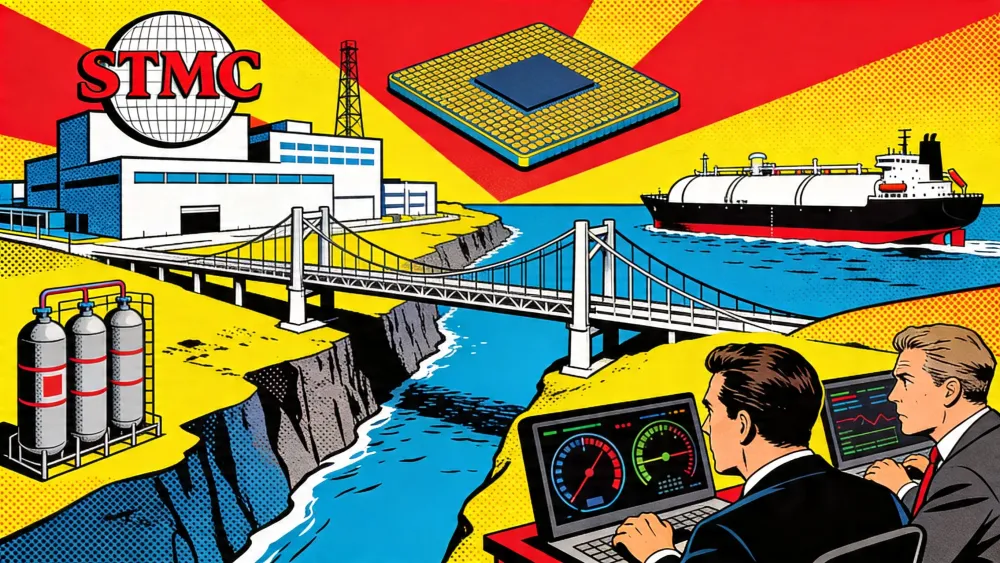
TSMC came into Thursday's earnings call with two messages that do not sit neatly together. Customers still want more AI chips. The war in Iran is now close enough to the fab floor that investors are asking about LNG, helium and hydrogen.
For 2026, the Taiwanese chip maker now expects revenue to grow by more than 30% in U.S. dollar terms. The spending message was just as plain: the year's capex budget, already set at $52 billion to $56 billion, is leaning toward the high end. On supply risk, management offered a narrower answer: Taiwan had enough liquefied natural gas through at least May, and TSMC buys specialty gases from several suppliers and regions.
That combination is the story. TSMC is not merely saying customers still want AI chips. It is saying the customers' hunger is strong enough to justify building more capacity while a shooting war exposes how fragile the inputs behind that capacity can be.
The thesis is simple: TSMC's earnings are less a victory lap for AI than a stress test for the whole compute economy. If the company can spend through geopolitical shock, the AI buildout gets another year of confidence. If it cannot, every cloud provider, chip designer and investor learns that the bottleneck was never only Nvidia's GPUs. It was the fuel, gases, machines and clean rooms behind them.
Key Takeaways
- TSMC raised 2026 revenue guidance above 30% as AI demand kept advanced fabs full.
- The Iran war pushed LNG, helium and hydrogen into the same conversation as chip revenue.
- Capital spending is moving toward $56 billion because customers are buying capacity insurance.
- The risk is not one shutdown. It is higher costs and tougher allocation if supply shocks drag on.
AI-generated summary, reviewed by an editor. More on our AI guidelines.
The boom now runs through a narrower bridge
TSMC's numbers would look muscular in any cycle. On its official Q1 results page, the company put first-quarter revenue at $35.90 billion, slightly above the January range. Gross margin: 66.2%, versus guidance of 63% to 65%. Operating margin landed at 58.1%, again above the range.
The mix matters more than the beat. CNBC reported that high-performance computing, which includes AI and 5G applications, accounted for 61% of first-quarter revenue, while chips at 7 nanometer and below made up about 74% of wafer revenue. Three-nanometer shipments alone accounted for 25%.
That makes TSMC less like a supplier riding the AI cycle and more like the bridge the cycle must cross. Nvidia, Apple, AMD, Broadcom, cloud providers and custom-chip teams can sketch demand on spreadsheets. The hard part starts after that. TSMC must convert the wish list into wafer starts, packaging capacity, clean-room square footage and procurement contracts.
Management knows the bridge is narrow. In January, C.C. Wei told investors the company saw an AI megatrend, but he also said he did not know whether the semiconductor market could stay good for three, four or five years in a row, according to Focus Taiwan. That was not false modesty. It was institutional anxiety spoken out loud by the one company with the best view of true AI chip demand.
Now the tone has changed. TSMC says it has checked again with customers and still sees demand strong enough to accelerate investment. Investor relief came fast because TSMC has a record of spending with discipline. Yet the same discipline makes this signal heavier. A company that fears overbuilding is choosing to build anyway.
The supply chain is calm until it is not
The Iran war turns TSMC's confidence into a harder test. Semiconductor fabs do not only need lithography machines and engineers. They need steady power, water, chemicals, hydrogen, helium and a shipping system boring enough to disappear from quarterly calls.
That boring layer has become visible. The Wall Street Journal reported that TSMC executives do not expect near-term production disruptions because Taiwan has secured enough LNG supply through at least May. The company also said helium and hydrogen come from multiple suppliers and regions, reducing the chance of a material production hit.
That is the right answer for a quarterly call. It is not the same thing as saying the risk has gone away. The American Prospect reported that Qatar's Ras Laffan Industrial City, a helium hub responsible for nearly one-third of global supply, had been offline after Iranian strikes in early March. It also cited Fitch Ratings for the claim that helium prices doubled after the war began.
Helium sounds peripheral until you remember what a leading-edge fab is. It is a machine for controlling tiny reactions at scale. Helium helps manage temperatures, prevent unwanted reactions and detect leaks. Hydrogen matters in processing. LNG matters because Taiwan's chip industry depends on imported energy.
You do not need a fab shutdown for this to change the economics. A month of elevated input prices can be absorbed by a company with TSMC's margins. A longer supply shock pushes costs into customer negotiations, delivery schedules and the ranking of who gets capacity first.
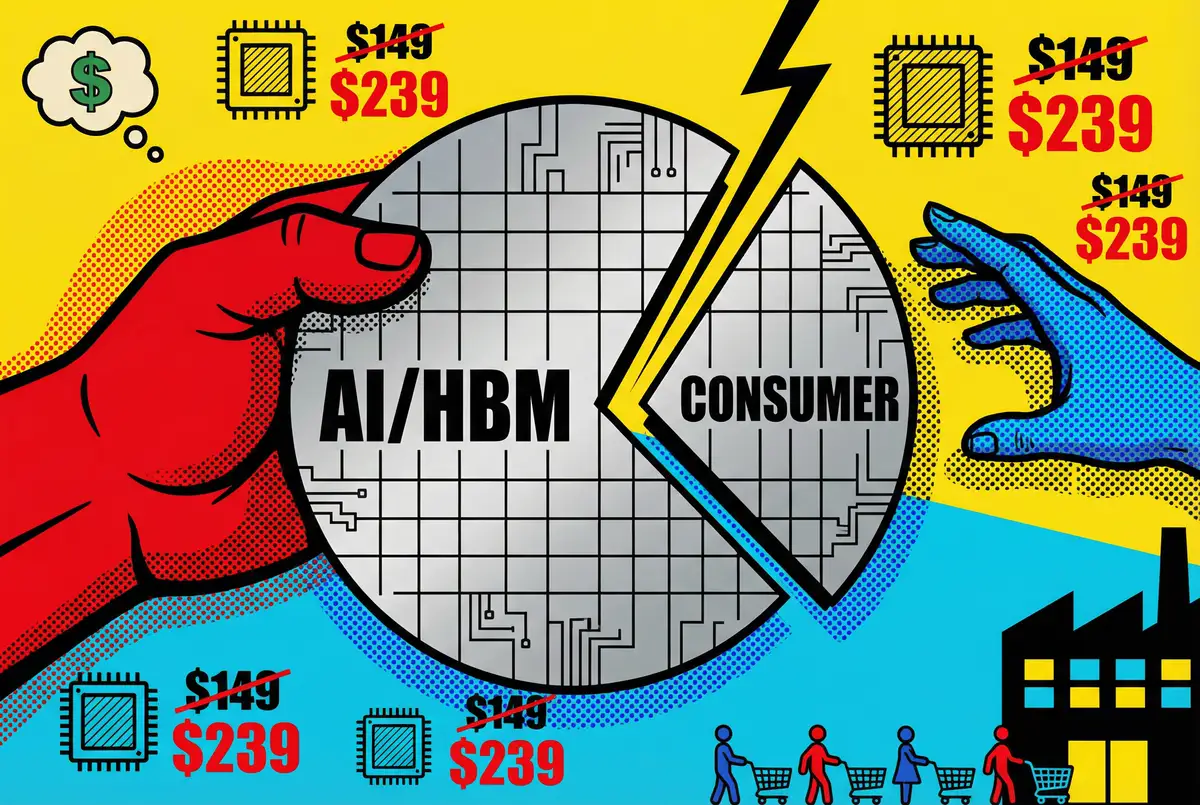
That is where anxiety moves from TSMC to its customers. If supply tightens, AI buyers sit closer to the front of the line because they pay for the most valuable wafers. Consumer electronics, PCs and lower-margin chip demand move behind them. The chip cycle then stops being a broad recovery and becomes a sorting machine.
AI demand is buying the option to outrun risk
TSMC's capital-spending plan is the clearest evidence that AI customers are trying to buy optionality. The company entered the year with planned 2026 capex of $52 billion to $56 billion, up from $40.9 billion in 2025. In April, management moved toward the high end.
Get the chip bottleneck before it hits earnings.
Strategic AI news from San Francisco. No hype, no "AI will change everything" throat clearing. Just what moved, who won, and why it matters. Daily at 6am PST.
No spam. Unsubscribe anytime.
That is not just a number. It is a claim about future scarcity. MarketBeat's earnings-call summary said advanced technologies at 7 nanometer and below made up 74% of wafer revenue, with 3 nanometer at 25%. It also said management expects high-performance-computing demand to remain strong and second-quarter revenue to reach $39.0 billion to $40.2 billion.
Those figures imply customers are not merely placing orders for today's AI chips. They are trying to reserve the next nodes, the next packaging lines and the next geography. TSMC is adding capacity in Taiwan and has expanded its Arizona land position, according to the Wall Street Journal. Reuters reported that ASML lifted its 2026 revenue outlook as AI demand boosted equipment orders, reinforcing that the signal is moving upstream into the tools market.
This is the same pressure Implicator has tracked in other chip stories: AI demand does not spread evenly. It cannibalizes scarce inputs, from memory capacity to advanced packaging and machine time. In The Silicon Squeeze, the pattern was memory. With TSMC, the pattern is foundry capacity and the industrial systems underneath it.
The AI boom is buying the option to outrun risk. That option is expensive. It requires clean rooms before orders fully mature, tools before every end customer knows its model economics, and overseas fabs before the margin math is settled. But the alternative is worse for TSMC's customers: wait, and the bridge gets even narrower.
The margin story hides a political bargain
TSMC's 66.2% gross margin makes the expansion look almost easy. It is not. The company is making record margins while committing tens of billions of dollars to fabs that will be costlier, more dispersed and more exposed to politics than its Taiwan base.
Arizona is the clearest example. U.S. capacity gives TSMC and its customers a hedge against Taiwan risk, tariff fights and U.S. procurement pressure. It also changes the cost base. Management has warned that overseas fab expansion can weigh on gross margin. MarketBeat reported that fab ramps may dilute margin by roughly 2 to 3 percentage points.
Investors can accept that if AI demand keeps pulling. They will rebel if overseas fabs become political insurance that customers praise but do not pay for. That is the bargain inside the earnings call: customers want capacity resilience, governments want domestic supply, and TSMC wants pricing power high enough to fund both.
This is why the Iran war matters even if TSMC avoids a near-term production hit. It strengthens the argument for geographic and supplier redundancy. It also makes that redundancy more expensive. Every warning about helium, LNG or shipping becomes another reason to build buffers. Every buffer has a cost.
For now, TSMC can pass much of that cost through because AI customers are still afraid of being capacity-starved. Fear is doing useful work for the company. It keeps buyers close, reduces pushback on price and turns capex into a sign of strength rather than recklessness.
The real test arrives after the panic fades
The next question is not whether TSMC had a strong first quarter. It did. The question is what kind of company TSMC becomes if AI demand stays high while supply-chain shocks keep arriving.
One version is flattering. TSMC becomes the toll bridge for the AI economy, collecting higher margins because every serious model company needs advanced silicon and no rival can match its yield, process depth and customer trust. In that version, the Iran war becomes another proof point for why customers must fund more capacity, more buffers and more overseas fabs.
The other version is harder. TSMC becomes the company asked to solve everyone else's insecurity. Cloud providers want guaranteed supply. Washington wants domestic capacity. Taiwan needs energy resilience. Equipment vendors need order visibility. Investors want margins to stay near record levels. Those demands can coexist for a while. They cannot all win forever.
If you are watching the AI trade, TSMC's call gives you comfort and a warning. The comfort is that the world's most important foundry says customers still want more. The warning is that the same foundry is now discussing LNG, helium, hydrogen and war alongside revenue guidance.
That is what a real bottleneck sounds like. Not a shortage headline. Not a single failed shipment. A chief executive saying demand is strong, spending must rise, and the company has checked the inputs one more time.
For now, the bridge is open. The traffic is getting heavier. The toll is going up.
Frequently Asked Questions
What did TSMC change in its 2026 outlook?
TSMC now expects 2026 revenue to grow by more than 30% in U.S. dollar terms and said capital spending will likely land near the high end of its $52 billion to $56 billion range.
Why does the Iran war matter to TSMC?
Chip fabs depend on imported energy and specialty gases such as helium and hydrogen. TSMC says it has enough near-term supply, but the war has made those inputs visible to investors.
Is TSMC facing an immediate production disruption?
Management says no. It told investors Taiwan has LNG supply through at least May and that TSMC sources specialty gases from several suppliers and regions.
How much of TSMC's business is tied to advanced chips?
In the first quarter, chips at 7 nanometer and below accounted for about 74% of wafer revenue. Three-nanometer chips accounted for 25%.
What is the main investment risk?
The risk is that AI demand requires more capacity while geopolitical shocks raise the cost of building and running that capacity. Margins can absorb some stress, but not endless stress.
AI-generated summary, reviewed by an editor. More on our AI guidelines.


Free AI briefing · Weekdays
The AI stories that matter, sourced and explained.
Join the Morning Briefing. It goes out every weekday at 4:45 a.m. Pacific, with later sends for the East Coast, Berlin and Tokyo.
Free when you sign up: The Paperclip Compendium, our tested guide to running AI agents.
Free. Unsubscribe in one click.

Marcus Schuler
Editor-in-Chief and founder of Implicator.ai. Former ARD correspondent and senior broadcast journalist with 10+ years covering tech. Writes daily briefings on policy and market developments. Based in San Francisco. E-mail: editor@implicator.ai