 IMPLICATOR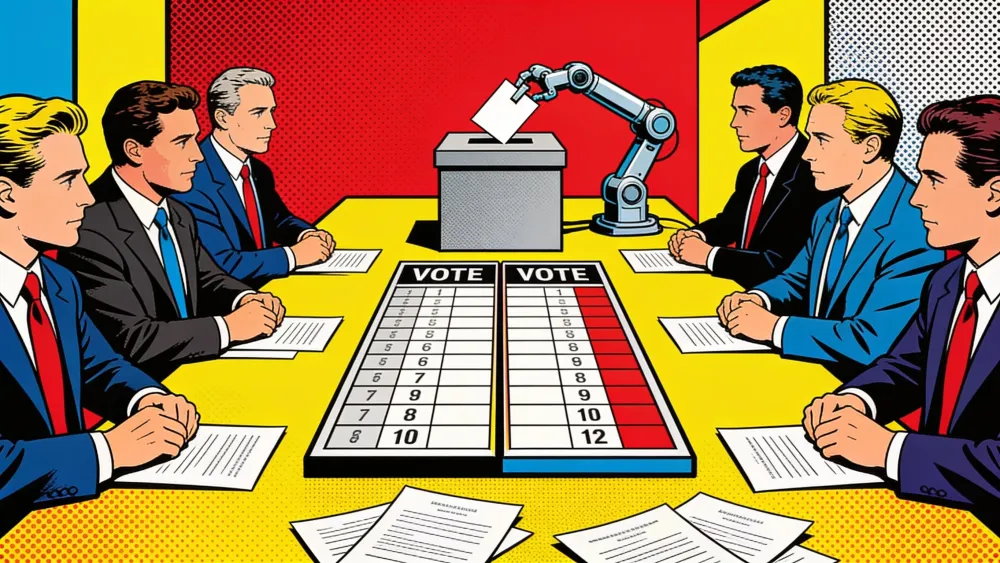
Fifteen of the 16 economists The Wall Street Journal surveyed on AI and the future of work said the technology will meaningfully lift labor productivity, and none said it will not. The same panel, published Tuesday and including Nobel laureate Daron Acemoglu and two economists who led the White House Council of Economic Advisers, broke three ways on whether AI will eliminate more jobs than it adds: eight expect no net change, five expect net losses, and two expect growth.
The distance between those two ballots is the survey's practical finding, because the experts cannot yet referee the claims employers are making. AI has been the leading stated reason for announced U.S. job cuts for three straight months, by outplacement firm Challenger, Gray & Christmas's count, while survey answers from panelists such as Harvard's Jason Furman describe the evidence of any aggregate labor-market impact as weak.
Key Takeaways
- WSJ surveyed 16 economists: 15 say AI lifts productivity, none disagree. On net jobs, eight expect no change, five losses, two growth.
- Challenger counted 38,579 AI-attributed layoffs in May, 40% of announced cuts, while BLS payrolls grew by 172,000.
- Stanford measured a 16% employment decline for workers 22 to 25 in AI-exposed jobs; graduate unemployment runs near 5.6%.
- Census data show fewer than one in five firms use AI at all, and both expert panels closed on the same demand: better measurement.
AI-generated summary, reviewed by an editor. More on our AI guidelines.
Eight votes for no change, five for net loss, two for growth
Acemoglu, who shared the 2024 economics Nobel, voted net loss and grounded his answer in two prior shocks. "Both imports from China and robot adoption had fairly negative displacement effects that were long-lasting," he wrote, "because they were sudden and the jobs they impacted were concentrated in certain local labor markets." Justin Wolfers of the University of Michigan, also in the loss camp, framed the exposure in class terms: "I think of AI as doing cognitive work, so this is a revolution coming squarely at white-collar workers. I now know what blue-collar workers felt like in the 1970s!"
The eight no-change votes came with timing caveats attached rather than reassurance. Furman, who chaired the Council of Economic Advisers under President Obama, wrote that "we are currently seeing little or no impact of AI on the labor market," and that even the evidence of reduced hiring in a few occupations is "weak," with an aggregate effect "small to zero." MIT's David Autor expects impacts within five to 10 years and put the weight on institutions rather than the technology: "We are currently unprepared, and most signs from Washington and Silicon Valley say: let it rip and damn the consequences." Michael Strain of the American Enterprise Institute, who also voted no change, reached back further: "The Industrial Revolution left average real wages stagnating and the quality of non-wage amenities declining for four decades."
A second question split the same group along nearly the same line. Eight economists called AI more likely to complement workers than replace them, and five took the opposite view.
Challenger's 38,579 against the BLS's 172,000
Companies announced 97,006 job cuts in May and pinned 38,579 of them on AI, per Challenger's monthly report. April's total was 83,387, which makes the May jump 16% in a single month. That is 40% of all announced cuts and the highest monthly AI total since the firm began tracking the reason in 2023. For scale, an Oxford Economics analysis of the same Challenger data counted roughly 55,000 AI-linked cuts across the first 11 months of 2025, about 4.5% of that period's announced losses. "AI is now the leading reason companies give for cutting jobs and the primary industry citing it is technology," said Andy Challenger, the firm's chief revenue officer.
The Bureau of Labor Statistics read the same month another way, reporting that May payrolls grew by 172,000, more than double the consensus near 80,000, and that the unemployment rate spent a third consecutive month at 4.3%.
One of the survey's two net-growth votes came from Jed Kolko, a Peterson Institute senior fellow who had already offered a way to square those numbers in a March research review: "A CEO can more proudly blame AI for a hiring freeze or layoff round than they can admit that they over-hired in the aftermath of the pandemic." Dean Ball, formerly an adviser on AI and emerging technology in the Trump administration, turned the same observation into a forecast in a New York Times Magazine panel published the same day as the Journal's survey: "I don't know what the unemployment rate will be in 2028, but I guarantee you that 100 percent of it is going to be blamed on AI by the American public and by lots of opportunistic politicians."
Get the AI economy, decoded daily
Strategic AI news from San Francisco. No hype, no "AI will change everything" throat clearing. Just what moved, who won, and why it matters. Daily at 6am PST.
No spam. Unsubscribe anytime.
Stanford's 16% decline and a 5.6% graduate unemployment rate
Where researchers do find damage, it sits at the bottom of the white-collar ladder. Economists at the Stanford Digital Economy Lab, using payroll records from ADP, measured a 16% relative employment decline for workers aged 22 to 25 in the occupations most exposed to AI, such as software development and customer service, while head counts for older workers in the same occupations grew. Unemployment among recent college graduates stands around 5.6%, well above the rate for all workers, and Handshake reports full-time postings on its early-career platform running 12% below pre-pandemic levels.
One of the survey's own panelists has published reasons for doubt. Kolko's review notes that research published by the Economic Innovation Group found postings in AI-exposed occupations started falling in 2022, before ChatGPT's public release, a timing that fits rising interest rates better than chatbots. And a Strada Institute survey of nearly 1,500 executives complicates the displacement story from the employer side: among companies using AI, 46% said the technology increased their entry-level hiring over the past year and 13% said the opposite, while 41% said it stripped routine tasks out of junior roles and 42% said it expanded the analytical and judgment work asked of them.
Know someone who'd find this useful? ✉️ Email it to a friend in one click, or they can subscribe free here.
What has thinned most visibly is the training ladder, even as early-career postings have also fallen. Ethan Mollick of Wharton told the Times panel the casualty is the oldest hiring mechanism on record: "We had this great technique, which was apprenticeship. It's worked for 4,000 years," he said. "And that all collapsed, right?" Autor argued in the Journal's survey that the effect could also run in reverse, because "AI can compress the learning curve, allowing less-experienced people to perform at higher levels sooner."
Walmart's arena rally and the Census one-in-five
What companies tell their workers is diverging from what they will put on paper. At Walmart's Associates Week in Arkansas this month, chief people officer Donna Morris told a rally inside a basketball arena that "technology will power our future. But our associates will lead it," the Financial Times reported from Fayetteville. At the company's annual meeting the same week, shareholders failed in a petition for a report on how AI will affect Walmart's workers. The retailer's tech and product teams announced hundreds of layoffs last month without linking them to AI, and its global headcount has declined slightly over five years while revenue rose by $151 billion, to $713 billion in 2025.
The measurement vacuum runs wider than one company. Census Bureau survey data show fewer than one in five U.S. firms use AI in any business function, a figure Erika McEntarfer, the former BLS commissioner President Trump fired in 2025 after a jobs report that displeased the White House, reads as a brake on disruption: "AI is unlikely to transform labor markets until it first transforms businesses." Stanford's Erik Brynjolfsson, among the most optimistic economists on the technology, told MIT Technology Review that while hundreds of billions of dollars go into deploying AI, "we're not investing even 1% of that on understanding the transition."
Sixteen economists agreed on productivity and split on jobs, and the closest the two panels came to consensus was on measurement. Ball, who helped draft the White House AI action plan, told the Times discussion that the federal government should start there: "We need better empirical economic data. You can't create policy remedies for a problem you don't understand." Challenger's June tally and the next BLS jobs report are due within weeks, and Brynjolfsson's lab is about to launch a regularly updated tracker of AI's effects on the economy, MIT Technology Review reported.
Frequently Asked Questions
What did the WSJ economist survey find about AI and jobs?
Fifteen of 16 economists said AI will meaningfully lift labor productivity, and none said it will not. On whether AI will eliminate more jobs than it adds, the panel split three ways: eight expect no net change, five expect net losses, and two expect net growth.
Is AI actually causing layoffs in 2026?
Companies attributed 38,579 of May's 97,006 announced job cuts to AI, about 40% and the highest share since Challenger, Gray & Christmas began tracking the reason in 2023. But payrolls grew by 172,000 the same month, and economists such as Jason Furman call the measurable aggregate impact small to zero.
Which workers are most affected by AI so far?
Entry-level white-collar workers. Stanford Digital Economy Lab researchers measured a 16% relative employment decline for workers aged 22 to 25 in the most AI-exposed occupations, while head counts for older workers in the same fields grew. Unemployment among recent college graduates stands around 5.6%.
Why do economists doubt companies' AI layoff claims?
Jed Kolko of the Peterson Institute wrote that a CEO can more proudly blame AI for layoffs than admit to over-hiring after the pandemic. Dean Ball predicts that whatever the unemployment rate is in 2028, all of it will be blamed on AI. Postings in AI-exposed occupations began falling in 2022, before ChatGPT launched.
How many companies actually use AI today?
Census Bureau survey data show fewer than one in five U.S. firms use AI in any business function. Former BLS commissioner Erika McEntarfer reads that as a brake on disruption: AI is unlikely to reshape labor markets until it first changes how businesses operate.
AI-generated summary, reviewed by an editor. More on our AI guidelines.



Marcus Schuler
Editor-in-Chief and founder of Implicator.ai. Former ARD correspondent and senior broadcast journalist with 10+ years covering tech. Writes daily briefings on policy and market developments. Based in San Francisco. E-mail: editor@implicator.ai