IMPLICATOR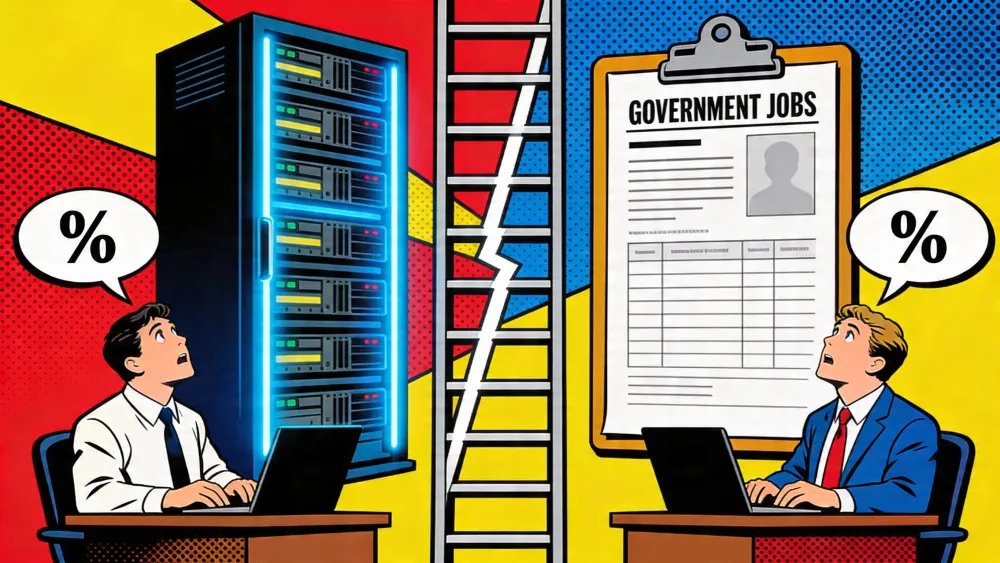
Yann LeCun said this weekend that Anthropic CEO Dario Amodei is wrong to warn that AI could wipe out half of entry-level white-collar jobs within one to five years. His case leans on March BLS data showing 4.3% unemployment and Anthropic's own research showing no broad unemployment split for AI-exposed workers. The fight matters because a 50% number can shape layoffs before the evidence catches up.
Key Takeaways
- LeCun says AI executives are the wrong people to forecast labor-market shocks.
- Amodei's warning centers on 50% of entry-level white-collar jobs within one to five years.
- BLS still shows 4.3% unemployment, not a 10% to 20% shock.
- The clearest early pressure sits in young, AI-exposed hiring pipelines.
AI-generated summary, reviewed by an editor. More on our AI guidelines.
The 50% number carries the room
LeCun's post was blunt: Amodei knows nothing about technological revolutions and labor markets, he wrote, and readers should listen to economists instead of AI chiefs. He named Philippe Aghion, Erik Brynjolfsson, Daron Acemoglu, Andrew McAfee, and David Autor.
That was a jurisdictional fight, not a model debate. Amodei's claim has been traveling since Axios published his warning last May: half of entry-level white-collar jobs could vanish, and unemployment could reach 10% to 20%. In January, he sharpened it in his essay, describing AI as a general labor substitute for humans. Half the jobs. Five years.
The math is heavier than the rhetoric
Here is the arithmetic. A 20% unemployment rate would be almost five times March's rate. BLS counted 7.2 million unemployed people in March, so Amodei's upper bound implies a rupture, not a weak labor market.
We are not there. February's JOLTS release was softer: 6.9 million openings, fewer hires, and job seekers on a lower floor. Finance lost 15,000 jobs in March. The office floor is anxious, but anxiety is not attribution.
Companies can freeze hiring because rates are high, customers are cautious, trade policy is messy, or investors reward any sentence with AI and layoffs in it. LeCun's sharper point is the label. Call every cut an AI cut and the cause disappears under the sticker.
Anthropic's data cuts both ways
Anthropic's own evidence cuts both ways. Its March Economic Index found coding remains the biggest Claude use case and about 49% of jobs had at least a quarter of their tasks performed with Claude somewhere in the data. That supports Amodei's concern. AI is already inside the spreadsheet, codebase, and sales email.
But a related Anthropic labor-market paper found no measurable unemployment split between highly exposed and unexposed occupations since ChatGPT's release. Programmers did not show the broad collapse the scary version needs.
The crack is younger workers. Anthropic's labor tracker found workers aged 22 to 25 in exposed jobs saw a roughly 14% drop in job-finding rates, echoing Stanford work on younger AI-exposed workers. Entry-level hiring can break before unemployment spikes because the missing job never appears. No rejection letter says "replaced by a model." The inbox just stays quiet.
Get the AI labor signal
Strategic AI news from San Francisco. Follow the numbers behind job claims, safety fights, and model launches before they become boardroom excuses.
No spam. Unsubscribe anytime.
Fear is real even when forecasts aren't
Workers are not waiting for economists to settle the curve. ADP Research reported in March that only 22% of global workers strongly agreed their job was safe from elimination, based on more than 39,000 workers in 36 markets. Axios separately found that 49% of lower-wage workers surveyed thought they could lose their jobs to AI.
That fear sits in Slack channels, campus career offices, and the silence after a hiring manager says headcount is under review.
Amodei gives that fear a number. LeCun sees a category error. Both can be partly right: AI can squeeze junior hiring and reward smaller teams without producing an immediate unemployment shock. The risk is permission rather than warning. Markets rarely audit causality before rewarding efficiency theater.
The forecast needs a receipt
LeCun's weakest line is historical. Saying technology never causes long-term mass unemployment does not prove this wave will behave like electrification, tractors, or software.
But Amodei's weakest line is the number. Fifty percent sounds precise enough to guide policy and loose enough to survive any miss. Is the claim jobs eliminated, openings never posted, tasks automated, wages crushed, or companies rebuilt around fewer workers? Those are different stories. They need different evidence.
For now, AI has not produced the unemployment shock. It has produced a hiring fog around junior white-collar work, a market incentive to blame cuts on software, and a worker class that believes the floor is moving. That justifies preparation. It is not enough to treat a CEO forecast as a jobs report.
Frequently Asked Questions
What did Yann LeCun say about Dario Amodei?
LeCun said Amodei was wrong about AI job losses and argued that AI executives, including himself, are not the right experts for labor-market forecasts.
What is Amodei's 50% AI jobs warning?
Amodei has warned that AI could displace half of entry-level white-collar jobs within one to five years and push unemployment to 10% to 20%.
Does current labor data support that warning?
Not at the broad unemployment level. BLS reported 4.3% unemployment in March 2026, while Anthropic's own tracker found no broad unemployment split for AI-exposed occupations.
Where is the earliest AI jobs pressure showing up?
The clearest signal is entry-level hiring. Anthropic's labor tracker found about a 14% drop in job-finding rates for workers aged 22 to 25 in exposed occupations.
Is LeCun saying AI will not affect jobs?
No. His narrower point is that layoffs and hiring freezes need evidence before they are attributed to AI, especially when trade, rates, and overhiring also matter.
AI-generated summary, reviewed by an editor. More on our AI guidelines.



Marcus Schuler
Editor-in-Chief and founder of Implicator.ai. Former ARD correspondent and senior broadcast journalist with 10+ years covering tech. Writes daily briefings on policy and market developments. Based in San Francisco. E-mail: editor@implicator.ai