IMPLICATOR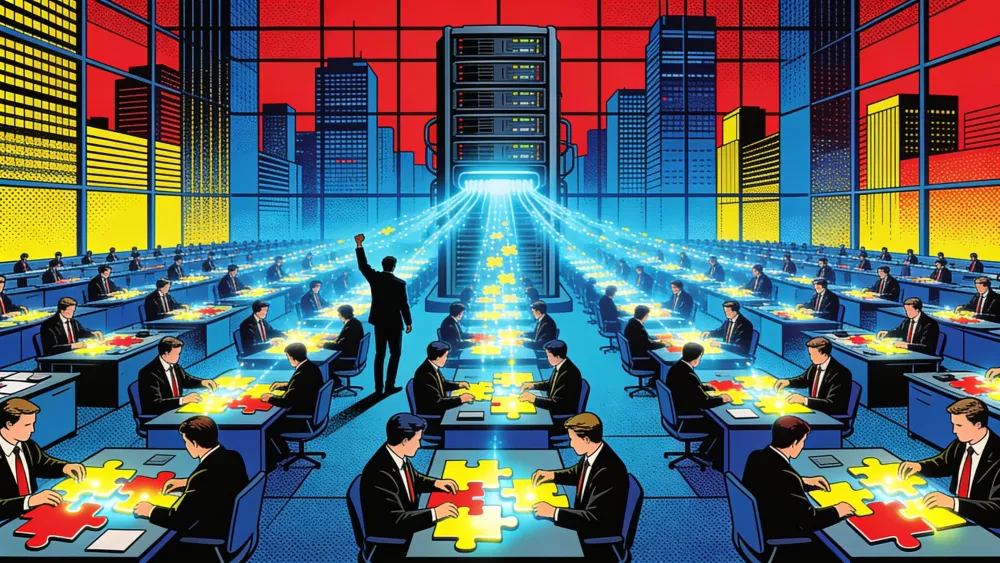
Mark Zuckerberg told Meta staff in a Friday internal memo that the company had "made mistakes and will almost certainly make more" in the restructuring that rebuilt its workforce around AI, according to a copy seen by Reuters. The note followed a week in which an employee hijacked a livestreamed presentation open to thousands of staff to tell its leaders that a Meta AI executive was "a piece of shit," WIRED reported, and a separate memo ordering employees to rein in the AI spending the company had spent months encouraging.
The two flashpoints look unrelated. One is a morale crisis inside the unit Meta built to feed its models; the other is a cost crackdown on the tools it pushed employees to adopt. They are the same management error measured twice. Meta optimized the things it could count, headcount moved into AI work and tokens consumed by employees, and treated that motion as progress toward the one output that matters, a model that can compete at the frontier. Its own chief technology officer, Andrew Bosworth, named the problem in a memo to roughly 6,000 staff this week: "All motion is not progress and token usage alone is not a measure of impact of any kind."
The stakes are not small. Meta told investors in April it would raise its annual capital-spending forecast to between $125 billion and $145 billion, much of it on AI infrastructure, and the restructuring that produced the revolt was the same one that cut roughly 8,000 jobs in May and reassigned 7,000 employees into AI work, according to Reuters and Meta's own disclosures. The unit at the center of it is three months old.
Key Takeaways
- An employee hijacked a livestreamed Meta presentation to insult a top AI executive, exposing revolt inside the 6,500-person Applied AI unit.
- Meta drafted engineers to generate coding puzzles for model training; many call themselves draftees and the work soul-crushing.
- After pushing AI use, Meta is now capping employee token spending it projects will hit billions in 2026.
- Zuckerberg admitted mistakes, but his fixes address working conditions, not the strategy's core contradiction.
AI-generated summary, reviewed by an editor. More on our AI guidelines.
The unit Meta assembled in March
Meta formed Applied AI in March to support researchers at Meta Superintelligence Labs, the group Zuckerberg built after investing $14.3 billion in Alexandr Wang's Scale AI and installing Wang as chief AI officer. The unit holds about 6,500 engineers and product managers and is run by Maher Saba, a 12-year Meta veteran who was previously a vice president in Reality Labs, the division that spent $83 billion on the metaverse before the company turned to AI. Three current employees told WIRED the work is menial: generating puzzles and coding problems used to train and evaluate frontier models, at a pace some describe as two tasks a week.
That output is also countable. Some engineers are asked to finish two tasks a week; at that rate, a 6,500-person unit would turn out on the order of 13,000 training problems a week, a data factory staffed by engineers Meta hired to build consumer software for billions of users. According to an internal announcement reviewed by Business Insider, the reason for the reassignment was that Meta's models still could not outperform humans at technical tasks like coding, so it needed its humans to show them how.
The engineers did not volunteer. Selected staff were told to join or leave the company, an arrangement rare for senior technical talent in Silicon Valley, and some now call themselves "draftees." One described the result to WIRED: "It's literally the gulag. You have zero purpose in life all of a sudden, you barely interact with anyone, you just have these tasks every week." Another said most colleagues find the work "soul-crushing."
The Claudeonomics leaderboard
The second crisis began as an incentive. Meta had made AI usage a "core expectation" in performance reviews, and an employee built an internal leaderboard, "Claudeonomics," named after Anthropic's Claude, that tracked all 85,000 staff by how many tokens they consumed, ranked the top 250, and handed out titles like "Token Legend." In one 30-day stretch, employees ran through more than 60 trillion tokens, worth roughly $900 million at standard API prices or about $100 million at Meta's negotiated rate, according to Fortune and an analysis by the newsletter wrk3. The top-ranked user averaged 281 billion tokens in a month, about 400 times the average across Meta's 85,000 employees, at a cost Fortune estimated above $1.4 million for that one person.
Bosworth defended the spending at the time. He told Fortune his best engineer was spending the equivalent of his salary on tokens but was "5x to 10x more productive," and said of the trend, "It's like, this is easy money. Keep doing it." Two months later the position reversed. In a memo to about 6,000 employees this week, Meta warned of an "exponential increase" in AI usage and said it was "tracking to spend billions on internal use alone in 2026," The Information reported. It has built a dashboard called AI Gateway that tracks spending and flags unusual spikes; the same memo told employees to shift to Meta's own MetaCode assistant rather than third-party tools like Claude, with per-team token budgets due in 2027.
Get Implicator.ai in your inbox
Strategic AI news from San Francisco. No hype, no "AI will change everything" throat clearing. Just what moved, who won, and why it matters. Daily at 6am PST.
No spam. Unsubscribe anytime.
Muse Spark and the frontier gap
Zuckerberg's defense of all this is that the disruption is the price of a historic shift. "I don't want to overpromise because the world is changing in ways that are out of our control," he wrote, per Reuters. Meta released its pioneering open-weight Llama models three years ago and has had mixed results since; its newest, Muse Spark, is described as its first frontier model and its first without open weights, and its models are not yet competitive at the frontier, according to The Decoder. The drafted engineers and the token spending both exist to close that frontier gap, which is the same gap that has them writing coding puzzles instead of building products.
Meta is not alone in struggling to connect AI activity to results. Uber exhausted its entire 2026 AI coding budget by April, and its operating chief, Andrew Macdonald, said the link between usage and output is unproven: "It's very hard to draw a line between one of those stats and, 'Okay, now we're actually producing 25% more useful consumer features.'" Amazon shut down its own token-usage leaderboard, KiroRank, on May 29 after employees gamed it the same way Meta's was gamed. The pattern, Matteo Cellini wrote in wrk3, is a confusion of adoption with readiness: 88% of organizations used AI in at least one function last year, but only 7% called it fully integrated.
Know someone who'd find this useful? ✉️ Email it to a friend in one click, or they can subscribe free here.
The surveillance staff are fighting
The discontent predates this week. More than 1,600 employees have signed a petition demanding Meta halt a program that monitors U.S. workers' keystrokes and mouse activity to generate AI training data, a system internally called the Model Capability Initiative; the company has scaled it back to let staff pause collection for up to 30 minutes and request exemptions. Flyers in U.S. offices reframed the program as an "Employee Data Extraction Factory," and a unionization drive began in the U.K.
Leadership has heard it. At an Instagram all-hands this week, chief product officer Chris Cox described the "brutal" environment created by "the insanity of this company" and compared the past months to "running a marathon in the middle of a hailstorm and then, like, your teammate gets replaced and then we're recording you," according to a recording heard by WIRED. Cox also tried to deflate the technology itself. AI "is neither god, nor is it the devil," he said, "and it's nowhere near as good as you think it is, and it is nowhere near as bad as you think it is. And it changes every week … and it doesn't know what day of the week it is." On some teams, the ratio of individual contributors to managers had reached as high as 50 to one, according to Reuters.
What Zuckerberg promised on Friday
The Friday memo was damage control with a budget attached. Zuckerberg reiterated that Meta does not expect more company-wide layoffs this year, said he would limit the number of employees reporting to each manager, and raised budgets for team events, according to Reuters. He also wrote that staff in many offices would have assigned desks again by year-end, WIRED reported. He framed Applied AI as a waypoint rather than a destination, writing that the work "lets very talented people contribute to those efforts while we create other roles they can contribute to around Meta over the coming months."
That promise sits against the company's stated ambition. "Meta's north star is to be the best place for the most talented people in the world to make an impact," Zuckerberg wrote in the same memo, days after some of those people sat through a presentation interrupted by a colleague's open-mic profanity and called their assignments a gulag. The fixes Zuckerberg offered address the conditions of the work, the desks and the manager ratios, not the contradiction underneath it: the strategy needs elite engineers to do menial labor and needs a level of AI spending the company can no longer tie to results.
What Meta has not disclosed is the return. The company plans to introduce its new AI controls in the coming weeks and impose full token budgets in 2027, per The Information, and it has scheduled the unifying hackathon for July, an event WIRED reported employees already dread. Bosworth, in the same memo that capped the spending, had already told staff that token usage "is not a measure of impact of any kind."
Frequently Asked Questions
What is Meta's Applied AI unit?
Applied AI is a roughly 6,500-person unit Meta formed in March 2026 to support Meta Superintelligence Labs. Its engineers generate coding puzzles and problems to train and evaluate AI models. Many were reassigned without a choice and call themselves draftees; multiple told WIRED the work is soul-crushing. It is run by Maher Saba, a former Reality Labs vice president.
Why did a Meta employee disrupt a company presentation?
During a livestreamed presentation open to thousands of staff, an employee demanded leaders tell a Meta AI executive he was a piece of shit, according to WIRED. The outburst reflected frustration inside Applied AI over forced reassignment and menial work, part of what employees describe as record-low morale following Meta's AI restructuring.
What are tokenmaxxing and Claudeonomics?
Tokenmaxxing is consuming as many AI tokens as possible, often to inflate adoption metrics. At Meta, an employee built an internal leaderboard called Claudeonomics that ranked staff by token use. Employees burned more than 60 trillion tokens in 30 days, worth roughly $900 million at API prices. Meta has since shut the leaderboard down and is capping spending.
How much is Meta spending on internal AI use?
A memo to about 6,000 employees said Meta is tracking to spend billions on internal use alone in 2026, The Information reported, separate from a planned $600 billion data-center buildout through 2028. The company is rolling out a dashboard called AI Gateway and will impose per-team token budgets in 2027.
What did Zuckerberg promise employees?
In a Friday memo, Zuckerberg said Meta does not expect more company-wide layoffs this year, would limit how many employees report to each manager, raise team-event budgets, and restore assigned desks by year-end. He called Applied AI a waypoint and promised new roles for reassigned staff over the coming months.
AI-generated summary, reviewed by an editor. More on our AI guidelines.



Marcus Schuler
Editor-in-Chief and founder of Implicator.ai. Former ARD correspondent and senior broadcast journalist with 10+ years covering tech. Writes daily briefings on policy and market developments. Based in San Francisco. E-mail: editor@implicator.ai