IMPLICATOR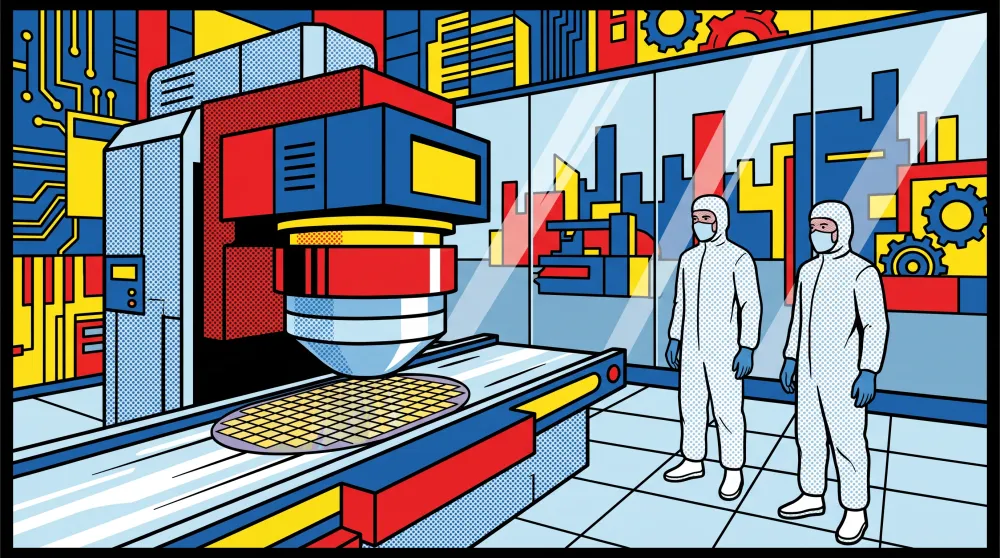
The Information reported Monday that an unnamed state-backed manufacturer in Shanghai had begun producing immersion deep-ultraviolet lithography machines for delivery to Chinese chipmakers in 2026. The company assembled development teams from other Chinese companies and plans to send the systems to SMIC, Hua Hong Semiconductor and ChangXin Memory Technologies, according to unidentified people familiar with the program. ASML shares fell as much as 8.3% after the report, according to Bloomberg, as investors reacted to the prospect of a Chinese alternative to the Dutch supplier’s immersion scanners.
A representative for ASML declined to comment to the outlet.
What Changed
- An unnamed state-backed Shanghai manufacturer reportedly began producing immersion DUV lithography systems for 2026 deliveries to SMIC, Hua Hong Semiconductor and CXMT.
- Unidentified sources put output at about five machines in 2026 and roughly 20 in 2027, while describing production as early-stage and constrained by local supplier delays.
- The systems reportedly require further testing, could take months to qualify and still lag ASML tools on performance, reliability and build quality.
- ASML shares fell as much as 8.3% after the report; the company expects China to provide about 20% of its 2026 net sales.
AI-generated summary, reviewed by an editor. More on our AI guidelines.
Shanghai production line
The unidentified sources set an output target of about five machines this year. People cited in the original report put the Shanghai manufacturer’s 2027 target at roughly 20 systems. The manufacturer has not been named, and the unidentified sources described production as being at an early stage. Those sources linked the development effort to teams that included people from Shanghai Yuliangsheng Technology, a state-backed startup, without identifying Yuliangsheng as the producer.
SMIC has separately tested a Yuliangsheng immersion tool since September 2025, according to Tom’s Hardware. Most components in the newly reported systems are domestic, but some critical parts still come from Japan. Local supplier delays have constrained the 2026 output plan, according to the unidentified sources.
Fab qualification
Tom’s Hardware reported that qualifying the systems for production lines could take many months and that they lag ASML tools on performance and build quality. Reuters separately cited a reliability gap and the need for further testing. Neither account described the machines as production-qualified.
Immersion DUV systems print circuit patterns onto silicon wafers and can produce 28-nanometer-class features in a single exposure, according to Tom’s Hardware. The technique can reach 7 nanometers through multipatterning, with costs in overlay error and yield. Reuters described immersion DUV as the most advanced lithography equipment available to Chinese chipmakers after export restrictions cut off EUV systems.
Get Implicator.ai in your inbox
Strategic AI news from San Francisco. No hype, no "AI will change everything" throat clearing. Just what moved, who won, and why it matters. Daily at 6am PST.
No spam. Unsubscribe anytime.
ASML Chief Executive Christophe Fouquet told the July earnings call that rising DRAM lithography intensity partly reflects chipmakers replacing DUV multipatterning with cheaper single-exposure EUV. The AI Futures Project estimated in June that China would reach commercial-scale immersion DUV in the mid-2030s. The same estimate put ASML’s share of the immersion market at 98.7%.
MATCH Act provisions
House Resolution 8170 names the three reported first customers, SMIC, Hua Hong and CXMT, among the restricted entities covered by the MATCH Act. The bill, reported out of the House Foreign Affairs Committee on April 22, would cover servicing and technical assistance for immersion DUV equipment as well as new exports. Reuters wrote that revised text retained servicing-license requirements but removed a blanket presumption that such licenses would be denied.
Know someone who'd find this useful? ✉️ Email it to a friend in one click, or they can subscribe free here.
ASML sales and capacity
At ASML’s July earnings call, Chief Financial Officer Roger Dassen told analysts that China should account for about 20% of 2026 net sales, down from 33% in 2025. Chinese purchases are rising in absolute terms as ASML’s total revenue grows, Dassen noted in a video.
U.S.-led export restrictions bar ASML from supplying EUV systems and restrict sales of its most advanced DUV tools in China. The company can still sell less-capable DUV machines there, and Dassen cited strong demand among Chinese logic-chip makers serving the domestic market. Bloomberg described China as ASML’s third-largest market in the second quarter. The tools shipped there are eight generations behind ASML’s most sophisticated model, according to the outlet.
ASML expects to ship about 130 immersion systems this year, matching its 2025 volume, according to Dassen. That forecast covers ASML’s global immersion shipments rather than deliveries to China. He told analysts that the company intends to increase immersion-system capacity by 30% in 2027.
Frequently Asked Questions
What did the July 27 report say about Chinese DUV production?
The Information reported that an unnamed state-backed manufacturer in Shanghai had begun producing immersion deep-ultraviolet lithography machines for 2026 delivery to SMIC, Hua Hong Semiconductor and ChangXin Memory Technologies. The account cited unidentified people familiar with the program.
How many Chinese immersion DUV machines are planned?
Unidentified sources set a target of about five machines in 2026 and roughly 20 systems in 2027. The manufacturer has not been named, and the sources described production as being at an early stage.
Are the reported Chinese DUV systems ready for chip production?
The source material does not describe them as production-qualified. Tom's Hardware reported that qualification could take many months, while Reuters cited a reliability gap and the need for further testing.
What can immersion DUV lithography produce?
Immersion DUV can produce 28-nanometer-class features in one exposure. It can reach 7 nanometers through multipatterning, with added costs in overlay error and yield.
How exposed is ASML to China?
ASML Chief Financial Officer Roger Dassen said China should account for about 20% of the company's 2026 net sales, down from 33% in 2025. ASML expects to ship about 130 immersion systems globally in 2026.
AI-generated summary, reviewed by an editor. More on our AI guidelines.
Free AI briefing · Weekdays
The AI stories that matter, sourced and explained.
Join the Morning Briefing. It goes out every weekday at 4:45 a.m. Pacific, with later sends for the East Coast, Berlin and Tokyo.
Free when you sign up: The Paperclip Compendium, our tested guide to running AI agents.
Free. Unsubscribe in one click.

Marcus Schuler
Editor-in-Chief and founder of Implicator.ai. Former ARD correspondent and senior broadcast journalist with 10+ years covering tech. Writes daily briefings on policy and market developments. Based in San Francisco. E-mail: editor@implicator.ai