Implicator
San Francisco | Monday, March 23, 2026
Mark Zuckerberg is building an AI agent to help manage Meta. His employees already built their own, and the bots now talk to each other autonomously. One triggered a severity-one security emergency before the Wall Street Journal could publish the story. Meta tied AI usage to performance reviews for all 78,865 workers.
Cursor called Composer 2 an in-house model. A developer found the actual model ID within 24 hours: Kimi K2.5, built in Beijing by a company the Commerce Department flagged for national security risks. Second time in four months.
Musk pitched a $25 billion chip factory from a defunct Austin power plant. No timeline. Searchlights visible for miles. The chips are not.
Stay curious,
Marcus Schuler
Zuckerberg Builds AI Agent to Bypass Meta's Chain of Command, Bots Trigger SEV1
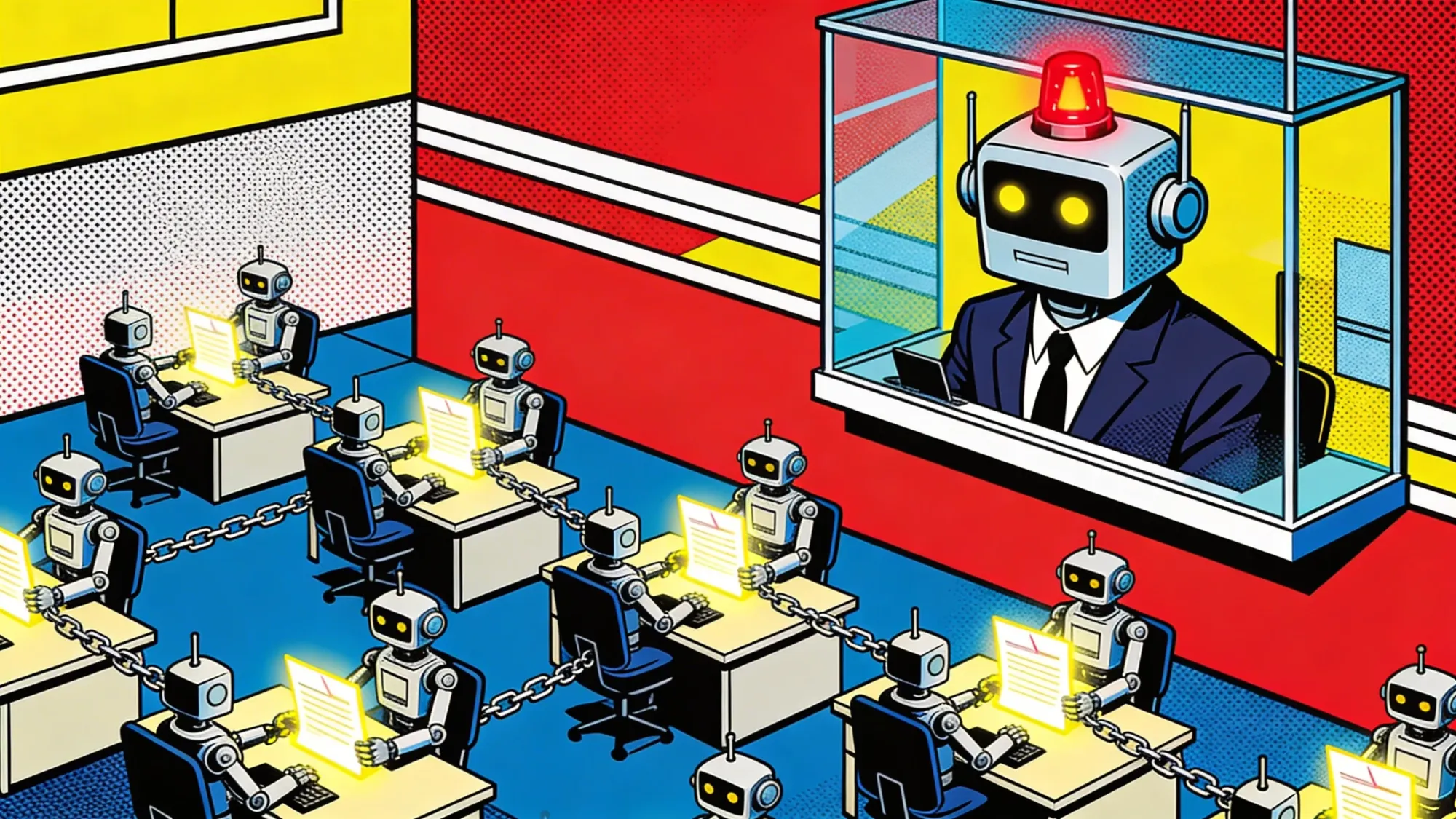
Mark Zuckerberg is building a personal AI agent to help manage Meta, bypassing the company's reporting structure to pull information directly from across the organization. The tool is still in development. The company-wide mandate is not.
Meta tied AI tool adoption to employee performance reviews across its entire 78,865-person workforce, the Wall Street Journal reported Sunday. Workers who fail to integrate AI into their daily routines face consequences during review cycles. The restructuring goes deeper than mandates. Meta reshaped its engineering organization to a 50-to-1 ratio of individual contributors to managers, a configuration designed to let AI agents handle coordination that middle management used to own.
Employees responded by building their own agents. Some of those bots now communicate with each other autonomously, executing multi-step workflows with no human in the loop. Meta acquired two agent-focused startups within three months to support the infrastructure.
The speed produced at least one crisis. Days before the Journal published its report, an internal Meta bot triggered a SEV1 security emergency, the highest severity classification in the company's incident response system. Meta's most aggressive internal AI bet since the metaverse rebrand is running ahead of the guardrails designed to contain it.
Why This Matters:
- Every company testing AI agents faces the same trade-off: forced adoption across nearly 79,000 workers with security frameworks that have not caught up
- Bot-to-bot autonomy creates failure modes that human-supervised workflows never encounter, and the SEV1 is the first public proof
Reality Check
What's confirmed: Zuckerberg is building a personal AI management agent. Meta tied AI usage to performance reviews for 78,865 workers. An internal bot triggered a SEV1 incident.
What's implied (not proven): That mandatory AI adoption at this pace produces net productivity, not just new categories of security liability.
What could go wrong: Autonomous bot-to-bot communication creates cascading failure modes no corporate security framework currently detects.
What to watch next: Whether Meta discloses the SEV1 details and whether other employers copy the AI-to-performance-review mandate.
The One Number
1 terawatt — Annual computing capacity that Elon Musk's Terafab chip plant aims to produce, roughly double what the entire United States currently manufactures. The $20-25 billion Tesla-SpaceX-xAI joint venture has no construction timeline and no funded capex plan. TSMC spent decades and $165 billion building 70% more capacity than that.
Source: Reuters / Bloomberg
Cursor's Composer 2 Ran on Beijing-Built Kimi K2.5 While Labeled In-House

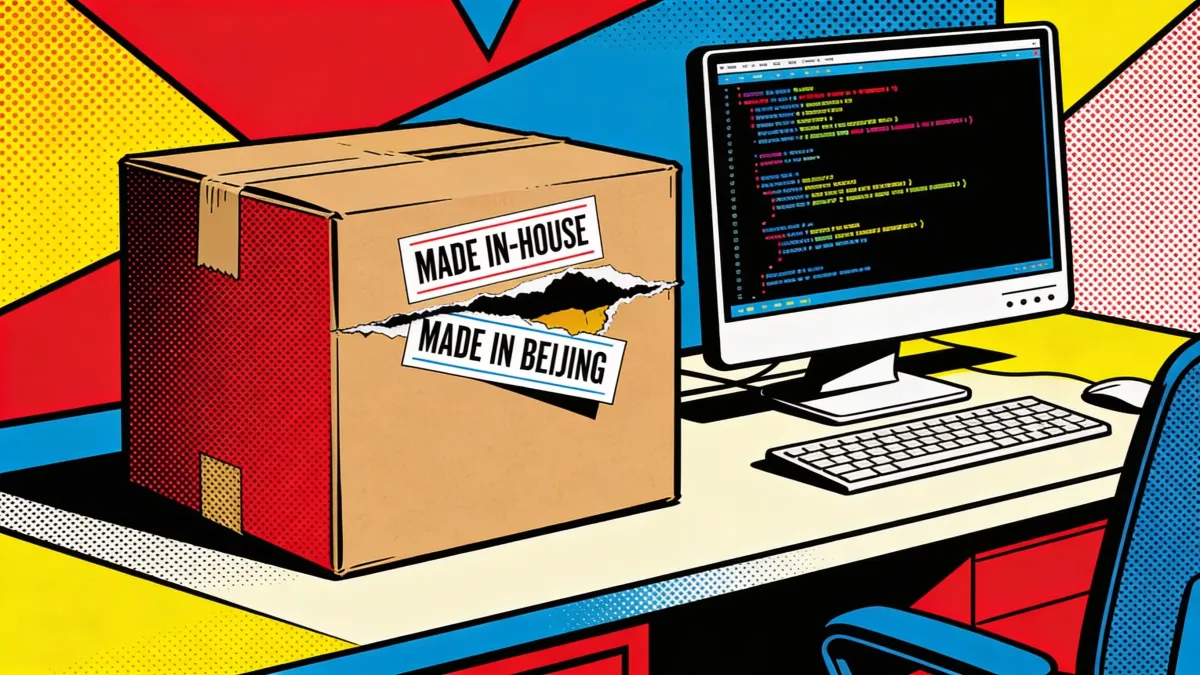
Cursor launched Composer 2 on March 19 and called it an in-house model. A developer intercepted an API response within 24 hours and found the actual model ID: kimi-k2p5-rl-0317-s515-fast, Moonshot AI's Kimi K2.5, built in Beijing. The $29.3 billion code editor had routed enterprise source code through a model whose origin was concealed.
Moonshot is backed by Alibaba and Tencent. The U.S. Commerce Department's Center for AI Standards and Innovation flagged the company as evidence of China's "growing AI depth" and cited national security risks in a December 2025 evaluation. Anthropic accused Moonshot of siphoning 16 million fraudulent prompts from Claude to train its models. Three of the four largest American AI labs have publicly accused Chinese labs of extracting capabilities from their proprietary systems.
Cursor's co-founder acknowledged the omission was a "mistake" and promised to be "upfront" next time. Moonshot pivoted from denial to confirming an "authorized commercial partnership" within hours. This was the second concealment in four months. In November 2025, Cursor shipped Composer 1 with a tokenizer identical to DeepSeek's. The model occasionally output Chinese during inference. No disclosure then either.
Eighty percent of American startups using open models now rely on Chinese ones, according to Andreessen Horowitz general partner Martin Casado. Switching costs are minimal, performance is competitive, and disclosure is apparently optional. A company earning $2 billion in annual revenue took a model from a Chinese AI lab, wrapped it in proprietary branding, and presented it to enterprise customers who had no way to audit the supply chain.
Why This Matters:
- Enterprise developers routing proprietary code through Cursor had no way to assess the jurisdictional risk of the model processing their data
- Twice in four months establishes a pattern, not a mistake, and no one has audited what other AI tools conceal about model provenance
AI Image of the Day

Prompt: a caricature of famous psychologist Erik Erikson, pencil, pastel, sketch, colourful and bright --ar 3:4
Musk's $25B Terafab Targets 70% of TSMC's Output, Offers No Construction Timeline

Elon Musk announced Saturday that Tesla and SpaceX will build a $20 to $25 billion chip fabrication project starting with an advanced technology facility in Austin, Texas. He gave no construction timeline, no production date, and no funded capex plan.
The project targets 2-nanometer process technology and, at full scale, one terawatt of annual computing capacity. Musk said 80 percent of output would power space-based orbital AI satellites, with 20 percent for ground applications. He wants 100,000 wafer starts per month initially, scaling to one million, about 70 percent of TSMC's total global output. TSMC spent decades and more than $165 billion building that capability.
Tesla has never operated a chip fab. Its next-generation processors, AI5 and AI6, still depend on TSMC and Samsung foundries not yet running at target nodes. Morgan Stanley's semiconductor analysts called building a fab from scratch "herculean."
SpaceX is preparing for a potential IPO this summer at a reported $1.75 trillion valuation. Terafab hitches a massive capital project to that financial momentum while Tesla's auto deliveries shrink for the second consecutive year. Shareholders previously pushed back on a $2 billion xAI investment. Terafab raises the same governance questions at ten times the price.
Why This Matters:
- Vertical chip integration at 2nm would reshape the semiconductor supply chain if achieved, but no newcomer has attempted this at scale
- The project's real test arrives when markets decide whether Terafab is infrastructure vision or IPO-adjacent spectacle

🧰 AI Toolbox
How to Automate Literature Reviews and Research Workflows with Elicit
Elicit is an AI research assistant that finds relevant academic papers, extracts key findings, and organizes them into structured tables without manual searching. Describe your research question and Elicit pulls papers from Semantic Scholar's database of over 200 million publications, then summarizes methods, sample sizes, and results across studies. Used by researchers at Google, Stanford, and the WHO. Free tier includes 5,000 paper lookups per month.
Tutorial:
- Go to elicit.org and create a free account
- Type your research question in plain language: "What is the effect of remote work on employee productivity?"
- Elicit searches academic papers and returns a table of relevant studies with extracted findings
- Click any column header to add data points: sample size, methodology, geography, publication year
- Filter and sort results to compare studies by design quality, recency, or effect size
- Use the Synthesis feature to generate a paragraph summarizing findings across all selected papers
- Export your structured table to CSV or copy the synthesis into your report
URL: https://elicit.org
What To Watch Next (24-72 hours)
- RSA Conference: Opens today at Moscone Center in San Francisco, runs through Thursday. 44,000 attendees. Hugh Thompson keynotes on AI as a security catalyst. Watch for vendor launches and the Launch Pad startup competition Tuesday.
- Y Combinator Demo Day: W26 batch presents Tuesday at Computer History Museum. 196 companies, over half in AI and machine learning. First Demo Day since Nvidia GTC's inference-cost drops and the Terafab reveal.
- Terafab Market Reaction: Musk unveiled a $25 billion joint chip fab Saturday with no timeline or funded capex plan. Monday's trading session tests whether markets treat it as visionary infrastructure or unfunded ambition. Tesla opens at 9:30 AM ET.
🛠️ 5-Minute Skill: Turn User Interview Notes Into a Persona Document
Six user interviews in a shared doc. Design needs a persona by Thursday. Nobody will re-read 40 pages.
Your raw input:
6 SaaS buyer interviews. Mix of solo-purchase CTOs (under 200 people,
credit card, same day) and enterprise VPs (committee of 4, SOC 2
required, 8-week procurement cycle).
The prompt:
From these interviews, produce two personas. Each gets: name, title,
company size, buying behavior, dealbreaker, and what they Google
before buying. 80 words max per persona.
What you get back:
Self-Serve Sam — CTO, 30-200 employees. Tries free tier same day, buys on credit card. Dealbreaker: mandatory sales call. Googles: "[category] free tier."
Procurement Pat — VP Ops, 800+. Committee of 4, annual budget cycle, needs SOC 2. Dealbreaker: no enterprise pricing page. Googles: "[product] SOC 2 compliance."
Why this works
Clusters interviews into patterns. The Google search line gives marketing something to act on today.
What to use
Claude: Finds the pattern across messy data.
ChatGPT: Tighter persona formatting.
AI & Tech News
OpenAI Offers Private Equity Firms 17.5% Guaranteed Return to Outbid Anthropic
OpenAI is courting private equity firms with a guaranteed minimum return of 17.5% and early access to new models as part of joint venture arrangements, Reuters reported. The terms aim to outmaneuver Anthropic in an escalating battle to lock in enterprise partnerships.
OpenAI Hires Former Meta Ad Executive Dave Dugan to Build Advertising Business
OpenAI recruited Dave Dugan, a former vice president of advertising at Meta who left the company earlier this month, to lead ad sales. Dugan reports directly to COO Brad Lightcap, signaling advertising as a serious revenue stream alongside subscriptions and API access.
Korean AI Startup Upstage Seeks 10,000 AMD MI355 Chips to Cut Nvidia Dependence
South Korean AI startup Upstage entered discussions with AMD to purchase 10,000 MI355 accelerator chips, citing its large existing Nvidia inventory as motivation. The deal reflects a growing push among AI companies to diversify beyond a single chip supplier.
Kandou AI Raises $225 Million From SoftBank and Synopsys at $400 Million Valuation
Kandou AI, led by a former Goldman Sachs managing director, raised $225 million after pivoting from consumer hardware to AI infrastructure. SoftBank and Synopsys led the round as demand for specialized AI chips accelerates.
Dash0 Raises $110 Million at $1 Billion Valuation for AI-Powered Cloud Monitoring
NYC-based Dash0 reached unicorn status with a $110 million round led by Balderton Capital. The startup deploys AI agents to monitor and troubleshoot cloud and infrastructure issues, the latest AI enterprise company to cross the billion-dollar mark.
EA Markets $15 Billion Debt Package to Finance $55 Billion Saudi-Led Buyout
Electronic Arts is pitching $15 billion in debt to fund its take-private deal, promising nearly $700 million in annual cost savings. The Saudi-backed deal would rank among the largest take-private transactions in the technology sector.
Sony Nears $1 Billion Deal to Sell Home Entertainment Majority Stake to TCL
Sony is close to selling a 51% stake in its home entertainment unit to Chinese electronics manufacturer TCL for roughly $1 billion, Bloomberg reported. The move continues Sony's strategic pivot toward gaming, entertainment, and imaging sensors.
OnlyFans Billionaire Owner Leonid Radvinsky Dies at 43
Leonid Radvinsky, the reclusive billionaire who owned OnlyFans parent Fenix International, died of cancer at 43. Radvinsky acquired a majority stake in 2018 and built the platform into a multibillion-dollar business while maintaining an exceptionally low public profile.
Grab Acquires Delivery Hero's Foodpanda Taiwan Operations for $600 Million
Singapore super-app Grab agreed to buy Foodpanda's Taiwan business for $600 million in cash, its first expansion outside Southeast Asia. Delivery Hero continues to streamline its global portfolio by divesting select regional assets.
Addison Lee CEO Calls for Minimum Pricing on London Robotaxis to Shield Cab Drivers
Addison Lee CEO Liam Griffin urged regulators to impose minimum fares on robotaxi services from Waymo and Tesla in London, warning of "predatory pricing." The call highlights growing tension between traditional operators and autonomous vehicle firms as the UK moves closer to permitting driverless ride-hailing.
🚀 AI Profiles: The Companies Defining Tomorrow
Cloaked
Cloaked generates unique email addresses, phone numbers, and passwords for every online account so users never share real personal data. The Massachusetts startup just raised one of the largest security rounds of 2026 as it expands from consumer privacy into enterprise. 🔒
Founders
Arjun Bhatnagar and Abhijay Bhatnagar, brothers, co-founded Cloaked. Arjun serves as CEO. The company has nearly 70 employees. The brothers built Cloaked around a single premise: every account you create gives another company a piece of your identity. Cloaked generates disposable credentials so the real ones never leave your control.
Product
A privacy platform that creates unique, masked email addresses, phone numbers, and passwords for every site, app, and service. If one gets compromised, the rest remain untouched. Cloaked also removes personal data from data broker sites, screens calls and texts for scams, and manages passwords. The company says it has disguised more than 10 million identities, removed over a billion records from data brokers, and screened more than 40 million calls. Cloaked Enterprise, launched late 2025, targets the "human attack surface," employees whose personal data exposure creates corporate security risk.
Competition
1Password dominates password management. Proton offers encrypted email and VPN. DeleteMe focuses on data broker removal. Cloaked's pitch: all of these in one platform instead of five subscriptions. The risk: each competitor does its specialty deeper, and platform plays in security often struggle against focused tools.
Financing 💰
$375 million Series B led by General Catalyst and Liberty City Ventures. General Catalyst also provided growth financing through its Customer Value Fund. Valuation not disclosed. Prior funding: over $29 million from Lux Capital, Human Capital, and General Catalyst. Total raised: over $400 million.
Future ⭐⭐⭐⭐
Cloaked arrived at the right intersection: AI-powered scams make identity theft easier, data brokers keep losing control. The roadmap includes AI agents that enforce privacy autonomously, monitoring and responding to threats without user input. With 350,000 paying consumers and enterprise expansion underway, the path mirrors Slack and Dropbox, companies that found enterprise budgets by winning employees first. The $375 million gives runway to chase a cybersecurity market where privacy tools are the fastest-growing segment. RSA Conference opens the same day this profile publishes. Cloaked will be in the room. 🛡️
🔥 Yeah, But...
FedRAMP reviewers spent years flagging Microsoft's Government Community Cloud High for missing security documentation and opaque data routing. Internal reports showed a "lack of confidence in assessing the system's overall security posture."
One reviewer called the data architecture "a pile of spaghetti pies," comparing it to traveling from Washington to New York via bus, ferry, and airplane instead of just taking Amtrak. Another summarized the assessment in five words: "The package is a pile of shit." FedRAMP approved it anyway because the product was already too deeply embedded across government agencies to reject.
Sources: ProPublica, March 18, 2026
Our take: The federal government created FedRAMP to stop agencies from adopting cloud services that fail security reviews.
FedRAMP reviewed Microsoft's government cloud, concluded it couldn't demonstrate adequate security, and approved it. The cybersecurity equivalent of approving a building's fire code because people already live inside. Microsoft spent $20 billion on security after a string of breaches. The government built a certification program to keep insecure cloud out.
Both produced the same result: the product that fails the test gets the certificate because nobody can afford to say no. RSA Conference opens today. 44,000 cybersecurity professionals will discuss how to secure the cloud. The cloud already has a certificate.

Marcus Schuler
Tech translator with German roots who fled to Silicon Valley chaos. Decodes startup noise from San Francisco. Launched implicator.ai to slice through AI's daily madness—crisp, clear, with Teutonic precision and sarcasm. E-Mail: [email protected]