IMPLICATOR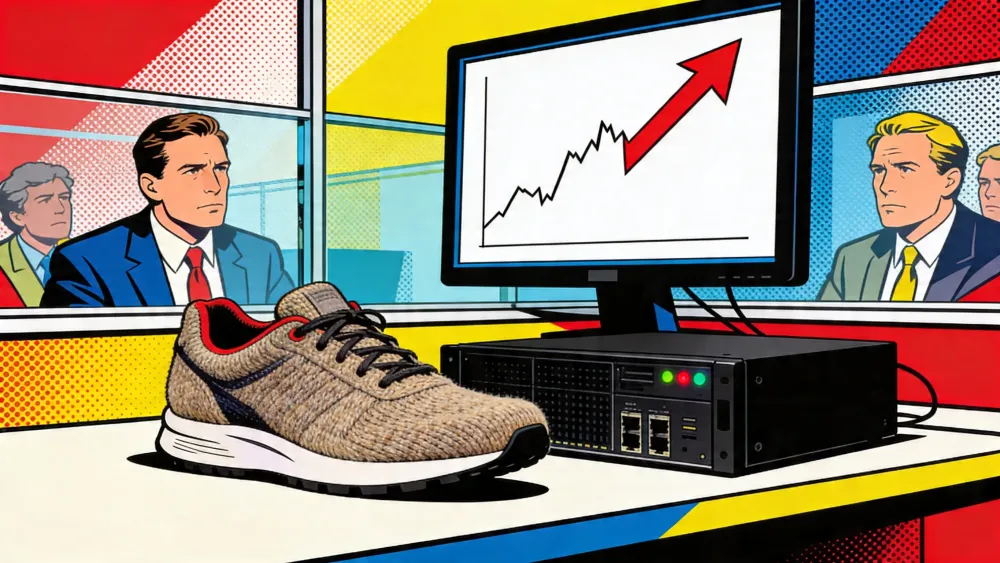
Allbirds, the struggling shoe company once valued at more than $4 billion, is selling its footwear brand and said Wednesday it plans to turn the remaining public company into an AI compute infrastructure business.
The stock went vertical. CNBC reported shares jumped from below $3 to above $17, a move of more than 700%, after the company said it had lined up a financing facility of up to $50 million and expected to rename itself NewBird AI. Reuters later reported the stock was up 435% at $13.33, giving the company a market value near $116 million during the session.
The spectacle is easy to mock: wool sneakers one day, GPUs the next. But the central question is not whether AI compute is a real market. It is. The question is who will control NewBird AI, whether those people know the infrastructure business, and whether they understand the cost, power, hardware, leasing and customer risks they are taking on.
Right now, investors do not have that answer. Allbirds has not named the institutional investor behind the facility. It has not named the AI infrastructure counterparty that would lease or manage the GPU assets. It has not named the chief operating officer the investor has the right to appoint. A same-day review of CNBC, Reuters, TechCrunch, AP, Quartz, The Verge, Forbes, Business Insider and the Techmeme feed found the same hole: coverage describes an unnamed or undisclosed institutional investor, not a responsible party investors can diligence. Until those names are public, the stock's surge is not a judgment on a new business. It is roulette with a ticker symbol.
Key Takeaways
- Allbirds is selling the shoe brand while the remaining public shell tries to pivot into AI compute infrastructure.
- The institutional investor, AI operating partner and investor-appointed COO have not been named in public disclosures.
- The $50 million facility is staged, secured and potentially dilutive, with lease payments routed through a blocked account.
- The stock rally cannot be judged until NewBird discloses who is actually backing and operating the venture.
AI-generated summary, reviewed by an editor. More on our AI guidelines.
The people question comes before the GPU question
Allbirds agreed in March to sell its intellectual property and certain assets and liabilities to American Exchange Group for an estimated $39 million, subject to stockholder approval and closing adjustments. American Exchange Group is expected to keep selling products under the Allbirds brand.
That means the company investors chased Wednesday is not the old Allbirds with a new side project. It is the listed shell left after the shoe brand moves out. The remaining company wants to become NewBird AI, buy GPU assets and lease compute capacity to customers that cannot get enough from spot markets or hyperscalers.
That idea can be serious if the right people stand behind it. AI infrastructure is a hard business. It is not enough to buy chips and wait for customers. A provider needs hardware procurement, data-center access, power, networking, cooling, uptime, security, billing, customer support and lease discipline. A financing mistake can bleed the upside before the first server is paid off.
So the first diligence question is plain: who are these people?
The preliminary proxy statement does not answer it. It says the company has entered an agreement with an institutional investor for up to $50 million in senior secured convertible notes. It says GPU purchases will be subject to investor approval. It says lease payments will flow into a blocked control account for the investor's benefit. It says the investor has the right to appoint a new chief operating officer.
That is a lot of control for an unnamed party.
Some names around the transaction are public. American Exchange Group is buying the shoe assets. Chardan is the placement agent. Holland & Hart is legal counsel to Allbirds. Those names do not solve the main problem. The party with the financing rights, the party expected to judge GPU purchases and the person expected to run operations are still missing from the public record.
If the investor has deep experience in GPU procurement, data-center finance or compute leasing, NewBird becomes more interesting. If the investor is mainly a structured-finance shop using a hot AI wrapper around a secured asset deal, the common stock deserves a different price. If the operating partner is a serious infrastructure company, the odds improve. If there is no real partner yet, the odds drop fast.
You cannot know which version is true from the current disclosure.
The old Allbirds team is not the obvious answer
The existing Allbirds leadership is not built like a cloud infrastructure team. That is not an insult. It is what the company was.
Allbirds came to market as a consumer brand: sustainability language, clean design, premium shoes and Silicon Valley customers. The company then spent years trying to repair a retail model that stopped working. Revenue fell from $298 million in 2022 to $152 million in 2025, according to CNBC. It closed its remaining full-price U.S. stores by the end of February 2026. By March, the board was ready to sell the brand.
The proxy shows that the board began reviewing strategic alternatives in September 2025, contacted more than 90 parties, and considered the company's substantial doubt about its ability to continue as a going concern. It also models a post-sale entity with $2.5 million in cash, $5 million in total assets and $1 million in stockholders' equity after the sale and initial financing effects.
That is not the starting point of a normal AI infrastructure company. It is the starting point of a public shell that needs outside capital and outside competence.
This is why the unnamed COO matters. The investor's right to appoint that person may be the most important line in the filing. NewBird does not need another retail operator. It needs someone who can price GPUs, judge hosting contracts, negotiate lease terms, manage depreciation and know when a hardware cycle has turned against them.
If that person arrives with a credible track record, the story changes. If the role goes to someone without direct infrastructure experience, the stock rally looks more like keyword trading.
The market is real. That does not make NewBird real yet.
The best argument for NewBird is that the AI compute shortage is not fake. Data-center capacity is tight. GPU supply has been fought over by hyperscalers, AI labs and cloud upstarts. Implicator has covered the same pressure in Google's AI infrastructure problem, where compute limits cap even the largest platforms.
Allbirds said NewBird will initially seek to acquire high-performance, low-latency AI compute hardware and provide access under long-term lease arrangements. The target is customers who need dedicated capacity that spot markets and hyperscalers do not reliably provide.
That is a plausible opening. It is also a crowded, capital-heavy opening. CoreWeave, Lambda, Runpod, Oracle, hyperscalers and data-center landlords already fight over pieces of this market. Some own customer relationships. Some own power. Some own software. Some own procurement channels. NewBird has not yet shown which advantage it owns.
AP quoted AI infrastructure executive Bill Kleyman saying the move was "not a very natural adjacency." His practical checklist is the right one: GPU access, long-term power agreements, cooling strategy and a credible operating model. That is why the missing biographies matter. This is not a brand extension. It is a move into an asset, power and operations business.
Buying GPUs is not an advantage by itself. Buying them at the right price, putting them in the right facility, keeping them online and leasing them to creditworthy customers at the right spread can be. That work requires judgment. It also requires timing. A GPU that looks scarce today can become less attractive when a new chip generation ships, when rental prices soften or when a customer shifts workloads.
That is why the investor's identity matters more than the headline facility size. A $50 million facility in the hands of skilled infrastructure people could create a small, real asset business. The same facility in the hands of tourists could become expensive hardware, weak leases and dilution.
Get the AI infrastructure story before it hits the invoice
Strategic AI news from San Francisco. No hype, no "AI will change everything" throat clearing. Just what moved, who won, and why it matters. Daily at 6am PST.
No spam. Unsubscribe anytime.
The financing protects the investor first
The market treated the $50 million number like fresh rocket fuel. The proxy reads differently.
The facility is a senior secured convertible note arrangement, not free cash. It is issued in stages. It carries 12% interest that can rise after a default. It is secured by company assets, including the future electronics assets. The investor receives conversion rights, registration rights, a future financing right and the ability to appoint a COO.
That structure may be sensible if the investor is taking real risk. It also means common shareholders are not first in line.
The proxy says lease payments from the GPU assets will go into a blocked control account for the investor's benefit. That is the cash-flow detail to watch. NewBird can announce revenue later, but you will need to know where that cash goes before you know what common holders own.
This is the shell game inside the shell game. The Allbirds brand moves to American Exchange Group. The public listing remains. The investor funds the new hardware plan. The noteholder receives security and control rights. Public shareholders keep the upside story, but only after the financing stack takes its share.
That does not make the deal bad. It makes it conditional. NewBird needs strong people because the structure gives them little room for sloppy execution.
The stock move was a vote on hope, not management
There is a reason the stock exploded before the details arrived. Investors feel fear that the obvious AI winners are already expensive. They feel envy when chip and cloud companies turn compute scarcity into market value. A tiny public company promising GPU exposure offers a cheaper story.
But price action is not due diligence. A 700% jump can happen before anyone knows the investor, the operator, the COO, the hardware, the sites, the leases or the customers. That is what happened here.
The next test is not the name NewBird AI. It is disclosure.
Stockholders should learn who the institutional investor is. They should learn who will run the AI infrastructure operation. They should learn whether the company has a signed operating partner or only an intention to find one. They should learn what hardware is being bought, where it will be hosted, who will lease it and how much cash reaches the public company after the secured noteholder is paid.
Until then, you are not evaluating NewBird AI. You are evaluating the market's appetite for an unnamed team attached to the right buzzword at the right moment.
That is why this story is stranger than a normal turnaround. A bad retail company can still hire a good retail operator and show the market a plan. NewBird has not yet shown the operator. It has shown a name, a financing outline and a market theme. That is not enough to separate an informed bet from a spin of the wheel.
What would make the rally look justified
The path to credibility is not complicated. It is just hard.
NewBird needs to name serious backers with infrastructure experience. It needs to appoint an operator who has actually managed compute assets, not just marketed them. It needs a hosting plan with power, cooling and network capacity. It needs customers with lease terms that survive the note economics. It needs to show the dividend math after the shoe sale and the dilution math after note conversion.
If those details are strong, the stock's move may look less ridiculous in hindsight. A small public shell with scarce compute assets, a competent operator and contracted demand could be worth more than a dying shoe company.
If those details are weak, the Long Blockchain comparison gets sharper. The iced tea company that renamed itself during the crypto boom also found a market hungry for a hot-sector story. It did not turn the announcement into a durable business.
Allbirds has found the market's most powerful word. AI still opens wallets. But NewBird is not a company yet in the way investors need it to be. It is a proposal, a financing structure and an unnamed set of people who may or may not know how to operate in one of the most demanding corners of the AI economy.
The shoes have already been sold.
Now the market needs to see who is standing inside the shell.
Frequently Asked Questions
Is Allbirds becoming an AI company?
The public company behind Allbirds is trying to become NewBird AI after selling the footwear brand and assets to American Exchange Group. The shoe brand is expected to continue under the buyer.
Who is backing NewBird AI?
Allbirds has disclosed an unnamed institutional investor for the proposed $50 million financing facility. It has not named the investor, the AI infrastructure counterparty or the COO that investor can appoint.
Why did Allbirds stock jump so much?
Investors reacted to the AI compute pivot and the proposed financing facility. The rally priced the possibility of scarce GPU exposure before the company disclosed who will run the venture.
What are NewBird AI's chances of success?
They cannot be judged from the current disclosure. The market is real, but NewBird still needs credible backers, an experienced operator, GPU access, hosting, customers and lease economics that leave value for common shareholders.
What should investors watch next?
The key items are the investor's identity, the COO appointment, any infrastructure partner, customer lease terms, GPU procurement details, dividend math and dilution from note conversion.
AI-generated summary, reviewed by an editor. More on our AI guidelines.
Related Stories
Free AI briefing · Weekdays
The AI stories that matter, sourced and explained.
Join the Morning Briefing. It goes out every weekday at 4:45 a.m. Pacific, with later sends for the East Coast, Berlin and Tokyo.
Free when you sign up: The Paperclip Compendium, our tested guide to running AI agents.
Free. Unsubscribe in one click.

Marcus Schuler
Editor-in-Chief and founder of Implicator.ai. Former ARD correspondent and senior broadcast journalist with 10+ years covering tech. Writes daily briefings on policy and market developments. Based in San Francisco. E-mail: editor@implicator.ai