IMPLICATOR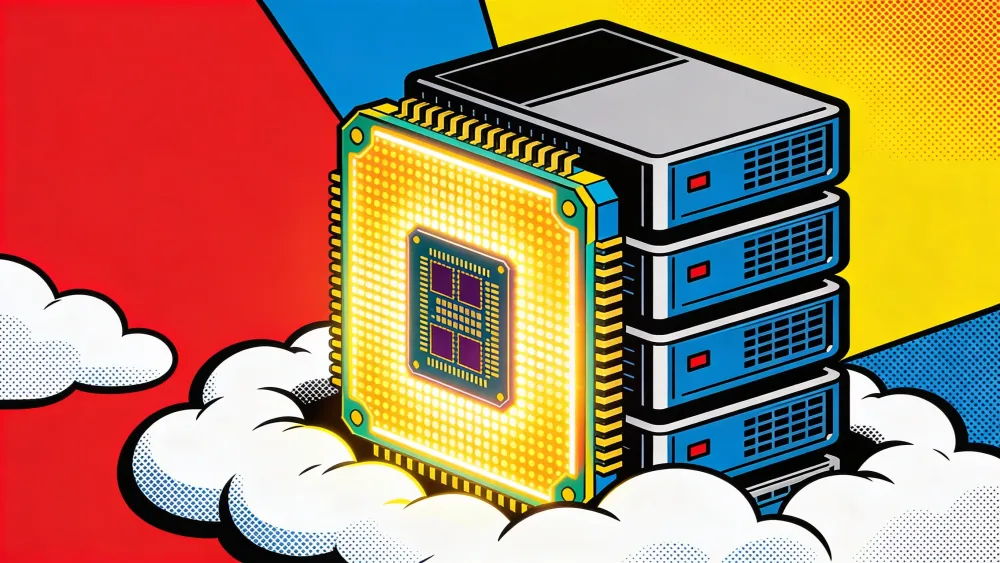
Buried midway through a 5,000-word shareholder letter, Andy Jassy dropped a number that changes how you should think about Amazon. If its chip business were a standalone company, selling to outside buyers the way Nvidia does, it would generate roughly $50 billion in annual revenue. That would make it one of the ten largest semiconductor companies on Earth. Larger than AMD. Larger than Qualcomm. Larger than Intel's foundry ambitions.
But Amazon's chip business is not a standalone company. It exists entirely inside AWS, monetized only through cloud compute instances. Customers rent Trainium by the hour. They never touch the silicon. That distinction matters more than Jassy wants you to believe, because a chip business trapped inside a cloud platform and a chip business competing in the open market are two very different animals. And Jassy's letter reads less like a defense of capital spending and more like a prospectus for the company Amazon wants to become.
This is the fifth annual letter since Jassy succeeded Jeff Bezos. The previous four followed a pattern: defend the spending, invoke the long-term, remind everyone that patience built AWS. This year's version does all of that. Free cash flow collapsed, $38 billion down to $11 billion. At most companies, that kind of crater gets somebody fired. Amazon shrugged. Top-line revenue sailed past $717 billion and operating income cleared $80 billion. The stock market didn't care. It wiped more than $450 billion off Amazon's market cap after the $200 billion capex figure surfaced in February. Investors are anxious. The letter acknowledges that anxiety, then proceeds to ignore it.
What makes 2026 different is what Jassy chose to reveal. Not just another round of "trust me, the demand is real." He disclosed hard numbers that Amazon has never shared before: AWS AI revenue has hit a $15 billion annual run rate, the first time Amazon has broken that figure out. Three years after AWS launched commercially, the cloud division had a $58 million run rate. Three years into the AI wave, the AI business alone is 260 times larger. Those numbers tell a story the headline writers missed. The letter is not defensive. It is emboldened.
Key Takeaways
- Amazon's chip business generates $20B+ annually and could be worth $50B as a standalone company, Jassy revealed for the first time
- AWS AI revenue hit a $15 billion run rate, the first time Amazon has disclosed the figure separately
- Top Trainium customers OpenAI and Anthropic are also companies Amazon invested $58B+ in, creating circular demand
- Jassy hints at selling chips externally, which would transform Amazon from cloud landlord to direct Nvidia competitor
AI-generated summary, reviewed by an editor. More on our AI guidelines.
A semiconductor company wearing a cloud costume
Amazon's custom silicon program spans three chip families. Graviton handles general-purpose computing and has eaten Intel alive inside AWS. Ninety-eight percent of the top 1,000 EC2 customers now run on it. Two large customers asked to buy all available Graviton capacity for 2026. Amazon said no.
Trainium is the AI accelerator, Amazon's direct answer to Nvidia's H100 and B200 chips. Trainium2 has sold out, with 1.4 million chips deployed. Anthropic's Claude runs on more than a million of them. Trainium3 started shipping in early 2026 and is nearly fully subscribed. Trainium4, still 18 months from broad availability, already has significant reservations locked in.
Then there's Nitro, less glamorous but just as critical, handling the virtualization and networking plumbing that keeps EC2 running.
Add it up and Amazon's silicon portfolio throws off more than $20 billion a year, with growth rates that would make any semiconductor startup drool. Jassy put the open-market equivalent at $50 billion, priced the way Nvidia prices its wares. He was not being hypothetical. He was testing the market's appetite.
"There's so much demand for our chips that it's quite possible we'll sell racks of them to third parties in the future," Jassy wrote. One sentence. No elaboration. But if you have been watching Amazon long enough, you recognize the playbook. AWS started as internal infrastructure. Fulfillment by Amazon started as internal logistics. Both became massive external businesses. The chip business is following the same arc, and the vertical integration strategy Amazon outlined at re:Invent in December now has revenue figures attached to it.
Here is the part that should embarrass every semiconductor analyst who missed it. In 2015, Amazon wrote a $350 million check for Annapurna Labs, a small Israeli chip outfit that barely registered in the trade press. A rounding error for a company burning $200 billion this year alone. But the Annapurna team stuck around. They built Graviton, then Trainium, then Nitro. They designed the servers, wired the switches, engineered the cooling. Eleven years of quiet compounding while the industry was distracted by Nvidia.
The customer problem nobody mentions
Here is where the prospectus gets complicated. Jassy's strongest evidence for demand comes from two customers: OpenAI and Anthropic. OpenAI committed to spending $100 billion on AWS over eight years and will consume 2 gigawatts of Trainium compute. Anthropic runs Claude on more than a million Trainium2 chips through Project Rainier, one of the world's largest AI compute clusters.
These are real commitments. Real workloads. Real revenue.
Get Implicator.ai in your inbox
Strategic AI news from San Francisco. No hype, no "AI will change everything" throat clearing. Just what moved, who won, and why it matters. Daily at 6am PST.
No spam. Unsubscribe anytime.
But Amazon also invested $50 billion in OpenAI and at least $8 billion in Anthropic. When your two marquee chip customers are companies you bankrolled, the demand signal gets harder to read. Is OpenAI choosing Trainium because the silicon is better, or because the investor relationship makes it frictionless? The answer is probably both, which is exactly the kind of entanglement that makes independent validation difficult.
We flagged this pattern when Amazon's initial OpenAI investment structured itself as a closed loop: Amazon invests in a company, that company commits to buying Amazon's infrastructure, and the revenue from that infrastructure justifies more investment. The loop has only gotten tighter. Tom's Hardware noted that OpenAI also has deals with Broadcom, AMD, and Nvidia through Azure. It is not exclusively committed to Trainium. But the financial entanglement creates gravity that pure market competition does not.
Apple is also a Trainium customer, according to Business Insider. That is a genuinely independent signal. But Jassy did not put a number on it, and one unnamed customer does not make a market.
There is a telling absence in the letter that reinforces this reading. Modern Retail's analysis found that for the first time since 2016, the shareholder letter contains no mention of the word "seller." Third-party merchants, the millions of small businesses that power Amazon's marketplace and used to get their own section in every shareholder letter? Gone. Not downplayed. Absent. Retail is still the biggest revenue bucket at 38 percent, but watch the trajectory. A year ago it was 43 percent. The gravity is pulling in one direction. Jassy is not hiding this shift. He is accelerating it. The letter tells you exactly where he thinks the future margin lives, and it is not in selling toasters.
Why Nvidia is watching, not panicking
Jassy's most pointed line in the entire letter: "Virtually all AI thus far has been done on NVIDIA chips, but a new shift has started." That is not a partnership statement. That is a declaration of intent.
And yet. Nvidia pulled in $215.9 billion in actual revenue last year. Amazon's chip business generates $20 billion in internal revenue. Even the theoretical $50 billion would be less than a quarter of Nvidia's take. The gap is enormous. That's the math that lets Jensen Huang sleep at night.
More importantly, early Trainium generations had real problems. Business Insider reported last year that some startups found Trainium 1 and 2 "underperforming" compared to Nvidia chips. Software compatibility was rough. Debugging tools were immature. The pitch was cheaper silicon, but the hidden cost was engineering time.
Amazon claims Trainium3 fixes most of this. Performance is up 30 to 40 percent over the previous generation. The new Trn3 UltraServers cost up to 50 percent less to run than classic cloud servers for comparable workloads. Custom Neuron switches let every Trainium3 chip talk to every other chip in a mesh configuration, slashing latency. And moving a workload to Trainium now requires "basically a one-line change," according to Amazon's chip team. If those claims hold up at production scale, Trainium3 is the generation where the technology stops being a cheaper alternative and starts being a legitimate competitor.
The smartest move in the letter is Trainium4's NVLink Fusion support. Rather than forcing customers to choose between Trainium and Nvidia, Amazon is building interoperability. You can run both chip families in the same rack. Bridge, not wall. That is a concession dressed as confidence, and it tells you Amazon knows it cannot win a replacement war against Nvidia's CUDA ecosystem. Not yet.
Google showed what full-stack control can deliver. Its TPU chips, combined with Gemini models and Search distribution, arguably closed the gap with OpenAI by late 2025. Amazon is chasing that same vertical power, from silicon to model hosting to application layer. But Google built its models in-house. Amazon funds other people's models and rents them the silicon to run on. The architectures look similar. The dependencies could not be more different.
What $200 billion actually buys
Forget the emotional appeals. Forget the Bezos nostalgia. Look at the physical footprint. Amazon bolted 3.9 gigawatts of new power capacity onto its network in 2025 alone and expects to double the total by late 2027. It committed $12 billion for new data centers in Mississippi alone. The $200 billion is not speculative. It is already being poured into concrete and copper.
Jassy projects that Trainium at scale will save "tens of billions of capex dollars per year" and deliver "several hundred basis points of operating margin advantage" over buying Nvidia chips. If even half of that materializes, the chip business pays for itself by reducing the cost of everything else Amazon builds. That is not a bet on AI demand. It is a bet on margin structure. And it explains why free cash flow cratering to $11 billion has not changed the spending trajectory one degree.
Meanwhile, the letter dropped a second external-business hint that most coverage ignored: Amazon may also sell its robotics solutions to outside industrial and consumer customers. That would mean externalizing both the silicon and the physical infrastructure, two more captive businesses following the AWS escape route into the open market.
The winners here are the companies nimble enough to use both. Run training on Nvidia, deploy inference on Trainium, and pocket the savings. Amazon is betting you will do exactly that, and then find it increasingly hard to leave.
The losers are anyone who assumes the current chip market is permanent. Jassy put the $50 billion number in writing for a reason. Not as an idle comparison. As an invitation. Amazon does not want to be the company that rents Nvidia's chips to the world forever. It wants to make them optional. Whether it can prove that case with customers it did not bankroll is the $200 billion question nobody in Thursday's letter bothered to answer.
Frequently Asked Questions
How much is Amazon's chip business worth?
Amazon's custom silicon portfolio, covering Graviton, Trainium, and Nitro, generates more than $20 billion annually. Jassy said if the business operated as a standalone chipmaker selling externally, revenue would reach roughly $50 billion, putting it among the world's largest semiconductor companies.
What is Amazon Trainium?
Trainium is Amazon's custom AI accelerator chip, designed to compete with Nvidia's GPUs. There are 1.4 million Trainium chips deployed. Trainium2 powers Anthropic's Claude and most Bedrock inference. Trainium3 offers 30-40% better price-performance, and Trainium4 ships in about 18 months.
Will Amazon sell its chips to outside buyers?
Jassy hinted it's "quite possible" Amazon will sell chip racks to third parties. Currently, customers access Trainium only through AWS cloud instances. External sales would position Amazon as a direct competitor to Nvidia in the merchant silicon market.
How much has Amazon invested in OpenAI and Anthropic?
Amazon invested $50 billion in OpenAI and at least $8 billion in Anthropic. Both are major Trainium customers, with OpenAI committing $100 billion to AWS over eight years and Anthropic running Claude on more than a million Trainium2 chips.
Why did Amazon's stock drop despite strong revenue?
Amazon's $200 billion capex plan spooked investors and wiped more than $450 billion from the company's market cap. Free cash flow dropped from $38 billion to $11 billion. Jassy says most spending is backed by customer commitments and will pay off in 2027-2028.
AI-generated summary, reviewed by an editor. More on our AI guidelines.


Free AI briefing · Weekdays
The AI stories that matter, sourced and explained.
Join the Morning Briefing. It goes out every weekday at 4:45 a.m. Pacific, with later sends for the East Coast, Berlin and Tokyo.
Free when you sign up: The Paperclip Compendium, our tested guide to running AI agents.
Free. Unsubscribe in one click.

Marcus Schuler
Editor-in-Chief and founder of Implicator.ai. Former ARD correspondent and senior broadcast journalist with 10+ years covering tech. Writes daily briefings on policy and market developments. Based in San Francisco. E-mail: editor@implicator.ai