If you've followed the export control debate, you know the choreography. Executives express concern, hedge with caveats, defer to policymakers. Dario Amodei abandoned it. Speaking to Bloomberg at Davos, the Anthropic chief executive called the administration's decision to let Nvidia sell advanced chips to China "crazy." Then he went further: "It's a bit like selling nuclear weapons to North Korea."
The nuclear comparison was not performance. Amodei has warned for years that advanced AI represents a new kind of strategic asset. Whoever controls it shapes geopolitical power for decades. He means it. Watching the administration reverse course on export controls, he dropped the careful language entirely.
"It would be a big mistake to ship these chips," Amodei said in Davos on Tuesday. "This has incredible national security implications."
The broadside came as the Bureau of Industry and Security finalized licensing rules that would permit Nvidia's H200 processors to reach Chinese buyers. AMD is seeking similar clearance for its MI325X chips. Both would represent the most advanced AI hardware legally exported to China since restrictions began more than two years ago.
Hours later, Google DeepMind CEO Demis Hassabis offered a contrasting assessment from the same venue, the Congress Centre's interview stages cycling through executives like an assembly line of careful optimism. Chinese AI companies trail western frontier labs by roughly six months, he said. They replicate well. Leading? Not yet. Maybe not ever.
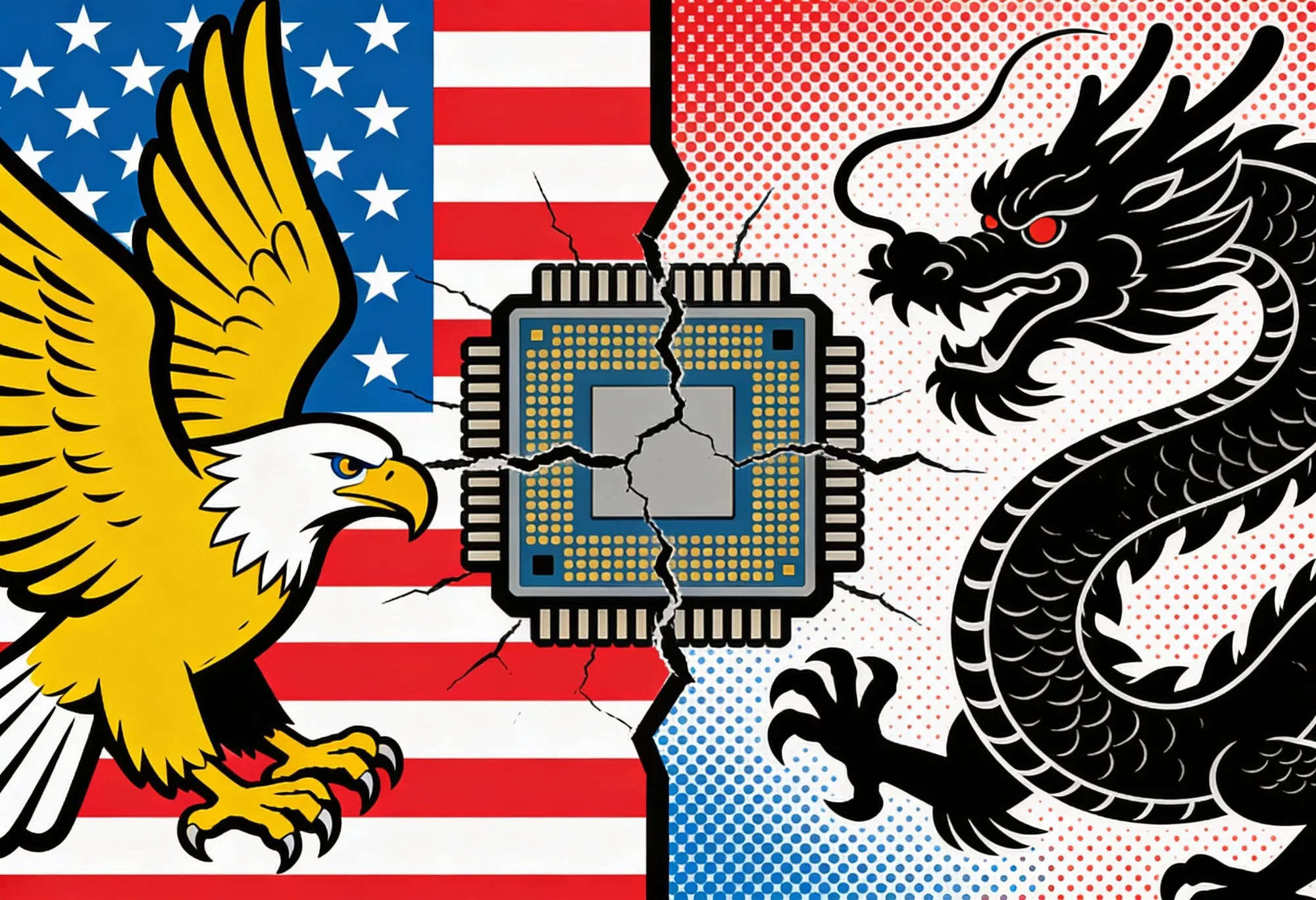
Two AI executives, two readings of the same threat. The split runs through the Republican Party too: national security hawks want the chips blocked, free-trade voices want the revenue. Think of it as a debate between firefighters: Amodei wants to cut the fuel supply, Hassabis thinks the fire is contained regardless.
The Breakdown
• Amodei compared H200 chip sales to China to "selling nuclear weapons to North Korea" at Davos
• Hassabis estimates Chinese AI labs trail western frontier by six months, down from two years in 2022
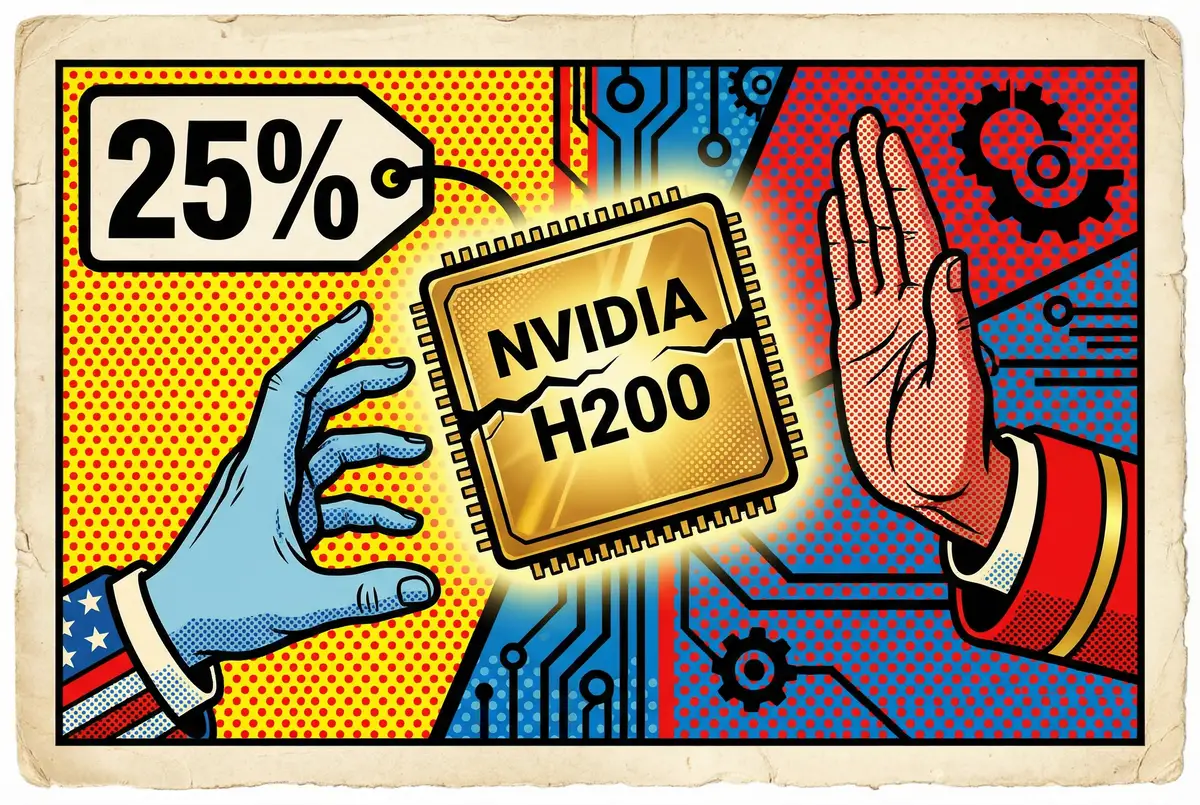
• Trump administration approved sales with 25% tariff, satisfying neither security hawks nor free traders
• Both CEOs admitted AI is already reducing junior hiring at their own companies
Amodei's theory of the case
The Anthropic CEO's opposition rests on a specific vision of where AI development leads. He described future AI systems as "a country of geniuses in a data center," envisioning 100 million entities smarter than any Nobel laureate operating under the control of a single nation. The chips enable training those systems. Whoever has them builds first.
"So imagine 100 million people smarter than any Nobel Prize winner, and it's going to be under the control of one country or another," Amodei told Bloomberg's John Micklethwait.
The framing matters. Most debates about AI chips focus on current capabilities, on benchmarks and parameter counts and inference costs. Amodei pushed the conversation forward, asking what happens when the models those chips train become genuinely transformative. At that point, he argued, the question of who controls them becomes existential.
China remains constrained by existing embargoes, Amodei argued. The restrictions work. Relaxing them hands Beijing a shortcut it hasn't earned through indigenous development.
Amodei made the same trip last January. Same venue, same warning. At Davos 2025 he talked about "1984 scenarios, or worse," Orwell's totalitarian nightmare applied to AI. Back then, export controls were tightening. Now they're loosening, and his language has gotten sharper to match.
Amodei occupies an unusual position among major AI executives. He criticizes administration policy openly while simultaneously trying to maintain working relationships in Washington. He has pushed back on preemption doctrine. Now he's pushing back on export controls. Among the CEOs running frontier AI labs, he stands largely alone in openly contradicting White House priorities.
That willingness to dissent carries risk. Anthropic competes for government contracts and regulatory goodwill. Speaking out against a policy championed by the administration's AI czar is not a calculated business move. It appears to reflect genuine alarm.
Stay ahead of the AI race
Strategic AI news from San Francisco. No hype, no "AI will change everything" throat clearing. Just what moved, who won, and why it matters. Daily at 6am PST.
No spam. Unsubscribe anytime.
Hassabis: six months behind, not catching up
Hassabis presented a less alarmed reading of Chinese capabilities during his interview with Emily Chang. The DeepMind chief acknowledged Chinese labs have impressed with their efficiency but questioned whether they've demonstrated genuine frontier innovation.
"The response to DeepSeek's R1 model when it was released a year ago was a massive overreaction," Hassabis said.
The Hangzhou-based startup stunned the industry when R1 emerged at a fraction of Silicon Valley development costs. Chinese researchers, forced to work under semiconductor restrictions, had pursued unconventional architectures and training methods. The results suggested hardware constraints might not slow China as much as Washington hoped. Some observers wondered if the export controls had backfired, forcing Chinese engineers into creative solutions they might not have discovered otherwise.
Hassabis granted the model was "impressive" but drew a distinction between catching up and breaking through. "They're very good at kind of catching up to where the frontier is, and increasingly capable of that," he said. "But I think they've yet to show they can innovate beyond the frontier."
The distinction matters for policy. If Chinese labs can only replicate American advances with a delay, then maintaining that delay through export controls makes strategic sense. If they're capable of genuine breakthroughs, restrictions may simply redirect their innovation rather than prevent it.
The six-month gap Hassabis cited offers some comfort to American labs, though the margin has narrowed considerably. When export controls first tightened in late 2022, estimates placed China two years or more behind. If Hassabis is correct, that lead has shrunk by 75 percent even with restrictions in place. The trend line should concern Washington regardless of where the current snapshot lands.
Some barriers are already falling. Minimax and Zhipu, two prominent Chinese AI startups, completed Hong Kong stock exchange listings this month. Investor appetite for China's AI sector persists despite hardware constraints. Capital continues to flow toward Chinese AI development even as American policy attempts to starve it.
The policy mechanics
You might assume the administration picked a side in this debate. It picked both.
The Bureau of Industry and Security revised licensing procedures last week, clearing a path for H200 sales that had been blocked under Biden-era rules. Trump then announced a 25 percent tariff on the chips Nvidia plans to ship. The result is a toll booth on a road the government said no one should drive: pay the fee, take the hardware, pretend the security concerns were about revenue all along.
China gets the chips. The Treasury gets a cut. The strategic calculus remains contested.
Nvidia lobbied hard for the change, arguing that continued embargoes would simply accelerate Chinese development of domestic alternatives. The chipmaker's H200, introduced more than two years ago, sits below its current Blackwell generation and the forthcoming Vera Rubin family in performance terms. Sales of those more advanced processors remain blocked on national security grounds.
The argument has a certain logic. China will build competitive chips eventually, embargo or not. So why forfeit billions in Nvidia revenue just to delay something you can't prevent? Better to take the money and keep commercial relationships that offer some window into what Beijing is building.
Amodei rejects this reasoning. In his view, the timeline matters enormously. Every month of delay in Chinese AI capabilities is a month for American labs to extend their lead, for American companies to establish market positions, for American policymakers to develop governance frameworks. Accelerating China's progress, even marginally, trades long-term strategic advantage for short-term commercial gain.
The policy has exposed fractures within Republican ranks. House Foreign Affairs Committee Chair Brian Mast is pushing legislation to prevent China from accessing sensitive American technology. MAGA influencers including Laura Loomer and AI czar David Sacks have defended the president's approach, attacking Mast publicly.
Amodei declined to name Sacks directly when pressed on who shaped the policy. "I wouldn't refer to any particular people," he said. "But I would just say that this particular policy is not well advised."
The diplomatic hedge was thin. Sacks is widely viewed as the architect of Trump's AI approach. Criticizing the policy without naming its author fools no one.
The jobs admission
You might expect tech executives to deflect questions about AI displacing workers. Both Hassabis and Amodei answered directly, and the answer from both was yes.
"I think we're going to see this year the beginnings of maybe it impacting the junior level," Hassabis said. "I can feel that ourselves, maybe like a slowdown in hiring." He pointed to entry-level roles and internships as particularly exposed.
Amodei went further. Last year he predicted AI could eliminate half of all entry-level white-collar positions and push unemployment to 20 percent. On Tuesday, he confirmed that forecast stands.
"Now I think maybe we're starting to see just the little beginnings of it, in software and coding," he said. "I can see it within Anthropic, where I can look forward to a time where on the more junior end and then on the more intermediate end we actually need less and not more people."
Fewer people. That's what Amodei sees coming, and he's willing to say so while most of his peers reach for euphemisms about "evolving roles."
The timeline he offered for broader economic disruption was stark. Somewhere between one and five years, he said, the exponential improvement curve will "overwhelm our ability to adapt." Both CEOs have previously called for institutional responses, including international governance bodies and economic intervention programs, to mitigate the worst outcomes. Whether those institutions can form quickly enough remains doubtful.
Daily at 6am PST
Don't miss tomorrow's analysis
No breathless headlines. No "everything is changing" filler. Just who moved, what broke, and why it matters.
Free. No spam. Unsubscribe anytime.
Physical AI complicates the picture
Hassabis also discussed DeepMind's expanding ambitions beyond language models, and the shift matters for the chip debate. Training a language model requires massive compute clusters running for months. Training a robot requires interaction with the physical world, a constraint that doesn't scale the same way.
Hassabis pointed to the human hand as the benchmark. "It's very hard to match the reliability, the strength and the dexterity," he said. A breakthrough is coming, he believes. When? He wouldn't say.
If physical AI becomes the next frontier, hardware advantages may matter less than access to real-world training environments. China's manufacturing base, its robotics installations, its willingness to deploy experimental systems at scale could prove more valuable than any chip. The export control debate assumes compute is the bottleneck. That assumption may not hold.
DeepMind's parent company has gained ground against OpenAI in recent months. In December, OpenAI CEO Sam Altman declared a "code red" after Google released an AI model that outperformed OpenAI's best software on multiple benchmarks. The AI race isn't simply America versus China. It's a multi-front competition where American companies fight each other while also trying to stay ahead of Chinese rivals. Export controls help all American labs relative to Chinese competitors. They don't help Anthropic relative to Google or OpenAI.
The chips will flow
The H200s will reach China. The policy machinery is in motion, the tariffs set, the licensing framework established. Amodei's objections, however forcefully stated, will not reverse the decision.
What remains is the question of consequences. Amodei believes the chips will accelerate Chinese AI development at a critical moment, narrowing a gap that American labs have fought to maintain. Hassabis believes Chinese labs remain fundamentally unable to push past the frontier, making the chips useful but not decisive.
Amodei's position is more persuasive. The six-month gap Hassabis cites has already shrunk from two years under existing restrictions. Easing those restrictions while the gap continues to narrow is not caution. It's complacency dressed as commerce. If the timeline matters as much as Amodei argues, and his track record on AI forecasting suggests it does, then every month of acceleration handed to Chinese labs compounds over the years ahead. Nvidia's quarterly revenue does not offset that risk.
The answer will emerge over years, not months. By then, the policy will be difficult to reverse. The relationships will be established, the dependencies created, the precedents set. Amodei knows this. His Davos appearance was not an attempt to change the current decision. It was an attempt to establish a record, to say clearly what he believed before the consequences became undeniable.
The H200 sits in Nvidia's product lineup, two generations behind the cutting edge. It represents yesterday's technology by Silicon Valley standards. In the contest for AI supremacy, yesterday's technology may still be enough.
Frequently Asked Questions
Q: What is the Nvidia H200, and why does it matter?
A: The H200 is Nvidia's AI accelerator chip introduced in late 2023. It sits below Nvidia's current Blackwell generation and forthcoming Vera Rubin chips in performance. The H200 would be the most advanced AI chip legally exported to China since restrictions began, making it strategically significant despite being older technology.
Q: How far behind is China in AI development?
A: According to DeepMind CEO Demis Hassabis, Chinese AI labs trail western frontier labs by approximately six months. This gap has narrowed significantly from roughly two years when export controls first tightened in late 2022, representing a 75 percent reduction in the lead despite restrictions.
Q: What was DeepSeek's R1 model, and why did it matter?
A: DeepSeek's R1 was a reasoning model released by the Hangzhou-based startup in early 2025 at a fraction of Silicon Valley development costs. Chinese researchers built it using unconventional architectures while working under chip restrictions. Hassabis called the industry response a "massive overreaction."
Q: Why did Amodei compare chip sales to nuclear proliferation?
A: Amodei views advanced AI as a strategic asset comparable to nuclear weapons in its potential to reshape geopolitical power. He believes whoever controls the most advanced AI systems will have decisive advantages for decades. Selling the chips that enable those systems to a strategic competitor, in his view, is giving away that advantage.
Q: What jobs do AI executives say are most at risk?
A: Both Hassabis and Amodei pointed to entry-level and junior positions as most vulnerable. Amodei specifically mentioned software and coding roles, predicting AI could eliminate half of all entry-level white-collar jobs and push unemployment to 20 percent within one to five years.
Related Stories