IMPLICATOR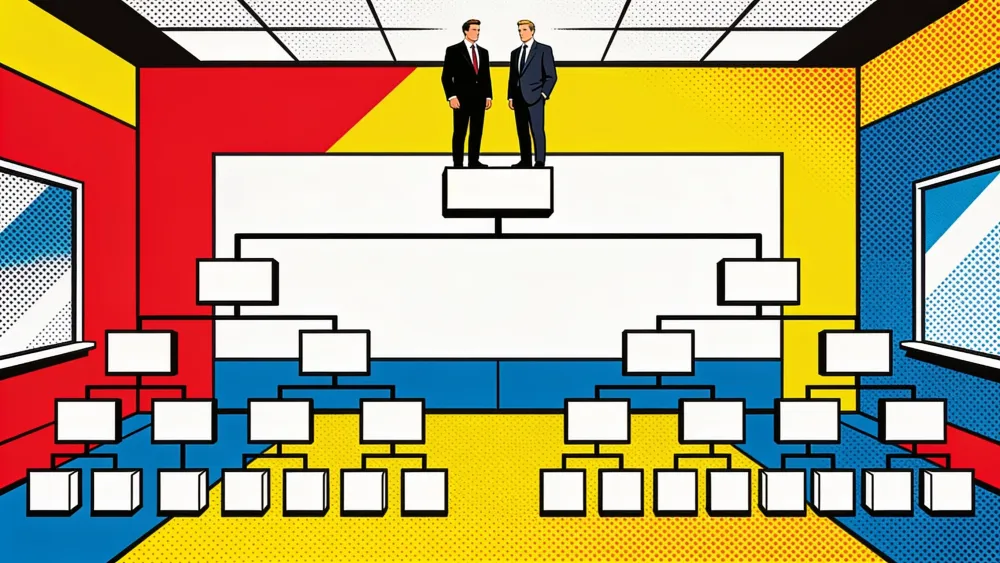
Dario Amodei runs Anthropic, an artificial intelligence company valued at $965 billion, with a single direct report, he told Bloomberg's Emily Chang this week. His entire executive team reports instead to his sister, President Daniela Amodei, who handles day-to-day operations and answers to the board; the only person Amodei directly manages is his chief of staff. He called the arrangement "incredibly freeing." "It's very hard to pay attention to the strategic picture if there's, like, a zillion things you have to handle tomorrow," he said.
That sets him against the prevailing trend in large tech. As firms strip out managers and widen the spans of those who remain, Amodei narrowed his span to one and stepped out of the operating chart. The setup reads as management minimalism, yet the operating company now runs through two co-founders who are siblings, both seated on the board, as Anthropic races to list its shares ahead of OpenAI.
Key Takeaways
- Dario Amodei runs Anthropic with one direct report, his chief of staff; the executive team reports to his sister, President Daniela Amodei, who handles operations.
- As tech widens CEO spans (Jensen Huang keeps ~60 reports, Sam Altman six to ten), Amodei shrank his to one and stepped out of the operating chart.
- Harvard economist Raffaella Sadun finds a delegate lets a CEO withdraw from management; Amodei is the limit case, handing the whole function to a co-founder.
- The structure concentrates control in two founder-siblings on the board as Anthropic files to go public at a $965 billion valuation.
AI-generated summary, reviewed by an editor. More on our AI guidelines.
Jensen Huang keeps 60 reports to strip out layers
The direction of travel in tech runs the other way. The average manager's span of control rose from 10.9 reports in 2024 to 12.1 in 2025, up from 8.2 in 2013, according to Business Insider. Nvidia's Jensen Huang says he keeps about 60 people reporting to him and does not hold one-on-ones with his staff. "I don't do 1-on-1s and almost everything that I say, I say to everybody at the same time," he told Lex Fridman. "If the CEO's direct staff is 60 people, the number of layers you've removed in a company is probably something like 7." OpenAI's Sam Altman has between six and ten direct reports, depending on the count and the date. Intel's Lip-Bu Tan told staff that "the best leaders get the most done with the fewest people." The cuts thinned middle management at Amazon, Meta and Google through 2025. Huang flattens by pulling the company toward himself, holding 60 lines of sight. Amodei flattened by removing his own line, keeping one report and routing the rest to a president.
Sadun's research splits CEOs into leaders and managers
The structure is less eccentric than it sounds. Raffaella Sadun, a Harvard Business School economist, has spent more than a decade measuring what chief executives actually do. Her team parsed time-use diaries from 1,114 of them across six countries and found two kinds. "Leaders" spend their hours in multi-function, high-level meetings. "Managers" work one-on-one with core functions. Firms run by the leader type are on average more productive, and the gap shows up only after that CEO is hired. A separate Sadun paper found that a delegate such as a chief operating officer lets a CEO withdraw from internal management and spend time elsewhere. Amodei has taken that finding to its limit, handing the entire managerial function to Daniela rather than merely lightening his own. CEO time, in her phrase, is "a scarce resource" whose allocation reveals a firm's priorities. By her logic the right span depends on the work, and a company facing a steady stream of novel, high-stakes problems argues for a narrow one.
Get Implicator.ai in your inbox
Strategic AI news from San Francisco. No hype, no "AI will change everything" throat clearing. Just what moved, who won, and why it matters. Daily at 6am PST.
No spam. Unsubscribe anytime.
Amodei spends close to half his time on culture
What Amodei kept is culture. In the same interview he estimated he spends "probably half" his time talking to staff about how Anthropic works, more than the "third, maybe 40 percent" he cited earlier this year. The vehicle is a biweekly all-hands he calls the Dario Vision Quest: no slides, a dense memo he writes himself, an hour spent talking it through. His worry is dilution as the company hires fast. "If you don't tell them how Anthropic operates, they'll simply recapitulate the only thing they know, which is how to operate at the companies that they came from," he said of recruits from big tech. Maintaining the culture is, by his account, his and Daniela's "number one top priority." The culture work scales with headcount, which has grown from a few hundred people to roughly 2,500, and Anthropic slowed hiring at one point to protect quality. Daniela, an early Stripe employee who ran safety and policy at OpenAI, holds the rest: finance, sales, recruiting, security and the operating engine, while Dario "sets vision, strategy, research and policy," Fortune reported.
Know someone who'd find this useful? ✉️ Email it to a friend in one click, or they can subscribe free here.
Both Amodei siblings sit on the board
The freeing arrangement is also a concentration of it. Both Amodei siblings sit on Anthropic's board, alongside investors and outside directors. The company filed confidentially for an initial public offering on June 1. That came days after a $65 billion round valued it at $965 billion, past OpenAI's $852 billion for the first time and nearly triple its $380 billion mark in February. It has lined up Morgan Stanley, Goldman Sachs and JPMorgan for a listing it wants as soon as this fall. Anthropic also has a Long-Term Benefit Trust, part of its public-benefit structure. The trust holds a special class of stock that lets it elect and remove a growing share of directors, eventually a majority. A supermajority of voting stockholders can rewrite the trust's powers without the trustees' consent, and one published analysis concluded the trust may be "quite subordinate to stockholders." Studies of dual-class listings treat concentrated founder control as a governance risk investors scrutinize, not a feature founders get to celebrate.
The founder-operator split is old. Steve Jobs had Tim Cook, Larry Page and Sergey Brin had Sundar Pichai, Mark Zuckerberg had Sheryl Sandberg. A chief executive turning toward strategy before an IPO is routine on its own; the unusual part at Anthropic is the degree of the split, and that the operator is a co-founder and a sibling rather than a hired deputy. Bankers disclose a structure like this under the heading of key-person risk. Anthropic's confidential S-1, once it becomes public, is where investors will see how much of a near-trillion-dollar company runs through two siblings.
Frequently Asked Questions
How many direct reports does Dario Amodei have?
One, his chief of staff. Anthropic's executive team reports instead to his sister, President Daniela Amodei, who handles day-to-day operations and reports to the board, Amodei told Bloomberg's Emily Chang.
How does that compare with other tech CEOs?
It runs against the trend. Nvidia's Jensen Huang says he keeps about 60 direct reports and holds no one-on-ones; OpenAI's Sam Altman has six to ten. The average manager's span of control rose to 12.1 reports in 2025.
What does Daniela Amodei do at Anthropic?
As president and co-founder, she runs operations and the commercial side, finance, sales, recruiting and security, while Dario sets vision, research, strategy and policy. She previously worked at Stripe and led safety and policy at OpenAI.
Why does Amodei spend so much time on company culture?
He estimates he spends about half his time on it, worried that fast hiring from big tech makes new staff copy old habits. Anthropic grew to roughly 2,500 employees, which raises the stakes on keeping the culture intact.
What does the structure mean for Anthropic's IPO?
Anthropic filed confidentially on June 1 at a $965 billion valuation. The setup concentrates control in two founder-siblings on the board, the kind of key-person and founder-control question public-market investors tend to scrutinize.
AI-generated summary, reviewed by an editor. More on our AI guidelines.

Free AI briefing · Weekdays
The AI stories that matter, sourced and explained.
Join the Morning Briefing. It goes out every weekday at 4:45 a.m. Pacific, with later sends for the East Coast, Berlin and Tokyo.
Free when you sign up: The Paperclip Compendium, our tested guide to running AI agents.
Free. Unsubscribe in one click.

Marcus Schuler
Editor-in-Chief and founder of Implicator.ai. Former ARD correspondent and senior broadcast journalist with 10+ years covering tech. Writes daily briefings on policy and market developments. Based in San Francisco. E-mail: editor@implicator.ai