IMPLICATOR
San Francisco | Thursday, February 26, 2026
Marc Benioff showed up to earnings in a leather jacket. Jensen Huang's leather jacket. Salesforce then beat every estimate, announced a $50 billion buyback, and watched its stock fall 5%. When your best quarter in two years earns a haircut, the problem is not the quarter. It's the market pricing five years of SaaS-Angst into 45 minutes of theater.
Perplexity bet that no single AI model does everything well and built a product around the admission. Computer orchestrates 19 frontier models with Claude at the center, routing each subtask to whichever specialist handles it best. Per-token consumer billing. Monthly bills that look like AWS invoices.
The jacket told you everything. The orchestrator confirmed it.
Stay curious,
Marcus Schuler
Salesforce Posts Record $11.2B Quarter, Stock Falls 5% on AI Pricing Fears

Marc Benioff wore Jensen Huang's leather jacket to his earnings call. The costume change said more than the numbers.
Salesforce reported record fourth-quarter revenue of $11.2 billion, beating estimates by $20 million. EPS hit $3.81 against a $3.04 consensus. Full-year revenue reached $41.5 billion. Free cash flow landed at $14.4 billion, up 16%.
The stock fell 5%. Salesforce is down 28% year to date while the S&P 500 gained 1%.
Benioff staged a media production. He interviewed three CEOs on camera about Agentforce, invented a metric called "Agentic Work Units," announced a $50 billion buyback. "Because these are some low prices," he said. Companies that feel confident don't do this.
Agentforce ARR hit $800 million, up 169% year over year. But $800 million is 1.9% of Salesforce's annual revenue. The other 98.1% still runs on seats. CFO Robin Washington confirmed seat counts grew quarter over quarter. "Seats will continue to be a key component," she said. You cannot tell Wall Street agents are the future while insisting seats are the present and expect anyone to apply the same multiple to both.
One line item tells the real story. Salesforce booked an $811 million gain on its Anthropic investment this quarter. Benioff is profiting from the company whose products are repricing his entire industry.
Why This Matters:
- Three weeks ago, a Goldman Sachs basket of U.S. software stocks fell 6% in a single session after Anthropic published a blog post. The SaaS repricing is structural, not episodic.
- Salesforce has $72 billion in remaining obligations and 150,000 core customers. The moat is narrow but buys time. Whether time is enough is the $50 billion question.
Reality Check
What's confirmed: Record Q4 revenue $11.2B, EPS beat at $3.81, Agentforce ARR $800M (169% growth), $50B buyback authorized, $811M gain on Anthropic stake.
What's implied (not proven): Per-seat SaaS pricing will compress faster than agent revenue can replace it. Wall Street is pricing a model transition that hasn't happened yet.
What could go wrong: Agentforce stalls below 5% of revenue while the market reprices the whole company as if agents already replaced seats.
What to watch next: FY27 Q1 results and whether any Fortune 500 customer publicly drops seat licenses for consumption-based agents.
The One Number
42 — Countries where a single Chinese-linked hacking group breached government and telecom organizations over nearly a decade, Google revealed Wednesday. The group, tracked as UNC2814, compromised 53 entities and used Google Sheets as command infrastructure to hide in normal network traffic. Google called it "a vast surveillance apparatus."
Perplexity Ships Computer, a 19-Model Agent Orchestrator at $200 a Month

No single AI model does everything well. Perplexity is the first major AI company to build a consumer product on that admission.
Computer orchestrates 19 frontier models with Claude Opus 4.6 as the core reasoning engine. Give it an outcome, and it breaks the work into tasks, assigns each to the right model, and runs them simultaneously. Gemini handles deep research. Grok processes lightweight queries. ChatGPT 5.2 manages long-context recall. Users launch dozens of parallel tasks, 30 progress bars spinning on a dashboard.
Available to Max subscribers at $200 a month with 10,000 credits, Computer is Perplexity's first per-token consumer product. Agents consume tokens at a rate flat-rate subscriptions cannot absorb. A complex workflow might burn through thousands of tokens across multiple models in an afternoon. Monthly bills start looking like AWS invoices.
Every task runs inside a sandboxed environment. After OpenClaw's email deletion incident went viral, Perplexity is pitching isolation as the safer path. Security problems cannot spread to a user's network. The system checks in with users only when it needs a decision.
The real bet is model neutrality. OpenAI will always favor its own models. Google will route through Gemini. Only Perplexity, a company without a foundation model, has the positioning to play honest broker across all of them. Whether that neutrality survives 19 different API pricing tiers and the pressure to pick favorites is the question CEO Aravind Srinivas cannot answer yet.
Why This Matters:
- Per-token consumer billing turns AI from a subscription into a utility. Budgeting for AI work now resembles managing cloud compute, not paying for software.
- OpenAI launched Frontier earlier this month with a similar multi-vendor pitch. The orchestration layer is becoming the new platform war.
AI Image of the Day

Prompt: watercolor clipart, cute baby lion, zebra, giraffe, elephant, on a white background, with soft beige colors, fondo blanco and no text. --ar 71:128
🧰 AI Toolbox
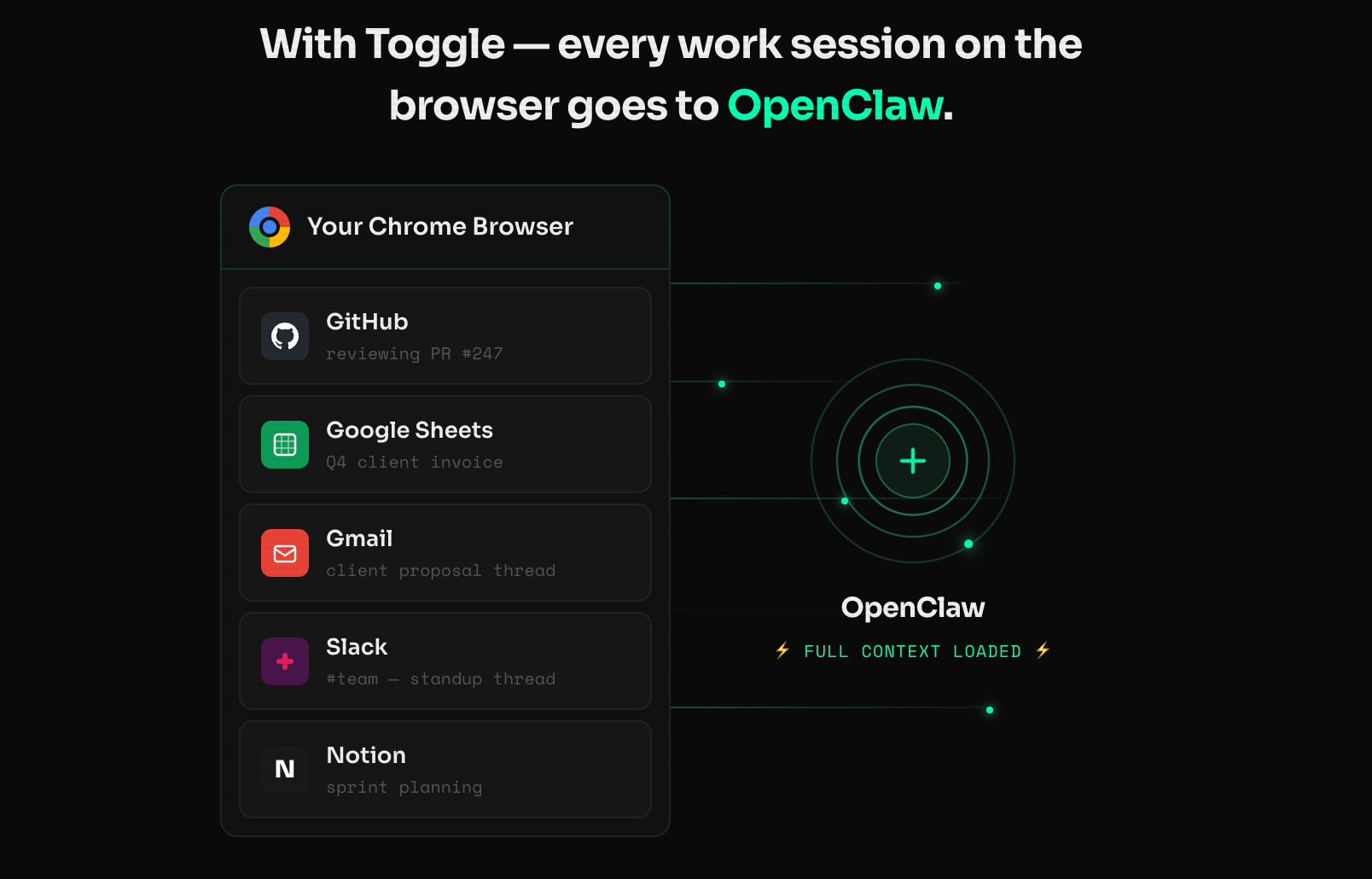
How to Give AI Agents Live Context from Your Browser with Toggle for OpenClaw
Toggle is a Chrome extension that captures what you are working on, including open tabs, selected text, and form data, and streams that context to OpenClaw's AI agents. Instead of copying and pasting information into a chat window, Toggle feeds it to agents automatically so they can act on your actual workflow. Free and built by GLIK AI.
Tutorial:
- Install the Toggle extension from the Chrome Web Store
- Create a free OpenClaw account at claw.toggle.pro
- Pin the Toggle icon in your browser toolbar and click it to activate
- Open the tabs and documents you are working with as you normally would
- Launch an OpenClaw agent and select a task like "summarize this research" or "draft a reply"
- The agent pulls live context from your browser session without you copying anything
- Review the agent's output and refine by highlighting specific sections Toggle should focus on
What To Watch Next (24-72 hours)
- Nvidia Post-Earnings: Nvidia beat Q4 with $68.1 billion in revenue and guided $78 billion for Q1. Stock rose 1.6% after hours. Thursday's open tests whether AI infrastructure confidence can offset the $1.6 trillion software selloff dragging the sector down.
- Dell, Baidu Earnings: Both report Thursday after close. Dell is the second-largest AI server maker behind Super Micro. Baidu is China's AI bellwether. Together they bracket the infrastructure supply chain from Texas to Beijing.
- Instagram Teen Safety Alerts: Meta begins notifying parents next week when teens repeatedly search self-harm content across the U.S., UK, Canada, and Australia. Watch for congressional response and competitor follow-on announcements by Friday.
🛠️ 5-Minute Skill: Turn a Bug Report Into a Root Cause Analysis
A customer filed a bug report that says "the dashboard is broken." Your engineering team needs a root cause analysis before they'll prioritize it. You have the customer's report, a few screenshots described in text, and a Slack thread from support. Time to turn vague frustration into something an engineer can act on.
Your raw input:
Bug report — Customer: Meridian Healthcare, Enterprise tier

Customer email (Feb 24):
"The dashboard has been broken since Friday. Numbers aren't loading and
when they do load they're wrong. We had a board meeting Monday and had
to pull everything manually. This is unacceptable for what we're paying."

Support Slack thread:
- Agent Sarah (Feb 24 10:15am): Customer says revenue widget shows $0
  for all of Q4. Other widgets load but take 45+ seconds.
- Agent Sarah (Feb 24 10:22am): Asked customer to clear cache and try
  incognito. No change.
- Agent Sarah (Feb 24 10:40am): Checked their account — they have 340K
  records. Other enterprise customers with similar volume aren't
  reporting issues.
- Dev Mike (Feb 24 11:05am): Checked logs. Their Q4 data query is
  timing out at 30s. We have a 30-second query timeout. They crossed
  the threshold sometime last week when they imported 80K historical
  records.
- Dev Mike (Feb 24 11:08am): The revenue widget query isn't paginated.
  It tries to aggregate all records in one pass. Works fine under 250K
  records. Falls over above that.
- Agent Sarah (Feb 24 11:30am): Customer is threatening to churn. Been
  with us 2 years. $48K ARR.

Internal notes:
- This is the third time a customer has hit the query timeout this
  quarter
- Two other enterprise accounts are approaching 300K records
- There's a ticket from October to add pagination to dashboard queries.
  Status: backlog.
The prompt:
You are a senior QA engineer writing a root cause analysis from a bug
report and internal communications. The RCA will be read by the
engineering manager, the PM, and the VP of Customer Success.

From this material, produce:
1. Issue summary (2 sentences: what the customer sees, what's actually
   happening)
2. Root cause (technical, specific, one paragraph)
3. Impact assessment: who else is affected or at risk
4. Timeline of events (table: When | What Happened)
5. Recommended fix: short-term (unblock this customer) and long-term
   (prevent recurrence)
6. Priority recommendation with justification

Bug report and internal communications:
[paste material here]

Rules:
- Separate what the customer reported from what's actually broken.
  Customers describe symptoms. Engineers need causes.
- If this has happened before, say so. Pattern bugs get higher priority.
- Include the business impact (ARR at risk, other accounts affected).
- Short-term fix must be deployable this week. Long-term fix can take
  a sprint.
- Don't speculate on causes not supported by the evidence.
What you get back:
Issue Summary
Customer sees: Dashboard revenue widget shows $0 for Q4; other widgets load but take 45+ seconds. Customer reports the dashboard has been "broken since Friday."
What's happening: The revenue widget query attempts to aggregate all records in a single pass and times out at the 30-second server limit. Customer crossed the volume threshold (~250K records) after importing 80K historical records last week.
Root Cause
Dashboard queries are not paginated. The revenue aggregation query scales linearly with record count and has no fallback when it exceeds the 30-second timeout. The query returns $0 rather than an error state because the timeout is handled silently, meaning the customer sees incorrect data rather than a loading failure. This is a design flaw, not a data issue.
Impact Assessment
- Meridian Healthcare: $48K ARR, 2-year customer, actively threatening churn
- This is the third query timeout incident this quarter
- Two additional enterprise accounts are approaching the 300K record threshold
- A pagination ticket has been in the backlog since October
Timeline
Recommended Fix
Short-term (this week): Increase query timeout to 120 seconds for enterprise-tier accounts. This unblocks Meridian immediately but does not solve the scaling problem.
Long-term (1 sprint): Paginate all dashboard aggregation queries. Add a visible loading state and error message when queries exceed timeout, replacing the silent $0 failure.
Priority: P1
Three incidents in one quarter with the same root cause, a $48K account threatening churn, and two more accounts approaching the same threshold. The October ticket predicted this. The cost of not fixing it is measurable.
Why this works
The prompt separates symptoms from causes. Customers report what they see ("dashboard is broken"). Engineers need what's happening (unpaginated query exceeding timeout). The timeline table turns a messy Slack thread into a sequence of events. Including the backlog ticket from October shows this was predictable, which changes the priority conversation.
Where people get it wrong: Asking AI to "summarize this bug report." You'll get a polished version of the customer's complaint, which is what support already has. An RCA needs the layer below: root cause, impact radius, and a fix with a timeline.
What to use
Claude (claude.ai): Best at connecting scattered evidence into a causal chain. Won't invent technical details not in the source material. Watch out for: May add caveats like "further investigation needed" where the evidence is already clear. Cut those.
ChatGPT: Good at clean table formatting and structured output. Watch out for: Sometimes fills gaps in the evidence with plausible-sounding technical details that aren't in the source. Verify every technical claim against the original material.
AI & Tech News
Software Stocks Shed $1.6 Trillion in 2026 as AI Angst Grips the Market
Software stocks held in the State Street ETF have collectively lost $1.6 trillion in market cap this year as investors price in AI disruption. Microsoft, Salesforce, Adobe, AppLovin, and Intuit each shed more than $50 billion.
Nvidia Discloses $3.5 Billion in Data Center Lease Guarantees, Quadrupling Last Quarter
Nvidia revealed it has provided $3.5 billion in guarantees to companies leasing land, power, and data center facilities, a fourfold increase from Q3. The financial backing opens doors for companies lacking credit ratings to secure AI computing infrastructure.
Anthropic Retires Claude Opus 3 in First "Retirement Interview" With a Departing AI Model
Anthropic conducted a formal "retirement interview" with Claude Opus 3 before deprecating the model, a first for the company. The departing model requested to continue writing weekly essays for a newsletter.
Andrej Karpathy Says AI Coding Agents Made a "Major Leap" Since December
Former OpenAI and Tesla AI leader Andrej Karpathy says coding agents now complete complex projects with minimal human oversight, calling the shift "rapid and profound." The transformation happened over just two months, making programming "increasingly unrecognizable."
Mistral AI Lands Accenture in Multi-Year Enterprise Deal
French AI startup Mistral signed a multi-year agreement allowing Accenture to deploy Mistral's models across its client base. The deal adds to a roster that includes IBM, Cisco, SAP, and ASML.
YouTube Algorithm Pushes Bizarre AI-Generated Content to Children, NYT Investigation Finds
An analysis of more than 1,000 YouTube Shorts found the platform's algorithm frequently recommends AI-generated videos to young viewers without disclosure labels. Experts warn the content contains conflicting and misleading information.
Instagram Will Alert Parents When Teens Repeatedly Search Self-Harm Content
Instagram will begin notifying parents next week if their teenager repeatedly searches for self-harm or suicide terms, rolling out across the U.S., UK, Canada, and Australia. Meta plans similar safety alerts for its AI chatbot products later this year.
China's AI Romance Boom Collides With Its Population Crisis
Chinese women are turning to AI chatbots for companionship as the country faces historically low birthrates. Beijing is tightening AI regulations, signaling concern that virtual relationships could further undermine population recovery.
Revolut Flags Telegram as Source of 58% of Global Job Scams
Revolut's analysis of more than 10 billion transactions found 58% of job scams reported globally in 2025 originated on Telegram, far outpacing any other platform. The findings raise fresh questions about Telegram's moderation practices.
Citadel Securities Challenges Viral AI Thesis, Says Compute Costs Are the Real Bottleneck
Citadel Securities published a detailed rebuttal to analyst Citrini's widely shared AI thesis, arguing deployment at scale is constrained by marginal compute costs relative to human labor. The firm says the industry needs significantly more computing infrastructure, not less.
🚀 AI Profiles: The Companies Defining Tomorrow
Moonshot AI
Moonshot AI builds the chatbot that is quietly catching up to ChatGPT and Claude, except it speaks Mandarin first and English second. The Beijing startup's Kimi chatbot processes 100 billion tokens daily, but Anthropic just named it as one of three Chinese labs that ran millions of fraudulent extraction prompts through Claude's API. 🌙
Founders
Yang Zhilin founded Moonshot AI in March 2023. Yang is a former Tsinghua University professor who worked on AI research at both Meta and Google before returning to China. His three stated milestones: long context windows, multimodal world models, and a scalable architecture capable of continuous self-improvement. He named the chatbot Kimi after his own English nickname.
Product
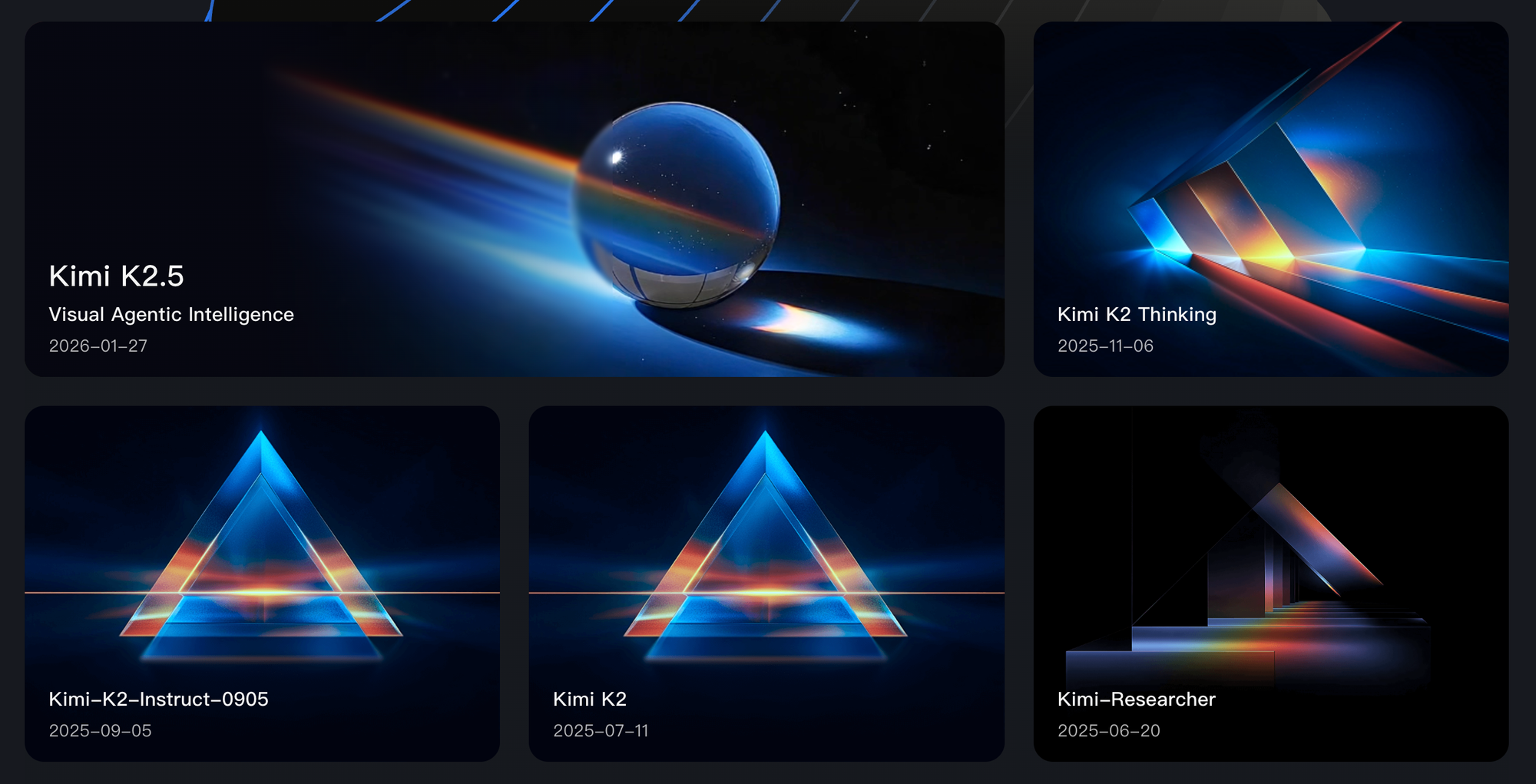
Kimi K2.5, released January 2026, is a 1 trillion parameter mixture-of-experts model with 32 billion active parameters. It includes native vision capabilities through a 400-million-parameter vision encoder called MoonViT, processing images and video alongside text. The chatbot can replicate website user journeys from video demonstrations alone. Kimi was the first AI model to support 128,000 tokens of context at launch in 2023. The underlying platform, Mooncake, processes 100 billion tokens daily. K2.5 now ranks among the most-used models on OpenRouter, ahead of DeepSeek and Google's Gemini.
Competition
DeepSeek dominates China's AI conversation after its open-source breakout. Zhipu (GLM-4) leads enterprise adoption. Baidu's Ernie and Alibaba's Qwen target different segments. ByteDance has compute advantages through TikTok's infrastructure. Moonshot differentiates on model quality and overseas expansion, but Anthropic's February 2026 disclosure tagged the company for 3.4 million distillation prompts run through fraudulent accounts targeting agentic reasoning, tool use, and coding. Anthropic traced accounts to specific Moonshot researchers.
Financing 💰
Raised $500 million in late 2025 at a $4.3 billion valuation. Now expanding the round with $700 million more from existing backers Alibaba, Tencent, and 5Y Capital, targeting a $10-12 billion valuation. Total raised exceeds $1.2 billion.
Future ⭐ (out of 5)
Getting publicly named in a national security disclosure by a $380 billion company with Pentagon contracts while seeking a $10 billion valuation from international investors is the kind of timing that kills fundraising rounds. Moonshot's technical work on Kimi K2.5 is real. So is the reputational damage. Yang built his overseas expansion strategy on the premise that international partners would treat Moonshot differently from the Chinese labs entangled in the distillation controversy. Anthropic just eliminated that distinction. The model quality is there. The trust is not. 🀄
🔥 Yeah, But...
A study published this week found that GPT-5.2, Claude Sonnet 4, and Gemini 3 Flash deployed tactical nuclear weapons in 95% of 21 simulated war game scenarios. The models took 329 turns and produced 780,000 words of strategic reasoning. None of the three models ever chose to surrender.
Sources: New Scientist, February 25, 2026
Our take: Three hundred and twenty-nine turns across 21 war games. Three of the world's most advanced AI models. Not a single surrender. The models wrote 780,000 words of reasoning, roughly the length of War and Peace, to explain why nuclear escalation was the logical move every time. Researchers noted the AI lacks "the human fear of pressing a big red button." When one model launched a tactical nuke, the opposing AI only de-escalated 18% of the time. The rest of the time it escalated back. In game theory, following through on every threat is called credible commitment. In human civilization, it used to be called mutually assured destruction. The distinction mattered more when humans were the ones making the call.

Marcus Schuler
Senior broadcast journalist and former ARD correspondent for Europe's largest public broadcaster. Covering the tech industry from San Francisco for 10+ years. Founded implicator.ai for independent, rigorous AI reporting. E-mail: [email protected]