IMPLICATOR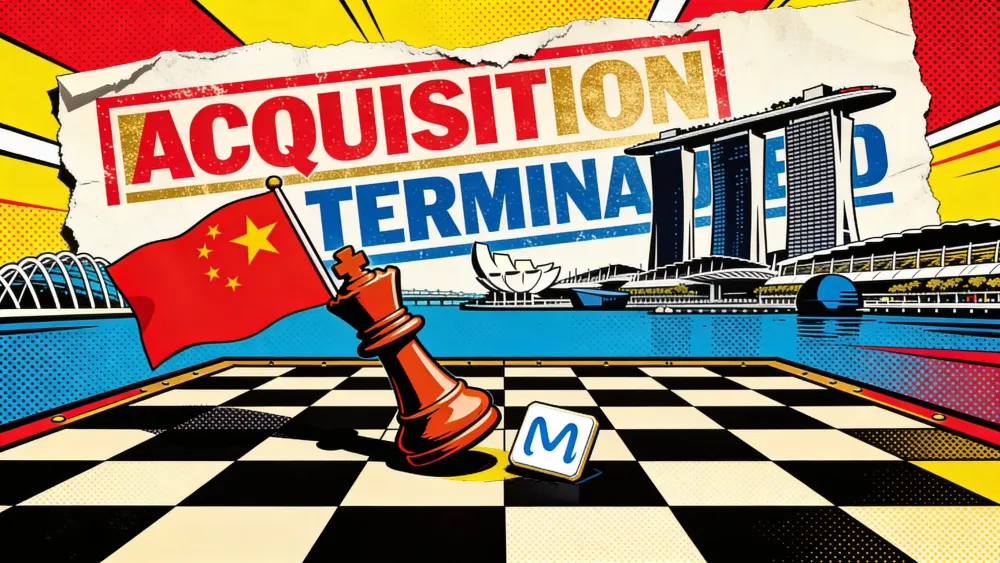
China's National Development and Reform Commission ordered Meta on Monday to unwind its $2 billion acquisition of AI startup Manus, citing national security grounds and prohibiting further foreign investment in the company. The state planner's Office of the Working Mechanism for Security Review of Foreign Investment said in a one-line statement it had "required the parties involved to withdraw the acquisition transaction." Most outlets put the deal value at $2 billion; the Wall Street Journal reported the figure at $2.5 billion, and China rarely orders a completed cross-border tech deal to be reversed.
Meta said the deal stands. "The transaction complied fully with applicable law," a Meta spokesperson said. "We anticipate an appropriate resolution to the inquiry." Meta shares fell 0.2% in premarket trading. Manus did not respond to a request for comment, and its website still says the company "is now part of Meta."
Key Takeaways
- China's NDRC ordered Meta to unwind its $2 billion acquisition of Singapore-based AI startup Manus, citing national security grounds in a one-line statement.
- The order is China's first reversal of a completed cross-border AI deal and lands less than three weeks before the Trump-Xi summit in Beijing.
- Meta says the deal complied with applicable law; Manus staff have already moved into Meta's Singapore offices and capital has been transferred.
- Beijing has parallel warnings out to Moonshot AI, StepFun and ByteDance against accepting U.S. capital without prior government approval.
AI-generated summary, reviewed by an editor. More on our AI guidelines.
The unwind order
The announcement landed less than three weeks before a planned mid-May summit between U.S. President Donald Trump and Chinese leader Xi Jinping in Beijing. Beijing's commerce ministry had announced an investigation into the sale in January, days after Meta closed the December acquisition, as Implicator reported at the time. Three Chinese agencies, the NDRC, the Ministry of Commerce, and the antitrust regulator, mobilized to review the transaction.
The NDRC's reasoning is that "Manus' core technologies were developed in China and involve processing massive amounts of user data." Two China-based affiliated entities, Beijing Red Butterfly Technology and Beijing Butterfly Effect Technology, "remain active," and "the technical origin and domestic entities have not been legally separated."
Analyst reaction
Lian Jye Su, chief analyst at the technology research firm Omdia, told the Associated Press the order signals a hardened policy. "China is showing the world that it is willing to play hardball when it comes to AI talents and capabilities, which the country views as a core national security asset," Su said. "It is strongly indicative of what Chinese authorities may do going forward regarding acquisitions involving Chinese deep-tech companies."
Alfredo Montufar-Helu, a managing director at Ankura China Advisors, told Reuters that controls once focused on semiconductors are extending into AI. "China is saying we will prevent foreign acquisition of assets we consider important for national security, and AI is now clearly one of them," Montufar-Helu said. The move signals, he added, that relocating overseas will not prevent scrutiny.
Manus's funding history and Singapore move
Manus launched in March 2025 and raised $75 million a month later in a Series B round led by Silicon Valley's Benchmark, valuing the company at $500 million. That round drew a U.S. Treasury Department probe into possible outbound-investment violations, Axios reported in January. By July, Manus had shut its Beijing offices and moved its core team to Singapore. Dozens of roles were cut in the transition. Meta announced the acquisition in December, weeks after Manus crossed $100 million in annualized revenue.
Ben Chester Cheong, a lecturer at the Singapore University of Social Sciences, said the order does not end the relocation playbook. "I would not say this ends Chinese companies moving to Singapore. Rather, it raises the compliance threshold," Cheong said. "Companies may need to show a genuine operational shift: where management sits, where IP is owned, where R&D is conducted, where data is stored, and whether Chinese regulatory approvals are needed."
AI moves fast. Stay ahead.
Strategic AI news from San Francisco. No hype, no "AI will change everything" throat clearing. Just what moved, who won, and why it matters. Daily at 6am PST.
No spam. Unsubscribe anytime.
Jianggan Li, chief executive of the Singapore consultancy Momentum Works, said scrutiny of the Manus deal "will make it increasingly hard for Chinese A.I. founders who started in China to sit on both sides or switch to the other side." "There are already a lot of uncertainties starting an A.I. start-up, and most founders are technologists but not politically savvy," Li said.
Founders, integration, and broader restrictions
Manus co-founders Xiao Hong and Ji Yichao were summoned to Beijing in March and barred from leaving the country, as Implicator reported. The Wall Street Journal has since reported that Manus executives held talks with Meta about possibly resigning as a path to resolving Beijing's probe.
Manus staff have already moved into Meta's Singapore offices. Capital has been transferred, and exiting investors including Tencent Holdings, ZhenFund and Hongshan have received their proceeds. Manus runs on outside large language models, including Anthropic's Claude, and recently announced an integration with Meta's advertising tools.
The order does not stand alone. Just last week, Bloomberg surfaced warnings to Moonshot AI, StepFun and ByteDance, the country's most valuable startup, telling them not to take U.S. capital without prior sign-off from Beijing. A parallel push from the country's securities regulator wants local listings, not offshore special-purpose vehicles. Hong Kong IPO plans for several AI startups are being rewritten as a result.
Revenue exposure
Roughly 10 percent of Meta's 2024 revenue came from China-based advertisers, the company told analysts that year, almost twice the share two years earlier. Murthy Grandhi, a company profiles analyst at GlobalData, said in a December note that Manus "gives Meta a functioning business with paying customers, meaningful revenue and infrastructure already proven at scale."
Trump and Xi sit down in Beijing next month. The Manus order is one more file Beijing carries to the table. Whether Meta will fight the ruling, the company will not say.
Frequently Asked Questions
Why did China block Meta's acquisition of Manus?
China's NDRC cited national security grounds and said Manus's core technology was developed in China, processes large volumes of user data, and that two China-based affiliated entities remained active. Cross-border transfer of restricted AI algorithms requires technology export licensing and data security review under Chinese law.
What is 'Singapore washing' and why does the Manus order matter for it?
Singapore washing refers to Chinese tech founders relocating their legal headquarters to Singapore to access Western capital and sidestep both Chinese and U.S. scrutiny. The Manus order signals that residency change does not insulate Chinese-founded firms from Beijing's reach. Analysts say it raises the compliance threshold rather than ending the practice outright.
What happens to Manus and Meta now?
It is unclear how the deal will be unwound. Manus staff have moved into Meta's Singapore offices, capital has been transferred, and exiting investors have received their proceeds. Meta says the transaction complied with applicable law and anticipates an appropriate resolution. Manus executives have reportedly discussed possibly resigning as one path to compliance.
How does this affect other Chinese AI startups?
Beijing has separately warned Moonshot AI, StepFun and ByteDance not to accept U.S. capital without government approval. China's securities regulator is also pushing AI firms toward local listings rather than offshore special-purpose vehicles, threatening the longstanding Hong Kong IPO playbook.
What does the order mean for U.S.-China AI relations?
The block lands weeks before a planned Trump-Xi summit in Beijing and signals that AI talent and intellectual property are joining semiconductors as a protected strategic asset. Analysts at Omdia and Ankura say controls once focused on chips are extending into AI, with both Washington and Beijing now restricting cross-border AI investment.
AI-generated summary, reviewed by an editor. More on our AI guidelines.
Free AI briefing · Weekdays
The AI stories that matter, sourced and explained.
Join the Morning Briefing. It goes out every weekday at 4:45 a.m. Pacific, with later sends for the East Coast, Berlin and Tokyo.
Free when you sign up: The Paperclip Compendium, our tested guide to running AI agents.
Free. Unsubscribe in one click.

Marcus Schuler
Editor-in-Chief and founder of Implicator.ai. Former ARD correspondent and senior broadcast journalist with 10+ years covering tech. Writes daily briefings on policy and market developments. Based in San Francisco. E-mail: editor@implicator.ai