
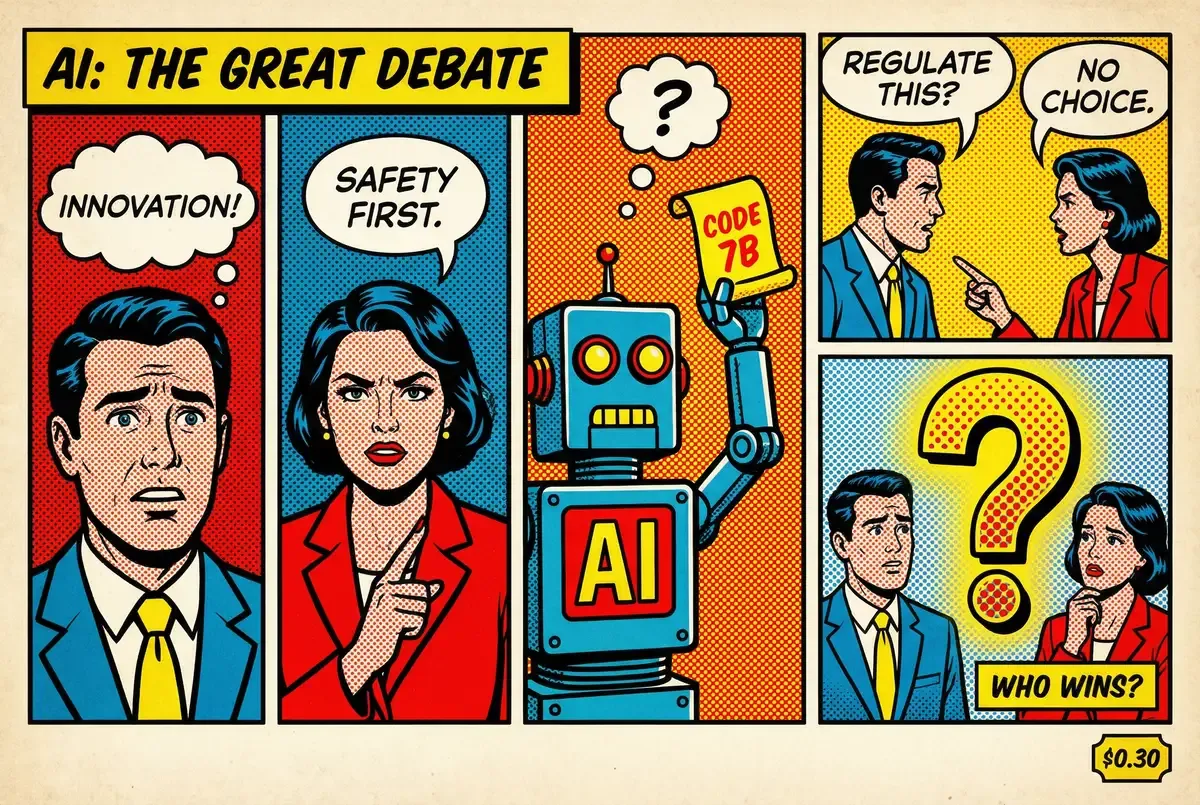
A Reddit user named ridablellama spent his lunch hour reading Hugging Face's announcement about a new tool that lets AI coding agents fine-tune language models. By evening, he'd posted a detailed breakdown of highlights and lowlights. The lowlights section carried a particular sting: "only can do up to 7B models!!! I was crushed I wanted to do a Qwen3 VL 8B next."
That ceiling tells you everything about where AI tooling actually stands versus where the marketing suggests it might be. Hugging Face released what it calls "Skills," a plugin system that teaches Claude Code, OpenAI's Codex, and Google's Gemini CLI to handle the entire fine-tuning pipeline through natural language commands. The pitch sounds transformative. Tell Claude to fine-tune Qwen3-0.6B on a coding dataset. Watch it validate your data, select appropriate hardware, submit training jobs to cloud GPUs, monitor progress, and push finished models to Hugging Face's Hub. Cost for a demo run: roughly thirty cents.
The reality is more constrained. And more interesting.
Quick Summary
• HF Skills lets Claude Code, Codex, and Gemini CLI fine-tune models up to 7B parameters through natural language, starting at $0.30 per run
• The 7B ceiling excludes popular architectures like Llama 3.1 8B and Qwen vision models, limiting utility for serious development work
• Requires Hugging Face Pro subscription ($9/month) plus GPU costs ($15-40 for production runs), complicating democratization claims
• Anthropic's Claude actively facilitating competitor training creates unresolved strategic tension with its core API business
The Mechanics of Conversational Training
Ben Burtenshaw, one of the engineers behind the project, announced it on December 4th with a post that accumulated 584 likes and 29,000 views within a day. The technical implementation works through packaged instruction sets that encode domain knowledge about model training. These "skills" contain decision trees for GPU selection, configuration templates for different training methods, and the procedural knowledge required to navigate Hugging Face's infrastructure.
When you tell Claude to fine-tune a model, the system consults these instruction packages to determine hardware requirements. A 0.6B parameter model gets routed to a t4-small instance at roughly $0.75 per hour. Models between 1B and 3B parameters step up to t4-medium or a10g-small hardware. Anything between 3B and 7B requires a10g-large or a100-large with LoRA adapters to fit within memory constraints.
Three training methods ship with the initial release. Supervised fine-tuning handles the standard case where you have input-output pairs demonstrating desired behavior. Direct preference optimization works with preference annotations, pairs where human labelers have marked one response as better than another. Group relative policy optimization tackles reinforcement learning scenarios with verifiable rewards, useful for math or coding tasks where correctness can be programmatically verified.
The workflow abstracts away genuine complexity. Dataset format validation catches the most common failure mode before you burn GPU hours. Trackio integration provides real-time monitoring of training loss. GGUF conversion handles the packaging required to run models locally through llama.cpp or Ollama. For someone who has manually configured training runs, the automation is substantial.
Seven Billion Parameters and Not One More
Here's where the gap between announcement and utility becomes apparent. The 7B parameter ceiling excludes most models that matter in the current open-source landscape.
Meta's Llama 3.1 comes in 8B, 70B, and 405B variants. The 8B version, arguably the most popular open model for fine-tuning, sits just outside the supported range. Qwen's vision-language models that ridablellama wanted to train start at 8B parameters. Mistral's newer releases cluster around 8B and above. The practical effect is that HF Skills works well for educational experiments and small-scale prototyping but struggles with the models researchers and developers actually want to customize.
One Reddit commenter offered a workaround: "nail a clean 7B LoRA first with real evals, then step up to 8B VL if you still need it." The suggestion acknowledges the limitation while proposing a two-stage workflow that defeats much of the convenience proposition. If you're going to manually configure the 8B training anyway, the automated 7B step becomes a detour rather than a foundation.
The documentation is candid about this. Under the hardware selection guide, models above 7B parameters receive a blunt assessment: "this HF skills job is not suitable." No workaround suggested, no timeline for expansion. Whether the constraint reflects technical limitations, cost considerations, or strategic positioning remains unstated.
Democratization Behind a Paywall
Hugging Face positions Skills as lowering barriers to model training. The framing echoes across AI tooling announcements. Make powerful capabilities accessible. Reduce friction. Democratize access.
The access requirements complicate this narrative. HF Skills requires a Hugging Face Pro or Team subscription. Pro runs $9 per month. Team plans scale with organization size. The GPU costs for training jobs add on top. A production fine-tuning run on a 7B model budgets $15-40 depending on dataset size and training duration.
These aren't prohibitive costs for professional developers or funded research teams. They represent meaningful barriers for the hobbyists, students, and independent researchers who constitute the rhetorical target of democratization language. A graduate student exploring fine-tuning for a thesis project faces a different calculation than an ML engineer at a well-resourced startup.
The subscription requirement also creates dependency on Hugging Face's infrastructure decisions. When the company adjusts pricing, changes hardware availability, or modifies the Skills framework, users adapt or find alternatives. Platform risk travels alongside platform convenience.
The abstraction does something else, too. Someone who fine-tunes their first model through Claude Code learns that certain commands produce certain outcomes. They watch loss curves descend. They get a model artifact at the end. But why does LoRA reduce memory requirements? What makes one learning rate schedule outperform another? Which dataset characteristics predict training failure before it happens? None of that transfers. The person who's only ever used the automated pipeline hits a wall the moment something breaks. And something always breaks.
When Your Product Trains Its Replacements
Anthropic built Claude. Hugging Face built Skills to teach Claude how to train open-source models that compete with Claude. The arrangement contains a strategic tension that neither company has publicly addressed.
Claude Code represents Anthropic's push into developer tooling, a market where usage-based revenue can compound as coding agents become integrated into professional workflows. Every fine-tuned open model that performs adequately for a specific use case represents a potential customer who doesn't need Claude's API for that application. The economics work against Anthropic's core business.
The Skills framework explicitly supports OpenAI's Codex and Google's Gemini CLI alongside Claude Code. Hugging Face appears indifferent to which frontier model orchestrates the training, which makes strategic sense from their perspective. They profit from compute usage regardless of which agent submits the jobs.
For Anthropic, the calculation is less obvious. Claude Code's utility partly depends on the breadth of tasks it can accomplish. Refusing to support competitor-training would limit that utility and push developers toward alternatives. Supporting it means actively facilitating a workflow that undermines API revenue. The company seems to have chosen capability breadth over strategic protection, at least for now.
One interpretation: Anthropic believes the frontier model advantage outpaces whatever ground open models might gain through easier fine-tuning. Another: they're betting that users who learn AI workflows through Claude develop loyalty that persists even when alternatives exist. Neither explanation fully resolves the tension.
Vibe Training and the Knowledge Gap
The rise of "vibe coding," using AI assistants to write software without deep understanding of the underlying systems, has already sparked debates about developer skill atrophy. HF Skills extends this pattern to machine learning.
A user on Twitter suggested asking Claude Code to "figure out the hyperparameters that best train a regime of models." Another proposed using it for "distillation of bigger models." The ideas are technically plausible and practically concerning. Hyperparameter optimization requires understanding what hyperparameters do, how they interact, and what signals indicate progress versus overfitting. Distillation involves subtle tradeoffs between teacher model capability, student model capacity, and task-specific performance characteristics.
The comment thread on Reddit revealed the knowledge distribution clearly. One user provided dense technical guidance: "For 7B (OLMo 3 or Granite), QLoRA with 4-bit NF4, r=16, alpha=32, dropout around 0.05 is a solid start; target attention and MLP blocks, freeze embeddings, and do a 1% probe run to verify loss and overfit before scaling." Another simply asked: "Could this be used to do the same process but locally?"
Years of accumulated expertise separate those two comments. HF Skills doesn't bridge that distance. It papers over it. And papering over complexity works right up until the training job fails with a cryptic CUDA error, or the model produces confident nonsense, or the loss curve plateaus for reasons the automated system can't diagnose. Then you're stuck. You've been invoking a tool without building the mental model to fix it.
Burtenshaw mentioned a benchmarking skill under development, one that would evaluate model performance after training. The absence of that capability in the initial release is telling. You can train models, but you can't systematically evaluate what you've created. The workflow optimizes for production without the quality gates that make production meaningful.
What's Actually Being Built Here
HF Skills represents a genuine technical achievement and a useful tool for specific applications. Training sub-7B models for well-defined tasks, particularly when you have clean datasets and clear success metrics, becomes substantially easier. The automation eliminates tedious configuration work. The cost tracking prevents budget surprises. The monitoring integration catches failures early.
The limitations matter more than the announcement suggests. Model size constraints exclude popular architectures. Subscription requirements filter out casual experimenters. Abstraction layers obscure the knowledge required for meaningful customization. Strategic tensions remain unresolved.
The trajectory here points somewhere specific. AI systems training other AI systems. Humans progressively further from the machinery. This already happens at frontier labs, where RLHF pipelines use AI feedback to train AI responses. HF Skills pushes that pattern downstream, into the hands of developers who may not realize how much of the process they're not seeing.
Call it democratization if you want. But access to a button isn't the same as access to understanding. The people who built these systems spent years learning why certain approaches work. The people pushing the button get the output without the education. That's a different kind of gatekeeping, just less visible than the old kind.
HF Skills makes easy things easier. The hard things, the problems that require genuine expertise, remain just as hard. Maybe harder, because the tooling suggests they've been solved.
Why This Matters
- For ML practitioners: The 7B ceiling limits immediate utility, but the workflow patterns established here will likely expand to larger models as Hugging Face's infrastructure scales. Watch for the benchmarking skill release as a signal of production readiness.
- For AI companies: The strategic template of frontier models training their own competitors will replicate across the industry. How companies navigate that tension, whether through capability restriction, pricing strategies, or differentiation, shapes competitive dynamics through 2026 and beyond.
- For developers evaluating AI tooling: There's a difference between a tool that speeds up something you already know how to do and a tool that lets you skip learning it entirely. The first kind makes you more productive. The second kind makes you dependent. Figure out which one you're holding before you build your workflow around it.
❓ Frequently Asked Questions
Q: What is LoRA and why does the system use it automatically for larger models?
A: LoRA (Low-Rank Adaptation) trains only a small subset of model weights instead of all parameters. This cuts memory use dramatically, making 7B models trainable on single GPUs. HF Skills applies LoRA automatically for any model above 3B parameters. Full fine-tuning at that scale would require multiple high-end GPUs costing significantly more per hour.
Q: What's the difference between SFT, DPO, and GRPO training methods?
A: SFT (supervised fine-tuning) teaches models using input-output examples. DPO (direct preference optimization) trains on pairs where one response is marked better than another. GRPO (group relative policy optimization) uses reinforcement learning with verifiable rewards, best for tasks like math or coding where answers can be checked programmatically. Most projects start with SFT, then optionally add DPO for alignment.
Q: Can I run HF Skills locally instead of paying for cloud GPUs?
A: No. HF Skills specifically submits jobs to Hugging Face's cloud infrastructure. One Reddit commenter pointed to npcpy as an alternative for local training with similar agent-driven workflows. Local training requires your own GPU hardware, typically at least 24GB VRAM for 7B models with LoRA, and manual configuration of the training environment.
Q: What is GGUF conversion and when would I need it?
A: GGUF is a file format optimized for running models locally through llama.cpp and tools like Ollama or LM Studio. After fine-tuning, HF Skills can convert your model to GGUF with quantization (Q4_K_M is common), shrinking file size while preserving most quality. You'd want this if you plan to deploy models on local hardware rather than cloud APIs.
Q: How much time does automated fine-tuning actually save compared to manual setup?
A: For someone experienced with training pipelines, HF Skills saves perhaps 30-60 minutes of configuration per run. For newcomers, it eliminates days of learning curve, but that's the tradeoff. The automation handles dataset validation, hardware selection, checkpoint configuration, and Hub integration. Manual setup teaches you what those components do. The skill gap shows up when debugging failed runs.
 Maria Garcia
 Marcus Schuler