 IMPLICATOR
Implicator PRO Briefing / Tuesday, June 23, 2026
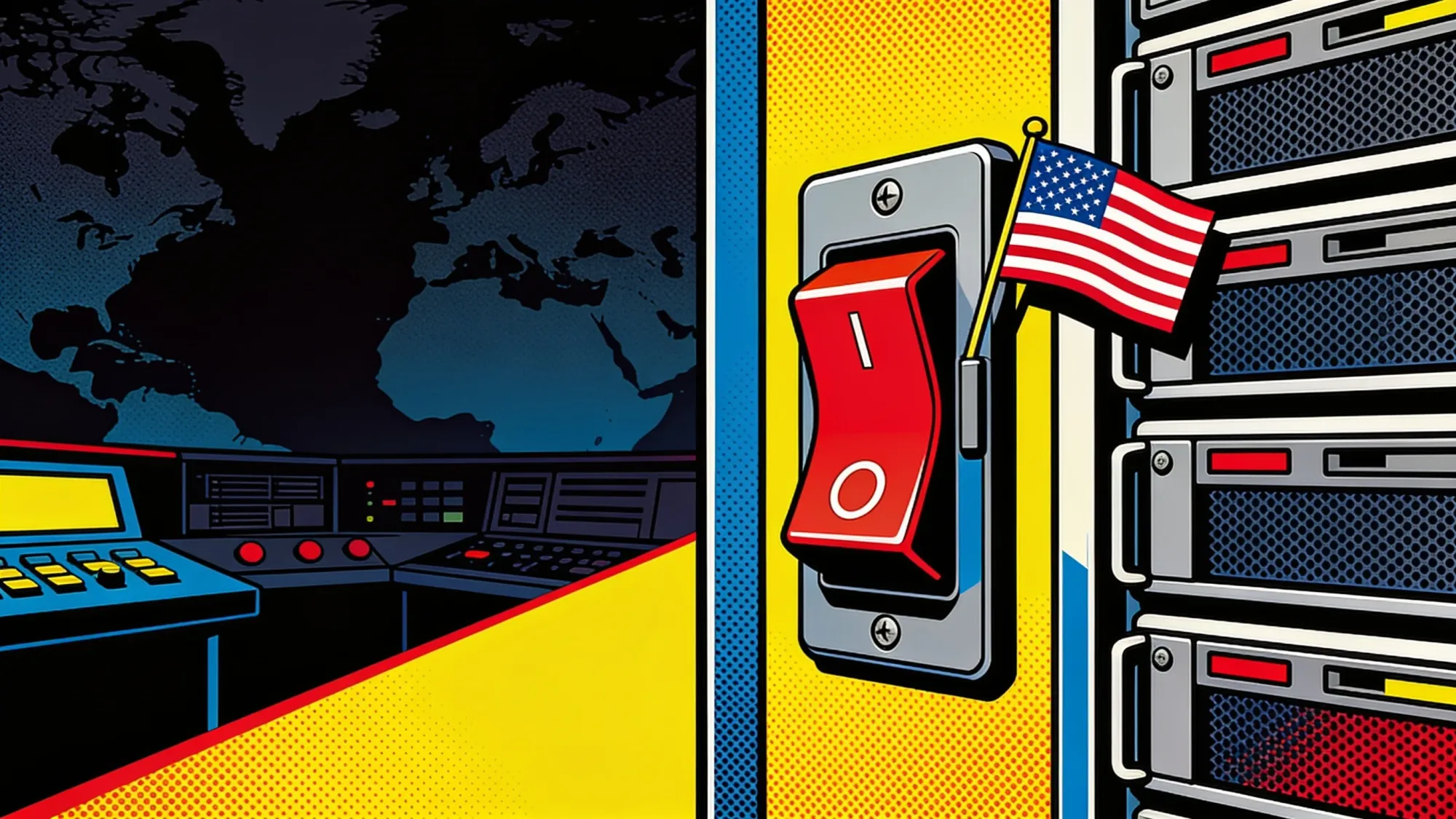
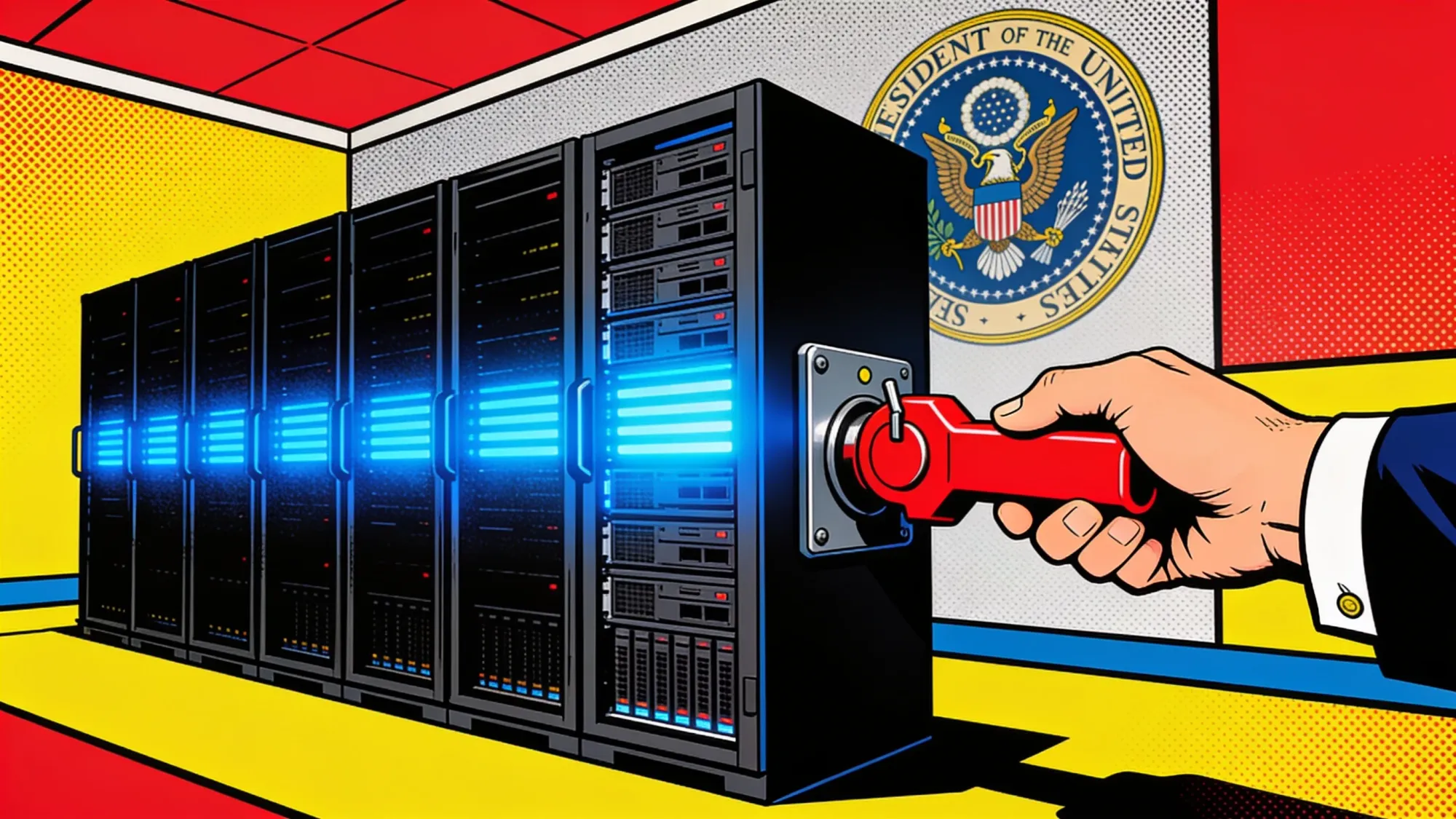
At 5:21 p.m. Eastern on Friday, June 12, a letter from Commerce Secretary Howard Lutnick reached Anthropic. It placed the company's two most capable models, Fable 5 and Mythos 5, under export controls that barred any foreign national, inside or outside the United States, from using them, including Anthropic's own non-citizen staff. That account comes from Anthropic's public statement and from a U.S. official's confirmation of the directive to news organizations. Because the company had no reliable way to sort users by passport at the level of an interface programmers connect to, it shut both models off for every customer on Earth. Simon Willison, a developer who scripted a check against the interface, recorded his own access dropping at 6:59 p.m. Pacific.
The reach went well past Anthropic's direct customers. Fable 5 had been wired into Amazon Bedrock, Google Cloud, Microsoft Foundry, Snowflake and Box; Mythos 5, the version with fewer guardrails, had gone only to the vetted partners in Anthropic's Project Glasswing program. The shutdown landed on all of them at once. The European Union, which the BBC reported had gained access to the Mythos tier earlier in June after weeks of talks, lost it overnight. A Commission spokesman, Thomas Regnier, said the bloc was "assessing" Anthropic's statement, which the EU framed as a fresh reminder of "Europe's need for technological sovereignty."
A frontier model sold as a hosted American service had been switched off across the planet, and not because a price changed or a contract lapsed. It went dark because a U.S. agency revised who was allowed to use it. Anthropic's other models, including Opus 4.8, kept running, while the two it had launched three days earlier as its most capable did not.
A frontier model sold as a hosted American service had been switched off across the planet, and not because a price changed or a contract lapsed.
One day earlier, on June 11, a Brussels research group had published a scenario arguing that Europe's deepest technology problem was not which models it could build but how little of the underlying stack it controlled. The Arq Foundation's "Europe 2031" document pegged Europe at roughly 5% of global AI computing capacity against about 80% for the United States, and it went viral during G7 talks in France as the Anthropic shutdown gave it a same-week proof. The scenario's authors reached a conclusion that sat oddly with European industrial pride: do not try to build a domestic Anthropic, they wrote, build enough compute capacity to make American operators want to come and bargain.
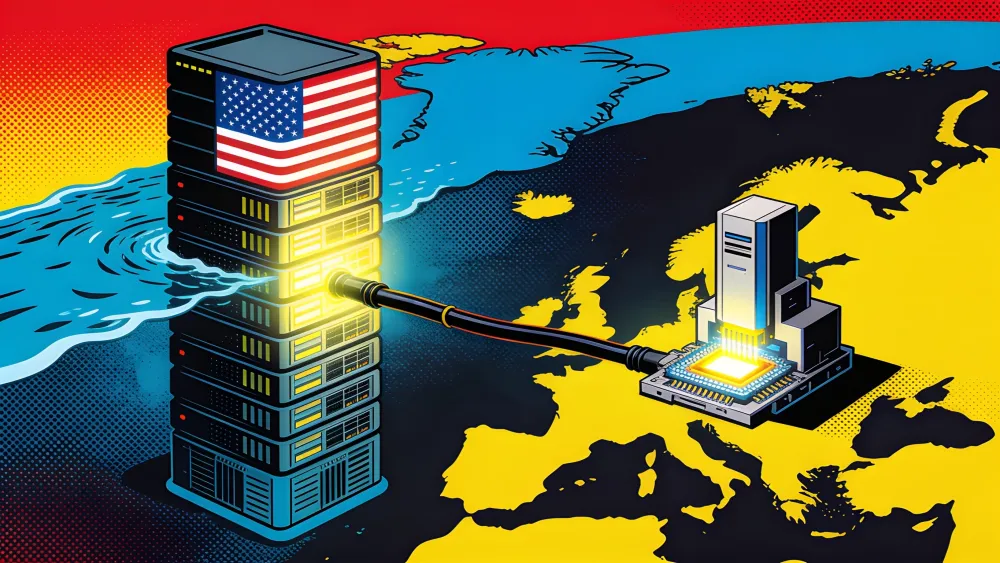
The number at the center of that scenario is shakier than its virality suggests, and the panic it fed treats European dependence as a single wall to climb. It is not. It is a stack of separate exposures, each with a different owner, a different exit and a different price. In some layers Europe has no near-term substitute for American suppliers. In others it could substitute at high cost over years. In a few, the dependence runs the other way, and Washington and Silicon Valley need Europe more than the reverse. The honest finding is that Europe is most exposed in the layers it argues about most, frontier compute, hosted models and cloud, and most protected in the ones it rarely raises in sovereignty speeches. The Anthropic order showed what the hard layer costs. The question worth asking is not whether Europe depends on America, but which layer, in which direction, at what price, and over what timescale.
What Changed
- On June 12, a U.S. export order forced Anthropic to disable Fable 5 and Mythos 5 for every customer worldwide within hours, days after the EU won access.
- A viral Brussels scenario pegs Europe at about 5% of global AI compute against roughly 80% for the United States, a soft number over a real, widening gap.
- AWS, Microsoft and Google hold 70% of Europe's cloud market; EU providers fell from 29% in 2017 to about 15% and stalled there.
- ASML is the only maker of EUV lithography systems, with Germany's Carl Zeiss SMT its sole optical-column supplier.
AI-generated summary, reviewed by an editor. More on our AI guidelines.
Key Takeaways
- Permission, not price: A hosted U.S. model can vanish globally when a U.S. agency changes who may use it, as Anthropic's June shutdown showed.
- Layered, not monolithic: European dependence is a stack of separate exposures, each with a different owner, exit and timescale.
- Loud where weak: Europe argues sovereignty hardest in frontier AI, the layer where it has the least to bargain with.
- The chokepoint runs upstream: ASML and Zeiss give Europe a veto over advanced-chip manufacturing that no rival can route around.
- Money sets the ceiling: One OpenAI round outweighed the entire Chips Act pipeline several times over, which is why rhetoric outruns delivery.
- Residency is not jurisdiction: U.S. law reaches U.S.-controlled providers even when the data sits in Frankfurt.
- Substitutable is not free: Cloud and payments can be replaced over years, not overnight, because the cost is architecture and habit.
The number everyone repeated, and where it comes from
The 5%-versus-80% split traveled faster than its sourcing. It came from the Arq Foundation scenario, the work of a team of European researchers including research director Daan Juijn and Maximilian Negele, who left the RAND think tank to join the project, and it leaned on a single arresting comparison: the largest American AI supercomputer draws about 1,250 megawatts, against 83 megawatts for the largest European one. By that one measure the biggest U.S. system pulls roughly fifteen times the power of Europe's best.
The cleaner sourced version of the gap is less tidy and more defensible. The State of Global AI Compute report compiled by GeoCoded drew on Epoch AI and Georgetown datasets that together cover only an estimated 10% to 20% of global AI-oriented compute. Within that partial view, the United States held 74.5% of AI supercomputer performance, China 14.1%, and the European Union 4.8%. The same report noted that the broader Top500 list, which measures public high-performance computing rather than private AI clusters, gives the United States 48.4% of aggregate performance. Even that more generous measure puts American capacity at roughly ten times the EU's narrow AI-supercomputer share.
So the viral figure is directionally right and numerically soft. Private clusters are not fully observable. Some trackers count public exaflops, some count known AI supercomputers, some infer capacity from data-center power draw, and each method captures a different slice. Treating 5% and 80% as a census overstates what anyone can measure; treating the gap as several-fold and widening is well supported. Juijn himself pushed back on the instinct his own numbers provoke. "We've seen multiple well-known voices say things like we need to build our own European Mythos," he said. "It really underestimates how difficult it is."
That caution is the useful part. The headline figure invites a single response, a European champion to match the American ones, when the evidence argues for something more selective. Before deciding what to do about dependence, it helps to separate market share from chokepoint power. A large foreign share is not automatically a hard chokepoint if a buyer can switch suppliers, even at painful cost. A smaller position can be a hard chokepoint if no one else makes the part, or grants the permission, that lets the work proceed. The Anthropic order was a permission problem. Most of the rest of the stack is a supplier problem, and the two have very different exits.
I — COMPUTE
Why the compute gap keeps widening
The reason Europe cannot close the compute distance with a single program is visible in the capital flows. On March 31, 2026, OpenAI said it had closed $122 billion in committed funding at an $852 billion post-money valuation, and described compute as a strategic advantage with Nvidia remaining the foundation of its training fleet. CNBC counted more than $380 billion in combined capital expenditure expected from Google, Microsoft, Meta and Amazon in a single year after they raised guidance, most of it on AI and data-center build-out. Stanford's 2025 AI Index put U.S. private AI investment at $109.1 billion in 2024, nearly twelve times China's $9.3 billion and about twenty-four times the United Kingdom's $4.5 billion.
Set those against Europe's flagship semiconductor program. The European Commission reports that the Chips Act has drawn more than €32 billion in approved public and private investment across thirteen first-of-a-kind facilities. That is real money, spread across technologies, member states and years. It is also smaller than OpenAI's single funding round by a wide margin: at current exchange rates the four U.S. hyperscalers expected to spend in one year more than ten times the entire Chips Act pipeline, and OpenAI raised in one round more than three times it. No EU member state and no EU-level instrument is operating anywhere near that scale.
The dependence here is not purely a Silicon Valley story, though the Valley sits at its center. Nvidia is the core merchant supplier of accelerators; Google, Meta, OpenAI and Anthropic are the Bay Area or Bay Area-adjacent labs setting the frontier; Apple and Google run the client platforms that generate inference demand. Microsoft and Amazon sit outside Silicon Valley, but their cloud and AI spending amplifies the Valley's chip and model suppliers rather than competing with them. For a European buyer, a near-term break from American AI compute would mean accepting lower capability, paying more to rent capacity through U.S. clouds, or running public EuroHPC systems that still depend on American accelerators.
This is the layer where substitution is hardest. A European bank can run a controllable assistant on a smaller open-weight model. It cannot reproduce the full frontier stack without foreign accelerators, foreign foundry capacity and foreign cloud integration. The realistic horizon for meaningful domestic capacity is five to ten years, and more than a decade for an indigenous accelerator base able to steer the supply chain the way an American hyperscaler can by committing tens of billions in a single procurement cycle. The scenario authors understood this, which is why they recommended buying bargaining position rather than chasing parity. That position assumes Europe holds something the other side wants, which it does, in the layers the compute debate tends to skip.
II — LITHOGRAPHY
The tool Silicon Valley cannot build without Europe
Europe has no independent leading-edge logic foundry to rival TSMC, Samsung or Intel. TrendForce found that only those three were actively advancing sub-7nm process nodes, with TSMC holding 64.9% of the global foundry market in the third quarter of 2024. The planned European Semiconductor Manufacturing Company (ESMC) fab in Dresden, a joint venture of TSMC, Bosch, Infineon and NXP, adds capacity but not an independent European leading-edge maker. Intel's cancelled Magdeburg project, which the company abandoned after concluding it had committed too much too soon without demand, per Brussels Signal, showed that announced industrial policy does not by itself produce a fab. Capacity needs customers, power, process knowledge, tool allocation and years of ramp.
Then comes the part of the stack where Europe sets the terms. ASML, based in the Netherlands, says it is the world's only manufacturer of extreme ultraviolet (EUV) lithography systems, the machines required to print the smallest features on advanced chips. ASML's own annual report identifies Carl Zeiss SMT in Germany as its single supplier of the optical columns those systems depend on, with production tied to facilities in Oberkochen and Wetzlar. A leading-edge fab can in principle choose among TSMC, Samsung and Intel as a manufacturing partner. It cannot choose a non-ASML EUV scanner if it wants to produce at the advanced node, and ASML cannot build one without Zeiss optics. That is one of the few genuine hard chokepoints in the entire global technology stack, and it points from Europe outward.
The design layer sits beside that chokepoint and complicates it. SemiAnalysis estimates that the three vendors of electronic design automation (EDA) software, the tools every advanced chip is designed with, hold more than 85% of the market combined, and values the 2025 EDA and IP business at about $18 billion. Two of the three, Synopsys and Cadence, are American; the third, Siemens EDA, is European-owned and strongest in physical verification. Washington has already shown through its China controls that it treats access to those tools as a national-security instrument. A European chip designer cut off from Synopsys and Cadence would struggle to finish an advanced design even with a foundry slot in hand. A U.S. or Asian fab cut off from ASML's EUV scanners would have no commercial replacement at all. The dependence runs both ways. A cutoff by either side would rebound onto its own industry, which is what has kept the standoff stable through three years of export-control pressure.
The reverse position is not clean sovereignty, and it would be a mistake to read it that way. ASML itself relies on outside vendors for components, often from a single or limited supplier, and its chain runs through the United States, Japan, Taiwan, South Korea and Germany. Its customers are global, and Dutch export policy on China has already been pulled into Washington's orbit. Europe can say no at the lithography layer, and the world has no quick answer when it does. It cannot turn that single chokepoint into a full semiconductor independence strategy, because the same machine depends on American and Asian parts and Asian buyers. The bargaining power is real and durable for this decade. The sovereignty conclusion often drawn from it is too broad.
Europe can say no at the lithography layer, and the world has no quick answer when it does.
III — INDUSTRY
Where dependence is mostly rhetoric
The AI-chip debate tends to swallow a category where Europe is plainly strong. Power, automotive and industrial semiconductors make cars, factories, grids and weapons work, and here the dependence claim mostly inverts. Infineon, citing TechInsights, put its 2024 share at 13.5% of the global automotive semiconductor market and 14.1% in Europe, where it ranked first, and its global automotive microcontroller share at 32% in a market worth $68.4 billion that year. NXP, rooted in the Netherlands, is central in automotive microcontrollers, radar and secure elements. STMicroelectronics matters in silicon carbide, sensors and industrial components. Bosch runs its own semiconductor production for automotive and industrial systems.
None of those firms replaces Nvidia or TSMC, and none pretends to. What they provide is real position in the chips behind electric vehicles, power conversion, factory automation and defense supply chains. American and Asian carmakers and industrial firms need European power and automotive silicon. To say Europe depends on Silicon Valley for these the way it depends on it for AI accelerators is rhetorical. The more honest risk in this category is global capacity and materials exposure, silicon carbide, gallium nitride, mature-node fabs and packaging, which Europe can expand over two to five years from a position of existing strength rather than from scratch.
Connectivity splits the same way. In subsea and long-haul capacity, American hyperscalers have become the center of gravity. TeleGeography found that content and cloud providers, specifically Google, Meta, Microsoft and Amazon, were the largest users of network capacity worldwide and accounted for more than 70% of all bandwidth usage as of 2023, and that Google alone owned fifteen active and planned private cables. Model training, inference and data replication all ride on private capacity that American firms increasingly own. In telecom equipment, the picture reverses again. Omdia, cited by TelecomTV, put the 2025 radio-access-network market at about $35 billion, with Ericsson the largest vendor outside China and Ericsson and Nokia both among the top suppliers in Europe, where the top five vendors hold about 95% of the market. Europe's network-security argument has been about Huawei and ZTE, not about any shortage of European vendors. A European carrier can buy Ericsson radios and still depend on American cloud regions and traffic patterns; an American hyperscaler can own transatlantic cable and still land it on European shores under European regulation. The two sides are tangled rather than ranked.
Track the AI sovereignty fight with us
Strategic AI news from San Francisco. No hype, no "AI will change everything" throat clearing. Just what moved, who won, and why it matters. Daily at 6am PST.
No spam. Unsubscribe anytime.
IV — CLOUD
The dependence nobody notices until the bill arrives
Cloud is the broadest everyday exposure because it sits under nearly everything else: enterprise software, AI services, developer tools, security and public-sector modernization. Synergy Research traced a sixfold rise in the European cloud market between 2017 and 2024, to €61 billion, while European providers' local revenues only tripled. The result was a share collapse: European providers fell from 29% of their home market in 2017 to about 15% in 2022, and have held near 15% since, while AWS, Microsoft and Google together account for 70%. SAP and Deutsche Telekom each hold about 2%. The European Parliament's 2025 brief on software and cyber dependencies reaches the same order of magnitude and adds that around 80% of EU corporate spending on software and cloud flows to U.S. vendors.
German firms increasingly name that dependence themselves. Bitkom, the German digital-industry association, reported in November 2025 that 89% of companies importing digital goods or services felt dependent on them, and that the share calling themselves strongly dependent on the United States had risen to 51% from 41% at the start of the year. Public budgets pull the same way: federal spending on cloud services roughly doubled from €136 million in 2021 to €286 million in 2024 and was expected to reach at least €344 million in 2025, most of it going to Amazon, Microsoft, Google and Oracle, according to the news site netzpolitik.org. Research for Germany's network regulator put AWS's share of the European infrastructure market at 53%, above its global share.
The binding part is not the rented server, which is portable. It is the layer of proprietary services built on top: identity, databases, data warehouses, serverless functions, AI interfaces, security tooling and workflow products that assume an American provider's environment. Moving a virtual machine is easy. Moving a decade of application architecture, compliance processes and staff habits is not. The same trap shows up one layer higher, in operating systems and productivity software. The Parliament brief notes that Android and iOS command almost all mobile operating-system use, Windows holds 73% of the desktop, Google Search exceeds 89%, and Microsoft, Oracle, Salesforce and IBM dominate productivity, CRM and analytics, with SAP the only European vendor of comparable scale. The switching cost there is document formats, identity directories, device management, audits, training and every partner integration that presumes a Microsoft, Google or Apple environment.
Europe is not absent at the application layer. SAP posted FY2025 cloud revenue up 23% and Cloud ERP Suite revenue up 28%. Dassault Systèmes is a global force in engineering and product-lifecycle software. Adyen, based in Amsterdam, disclosed €1.394 trillion in processed volume for full-year 2025. These are world-class businesses. They also sit mostly on top of American operating systems, clouds, mobile platforms and search, the layers that set reach, distribution and default settings for everything built above them.
The policy response is moving from slogans to criteria, slowly. Gaia-X, once pitched as a sovereign-cloud answer, has produced trust frameworks and more than fifteen European data spaces but no European AWS and no reversal of the market-share loss; it became a governance program, not a hyperscaler. The newer proposal, the Cloud and AI Development Act, is more concrete. The law firm Wilson Sonsini, in its analysis of the proposal, wrote that it aims to triple EU data-center capacity within five to seven years and would create four assurance levels for public cloud use, ranging from basic safeguards up to protection against non-EU control and foreign legal risk. Procurement can change demand faster than a startup can build scale. It also carries a two-sided failure risk: rules too weak let American hyperscalers keep the market under a sovereign label, and rules too strict without performance support push public buyers toward providers that cannot run modern AI workloads.
V — MODELS
What the Anthropic order actually proved
Foundation models are the layer where the Valley dependence is most politically visible, and where the June shutdown landed hardest. Stanford's AI Index counted 40 notable AI models from U.S. institutions in 2024, against 15 from China and three from Europe. The European entrants are real, Mistral, Aleph Alpha, DeepL and the image specialist Black Forest Labs, and they matter for sovereign, banking and enterprise uses where control and local deployment outweigh raw benchmark leadership. They do not yet remove dependence for frontier coding, advanced cybersecurity or agentic workflows, and the capital gap that drives the compute distance is the same one that limits how fast they can close.
The Anthropic episode turned that abstract dependence into an observed event, and the dispute behind it is worth following because it shows how the lever works. Anthropic released Fable 5 publicly on June 9, describing it as the first generally available model in its "Mythos-class" tier, with classifiers meant to block high-risk cybersecurity tasks; the less restricted Mythos 5 went only to vetted partners in its Project Glasswing program. According to reporting by Axios and the Wall Street Journal, Amazon chief executive Andy Jassy personally flagged a jailbreak technique to senior officials, after which Lutnick sent the enforcement letter on June 12. Reuters reported on June 15 that Lutnick said he acted because officials feared the models could be diverted to military intelligence users in China, Russia or other countries of concern. Separately, technology-press accounts pointed to a classified June 11 briefing, not independently confirmed, in which NSA Director General Joshua Rudd reportedly told Senator Mark Warner the Mythos model autonomously breached nearly all of the NSA's classified systems in a red-team exercise within hours, one day before the directive landed.
Know someone who'd find this useful? ✉️ Email it to a friend in one click, or they can subscribe free here.
Anthropic disputed the rationale rather than the facts of the order. The company said the cited concern was a narrow, non-universal bypass involving a prompt that asked the model to read a specific codebase and identify flaws, that comparable capability was available from publicly deployed models including GPT-5.5, and that applying the government's standard across the industry would, in its words, "essentially halt all new model deployments." White House adviser David Sacks countered that Anthropic had spent years arguing its Mythos systems were close to cyber weapons and then released one with guardrails it would not fully fix, framing the control as a consequence of the company's own choices.
The dispute sat on top of two other frictions: a June 2 executive order that asked AI companies to voluntarily submit frontier models for government review before release, which Anthropic's June 9 launch did not do, and a separate lawsuit in which Anthropic is challenging a Pentagon order barring federal agencies from using its tools, where a judge has blocked enforcement while litigation continues. Anthropic sent senior staff to a June 15 meeting with Commerce and the National Cyber Director's office that ended without resolution, and Lutnick and Anthropic chief executive Dario Amodei were both due at the G7 in Evian-les-Bains, France, where talks were expected to continue.
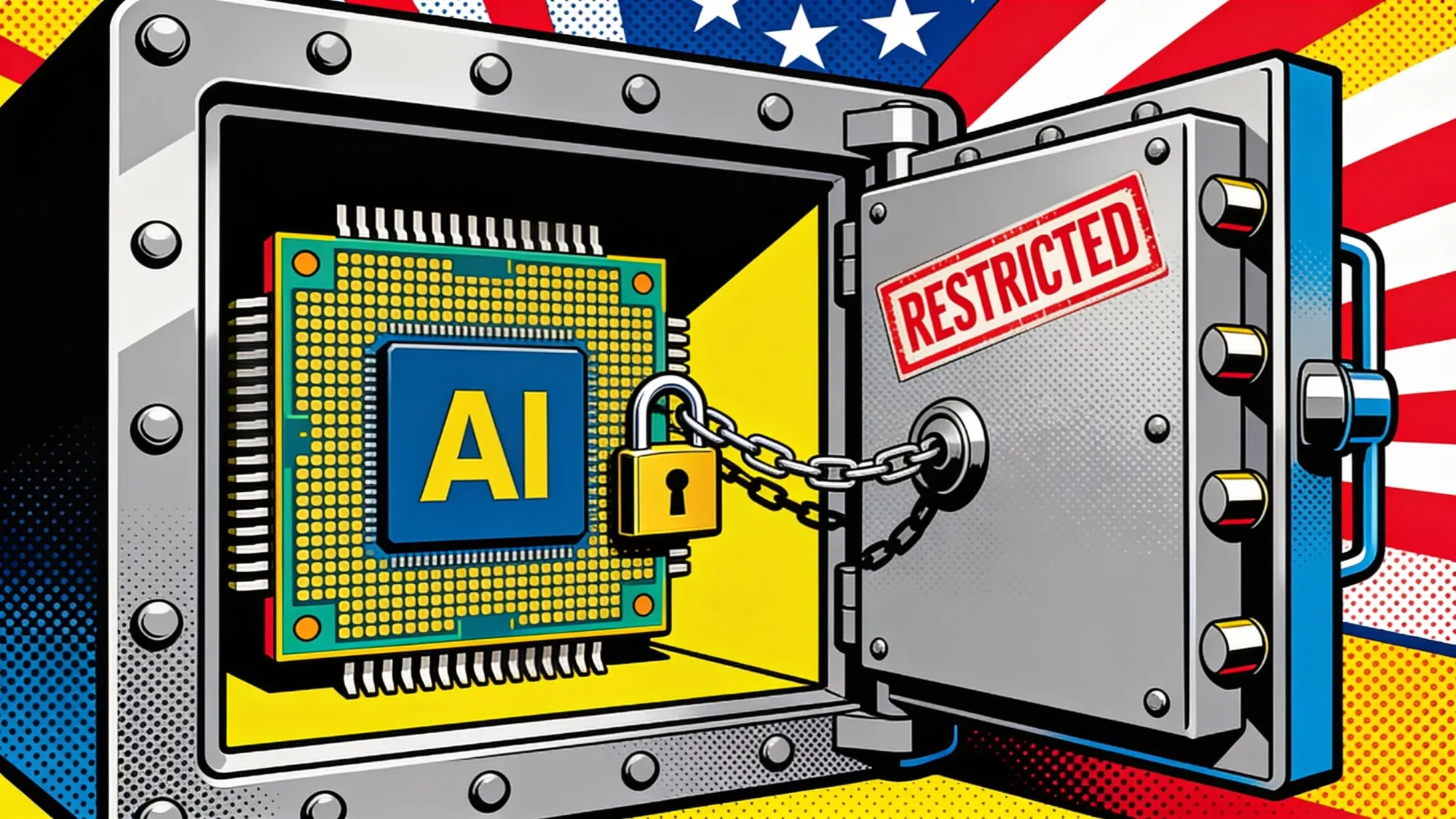
The narrow legal facts may stay contested. The dependence lesson does not turn on them. A model delivered as a hosted service by an American company can be withdrawn from every customer in the world because a U.S. authority changes the permission structure, and the holder of the service has to comply within hours. Europe experienced that as a consumer with no vote. The European Union, which had spent weeks negotiating access to the Mythos tier, lost it within hours and could say only that it was assessing.
That legal exposure is its own layer, and it is the one residency rules cannot fix. A European company can store data in Frankfurt and still face American legal reach if the provider is a U.S.-controlled firm. The European Parliament brief states plainly that the CLOUD Act and U.S. sanctions can allow access to European data even when it is stored locally. The European Commission's first periodic review of the EU-US Data Privacy Framework found the framework currently provides adequate protection, while acknowledging that Section 702 of the Foreign Intelligence Surveillance Act still permits targeting non-U.S. persons believed to be abroad. The Schrems litigation history means that adequacy is a legal and political question rather than a settled one. Europe can narrow the exposure fastest by specifying control, key management, support access and subcontractor rules for sensitive workloads, the approach our earlier reporting on Europe's data-trust problem traced through the Cloud Act rather than any single administration. It cannot make a U.S.-controlled provider free of U.S. law by requiring European data centers.
Europe has already watched that exposure turn operational. After the United States sanctioned International Criminal Court chief prosecutor Karim Khan in 2025, he lost access to his Microsoft email account, the German broadcaster Tagesschau reported, and the court's registrar, Osvaldo Zvala Giler, told reporters the institution had to reduce its dependencies and strengthen its technological autonomy. Asked at a French Senate hearing whether he could guarantee under oath that data held in the European Union would never reach American authorities, a senior Microsoft executive answered that he could not. The Anthropic order in June applied the same logic to model access rather than stored data, which is why a Commission already drafting cloud-sovereignty rules treated it as confirmation rather than surprise.
Payments show the same split between sovereign infrastructure and exposed interface. Europe owns its account-to-account rails through SEPA and the Eurosystem, but the consumer layer leans on American card schemes. The European Central Bank recorded 44.0 billion card payments inside the euro area in the first half of 2025, worth €1.7 trillion and accounting for 57% of non-cash transactions. Its report on card schemes found that international schemes handled about 61% of euro-area card payments in 2022, that thirteen euro-area countries rely entirely on international schemes for card transactions, and that none of the processors operating across EU borders can be identified as fully EU-owned. The ECB itself wrote that this raises questions about operational resilience and strategic autonomy. The European response, the Wero wallet developed by the European Payments Initiative and backed by European banks, is moving from peer-to-peer payments toward e-commerce and, on its roadmap, point-of-sale payments in 2026 and 2027. It is a substitutable dependence, not a hard chokepoint, because the euro-area banking system sits underneath the card layer. Card acceptance is wired into merchant terminals, fraud systems and cross-border settlement rules, which is why the ECB casts Wero's challenge as adoption rather than technology.
VI — THESIS
The map Europe should be using
The structural reason policy rhetoric keeps outrunning delivery is the money gap, and it is worth stating in plain terms. One American AI company raised more in a single round than the entire European Chips Act pipeline; four American firms expected to spend more than ten times that pipeline in one year. Against that, a €32 billion chips program spread across technologies and member states cannot buy parity with TSMC or Nvidia, and it was never going to. What it can do is support the places where Europe already has position: power devices, packaging, specialty processes and the optics and tools that the rest of the world cannot replace.
That points to the actual map. Europe's hardest dependence is concentrated and short-horizon in advanced AI compute, frontier hosted models, EDA at advanced nodes, the entrenched operating-system and productivity layer, and the legal exposure that follows U.S.-controlled providers. Its high-cost but workable dependence is in cloud infrastructure, payments and subsea capacity, all replaceable over years rather than overnight. Its genuine bargaining strength is upstream and industrial: EUV lithography through ASML and Zeiss, electronic-design tools through Siemens, automotive and power chips through Infineon, NXP, STMicroelectronics and Bosch, and telecom equipment through Ericsson and Nokia. Europe argues sovereignty hardest in the layer where it has the least to bargain with, while the lithography and chip layers where it could set terms rarely surface in the same speeches.
The corrective is not a single sovereign-tech slogan or a champion picked to match each American firm. It is a layered map that treats a permission problem and a supplier problem differently. The Anthropic order was a permission problem, and the only durable answer to it is either a model Europe controls outright or a contract that cannot be revoked from Washington, neither of which exists today for frontier capability. Cloud lock-in is a supplier problem, and it yields to portability rules, exit guarantees and procurement that rewards control without pretending a sovereign label fixes legal reach. The ASML chokepoint is bargaining strength, and its best use is exactly what the Arq scenario implied without quite saying: a card to play in allied technology policy, not a veto to wave. Germany's digital minister, Karsten Wildberger, gave the honest version in a June interview with ZDF, calling Europe "too dependent today" while rejecting any push to cut the United States off. The week after June 12 produced fresh calls for a homegrown Mythos and more backing for Mistral. The more useful conversation is about what Europe already holds that Silicon Valley cannot.
VII — SIGNALS
What to watch
Whether the four assurance levels survive into a final text with real teeth on foreign legal control, or get softened into branding. Wilson Sonsini's read of the proposal is the early baseline; the data-center tripling target over five to seven years is the number to track.
Whether the Commerce directive is lifted, narrowed or made permanent after the G7 talks, and whether the export-control tool spreads to other labs. Politico reported that the approach could expand to other labs as their models reach Mythos-class capability, with OpenAI named as the clearest candidate.
The European Payments Initiative's 2026 and 2027 rollout schedule for in-store and subscription payments. Adoption, not launch, is the test, and it depends on merchant economics rather than sovereignty language.
Whether Europe secures dedicated frontier-training capacity on its own soil with clear access rules for startups and researchers, or keeps renting capability through American clouds.
The ramp of the TSMC-Bosch-Infineon-NXP venture, the clearest test of whether Europe can add advanced-adjacent capacity where it has plausible strength rather than chasing leading-edge ownership it cannot yet finance.
Frequently Asked Questions
What did the U.S. do to Anthropic's models in June 2026?
On June 12, 2026, the Commerce Department issued an export-control directive barring any foreign national, inside or outside the United States, from using Fable 5 and Mythos 5. Because Anthropic could not filter users by nationality, it disabled both models for every customer worldwide. Other models, including Opus 4.8, kept running. Anthropic called the move a misunderstanding and began negotiating to restore access.
Is Europe really at 5% of global AI compute?
The 5%-versus-80% split came from the Arq Foundation's Europe 2031 scenario and is directionally right but numerically soft. A better-sourced dataset covering only 10% to 20% of AI compute showed the U.S. at 74.5% and the EU at 4.8%. The exact share is uncertain because private clusters are not fully observable, but the several-fold gap is well supported.
Where does Europe hold bargaining power over the United States?
Upstream and in industry. ASML, in the Netherlands, makes the world's only EUV lithography systems, and Germany's Carl Zeiss SMT is its sole optical-column supplier. Europe is also strong in automotive and power chips through Infineon, NXP, STMicroelectronics and Bosch, and in telecom equipment through Ericsson and Nokia. These are the layers Silicon Valley cannot easily route around.
Can data residency fix Europe's legal exposure?
No. The European Parliament notes that the CLOUD Act and U.S. sanctions can reach data held by a U.S.-controlled provider even when stored in Europe. The EU-US Data Privacy Framework is currently adequate, but Section 702 of FISA still permits targeting non-U.S. persons abroad. Reducing exposure requires changing control, key management and provider, not just where servers sit.
What is the EU doing about cloud and payment dependence?
The proposed Cloud and AI Development Act aims to triple EU data-center capacity within five to seven years and sets four assurance levels for public cloud, up to protection against non-EU control. On payments, the Wero wallet from the European Payments Initiative is moving toward point-of-sale use in 2026 and 2027. Adoption, not launch, is the test.
AI-generated summary, reviewed by an editor. More on our AI guidelines.
Sources & Further Reading
Primary Sources
- Statement on the directive to suspend access to Fable 5 and Mythos 5 — Anthropic, June 2026
- OpenAI raises $122 billion to accelerate the next phase of AI — OpenAI, March 31, 2026
- European Software and Cyber Dependencies — European Parliament Research Service, 2025
- European Chips Act — European Commission, DG CONNECT, 2026
- First periodic review of the EU-US Data Privacy Framework — European Commission, 2024
- Report on card schemes and processors — European Central Bank, 2025
- The 2025 AI Index Report: Economy — Stanford HAI, 2025
- Infineon bolsters global lead in automotive — Infineon Technologies, 2025
Research & Analysis
- State of Global AI Compute (2025 Edition) — GeoCoded, 2025
- EDA Market Primer: Cadence, Synopsys, Siemens — SemiAnalysis, 2026
- European Cloud Providers' Local Market Share Holds at 15% — Synergy Research Group, 2025
- Proposal for an Act to Reduce Reliance on Foreign Cloud and AI — Wilson Sonsini, 2026
Further Reading
- US saw risk of Anthropic models being diverted to foreign military intelligence — Reuters, June 15, 2026
- Trump's Anthropic restrictions may be illegal — Politico, June 18, 2026
The European Debate (German-language)
- Europe's dependence on US tech: the ICC case and the French Senate hearing — Tagesschau, 2025
- Europe's path to digital sovereignty (dependence survey) — Bitkom, 2025
- Administration in the cloud: the federal government grows dependent on Amazon and others — netzpolitik.org, 2025
- Wildberger on digital dependence: "We are too dependent today" — ZDFheute, 2026
Free AI briefing · Weekdays
The AI stories that matter, sourced and explained.
Join the Morning Briefing. It goes out every weekday at 4:45 a.m. Pacific, with later sends for the East Coast, Berlin and Tokyo.
Free when you sign up: The Paperclip Compendium, our tested guide to running AI agents.
Free. Unsubscribe in one click.

Marcus Schuler
Editor-in-Chief and founder of Implicator.ai. Former ARD correspondent and senior broadcast journalist with 10+ years covering tech. Writes daily briefings on policy and market developments. Based in San Francisco. E-mail: editor@implicator.ai