Implicator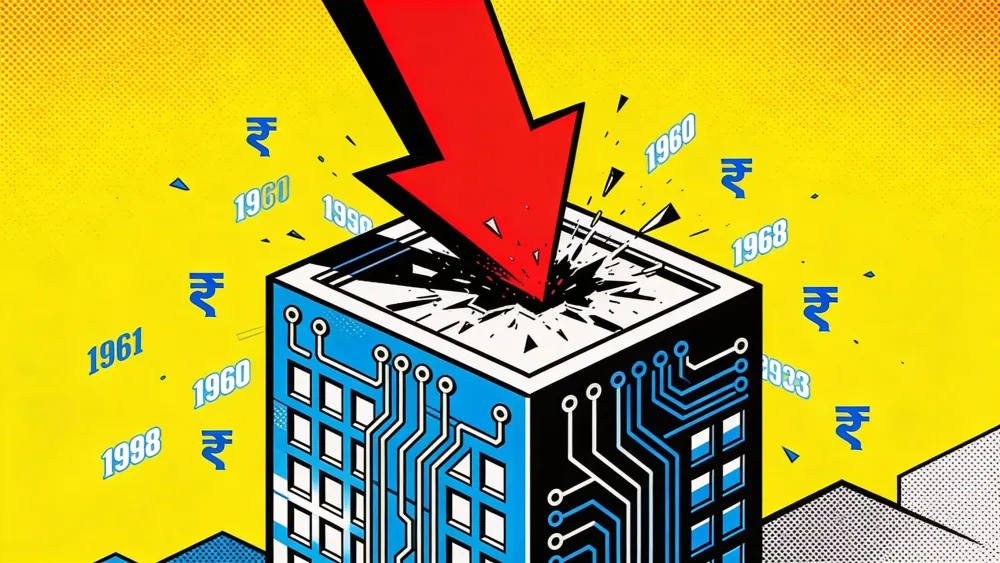
Fractal Analytics dropped as much as 5% in its Mumbai trading debut on Monday, capping a rough start for India's first pure-play artificial intelligence company to go public. Shares opened at ₹876 on the National Stock Exchange, below the issue price of ₹900, and kept sliding through the afternoon session. The company had already slashed the size of its offering by more than 40% earlier this month, from ₹49 billion to ₹28.34 billion ($313 million), after its bankers advised a more conservative pricing.
The Breakdown
• Fractal Analytics shares fell 5% in Mumbai debut, valuing the company at $1.6 billion, down from $2.4 billion in private markets seven months ago.
• The company slashed its IPO size by more than 40% to ₹28.34 billion ($313 million) after bankers advised conservative pricing.
• Employee subscriptions reached just 0.65 times their reserved portion, while retail investors barely cleared 1.1 times.
• Nearly two-thirds of the capital raised went to existing shareholders through an offer-for-sale, not into the company.
The debut put a number on a fear that has been rattling Indian markets for weeks. Software and IT stocks just had their worst stretch in 10 months, driven by anxious investors convinced that AI tools will cannibalize the outsourcing and analytics businesses that built India's tech sector. Fractal is backed by global investors TPG, Apax Partners, and Gaja Capital. It sells AI solutions to some of the world's largest corporations. And it still got caught in the downdraft from the very technology it packages.
The offering that shrank
Fractal's path to the public market looked different six months ago. The company raised $170 million in a secondary sale last July at a valuation of $2.4 billion. It had first crossed the billion-dollar mark in early 2022, when TPG invested $360 million, making it India's first AI unicorn.
That momentum didn't carry forward. CEO Srikanth Velamakanni told Reuters the company's bankers advised leaving "money on the table." A defensive move, and a polite way of saying the market wouldn't pay what Fractal had expected. So the original ₹49 billion offering got chopped to ₹28.34 billion. Even at that reduced size, the IPO was fully subscribed only on the final day of bidding, at 2.66 times overall.
The subscription breakdown told a clearer story. Qualified institutional buyers put in bids at 4.41 times their quota. Cautious retail investors barely showed up, at 1.1 times. Employees were even more reluctant, subscribing at just 0.65 times their reserved portion. When the people working at a company aren't rushing to buy its shares at IPO price, that says something about how the valuation looks from the inside.
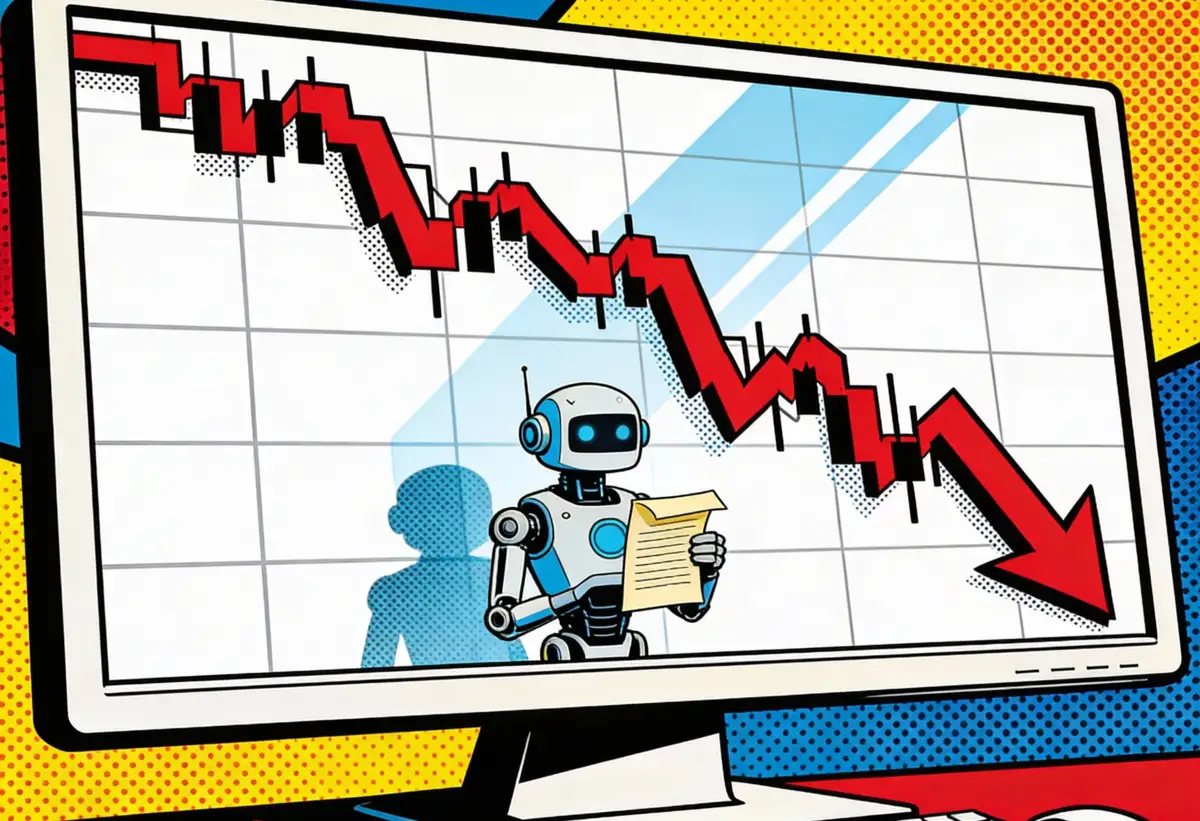
On the BSE, shares opened flat at ₹900, right at the issue price. On the NSE, they came in at ₹876, already below water. By midday, shares were trading around ₹855, according to Bloomberg, giving Fractal a market capitalization of roughly $1.6 billion. Seven months ago, private investors valued the company at $2.4 billion. The public market just marked it down by a third.
When AI eats its own
The uncomfortable part of Fractal's story is what the company actually does for a living. One arm, Fractal.ai, sells AI products and advisory work to large enterprises. The other, Fractal Alpha, incubates new businesses and absorbs acquisitions. Microsoft and Alphabet sit on the client roster. So do Fortune 500 firms in healthcare, telecom, and consumer goods. Most of that revenue lands from overseas. The U.S. writes the biggest checks. India should be throwing a parade for this company.
The pitch sounds simple. We help big enterprises make better decisions using data and artificial intelligence. Investors looked at that pitch on Monday and saw a business that might be sitting on the wrong side of a line it helped draw.
"The premium that Fractal Analytics' shares commanded in the unlisted market more than a week ago had disappeared due to fears of AI-driven disruption in traditional software and data analytics companies," Vipul Bhowar of Waterfield Advisors told Reuters.
Bhowar went further during CNBCTV18's listing coverage. He pointed specifically to tools built by companies like Anthropic as a source of investor nervousness. The concern isn't abstract. Large language models can now write SQL queries, generate dashboards, summarize datasets, and produce the kind of business analysis that used to require a team of consultants and a six-month contract. For a company like Fractal, which built its business on selling exactly those services, the threat is direct. When a wealth management firm names a specific AI lab while explaining why an AI company's stock is falling, you're watching a market try to sort out who gets eaten and who does the eating.
Fractal's own history complicates the question. The company has been around since 2000. For twenty years it did traditional consulting, the kind where you send analysts into a room with spreadsheets. Then came the AI rebrand in 2022. ChatGPT had just landed. Suddenly everyone wanted the letters A and I on the label. Revenue from operations grew 26% to ₹27.65 billion (roughly $305 million) through March 2025. Fractal flipped from a ₹547 million loss to a ₹2.21 billion profit. Strong numbers. But strong numbers for a 25-year-old analytics firm with an AI label read differently than strong numbers for a company born into the generative AI era. Investors are trying to figure out which one they just bought.
Bad timing, even by IPO standards
Fractal had the misfortune of listing during a week when India wants to talk about nothing but artificial intelligence. The government is hosting the AI Impact Summit in New Delhi, with global tech executives and policymakers filling conference rooms. Sam Altman said India now has 100 million weekly active ChatGPT users. Anthropic opened a Bengaluru office last month, tapping a former Microsoft India managing director to lead the expansion. Google, Microsoft, and Amazon have been pouring money into Indian AI operations for over a year, building data centers and hiring engineering teams across Hyderabad, Bengaluru, and Mumbai.
Stay ahead of the curve
Strategic AI news from San Francisco. No hype, no "AI will change everything" throat clearing. Just what moved, who won, and why it matters. Daily at 6am PST.
No spam. Unsubscribe anytime.
All of that investment should, in theory, help a domestic AI company going public. More AI spending in India should mean more demand for local analytics expertise. Higher demand, higher valuations. That's the logic, anyway.
Investors broke that chain. The parade of well-funded American AI labs entering India highlighted how much competition Fractal would face. OpenAI, Anthropic, and Google aren't just selling to Indian enterprises. They're building the tools that could replace the services companies like Fractal provide. Competitors carrying hundreds of billions in market cap, offering AI capabilities baked into products that enterprises already pay for. The question stops being whether Fractal's revenue is growing. It becomes whether that revenue will still exist in five years.
Mahesh M Ojha of Kantilal Chhaganlal Securities told CNBCTV18 that pricing "appears reasonable given the sector's growth prospects," but added that the business "carries elevated risk" and is "suitable for investors with a higher risk appetite." Fresh investors, he said, may prefer to wait for price discovery after listing. Not exactly a buy signal.
What the offer-for-sale reveals
Of the ₹2,834 crore total offering, ₹1,810 crore came from an offer-for-sale by existing shareholders. Nearly two-thirds of the capital raised went straight to early backers and insiders, not into the company.
Selling shareholders included Quinag Bidco (linked to Apax Partners), TPG affiliates, and members of the founding family. Promoter holding dropped from 18.18% to 16.98% after the listing. When the people who built a company and the private equity firms who backed it use an IPO primarily as an exit ramp, the message to public market investors is hard to miss.
Fractal said it would use the fresh-issue proceeds, about ₹1,024 crore, to pay down debt at its U.S. subsidiary, buy laptops, open new Indian offices, invest in R&D and marketing under its Fractal Alpha unit, and pursue unspecified acquisitions. Laptops and debt repayment. Not the kind of spending plan that makes growth investors reach for their wallets. Compare that to the AI companies Fractal competes with for attention: Anthropic has raised billions in venture capital, OpenAI commands a valuation measured in hundreds of billions, and Google pours tens of billions annually into AI infrastructure. Fractal is paying off loans and furnishing offices.
The hundred companies watching
Monday's debut mattered beyond Fractal's own ticker. Bloomberg reported that more than 100 prospective issuers in India have received regulatory approvals and are waiting for the right moment to list. Aye Finance, a lending company that also went public on Monday, fared even worse. Its shares dropped as much as 3.9% after its own downsized offering failed to reach full subscription.
India's stock market came off two record-setting years for IPO fundraising. That momentum stalled in 2026 as a broader market correction, fueled by foreign outflows and the software stock selloff, turned IPO windows into brick walls. A trade agreement with the United States earlier this month was supposed to crack things back open. Fractal and Aye Finance walked through and found nobody cheering.
For the AI and analytics companies in that pipeline, Monday's message was specific. You can have growing revenue, a legitimate client list, and a genuine AI business. The market still can't decide what those things are worth when the technology you depend on might also make you obsolete. No comparable Indian company trades on public markets, which means there's no benchmark, no peer group, no established framework for what an Indian AI firm should be valued at. Bhowar expects Fractal's shares to "consolidate around current levels until clarity emerges on the impact of AI on its business model."
That clarity won't come from one trading session or one earnings report. Fractal is now answering the valuation question in public, with a ticker symbol attached, in front of investors who can sell the moment they get nervous. The ₹876 opening price wasn't just a number on the NSE's board. It was a market's first attempt at pricing something India has never priced before. A domestic AI company whose biggest risk is AI itself.
Frequently Asked Questions
Q: What does Fractal Analytics actually do?
A: Fractal sells AI and data analytics products to large enterprises through two units. Fractal.ai handles AI advisory services for Fortune 500 clients including Microsoft and Alphabet. Fractal Alpha incubates new AI businesses and integrates acquisitions. Most revenue comes from overseas markets, with the U.S. as its largest source.
Q: Why did Fractal cut its IPO size by 40%?
A: CEO Srikanth Velamakanni said bankers advised leaving money on the table. Indian software and IT stocks had just suffered their worst stretch in 10 months, and investor appetite for AI-adjacent companies had weakened. The original ₹49 billion offering was reduced to ₹28.34 billion ($313 million).
Q: How does AI threaten an AI company like Fractal?
A: Large language models can now write SQL queries, generate dashboards, and produce business analysis that previously required consulting teams. Fractal built its business selling exactly those services. Analysts pointed to tools from companies like Anthropic as a direct source of investor nervousness about Fractal's long-term revenue.
Q: Who were the main sellers in Fractal's IPO?
A: Of the ₹2,834 crore total offering, ₹1,810 crore came from existing shareholders including Quinag Bidco (linked to Apax Partners), TPG affiliates, and founding family members. Promoter holding dropped from 18.18% to 16.98%. Only about ₹1,024 crore went to the company as fresh capital.
Q: What does Fractal's debut mean for other Indian IPOs?
A: More than 100 prospective issuers in India have regulatory approvals and are waiting to list. Fractal's weak debut, combined with Aye Finance dropping 3.9% in its own listing the same day, signals that India's two-year IPO boom has stalled in 2026 amid foreign outflows and software sector fears.
Harkaram Grewal
Maps the India–Germany–U.S. AI triangle from New Delhi. Background in cross-market operations and business development. Writes about supply chains, enterprise adoption, and talent—the unsexy forces that actually move global AI.