IMPLICATOR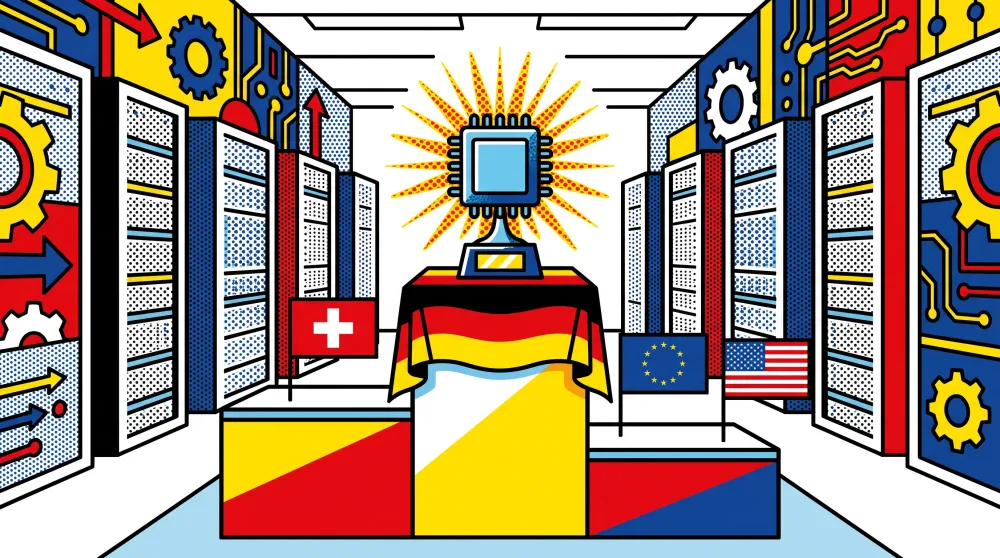
A German research consortium coordinated by the KI Bundesverband released Soofi S, an open-source German-English foundation model, this week, according to its pretraining report. In the team's tests, the model scored 79.1 on the German aggregate, beating every other fully open model in the comparison. Funded by Germany's Federal Ministry for Economic Affairs and Energy, the project's goal is an open European model family that runs on sovereign infrastructure and can be tested in industrial applications.
Key Takeaways
- A German consortium coordinated by the KI Bundesverband released Soofi S, an open-source German-English model that topped every fully open rival at 79.1 on the German aggregate benchmark.
- The 30-billion-parameter hybrid Mamba-MoE model activates about 3.2 billion parameters per token and trained on Deutsche Telekom's Munich data center using roughly 253,000 B200 GPU-hours.
- Qwen3.5 still leads on English and reasoning benchmarks, and critics say the training run duplicated most of Nvidia's Nemotron 3 Nano architecture at a high compute cost.
- Soofi S is not a public chatbot. Enterprises must apply for closed-beta access while the consortium seeks industry partners for its next phase.
Soofi leads fully open models at 79.1
The report compared Soofi S with 15 other open base models under the same evaluation harness. Within the fully open group, Soofi posted the highest English aggregate at 70.1 and the highest German aggregate at 79.1, finishing ahead of the Allen Institute for AI's Olmo 3 32B and the Swiss Apertus 70B. Its code results included 73.8 on HumanEval, 70.2 on MBPP, and 84.2 on MBPP-DE, all first-place scores among the fully open peers. It tied Qwen3.5 35B-A3B at 61.2 on INCLUDE-DE, a test of German regional knowledge.
Qwen3.5 belongs to the report's separate open-weight group, and it beat Soofi where the comparison gets harder. It led on the English aggregate, 74.6 to 70.1, and scored higher on the GPQA-Diamond and BBH reasoning tests. German competition mathematics produced a wider gap: Qwen3.5 scored 76.5 on Minerva MATH-DE, Gemma 3 27B reached 65.6, and Soofi recorded 56.0. On RULER's common-word extraction task, Soofi's hit rate fell to about 3% beyond 32,000 tokens of context, compared with 60% to 64% for the architecture-matched Nemotron baseline. The report attributes that result to the absence of synthetic extraction data in Soofi's long-context training set.
Nvidia's 52-layer design trains in Munich
Soofi adopts Nvidia's Nemotron 3 Nano reference design without modification. Its 52 layers comprise 23 Mamba-2 sequence-mixing layers, 23 granular mixture-of-experts layers, and six Grouped-Query Attention layers. The model has 31.6 billion parameters, with about 3.2 billion active for each token. Only the attention layers retain a KV cache, which the team notes keeps decode throughput high as context grows.
Training ran from March 24 to May 13, 2026, on Deutsche Telekom's Industrial AI Cloud in Munich. The run used as many as 512 Nvidia B200 GPUs and consumed about 253,000 B200 GPU-hours while processing roughly 27 trillion tokens. German accounted for 15.3% of the annealing-phase mix, compared with about 5% for all non-English languages in Nvidia's reference recipe. Deutsche Telekom says the facility runs on renewable energy, draws cooling water from the Eisbach canal, and supplies waste heat to the surrounding Tucherpark neighborhood.
Stay ahead of the curve
Strategic AI news from San Francisco. No hype, no "AI will change everything" throat clearing. Just what moved, who won, and why it matters. Daily at 6am PST.
No spam. Unsubscribe anytime.
Fromm answers the 253,000 GPU-hour criticism
Michael Fromm, Soofi's technical lead and head of pretraining data, acknowledged that Qwen3.5 leads on raw capability. "Our edge is capability + throughput + full openness," he posted on X.
Cloud Magazin described unnamed critics who estimated roughly 80% overlap with Nemotron's architecture and data mixture. They argued that continual pretraining from Nvidia's checkpoint would have required far less compute, and some called the report's self-defined capability index overstated. Fromm's team says training from scratch gave the consortium greater control over its data pipeline and made the technical process easier to reproduce.
Daniel D. Eckert, a reporter at the German daily Welt, argued that the release may put Berlin "back in the AI race" by reducing dependence on American and Chinese suppliers. Karl Lauterbach, chairman of the Bundestag's Committee on Research, Technology, and Space, placed Soofi below Claude and OpenAI's top models and wrote that "for a very wide range of industrial applications and administration, it's more than good enough."
Know someone who'd find this useful? ✉️ Email it to a friend in one click, or they can subscribe free here.
Soofi's closed beta has no commercial SLA
The consortium plans to release model weights, selected intermediate checkpoints, full training and evaluation code, and a per-source data inventory that also lists sources reviewed and excluded. It claims that package meets the Open Source Initiative's Open Source AI Definition 1.0. The Genios press corpus, which represents 1.3% of the first training phase, cannot be redistributed under its commercial license, although the report says about 99% of the overall mix can be independently reconstructed. The consortium had not finalized the model's license when it published the report.
Soofi S is not available as a public chatbot. Companies must apply for access to the closed beta and describe their intended use. The consortium provides no commercial service-level agreement, production support, security patches or incident response. It is now looking for industry partners to test the model on technical documents, code generation and agentic systems.
Frequently Asked Questions
What is Soofi S?
Soofi S 30B-A3B is a sovereign, open-source German-English foundation model built by a German research consortium coordinated by the KI Bundesverband and funded by Germany's Federal Ministry for Economic Affairs and Energy.
How does Soofi S compare to other open models?
Among 16 open models tested, Soofi S scored highest on both the English (70.1) and German (79.1) aggregates within the fully open group, beating Olmo 3 32B and Apertus 70B, though Qwen3.5 35B-A3B still leads on English and reasoning benchmarks.
How was Soofi S trained?
The model trained on Deutsche Telekom's Industrial AI Cloud in Munich using up to 512 Nvidia B200 GPUs, consuming about 253,000 GPU-hours over roughly 27 trillion tokens between March and May 2026.
Can companies use Soofi S today?
Not as a chatbot. Enterprises can apply for closed-beta access by describing a use case, but the consortium currently offers no commercial SLA, support, or patching.


Free AI briefing · Weekdays
The AI stories that matter, sourced and explained.
Join the Morning Briefing. It goes out every weekday at 4:45 a.m. Pacific, with later sends for the East Coast, Berlin and Tokyo.
Free when you sign up: The Paperclip Compendium, our tested guide to running AI agents.
Free. Unsubscribe in one click.

Marcus Schuler
Editor-in-Chief and founder of Implicator.ai. Former ARD correspondent and senior broadcast journalist with 10+ years covering tech. Writes daily briefings on policy and market developments. Based in San Francisco. E-mail: editor@implicator.ai