IMPLICATOR
SpaceX added Google to its IPO file on Friday. Two days after the company amended its prospectus to list 555,555,555 Class A shares at $135 each, a $75 billion offering The Implicator covered this week, SpaceX filed a Rule 433 prospectus disclosing a cloud service agreement with Google.
"On June 5, 2026, we entered into a Cloud Service Agreement with Google LLC," SpaceX wrote. Google agreed to pay $920 million a month from October 2026 through June 2029 for "approximately 110,000 NVIDIA GPUs, CPUs, memory, and other related components." At the full monthly rate, the 33-month period from October 2026 through June 2029 would total $30.36 billion before reduced ramp fees.
The computed total connects the two sides of the filing. For SpaceX, Google gives xAI's data-center buildout a named outside customer before public investors price the company. For Google, the contract rents Nvidia capacity from an AI rival while Gemini Enterprise demand outruns the company's near-term supply.
Key Takeaways
- Google agreed to pay SpaceX $920 million a month for about 110,000 Nvidia GPUs.
- The full-rate contract period implies $30.36 billion before reduced ramp fees.
- Google calls the deal bridge capacity for Gemini Enterprise as Cloud backlog tops $460 billion.
- SpaceX gets named outside compute revenue before investors price its IPO.
AI-generated summary, reviewed by an editor. More on our AI guidelines.
What the filing puts on the bill
Google's explanation was narrower than the term sheet. "This is a short-term, timely agreement to ensure we have bridge capacity to meet surging customer demand for our agent platform, Gemini Enterprise, which has been even higher than we expected," a Google Cloud spokesperson told Bloomberg, CNBC and Business Insider.
The filing writes Google's exit rights into the contract. If SpaceX misses the Sept. 30 delivery deadline, Google can terminate after a one-month grace period or accept fewer GPUs with a pro rata fee cut. After Dec. 31, 2026, the agreement may be terminated by either party upon 90 days' notice, SpaceX wrote.
The customer keeps its own models. SpaceX wrote that Google retains ownership of its content, AI models and related data, separating the hardware lease from any model-sharing arrangement.
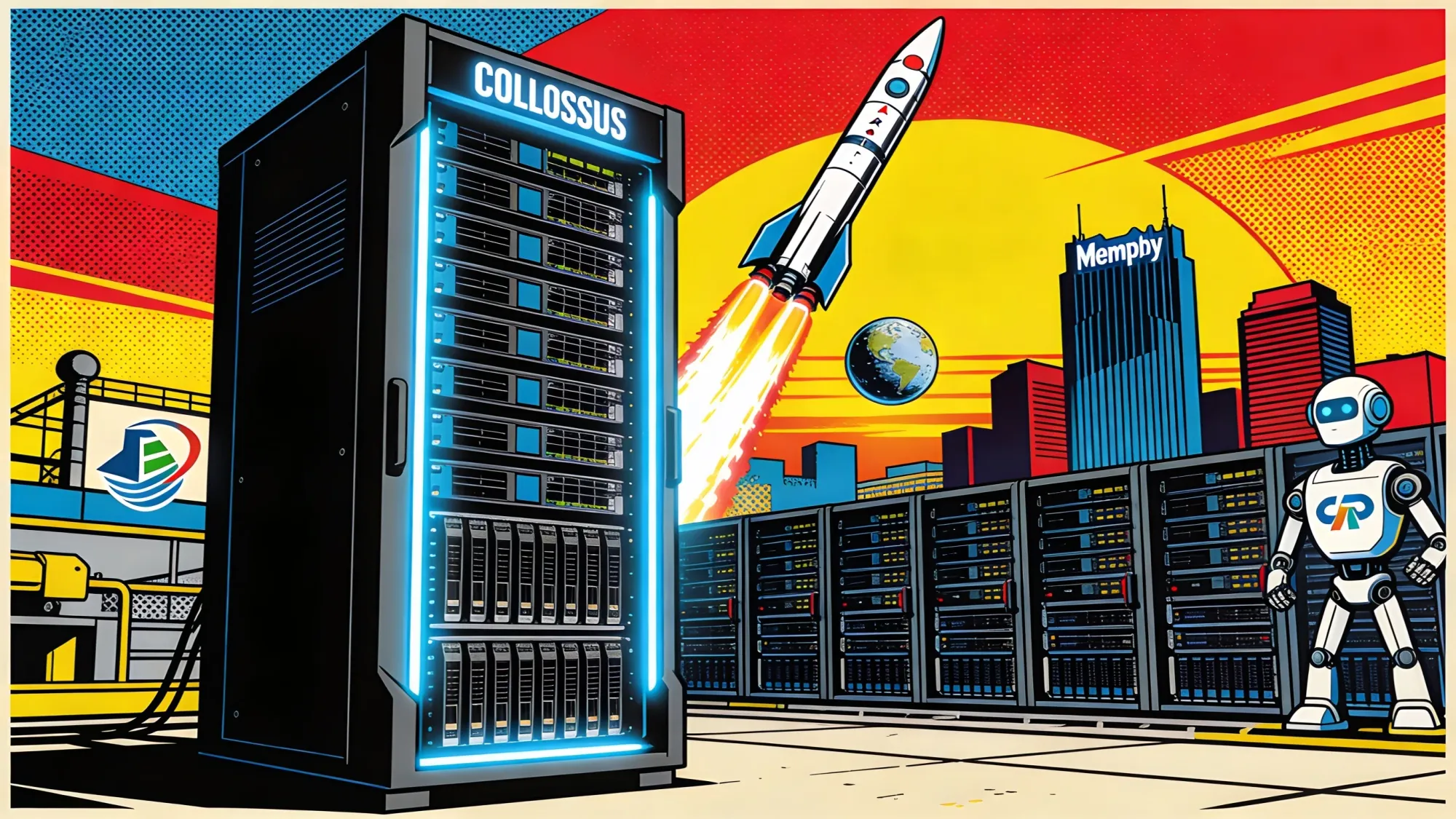
The structure resembles the earlier Anthropic deal, but the scale is different. Anthropic agreed to pay SpaceX $1.25 billion a month through May 2029 for access to SpaceX's Colossus compute infrastructure, with several reports identifying Colossus 1 as the main facility. Google's monthly bill is still about 74% of Anthropic's monthly commitment for roughly half the GPU count.
Google Cloud backlog and Gemini demand
The numbers complicate the adjective. Alphabet said Google Cloud's backlog, the measure of contracted work not yet recorded as revenue, nearly doubled in the most recent quarter to more than $460 billion. CNBC reported that Alphabet lifted its 2026 capital-spending plan to $180 billion to $190 billion, up from the prior $175 billion to $185 billion range, and then moved to raise about $85 billion in stock to fund AI demand.
Track the AI compute market
Strategic AI news from San Francisco. No hype, no "AI will change everything" throat clearing. Just what moved, who won, and why it matters. Daily at 6am PST.
No spam. Unsubscribe anytime.
Google is not short of chip strategy. It has its own TPU program, and Google Research's Project Suncatcher paper describes orbital TPU clusters with optical links and two prototype satellites planned with Planet by early 2027. Yet the Friday filing says the immediate capacity answer is Nvidia hardware from SpaceX.
SpaceX AI losses and customer revenue
For SpaceX, the Google contract addresses the weak line in its IPO story. CNBC reported that SpaceX's AI segment lost $2.5 billion in the March quarter on $818 million of revenue, while first-quarter capital expenditures reached $10.1 billion, including $7.7 billion for AI infrastructure. The company can now point to Google and Anthropic as outside buyers, rather than asking investors to value unused compute capacity only on future internal demand.
Know someone who'd find this useful? ✉️ Email it to a friend in one click, or they can subscribe free here.
SpaceX made that argument in its S-1. "This structure allows us to monetize unused compute capacity in our infrastructure, while still permitting reallocation of the capacity for our own internal initiatives if needed in the future," the filing said, according to Business Insider.
Musk built the Memphis Colossus facilities for Grok and xAI, but the largest disclosed compute contracts now involve Claude and Gemini, two model families that compete with Grok. Yahoo Finance reported that Grok has not kept pace with Claude, Gemini and OpenAI's ChatGPT.
Rival labs become capacity customers
Sameh Boujelbene, a Dell'Oro Group vice president, told Network World that the Anthropic-SpaceX arrangement was "less about excess capacity and more about compute becoming its own strategic asset class." Shay Boloor of Futurum Group said the market is moving beyond a simple hyperscaler model, toward capacity from "hyperscalers, neoclouds, frontier labs, vertically integrated AI platforms and specialized infrastructure providers."
Google enters that market with its own cloud, its own chips and a stake in SpaceX that Bloomberg estimates at roughly 5% after the xAI merger. The companies had also discussed orbital data-center launches, Bloomberg reported. SpaceX still names Google as a competitor in AI and, through Starlink and Google Fiber, in connectivity.
SpaceX is trying to sell investors a launch company, a satellite internet business and an AI compute provider in one security. The final prospectus should state how SpaceX accounts for the Google revenue and describes the 90-day termination right. Reuters reported that pricing is expected June 11 and trading June 12, though the schedule can still change.
Frequently Asked Questions
What did Google agree to buy from SpaceX?
Google agreed to pay $920 million a month for access to about 110,000 Nvidia GPUs, plus CPUs, memory and related components, under a cloud service agreement disclosed by SpaceX.
How long does the Google-SpaceX compute deal run?
The agreement runs from October 2026 through June 2029 at the full monthly rate, with capacity ramping through September at a reduced fee.
Why does Google need SpaceX compute capacity?
Google said the deal provides bridge capacity for Gemini Enterprise demand that exceeded expectations, even as Google continues to build its own TPU and cloud infrastructure.
Can Google exit the contract?
Yes. If SpaceX misses the Sept. 30, 2026 GPU delivery deadline, Google can terminate after a one-month grace period or accept fewer GPUs at a lower fee. After Dec. 31, 2026, either party can terminate on 90 days notice.
Why does the deal matter for SpaceX's IPO?
It gives SpaceX a named outside customer for xAI-related compute infrastructure, helping frame the AI segment as a revenue source rather than only a capital-spending burden.
AI-generated summary, reviewed by an editor. More on our AI guidelines.


Free AI briefing · Weekdays
The AI stories that matter, sourced and explained.
Join the Morning Briefing. It goes out every weekday at 4:45 a.m. Pacific, with later sends for the East Coast, Berlin and Tokyo.
Free when you sign up: The Paperclip Compendium, our tested guide to running AI agents.
Free. Unsubscribe in one click.

Marcus Schuler
Editor-in-Chief and founder of Implicator.ai. Former ARD correspondent and senior broadcast journalist with 10+ years covering tech. Writes daily briefings on policy and market developments. Based in San Francisco. E-mail: editor@implicator.ai