IMPLICATOR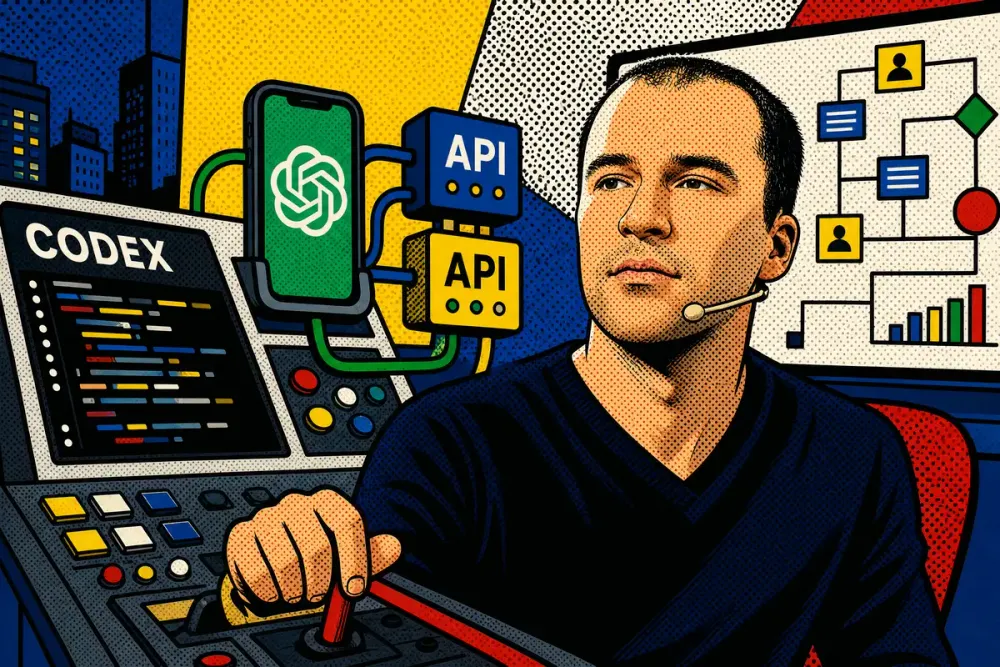
At 2:35 p.m. Eastern on Friday, May 15, WIRED updated its OpenAI reorganization story with additional details about executive roles. The story's main fact was already large enough: Greg Brockman, OpenAI's president and infrastructure lead, will now run product strategy as OpenAI folds ChatGPT, Codex, and the developer API into one core product team, WIRED reported.
OpenAI told WIRED that Brockman had previously held the product job on an interim basis while Fidji Simo, CEO of AGI deployment, was on medical leave. The change is now official. Codex is increasingly powering consumer and enterprise offerings that can perform digital tasks for users. WIRED said Nick Turley helped grow ChatGPT to more than 900 million weekly active users; OpenAI's Codex post says more than 4 million people use Codex each week. The smaller product is being asked to supply the operating logic for the larger one.
What Changed
- Greg Brockman is now OpenAI's official product lead while keeping infrastructure responsibilities.
- OpenAI is folding ChatGPT, Codex, and the developer API into one core product team.
- Codex mobile turns agent work into a managed approval and control surface.
- Enterprise pricing, Codex seats, and DeployCo make product structure a revenue issue.
AI-generated summary, reviewed by an editor. More on our AI guidelines.
Codex gets the product table
Brockman's memo framed the move in agent language. "We're consolidating our product efforts," he told staff. The Verge reported a longer version of the same point: OpenAI plans to "invest in a single agentic platform" and merge ChatGPT and Codex into one unified experience.
The org chart then put Codex people where the memo pointed. Thibault Sottiaux, previously the engineering lead for Codex, will lead core product and platform. Turley, who led ChatGPT from launch, moves to enterprise products. Ashley Alexander, a former Instagram vice president who has been leading health work at OpenAI, takes consumer product.
Sottiaux already had gravity inside the company. In April, WIRED reported that OpenAI was folding Prism, Kevin Weil's science workspace with roughly 10 people, under him. Bill Peebles left after Sora lost its standalone app and web surface. Srinivas Narayanan, CTO of enterprise applications, also told staff he was leaving, WIRED reported. Science, video, enterprise applications, consumer assistants, and coding work are no longer separate signals on the edge of the chart. They are reporting into a product structure built around Codex.
Mobile turns Codex into a control surface
The Codex mobile announcement on Thursday made the product problem concrete. In ChatGPT's iOS and Android apps, users can monitor Codex sessions while the agent keeps running on a laptop, Mac mini, devbox, or managed remote environment, OpenAI said. The company described the phone as a place to "review outputs, approve commands, change models, or start something new."
Business Insider published a Friday piece on developers who had already worked that way. Geoff Chan, a 39-year-old product lead at Raven.AI, kept a laptop open at his daughters' ice-skating practice while Claude Code and Codex ran. A 15-year-old founder in Bentonville walked school hallways with a laptop open while agents worked.
Follow the agent-platform shift
Strategic AI news from San Francisco. No hype, no "AI will change everything" throat clearing. Just what moved, who won, and why it matters. Daily at 6am PST.
No spam. Unsubscribe anytime.
OpenAI's May 14 Enterprise and Edu release note documents the same feature for administrators. The mobile app surfaces live project context, approvals, diffs, test results, screenshots, and terminal output. Remote control is off by default until admins enable it. Access tokens let companies run non-interactive Codex workflows tied to ChatGPT workspace identity. Codex seats can be billed as credits and sold separately from full ChatGPT Enterprise licenses.
Agent pricing was already visible
The reorganization also lands in the middle of a pricing fight. Axios reported Thursday that Anthropic is tightening paid Claude usage for third-party agent harnesses such as OpenClaw. OpenAI is moving the other way for now, with Sam Altman offering two months of free Codex usage to new business customers, Axios reported. The Information, cited in the same Axios story, reported that ServiceNow and Uber had already used their AI token budgets for the year.
Codex sessions can continue long after a user has closed the chat tab, which is part of why the May 14 enterprise release introduced credit-based Codex billing alongside ChatGPT workspace identity tokens. OpenAI's release page presents non-interactive Codex workflows as a billable enterprise feature, separate from a ChatGPT Enterprise subscription.
OpenAI also announced the OpenAI Deployment Company on May 11. Reuters described it as a majority-controlled unit with more than $4 billion in initial investment, and reported that OpenAI's Tomoro acquisition brings around 150 AI engineers and deployment specialists to the unit from day one. Its stated assignment, per Reuters, is to connect OpenAI models to customer companies' internal data and systems.
Brockman is also a witness in the Musk v. Altman trial in Oakland. Bloomberg reported this month that Brockman testified his OpenAI stake was worth nearly $30 billion, while OpenAI said its nonprofit arm held a stake worth about $200 billion. Musk's lawyers want remedies that could remove Brockman and Sam Altman from leadership and unwind the for-profit conversion. OpenAI says the lawsuit is an attack by a competitor.
Brockman's reorganized portfolio covers product strategy for ChatGPT, Codex, and the developer API. The org chart also gives him oversight of the separate Codex enterprise seats described in OpenAI's May 14 release note and of the deployment company announced May 11.
Frequently Asked Questions
What changed in OpenAI's reorganization?
Greg Brockman now officially leads product strategy while continuing his infrastructure role. OpenAI is also folding ChatGPT, Codex, and its developer API into one core product team.
Why does Codex matter in this reorganization?
OpenAI says Codex is increasingly powering consumer and enterprise offerings. The new org chart puts Codex leader Thibault Sottiaux over core product and platform.
What does Codex mobile do?
Codex mobile lets users monitor running sessions from ChatGPT on iOS and Android, review outputs, approve commands, change models, and start new work while execution continues elsewhere.
How does this affect enterprise customers?
OpenAI is pairing Codex with admin controls, access tokens, separate Codex seats, and a deployment company meant to connect models to customer data and workflows.
How is DeployCo connected to the product shift?
DeployCo gives OpenAI implementation labor for enterprise customers. It sits beside Codex seats and admin controls as OpenAI tries to turn agent workflows into business systems.
AI-generated summary, reviewed by an editor. More on our AI guidelines.



Marcus Schuler
Editor-in-Chief and founder of Implicator.ai. Former ARD correspondent and senior broadcast journalist with 10+ years covering tech. Writes daily briefings on policy and market developments. Based in San Francisco. E-mail: editor@implicator.ai