IMPLICATOR
On June 23, Lee Perry, a former state lawmaker and Box Elder County commissioner who had voted to let Utah’s Stratos data center proceed, watched Republican voters end his reelection bid. Contentious public meetings had left him feeling “physically sick” amid alleged death threats and false accusations. Perry said the project cost him the election. Asked whether he would act differently, he answered: “I wouldn’t vote differently, but I would push back against the state and make them come out publicly and tell everybody why they’re forcing it down our throat.”
Six weeks later, in an interview published August 9, Harvard historian Jill Lepore said, “I think there are political costs, and we’ll begin to see those at elections. Or maybe we won’t.”
The primary result was already on the record when the interview ran.
Lepore’s new book describes an “artificial state,” her term for public functions that private corporations and machines have begun to perform. The Utah election matters to that argument because voters used an old democratic instrument, a primary ballot, against officials who approved part of the physical plant behind AI.
What Changed
- Jill Lepore's "The Rise and Fall of the Artificial State" arrives from Liveright on August 25, arguing that private corporations have absorbed functions of the state without anyone consenting to it.
- Utah's longest-serving Senate president, J. Stuart Adams, lost his June 23 Republican primary by more than eight points over the 40,000-acre Stratos data center, and two Box Elder County commissioners lost with him.
- Seven in 10 Americans opposed a data center in their community in a March 2026 Gallup poll, and Emerson College polling of likely 2026 voters found opposition rising from 42% in December 2025 to 63% in July 2026.
- Stratos kept its development designation through the primary, and its developer said it would keep pursuing permits.
AI-generated summary, reviewed by an editor. More on our AI guidelines.
The Utah result
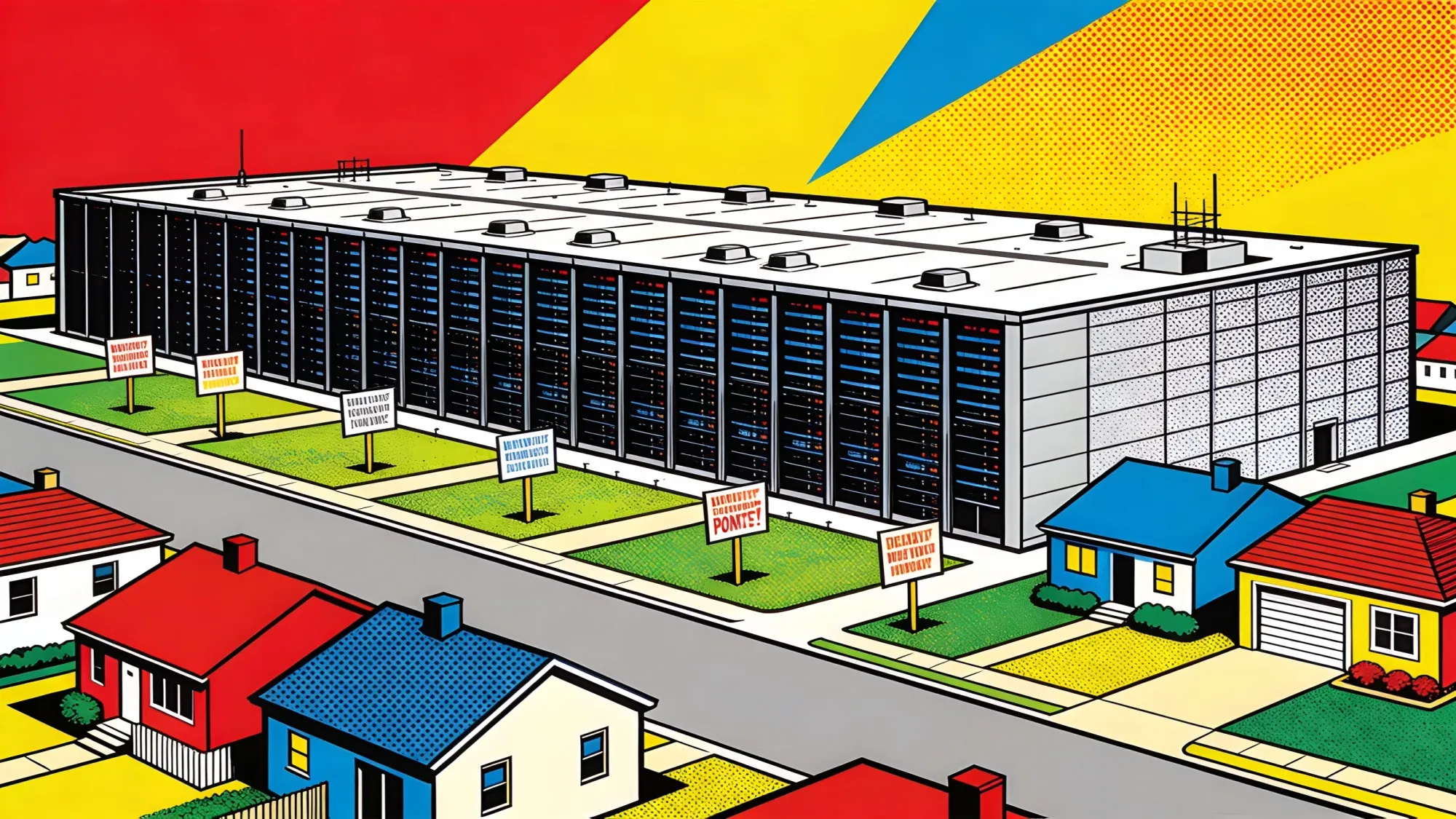
Stratos began as a proposed 40,000-acre campus in northwestern Utah. At full build, its 9-gigawatt demand would be more than double the energy the state currently uses in a year. County commissioners approved the project on May 4, 2026, after the commission said it had reviewed more than 2,500 public comments.
Perry and fellow commissioner Boyd Bingham lost their Republican primaries seven weeks later. J. Stuart Adams, Utah’s longest-serving Senate president and chair of the authority that fast-tracked Stratos, lost to Stephanie Hollist, a former university lawyer, by more than eight points.
Brenna Williams, who helped organize the Box Elder Accountability Referendum, called the result a “message vote,” not a well-researched judgment on what the challengers would do. A poll commissioned by her opposition group and conducted by an independent firm found more than 70% of the county opposed the plans. The survey does not establish why each voter chose a candidate.
Kevin O’Leary, the Shark Tank investor behind Stratos, offered a different account. He called critics paid “professional protesters” and claimed two Utah groups were linked to the Chinese Communist Party. He supplied no direct evidence for the funding claim. Independent researchers found little sign of a coordinated Chinese campaign.
In May, developers said they hoped to begin early work in the fall. The project’s development designation survived the primary, and its developer said it would keep pursuing permits.
The artificial state
Lepore, a Harvard professor and New Yorker staff writer married to a computer scientist, won the 2026 Pulitzer Prize for History for “We the People.” Her book, “The Rise and Fall of the Artificial State,” is due from Liveright on August 25, 2026.
Get Implicator.ai in your inbox
Strategic AI news from San Francisco. No hype, no "AI will change everything" throat clearing. Just what moved, who won, and why it matters. Daily at 6am PST.
No spam. Unsubscribe anytime.
Her phrase does not mean technology alone. It describes a government whose work, including public discussion and political decision-making, moves onto systems owned by private companies. In workaday terms, the meeting room becomes a platform, and citizens become data points that its owner can sort.
Lepore links data centers to that account. “You see this in all the little data center crises, town to town, county to county, state to state,” she said. In Lepore’s rendering of town meetings, residents say, “Who said we’re building this data center?” and demand details about water consumption. She argues that the artificial state will destroy the natural world whose resources it needs to run.
Know someone who'd find this useful? ✉️ Email it to a friend in one click, or they can subscribe free here.
Lepore traces that habit through science fiction and Silicon Valley’s reading of it. Stories in which machines absorb human work and government were written as warnings, she argues, yet executives including Elon Musk and Sam Altman treat parts of them as operating instructions. In Lepore’s account, Altman entertained the idea of an AI president in a Joe Rogan appearance.
Twitter supplies her smaller case. A 2020 study found that the most active 10% of U.S. adult users produced 92% of their tweets from November 2019 through September 2020. The median user posted once a month. Those figures describe Twitter then, not X now. After describing the company’s claim that the service was a digital town hall, Lepore said, “and that’s all just bananas.”
Private constitutions
The state-like language is literal. Anthropic released moral precepts for Claude in January 2026, written chiefly by Amanda Askell, a 37-year-old Scottish philosopher. Lepore argues that a corporate document drafted for a chatbot is not a constitution in a legal or political sense, because the governed did not grant the company authority.
Her concern is with consent, not computer use. “My beef is the ways in which private corporations have increasingly taken on the functions of the state,” she said on TechCrunch’s Equity podcast.
The political test
The backlash reaches beyond one county. Seven in 10 Americans opposed a data center in their community in a March 2026 Gallup poll. In Emerson College polling of likely 2026 voters, opposition rose from 42% in December 2025 to 63% in July 2026.
Lepore said elections work only if institutions still carry voters’ decisions into policy. The Stratos approvals remain intact after three incumbents lost. “Enough of democratic functioning has to be intact for people to actually be able to respond to malfeasance on the part of their representatives.”
Frequently Asked Questions
What does Jill Lepore mean by the "artificial state"?
Her term for a government whose work, including public discussion and political decision-making, has moved onto systems owned by private companies. She says she is not an anti-technologist and is married to a computer scientist. Her objection is to corporations taking on the functions of the state, which she argues no one consented to.
What happened in the Utah primary on June 23?
J. Stuart Adams, Utah's longest-serving Senate president and chair of the authority that fast-tracked the Stratos data center, lost his Republican primary to Stephanie Hollist by more than eight points. Box Elder County commissioners Lee Perry and Boyd Bingham also lost. Perry said the data center vote cost him the election.
How large is the Stratos data center project?
It began as a proposed 40,000-acre campus in northwestern Utah. At full build, its 9-gigawatt demand would be more than double the energy the state currently uses in a year. County commissioners approved it on May 4, 2026, after the commission said it had reviewed more than 2,500 public comments.
How widespread is opposition to data centers?
A March 2026 Gallup poll found seven in 10 Americans opposed a data center in their community. Emerson College polling of likely 2026 voters found opposition rose from 42% in December 2025 to 63% in July 2026. A poll commissioned by a Box Elder opposition group found more than 70% of that county opposed the plans.
Why does Lepore object to Anthropic's constitution for Claude?
Anthropic released moral precepts for Claude in January 2026, written chiefly by philosopher Amanda Askell. Lepore argues a corporate document drafted for a chatbot is not a constitution in any legal or political sense, because the governed never granted the company that authority.
AI-generated summary, reviewed by an editor. More on our AI guidelines.


Marcus Schuler
Editor-in-Chief and founder of Implicator.ai. Former ARD correspondent and senior broadcast journalist with 10+ years covering tech. Writes daily briefings on policy and market developments. Based in San Francisco. E-mail: editor@implicator.ai