IMPLICATOR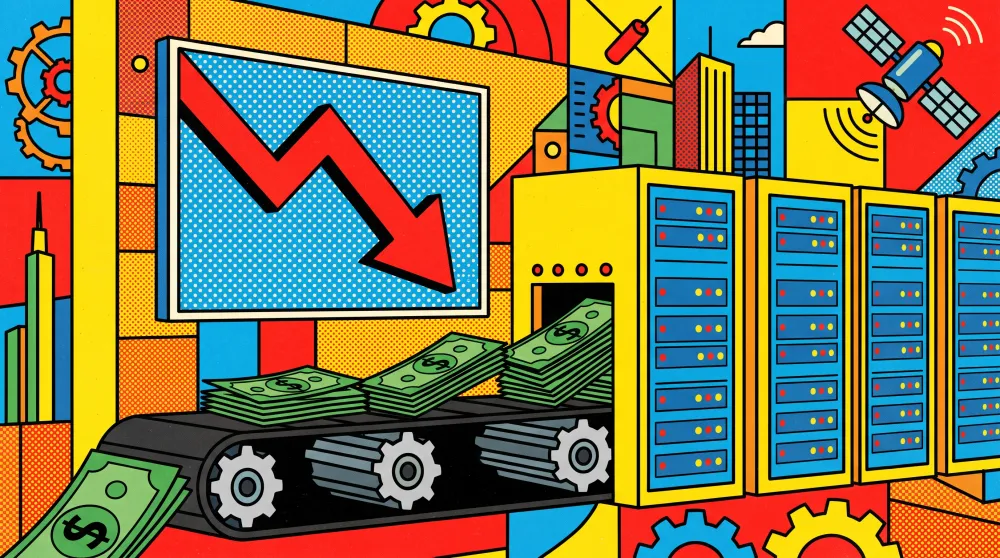
A basket of the seven largest U.S. technology stocks lost $797 billion in market value on Thursday, its steepest single-day decline since the tariff selloff of April 2025. The drop followed second-quarter results from Alphabet and Tesla, both of which told investors that spending on artificial intelligence is still climbing and both of which reported negative free cash flow for the quarter. Alphabet raised its 2026 capital expenditure guidance to as much as $205 billion, up from a previous ceiling of $190 billion, and warned of higher figures in 2027.
What Changed
- A basket of the seven largest U.S. technology stocks lost $797 billion in market value on Thursday, its steepest single-day decline since the tariff selloff of April 2025.
- Alphabet raised its 2026 capital expenditure guidance to as much as $205 billion, up from a previous ceiling of $190 billion, and warned of higher figures in 2027.
- Alphabet's second-quarter free cash flow was negative $5.855 billion, and the company sold $49.6 billion of stock in June earmarked for AI infrastructure.
- Tesla closed down 14.52%, its worst day since March 2025, and Morgan Stanley cut its price target to $400 while calling the spending necessary.
AI-generated summary, reviewed by an editor. More on our AI guidelines.
Tesla closes down 14.52%
Tesla finished the session down 14.52% at $319.69, its worst day since March 2025 and the largest decline in the S&P 500. The stock is off 24% in July, its lowest close since August 2025. Alphabet's Class A shares fell 7.13% to $317.69, the steepest one-day drop since May 2025. The two shed about $200 billion and $300 billion in market value respectively.
The Nasdaq Composite closed down 2.15% at 25,137.69, and the S&P 500 lost 1.21% to end at 7,408.30, its worst session since June 23.
Every member of the group ended lower. Apple, which has largely sat out the AI capital spending race, had the shallowest decline at 1.30%; Amazon fell 4.6%. The index now sits 11% below its late-May record, a drawdown of $2 trillion.
"The real problem is the amount of spend that's going on," said Ken Mahoney, chief executive of Mahoney Asset Management. "No one knows what the return on investment is."
Alphabet raised $49.6 billion in June
Alphabet's earnings release put second-quarter free cash flow at negative $5.855 billion, against $53.273 billion over the trailing twelve months. Cash from operations no longer covers what the company is spending on capacity. The same release shows how Alphabet covered the gap. In June it sold a combination of common and mandatory convertible preferred stock for $49.6 billion in net proceeds, earmarked in the filing for "capital expenditures to scale AI infrastructure and global compute," and it has registered an at-the-market program to sell up to $40 billion more, untouched as of June 30.
"These companies used to have the healthiest balance sheets in the history of corporate America, now they're asset heavy and there's a question about the ROI," said Jason Lemire, chief investment officer at Bold Wealth Partners. "That's a big change in how investors need to view them, and that's before you get to the lack of transparency in terms of their exact debt obligations over the coming years."
Bondholders have been repricing the same buildout for weeks. Alphabet's £1 billion century bond has lost about 10% since its February debut, and SpaceX's 2056 bond is down roughly 8% in the month since issue. Nvidia priced a $25 billion bond sale this month, its first since 2021. The Epoch Times, which compiled the moves, reported that the slump could signal investors seeking higher compensation as they wait longer for returns.
Get Implicator.ai in your inbox
Strategic AI news from San Francisco. No hype, no "AI will change everything" throat clearing. Just what moved, who won, and why it matters. Daily at 6am PST.
No spam. Unsubscribe anytime.
Borrowing costs rose on Thursday too. Brent crude settled 7% higher at $100.69 after attacks on two Saudi oil tankers in the Red Sea, pushing the 10-year Treasury yield to 4.69%. Traders lifted the probability of a Federal Reserve rate increase next week to 36%, from nearly 12% a week earlier, according to CME Group data.
"Higher yields are spooking markets," Thomas Martin, senior portfolio manager at Globalt Investments, said by phone. "The AI trade holds a huge impact for the trajectory of corporate earnings and economic growth, and financing is becoming risky for Big Tech and chipmakers if borrowing costs rise."
Know someone who'd find this useful? ✉️ Email it to a friend in one click, or they can subscribe free here.
Morgan Stanley cuts Tesla target to $400
Andrew Percoco of Morgan Stanley called Tesla's accelerating capital-spending cycle "a necessary investment to secure leadership in autonomy & robotics," then cut his price target to $400 anyway, citing cash burn that pushes free cash flow further negative. JPMorgan, Cantor Fitzgerald and Mizuho Securities also lowered their Tesla targets. Max Gokhman, senior vice president at Franklin Templeton, went the other way, arguing Tesla is one of the few companies that should be spending more on AI.
Alphabet's cloud revenue grew 82% to $24.77 billion, ahead of the $22.46 billion analysts expected, and the unit's operating margin widened to 35.6% from 20.7% a year earlier. "This is one of the strongest revenue growth quarters that Alphabet has had in five years, and Alphabet is a really great barometer for this whole AI wave," Alison Porter, portfolio manager at Janus Henderson, told CNBC.
Elon Musk was blunter on Tesla's call. "This is a massive capex year," he said. "I'm confident that all the things that we're investing in will yield incredible returns."
Meta, Microsoft and Amazon report second-quarter results next week. Along with Alphabet, the four signaled in April that they could spend as much as $725 billion combined this year. Nvidia reports in August.
Frequently Asked Questions
How much value did the largest technology stocks lose on Thursday?
A basket of the seven largest U.S. technology stocks lost $797 billion in a single session, the steepest one-day decline since the tariff selloff of April 2025. The index now sits 11% below the record it set in late May, a drawdown of $2 trillion.
How much does Alphabet now plan to spend in 2026?
As much as $205 billion, up from a previous ceiling of $190 billion. The company also warned that capital expenditure figures will be higher in 2027.
Why did Alphabet sell stock in June?
Its second-quarter free cash flow was negative $5.855 billion, so cash from operations no longer covered what it was spending on capacity. Alphabet sold a combination of common and mandatory convertible preferred stock for $49.6 billion in net proceeds, earmarked in the filing for capital expenditures to scale AI infrastructure and global compute.
Did any analyst defend the spending?
Yes. Andrew Percoco of Morgan Stanley called Tesla's accelerating capital-spending cycle a necessary investment to secure leadership in autonomy and robotics, though he still cut his price target to $400. Max Gokhman of Franklin Templeton argued Tesla is one of the few companies that should be spending more on AI.
What comes next for AI capital spending?
Meta, Microsoft and Amazon report second-quarter results next week. Along with Alphabet, the four signaled in April that they could spend as much as $725 billion combined this year. Nvidia reports in August.
AI-generated summary, reviewed by an editor. More on our AI guidelines.
Free AI briefing · Weekdays
The AI stories that matter, sourced and explained.
Join the Morning Briefing. It goes out every weekday at 4:45 a.m. Pacific, with later sends for the East Coast, Berlin and Tokyo.
Free when you sign up: The Paperclip Compendium, our tested guide to running AI agents.
Free. Unsubscribe in one click.

Marcus Schuler
Editor-in-Chief and founder of Implicator.ai. Former ARD correspondent and senior broadcast journalist with 10+ years covering tech. Writes daily briefings on policy and market developments. Based in San Francisco. E-mail: editor@implicator.ai