Implicator
San Francisco | Thursday, April 2, 2026
Maine is about to become the first state to freeze large data center construction, and 11 legislatures are watching to see if they should follow. A $550 million project at a former paper mill sits in limbo while ratepayers absorb the sharpest electricity price spike in the country.
On secondary markets, $600 million in OpenAI shares sit without a single buyer. Two billion dollars in cash waits for Anthropic instead. Goldman Sachs waives its carry fees for one and charges full freight for the other.
An Austrian developer, frustrated by Claude Code rate limits, built his own coding benchmark. Open-weights models scored 94.8%. The proprietary lead is now four percentage points and shrinking.
Stay curious,
Marcus Schuler
Maine Advances First State Data Center Moratorium as 11 States Weigh Similar Bans
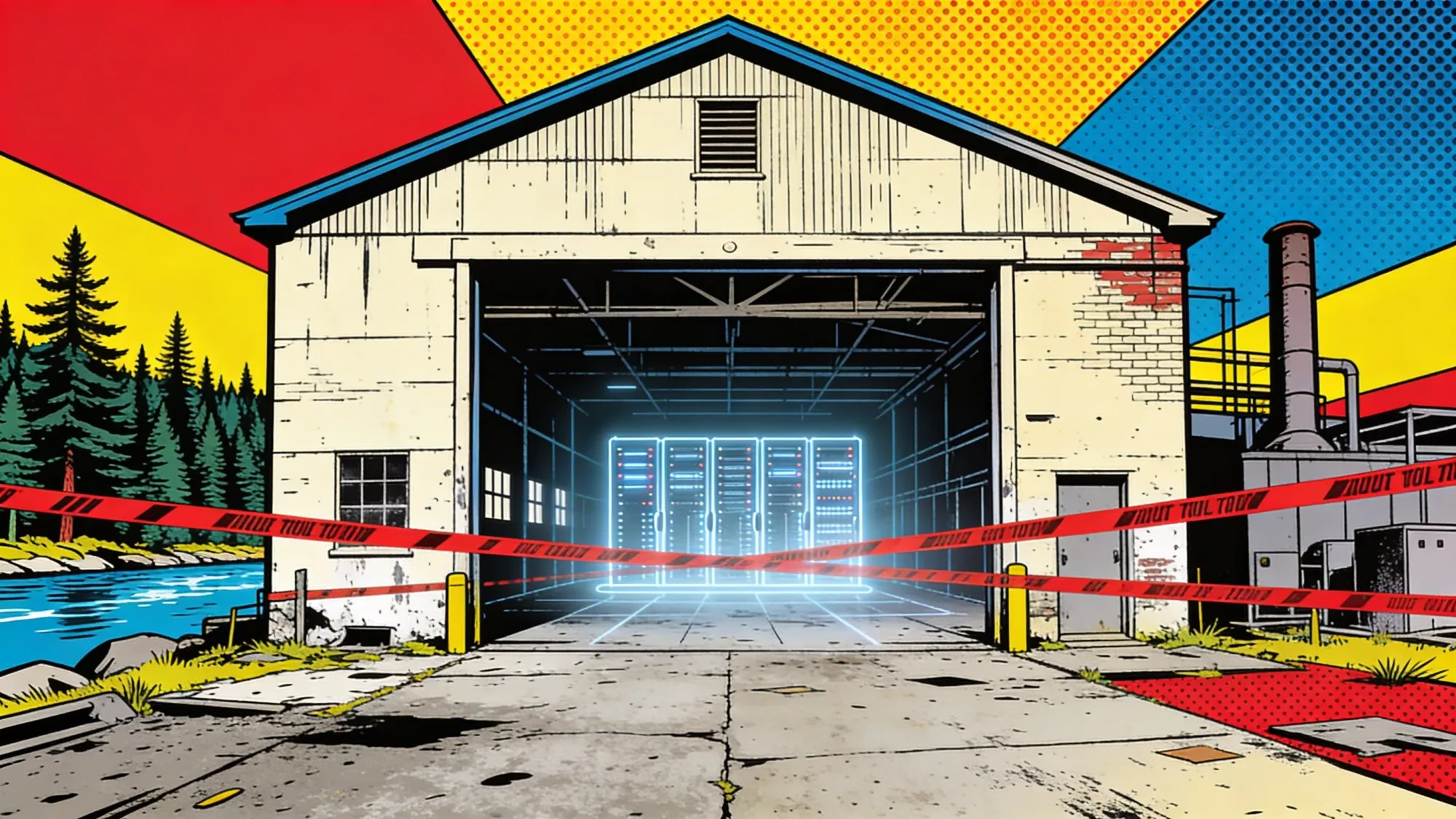
Maine's legislature passed LD 307, freezing permits for data centers above 20 megawatts through October 2027. Three towns had already rejected proposals on their own. A $550 million project at a former paper mill faces collapse.
The bill creates a Data Center Coordination Council to study grid, ratepayer, and environmental effects before lifting the freeze. Maine electricity rates jumped 10.6 percent last year, the sharpest annual spike in the country. Wiscasset, Lewiston, and Sanford all pushed back after proposals surfaced with minimal public notice.
This is not a progressive cause alone. Florida's DeSantis questioned whether anyone wants higher energy bills for chatbots. Sanders and Ocasio-Cortez want a national freeze. An NBC News poll found 57 percent of voters say AI's risks outweigh its benefits. Eleven other state legislatures introduced similar moratoriums this session. $98 billion in data center projects were stalled or canceled in Q2 2025 alone.
Why This Matters:
- Data center developers now face coordinated political opposition across 12 states, turning local zoning fights into a national infrastructure crisis.
- If Maine's moratorium survives legal challenge, it becomes the template for every state legislature debating the same bills this session.
Reality Check
What's confirmed: Maine's House passed LD 307. Eleven other states introduced moratorium bills this session. Three Maine towns rejected data center proposals independently.
What's implied (not proven): That moratoriums will survive the industry's legal and lobbying counter-offensive. Preti Flaherty is already running ads in 28 legislative districts.
What could go wrong: Maine exempts projects already in permitting, gutting the moratorium. The Jay mill project's 800 construction jobs become the political liability.
What to watch next: Maine Senate vote, expected within weeks. If it passes, watch for copycat bills accelerating in Georgia and Indiana.
The One Number
$170 billion — The estimated refund liability facing the federal government after the Supreme Court struck down Trump's Liberation Day tariffs in February. April 2 marks one year since the duties took effect. In that year, the U.S. goods trade deficit reached an all-time high and manufacturing employment fell by 89,000 jobs, the opposite of what the tariffs were designed to achieve. No refund process at this scale has ever been attempted.
Source: CSIS / Bloomberg
OpenAI Shares Can't Find Buyers as $2 Billion Floods Into Anthropic Instead
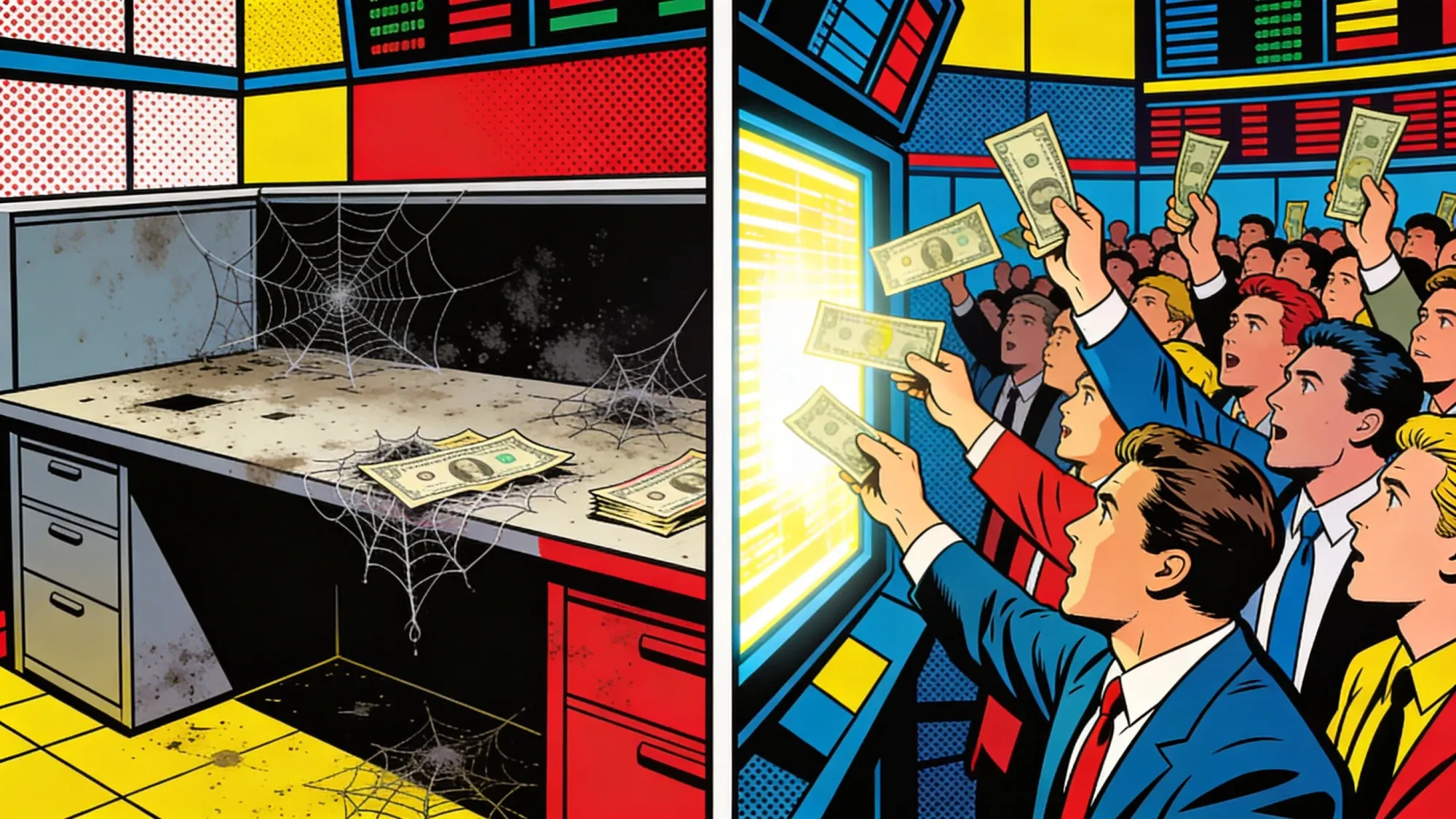
Six institutional investors tried to sell $600 million in OpenAI shares through Next Round Capital. Not a single buyer emerged. Meanwhile, $2 billion in cash sits ready for Anthropic across three secondary platforms.
Goldman Sachs now waives carry fees on OpenAI shares while charging full 15 to 20 percent on Anthropic equity. The concession signals what the numbers confirm: OpenAI's enterprise API share dropped from 50 to 25 percent over the past year, while Anthropic climbed from 12 to 32 percent. The rotation comes one day after OpenAI closed a record $122 billion fundraising round at an $852 billion valuation. Primary rounds and secondary markets run on different logic. Existing investors buy to maintain stakes, then quietly sell exposure. The $122 billion headline and the $600 million nobody wants coexist.
Why This Matters:
- Secondary market demand is the unfiltered signal, and banks waiving fees on OpenAI while charging full freight on Anthropic confirms the rotation.
- If Anthropic lists its IPO first, it could absorb pent-up retail AI demand before OpenAI reaches the public market.

AI Image of the Day

Prompt: A candid flash photograph of an awkward nerdy Asian woman in her 20s with medium-length black curly hair, wearing thick-rimmed glasses. She is wearing a loose-fitting white t-shirt that covers her midsection, and black baggy jeans. She is facing the camera directly but not making eye contact, caught in a natural unposed moment. She sits on a chair at a low black table in a private Korean bar room that looks like a karaoke-style room, with brown sofas, white clean wall, and a high clean ceiling. She is surrounded by other women casually drinking together. Empty soju bottles, small dishes, and beer glasses scatter across the table. Photographed with a Canon PowerShot A80 digital camera, sharp and clear detail, early 2000s digital snapshot style, candid and raw, with harsh flash emphasizing the cramped yet intimate nerdy drinking atmosphere, spontaneous off-balance composition
Open-Weights LLMs Score 94.8% on Custom Coding Benchmark, 4% Behind Claude Opus
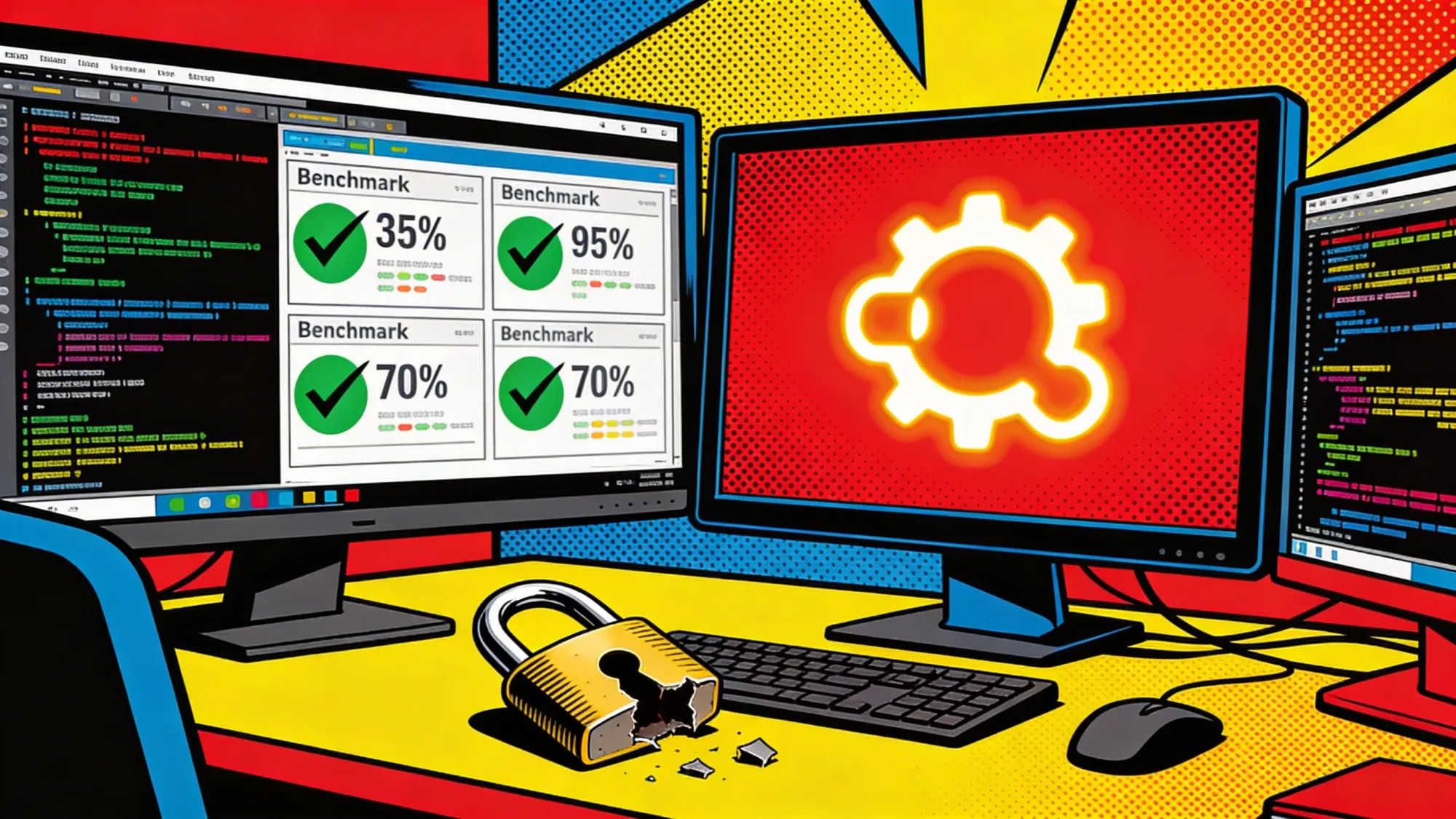
An Austrian Ghost hosting operator built a 20-task TypeScript benchmark from six months of real commits and tested 16 models against it. Alibaba's Qwen3-Coder-Next scored 94.8% against Claude Opus 4.6's 98.8%. One self-correction loop closed the gap to zero.
The investigation started when rate-limit errors kept interrupting his $200-per-month Claude Code subscription. Anthropic admitted users are burning through limits faster than projected. Fedoruk-Betschki's benchmark sidesteps SWE-bench contamination by using synthetic codebases with hidden test suites. Thirteen of 16 models cleared 92 percent. MiniMax hit 80.2 percent on SWE-bench Verified at one-twentieth of Claude's per-token cost. Qwen3-Coder-Next runs locally on 30GB of VRAM under an Apache 2.0 license. No rate limits, no per-token billing, no code leaves the machine.
Why This Matters:
- The 4 percent gap collapses to zero with one test-feedback loop, the same loop every coding assistant already runs.
- Developers on well-understood stacks now have a cost argument to run inference locally, eroding the subscription model that funds proprietary AI research.
🧰 AI Toolbox
How to Create Professional Brand Assets From a Text Description with Shopify Tinker

Tinker is a free mobile app from Shopify that bundles more than 100 AI tools for creating images, videos, logos, and product photography. Describe what you need in plain language and Tinker picks the right model, writes the technical prompt, and delivers the result. Everything stays in one environment, so the app carries your brand style across assets automatically. Free on iOS and Android.
Tutorial:
- Download Tinker from the App Store or Google Play and create a free account
- Browse tools by output type: product photos, logos, social media graphics, videos, or background removal
- Describe what you want in plain language: "A minimalist logo for a coffee subscription service"
- Tinker selects the best AI model and generates multiple options in seconds
- Edit results with built-in tools for color adjustment, text overlay, and cropping
- Create a second asset and watch Tinker carry over your brand style from the first
- Download in the right format and resolution for your platform: Instagram, Shopify store, or print
URL: https://www.shopify.com/news/introducing-tinker
What To Watch Next (24-72 hours)
- Amazon: In talks to acquire satellite company Globalstar for $9 billion to challenge SpaceX's Starlink, the Financial Times reported Wednesday. Apple owns 20% of Globalstar and must agree to any deal. A resolution between the two could come within days.
- HumanX: The largest enterprise AI conference opens Monday at Moscone Center in San Francisco with 6,500 attendees and 350 speakers. Fei-Fei Li, AWS CEO Matt Garman, and Google Cloud's Francis deSouza keynote. Enterprise AI vendor decisions for H2 2026 start here.
- Liberation Day anniversary: One year since Trump's reciprocal tariffs, struck down by the Supreme Court in February. Manufacturing lost 89,000 jobs during the tariff year. The refund process begins amid a goods deficit that hit an all-time high.
🛠️ 5-Minute Skill: Turn a Failed Experiment Into a Lessons-Learned Brief
Your team ran a six-week A/B test that showed no lift. Leadership wants to know what you learned, not just that it failed. You need a one-page brief that justifies the spend and shapes the next experiment.
Your raw input:
A/B test: new onboarding flow vs. control. 6 weeks, 14,000
users. Variant showed +1.2% activation, not statistically
significant (p=0.34). Cost: $18K in engineering time.
The prompt:
From this experiment summary, produce a lessons-learned brief:
(1) what the hypothesis was, (2) what the data actually showed,
(3) one thing we now know that we didn't before, (4) what to
test next based on this result. Under 100 words. No spin.
What you get back:
Hypothesis: A simplified onboarding flow would lift 7-day activation by 5%+.
Result: +1.2%, not significant at n=14,000. The flow wasn't the bottleneck.
New insight: Drop-off clusters at step 3 (permissions screen), not step 1 (signup). Users who pass permissions activate at 89% regardless of flow.
Next test: Reduce permissions to two required fields. Test at half the sample size, 3 weeks.
Why this works
"It didn't work" teaches nothing. The prompt forces extraction of what you now know that you didn't before, which is the only return on a failed experiment.
What to use
Claude: Better at distinguishing "no signal" from "wrong question."
ChatGPT: Faster at structuring the brief for a slide deck.
AI & Tech News
Chinese Chipmakers Capture 41% of Domestic AI Server Market as Nvidia's Lead Shrinks
Chinese GPU manufacturers shipped enough AI accelerators to claim 41% of the domestic market in 2025, according to IDC. Nvidia held 55% with 2.2 million cards shipped, but the trajectory favors local competitors backed by government procurement mandates.
Oracle Cuts 10,000 Jobs in India as AI Pivot Reshapes Global Workforce
Oracle eliminated roughly 20% of its Indian workforce, part of a global restructuring affecting 30,000 employees. The layoffs accompany a strategic shift toward AI infrastructure and cloud services.
Nvidia Supplier Innolight Files for $3 Billion Hong Kong IPO
Zhongji Innolight, a Chinese optical components maker and key Nvidia supplier, filed confidentially for a Hong Kong secondary listing. The Shenzhen-traded company is expanding international access as demand for AI data center optics grows.
Poolside Turns to Google After $2 Billion Nvidia Round and CoreWeave Deal Collapse
AI startup Poolside is in discussions with Google and other cloud providers to salvage a 2-gigawatt Texas data center project. Both a $2 billion Nvidia-led funding round and a CoreWeave infrastructure agreement fell through.
Microsoft CFO Under Scrutiny After Data Center Pause Constrains AI Growth
Amy Hood's decision to halt certain data center expansions in 2025 has contributed to Microsoft's current supply constraints. The pause puts Hood in a challenging position as demand for AI infrastructure outpaces capacity.
AI-Powered Telehealth Startup Hits $401 Million in Sales With Two Full-Time Employees
Medvi generated $401 million in revenue selling GLP-1 weight-loss drugs through a telehealth platform built with a dozen AI tools and a $20,000 budget. The company projects $1.8 billion for 2026.
Alibaba Launches Third Closed-Source AI Model in Three Days
Alibaba released Qwen3.6-Plus with enhanced agentic coding capabilities, its third proprietary model in 72 hours. The rapid-fire launch marks a visible shift from Alibaba's open-weights strategy toward paid products.
Cloudflare Releases EmDash, an Open-Source WordPress Alternative Built by AI Agents
Cloudflare published EmDash, a TypeScript-based CMS built on Astro and licensed under MIT, positioning it as a serverless WordPress successor. The company says AI coding agents built the project as a demonstration of agent-driven development.
Two-Thirds of UK Teachers Say AI Is Eroding Students' Writing and Critical Thinking
A National Education Union poll found 66% of secondary teachers in England report declining academic skills among students using AI tools. The survey highlights growing concern that reliance on AI is undermining fundamental writing and problem-solving development.
OpenClaw Partners With ByteDance to Launch Official China Mirror Service
ByteDance will provide server infrastructure for a Chinese-language version of OpenClaw's ClawHub marketplace, which distributes specialized files for AI agent tasks. The partnership signals rapid Chinese adoption of the AI agent tooling ecosystem.
🚀 AI Profiles: The Companies Defining Tomorrow
Sierra
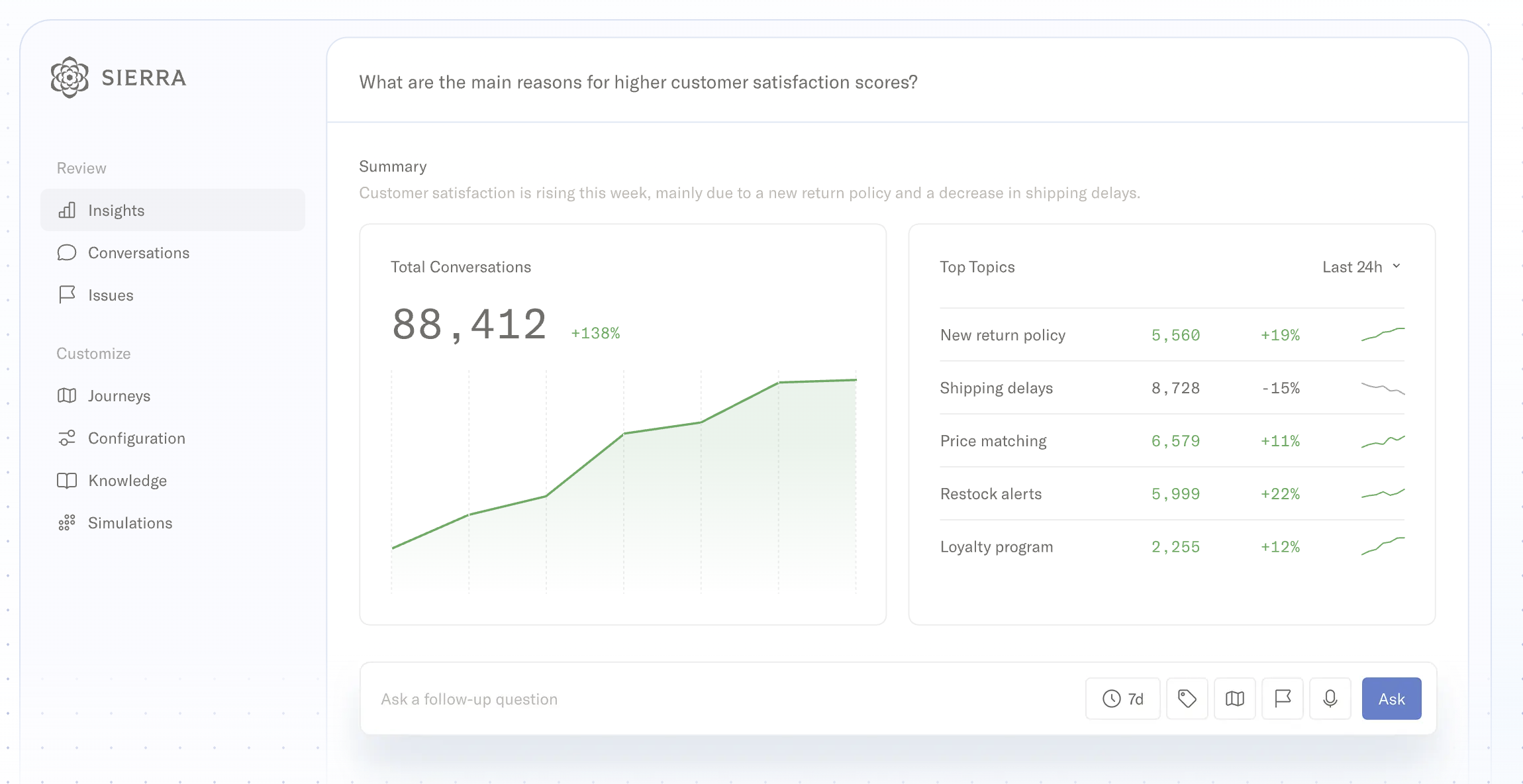
Sierra builds AI agents that handle customer conversations for companies like SoFi, WeightWatchers, and Sonos. The startup hit $100 million in annual recurring revenue faster than almost any enterprise software company in history. 🤖
Founders
Bret Taylor and Clay Bavor co-founded Sierra in early 2024. Taylor served as co-CEO of Salesforce, chairman of OpenAI's board during the Sam Altman firing crisis, and previously co-created Google Maps. Bavor spent 18 years at Google running Gmail, Google Drive, and the company's AR/VR division. Combined, they managed products used by billions.
Product
An AI agent platform for customer-facing conversations. Sierra agents handle support, sales, and account management across chat, voice, and messaging channels. Rather than scripted chatbots, the agents reason through complex requests: processing refunds, changing subscriptions, troubleshooting products. Sierra claims its agents resolve issues at rates comparable to human agents while operating around the clock. Customers include SoFi, Ramp, Brex, ADT, Casper, and WeightWatchers.
Competition
Intercom, Zendesk, and Salesforce all added AI to existing customer support platforms. Decagon targets enterprise customer support with AI agents. Bland AI and Parloa build voice-specific agents. Sierra differentiates on founder credibility and enterprise relationships: Taylor's Salesforce network opens doors that startups cannot knock on. The risk: Salesforce itself is building Agentforce, and Marc Benioff has publicly targeted Sierra's market.
Financing 💰
$350M at $10 billion valuation (September 2025), led by ICONIQ Growth and Greenoaks. Previous rounds: $175M at $4.5B and $110M led by Sequoia and Benchmark. Total raised: $635 million.
Future ⭐⭐⭐⭐
$100M ARR in seven quarters is the kind of growth that makes VCs invent new superlatives. Taylor and Bavor's combined resume reads like a tech industry highlight reel, and their enterprise networks convert into sales calls that cold outreach never could. The $10B valuation prices in category dominance. The constraint: Benioff built Salesforce into the CRM default, and he is not going to watch Taylor build a competitor on top of it. Agentforce is Salesforce's direct response. Sierra needs to prove AI agents are a platform, not a feature, before the incumbents absorb the category. 📞
🔥 Yeah, But...
The Biggest IPO in History Will Be a Rocket Company That Bolted On an AI Subsidiary Two Months Ago.
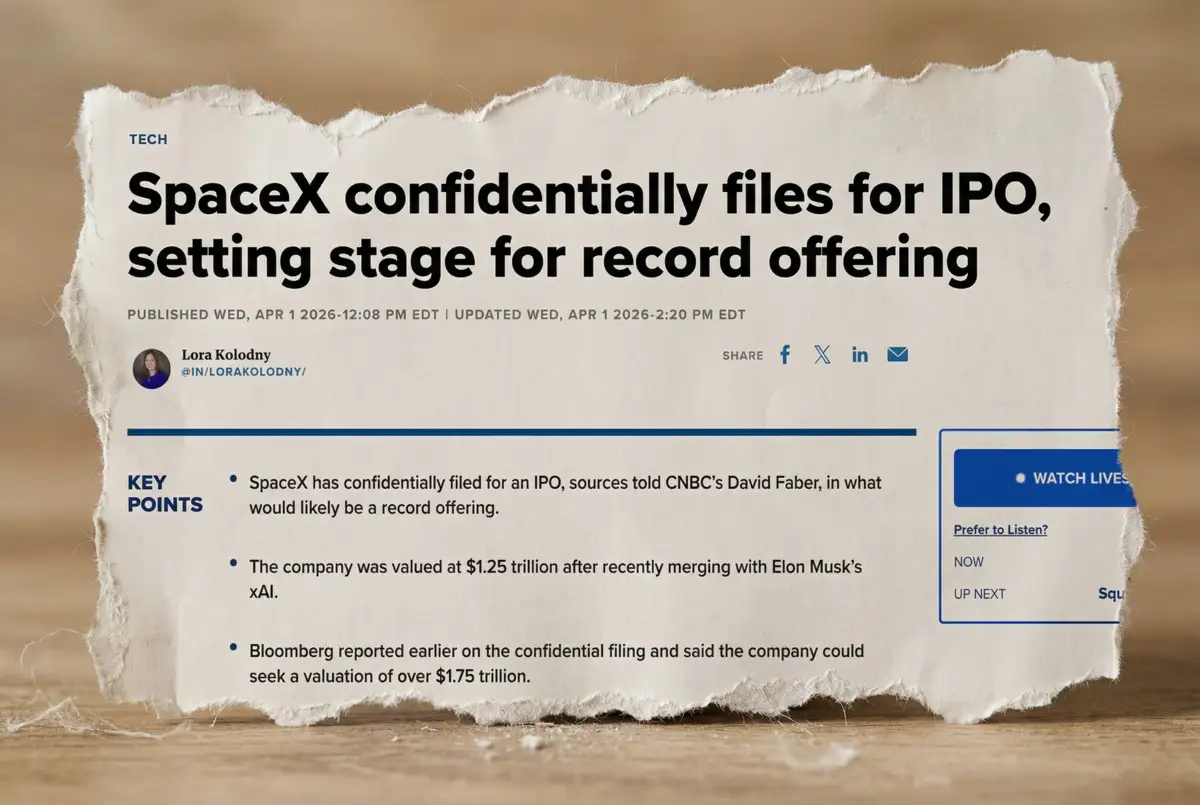
SpaceX submitted a confidential IPO registration to the SEC on Tuesday, targeting a June listing at a $1.75 trillion valuation. Twenty-one banks are managing the offering, internally codenamed "Project Apex." The filing puts SpaceX ahead of OpenAI and Anthropic, which are both exploring their own public listings.
Sources: Bloomberg, April 1, 2026 | CNBC, April 1, 2026
Our take: The biggest IPO in human history will not be an AI company. It will be a rocket company that added "artificial intelligence" to the prospectus two months before filing. OpenAI has 800 million weekly users and is restructuring its corporate governance for the third time. Anthropic just won an injunction against the Pentagon. SpaceX handed 21 banks a registration codenamed "Project Apex" and booked a June slot. Saudi Aramco's $29.4 billion record now looks like a seed round. The companies that built the technology are still rehearsing. The one that strapped it to a rocket is already selling tickets.

Marcus Schuler
Tech translator with German roots who fled to Silicon Valley chaos. Decodes startup noise from San Francisco. Launched implicator.ai to slice through AI's daily madness—crisp, clear, with Teutonic precision and sarcasm. E-Mail: [email protected]