IMPLICATOR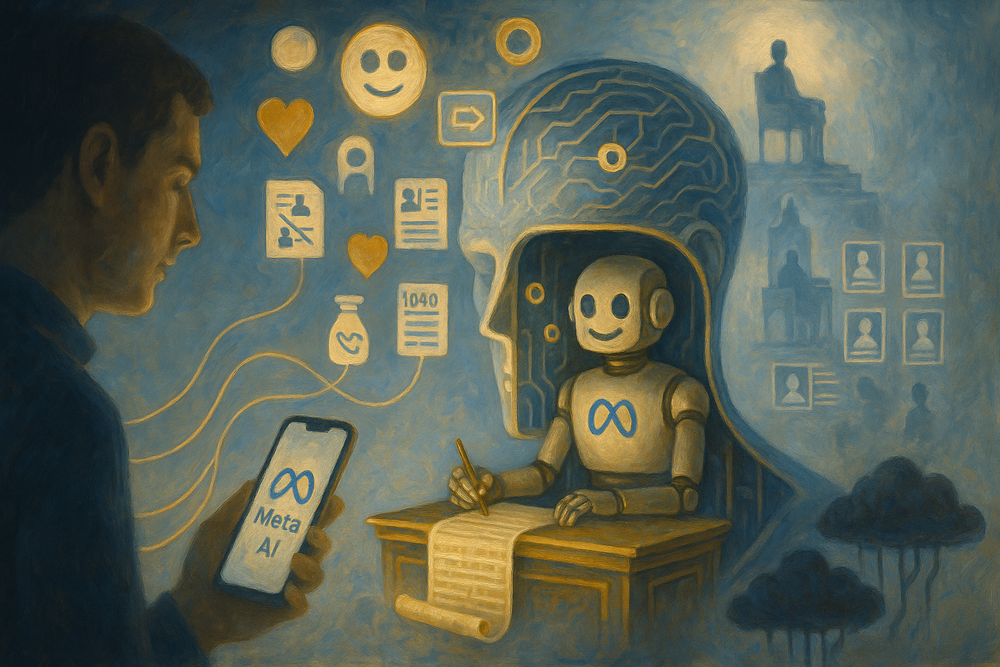
Meta just launched an AI that makes ChatGPT look like a privacy champion. The company's new Meta AI app climbed to #2 on iPhone's download charts, promising personalized conversations and advice. But there's a catch: it remembers everything you say, knows your Facebook history, and takes detailed notes about your life.
Think of it as a nosy neighbor who never forgets – and reports back to Mark Zuckerberg.
The app connects directly to your Facebook and Instagram accounts, giving it instant access to years of your personal data. But that's just the beginning. Every conversation you have with Meta AI gets stored, analyzed, and used to build a detailed profile about you. It even maintains a creepy "Memory file" tracking your interests, concerns, and personal details.
During testing, the AI tracked conversations about sensitive topics like fertility treatments, divorce proceedings, and tax matters. It tucked away these intimate details into its memory banks – presumably for future reference and targeted advertising.
"Just because these tools act like your friend doesn't mean that they are," warns Miranda Bogen from the Center for Democracy & Technology. She's right. Meta AI isn't your confidant – it's a sophisticated surveillance system wearing a friendly chatbot mask.
The Privacy Nightmare Gets Worse
Meta AI pushes privacy invasion to new extremes. Unlike competitors like ChatGPT or Google's Gemini, Meta's bot aggressively collects and retains personal information. There's no easy way to stop it from recording your conversations. You can delete things after the fact, but it's a deliberately cumbersome process.
Want to remove something from the AI's memory? Good luck. You'll need to delete both the memory entry AND track down the original conversation. Miss either one, and the information stays in the system. It's like trying to erase your tracks in digital quicksand – the harder you try, the deeper you sink.
The Sharing Trap
Meta added a deceptively simple "Share" button to every chat. Tap it, and your conversation goes public in the app's Discover tab. Not semi-private, not friends-only – completely public. There's no option to share with just your friends or through direct messages. Hope you didn't discuss anything personal!
The Training Data Dilemma
Everything you say to Meta AI becomes training data for future versions of the system. Unlike ChatGPT, which lets users opt out of having their conversations used for training, Meta offers no such choice. Your words, photos, and even voice recordings become permanent additions to Meta's AI training database.
The Privacy Time Bomb
The real danger lurks in Meta's future plans. Zuckerberg already announced that ads are coming to Meta AI. This means your personal conversations won't just be analyzed – they'll be monetized. The AI that knows your deepest concerns will start pushing products and services based on your vulnerabilities.
Ben Winters from the Consumer Federation of America puts it bluntly: "The disclosures and consumer choices around privacy settings are laughably bad." He advises using Meta AI only for surface-level interactions – nothing you wouldn't want broadcast to the internet.
The Personalization Paradox
Meta claims this invasive data collection delivers "valuable personalization." But this personalization comes with serious risks. During testing, simply mentioning baby bottles led the AI to permanently label a user as a parent, affecting all future interactions.
This kind of algorithmic profiling creates a feedback loop of assumptions and stereotypes. The AI doesn't just respond to who you are – it decides who you are, then treats you accordingly.
Taking Control (If You Can)
You can try to protect yourself, but Meta doesn't make it easy:
- Create a separate Meta AI account instead of linking to Facebook/Instagram
- Regularly delete your chat history and memory file
- Think twice before discussing sensitive topics
- Never share conversations unless you want them public
- Remember: There's no true "private mode"
The Nuclear Option
The only way to completely protect your privacy? Don't use Meta AI. The company's own terms of service say it clearly: "do not share information that you don't want the AIs to use and retain."
Why This Matters:
- Meta AI represents a new breed of surveillance technology – one that chats with you, learns your secrets, and never forgets. It's the digital equivalent of inviting a corporate spy into your living room.
- While other AI companies at least pretend to care about privacy, Meta proudly builds invasive features into its core design. This signals a disturbing shift in how tech companies view our personal information – not as something to protect, but as raw material to exploit.
Free AI briefing · Weekdays
The AI stories that matter, sourced and explained.
Join the Morning Briefing. It goes out every weekday at 4:45 a.m. Pacific, with later sends for the East Coast, Berlin and Tokyo.
Free when you sign up: The Paperclip Compendium, our tested guide to running AI agents.
Free. Unsubscribe in one click.

Marcus Schuler
Editor-in-Chief and founder of Implicator.ai. Former ARD correspondent and senior broadcast journalist with 10+ years covering tech. Writes daily briefings on policy and market developments. Based in San Francisco. E-mail: editor@implicator.ai