IMPLICATOR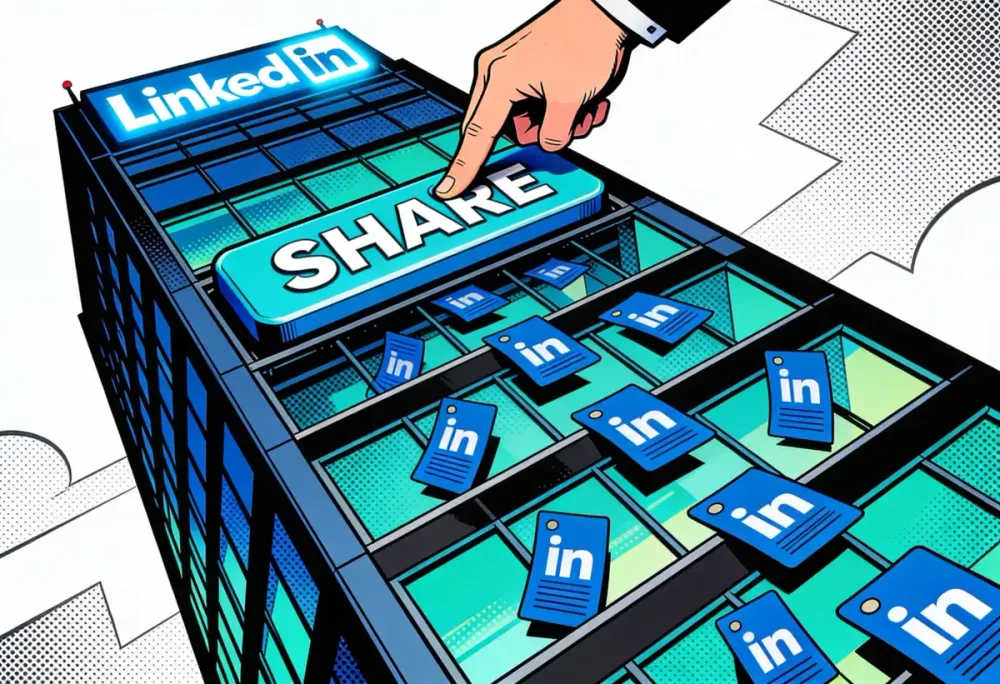
Microsoft published its Global AI Adoption 2025 report on January 8th. Within 72 hours, scrolling LinkedIn felt like walking through a house where every room had the same poster on the wall. Brad Smith's headshot appeared three times in two thumb-scrolls. The same statistics—"one in six," "Global North versus South," "UAE leads at 64%"—surfaced in post after post, wrapped in the same blue-tinted repost cards, the same Microsoft corporate imagery. The feed had a texture: glossy, insistent, uniform.
The pattern looked like coordinated amplification—because it was. But the mechanism was hiding in plain sight.
Microsoft didn't need to distribute internal talking points. The company built something simpler: a set of share-ready source texts, a launch post from President Brad Smith designed for resharing, and a Share button pointing directly to LinkedIn. The coordination wasn't secret. It was architectural. And it helps when you own the building.
The Breakdown
• Microsoft published share-ready content across three channels with identical statistics, then pointed a Share button at LinkedIn—a platform it bought for $26.2 billion
• Brad Smith's launch post was designed for resharing; LinkedIn's repost mechanic reproduced his words verbatim across hundreds of executive feeds
• The timing matters: the report landed after a year of skeptical AI coverage and declining enterprise adoption metrics
• Microsoft's methodology measures AI adoption using clicks on Microsoft services—higher adoption always means more Microsoft usage
The landlord advantage
Most companies run coordinated launches on LinkedIn. Salesforce does it. IBM does it. Every consulting firm does it. They're all guests in someone else's house, hoping the algorithm treats them well.
Microsoft bought the house in 2016 for $26.2 billion. When Microsoft wants to move a narrative from corporate blog to professional feed, it's not sending a package across town. It's moving furniture between rooms it owns.
This matters for everything that follows. The Share button on Microsoft's report page isn't a window to the outside world. It's a door between two rooms in the same building.
The source text package
Microsoft didn't just publish a report. The company released a coordinated content package across multiple owned channels, all using near-identical language:
The Corporate Responsibility report page leads with the headline statistics: "one in six" people worldwide using generative AI, Global North adoption at 24.7% versus 14.1% in the Global South, UAE leading at 64.0%, Singapore at 60.9%.
The "On the Issues" blog post (January 8, 2026) uses the same headline framing, the same statistics, the same country rankings, in the same order.
Microsoft Signal, the company's short-form content platform, published a condensed abstract hitting the same beats in a highly shareable format.
Three channels, one storyline, identical numbers. The sequencing isn't coincidental—it's a communications package designed for amplification.
The moral closer has a source
One phrase kept appearing across LinkedIn posts: "The next wave of innovation must benefit more people, in more places, not fewer."
The phrasing was too specific to be spontaneous. It felt like suggested share text—language handed down from comms.
It was. But the source isn't a hidden internal document. That line appears in Microsoft's own report page, positioned as the culminating message about AI diffusion and equity. Employees weren't copying from a secret template. They were copying from the public report—which was written to be copied.
Microsoft made the moral framing so quotable that people quoted it. That's not a conspiracy. That's good communications work. The question is what happens when good communications work flows through a building you own.
Distribution was designed in
The Corporate Responsibility report page includes an explicit Share block with a LinkedIn option. One click, and you're posting about Microsoft's AI adoption findings to your professional network.
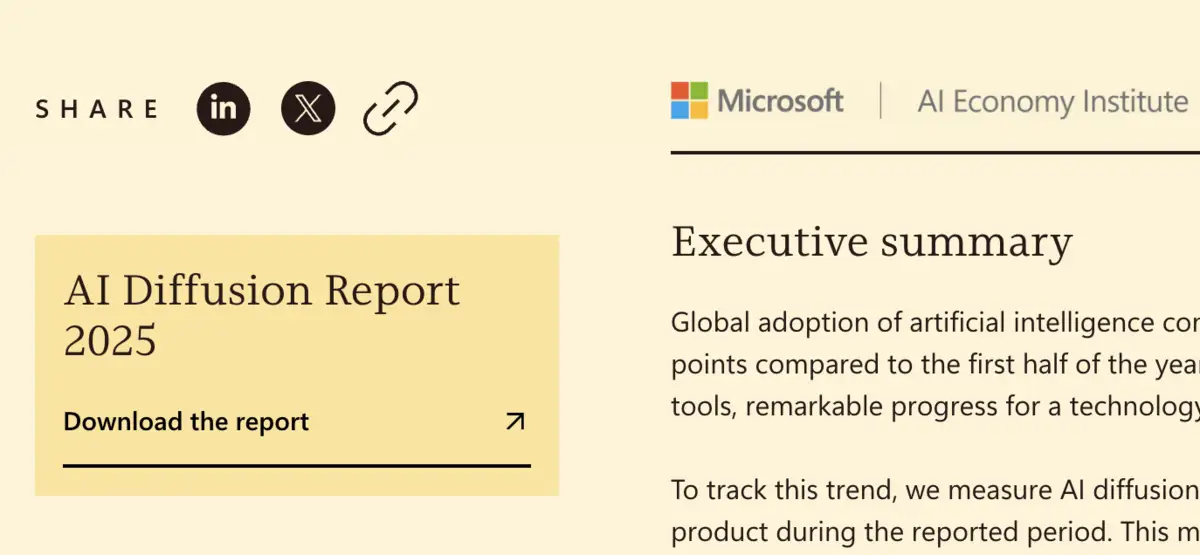
This sounds mundane—every corporate page has share buttons. But remember the building. Microsoft publishes share-ready text on a Microsoft website. It provides a one-click path to LinkedIn. LinkedIn is a Microsoft property. The company installed a door between two rooms it owns and labeled it "Share."
The Brad Smith cascade
Here's where the mechanism becomes visible.
Brad Smith, Microsoft's Vice Chair and President, posted a launch blurb on January 8th tying the report to his "Tools and Weapons" framework and the AI diffusion narrative. The post was polished, on-message, and designed for one thing: resharing.
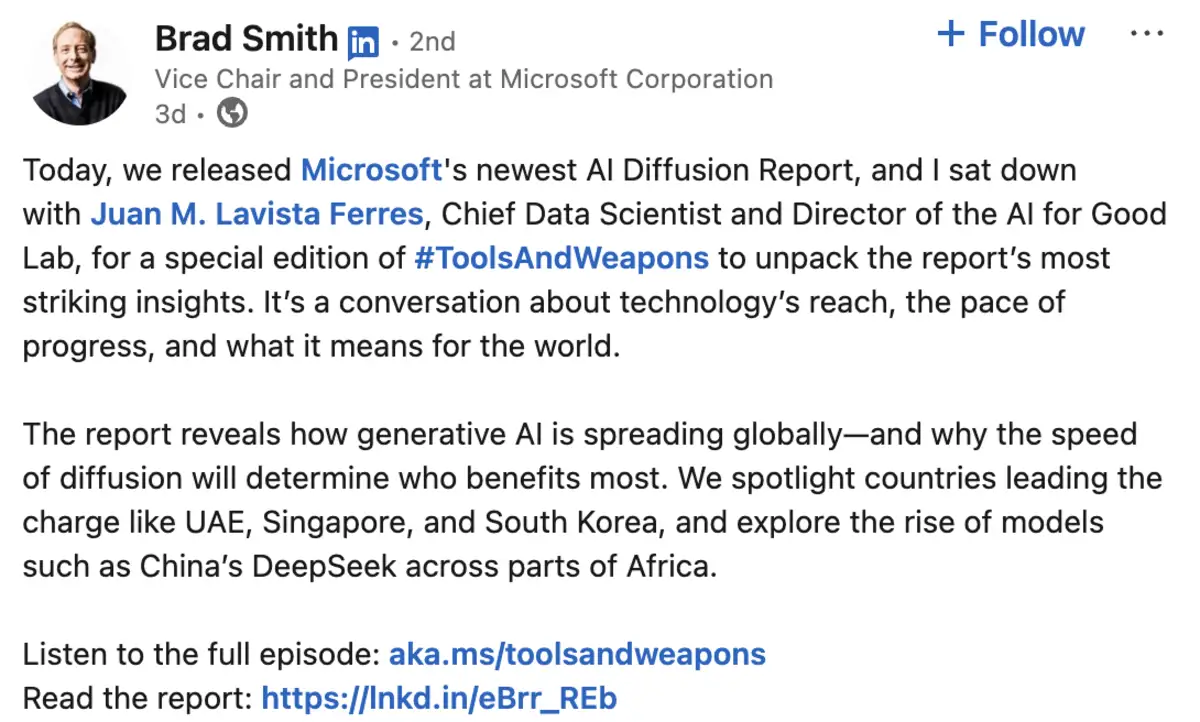
And reshare they did. Other Microsoft executives posted their own brief introductions, then embedded Smith's post underneath. LinkedIn's repost mechanic reproduces the original text word-for-word in the embed card.
Antony Cook, Microsoft's Corporate Vice President, added a one-line setup, then embedded Brad Smith's full post below. Mike Yeh did the same: original commentary on top, Brad Smith embed underneath. Naim Yazbeck, Microsoft's regional lead for the Middle East and Africa, amplified the same framing and explicitly attributed the story to Brad Smith.
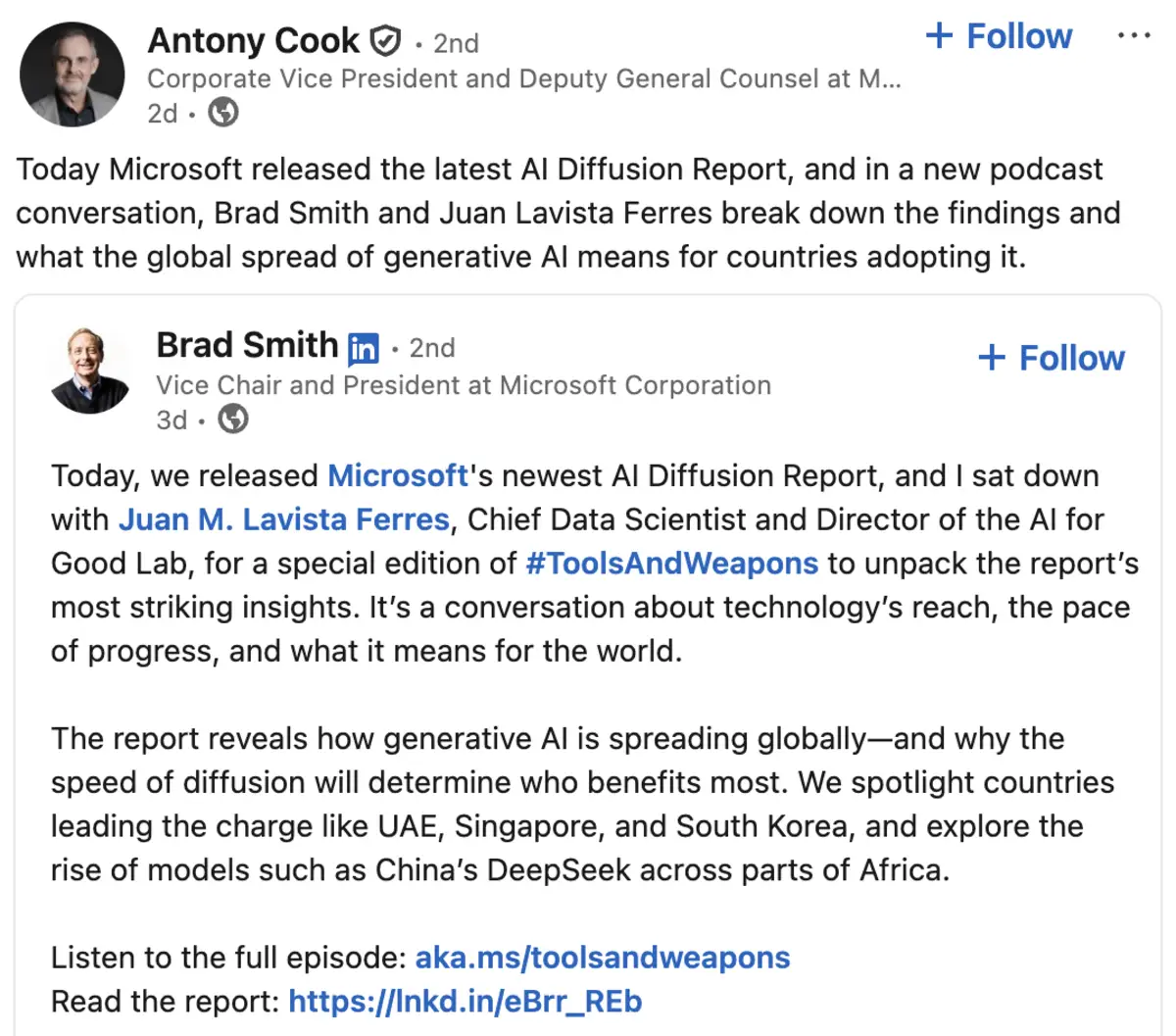
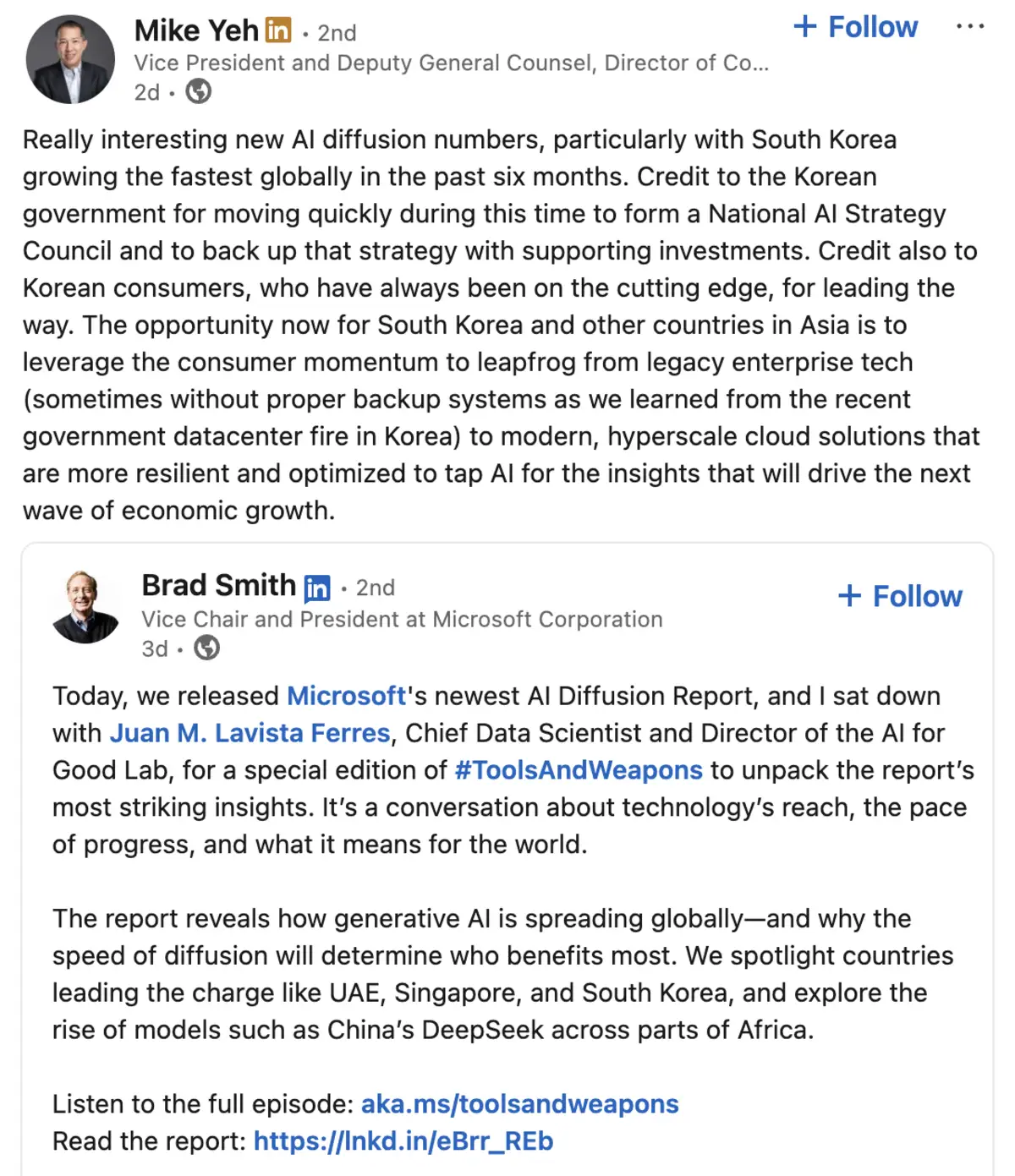
This is what you're seeing when you scroll LinkedIn during a Microsoft launch. Some of the "identical text" isn't employees copy-pasting from a template. It's the platform's repost mechanic reproducing Brad Smith's words every time someone hits the button. The amplification is real. The coordination is real. But the mechanism is a feature, not a leak.
The swarm
It wasn't just Brad Smith. It was Matthew Milton in Canada pushing the "diffuse it to their people" thesis and localizing it to "Canada ranks 14th." It was Naim Yazbeck in the Middle East framing the UAE's top ranking as regional victory. It was partners like Simon Doy, a Microsoft MVP running a consultancy, using the report as credibility before pivoting to a Copilot sales pitch. It was David Cornell from the Threat Analysis Center—not an AI economics role, a security intelligence function—posting a polished summary with the same statistics and framing.
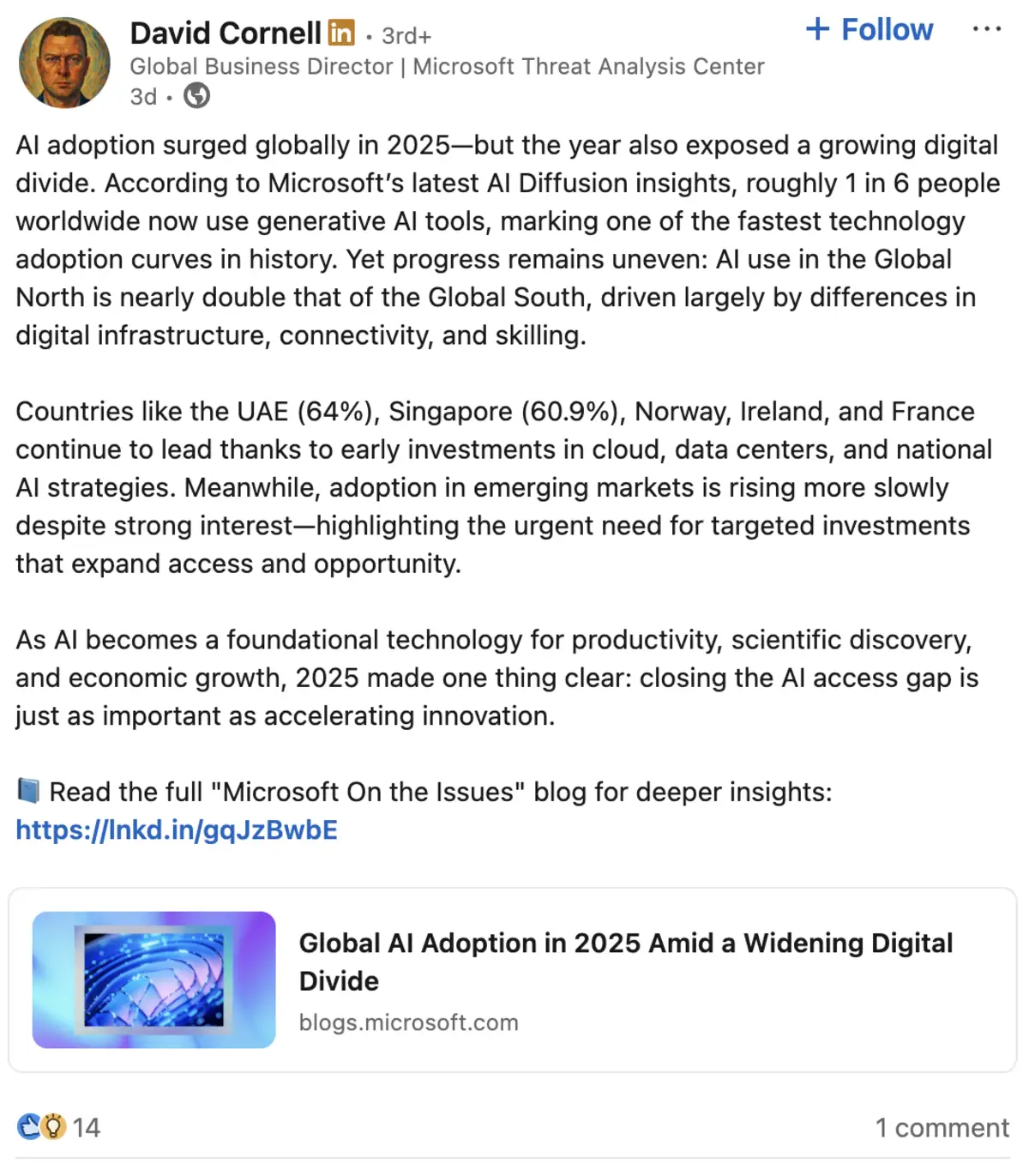
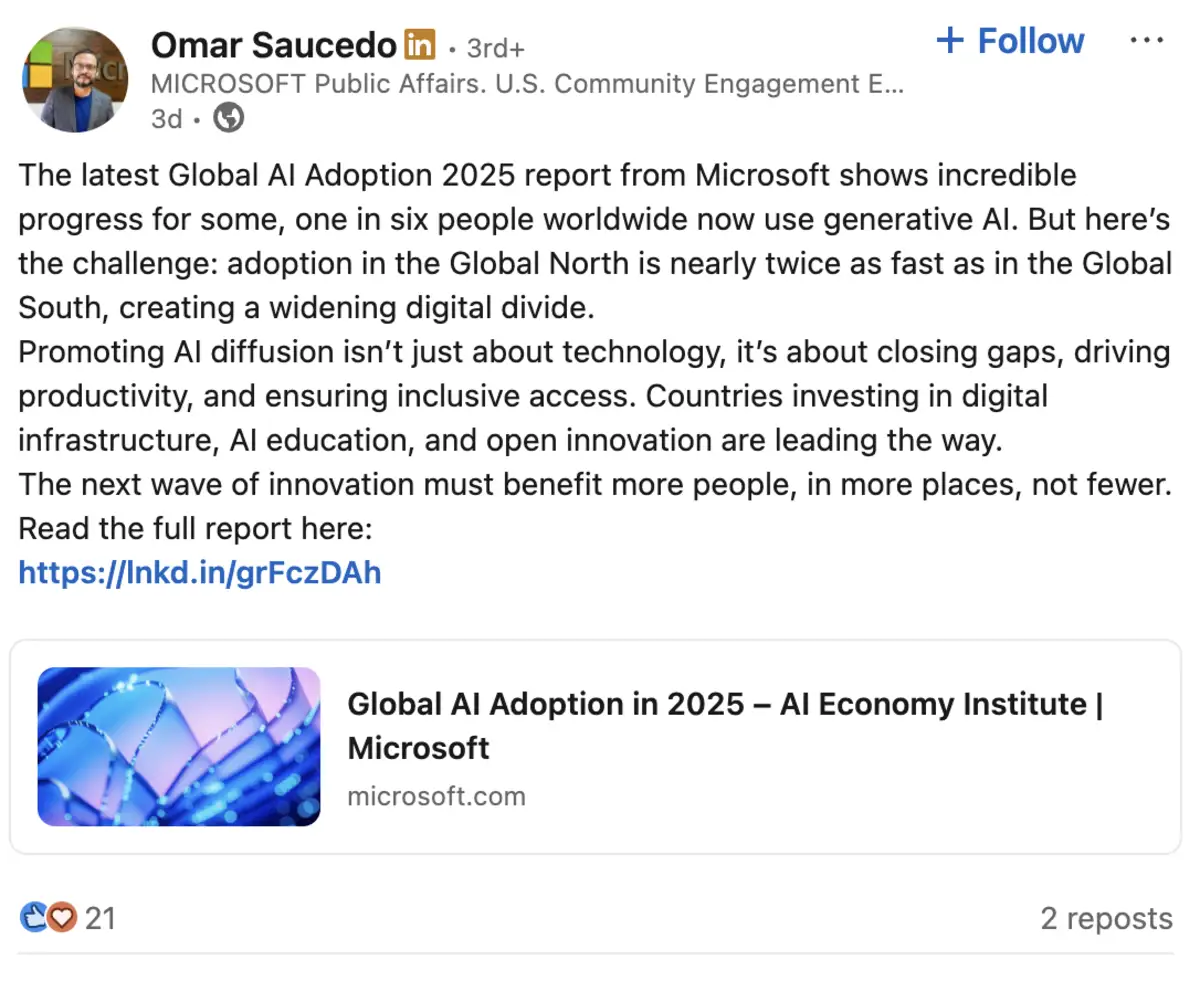
Senior executives set the tone. Regional leaders localized. Partners commercialized. Employees across unrelated divisions amplified. The swarm moved through the feed in a matter of days, and every participant was either inside the building or adjacent to it.
The press pickup confirms the package worked
Third-party coverage tells you whether a communications package succeeded. Computerworld's coverage—published the same day as Microsoft's report—leads with the same framing: "Global North" versus "Global South," "one person in six," "widening divide." Even the headline echoes Microsoft's language.
That's not reporters being lazy. That's Microsoft making the story easy to tell their way. The stats package was press-ready. The narrative was pre-structured. Outlets repeated it because Microsoft did the work of making it repeatable.
Why this report?
Microsoft publishes dozens of reports each year. Most don't get the full amplification treatment. This one did. The timing suggests anxiety.
The report landed after a year of increasingly skeptical AI coverage. In late 2025, the Bank for International Settlements found AI's contribution to US GDP growth was half the dot-com boom and one-fifth of Japan's 1980s investment surge. MIT research showed 95% of enterprise AI pilots deliver zero ROI. Census Bureau data revealed large-company AI adoption declining for the first time since tracking began. Meanwhile, DeepSeek gained ground across the Global South by being free—while Microsoft and OpenAI charge subscriptions.
The skeptical narrative was hardening. Microsoft needed to be loud because the quiet metrics—actual enterprise ROI, actual productivity gains—weren't doing the talking.
"One in six people worldwide now use generative AI" is a counter-narrative. It says: adoption is accelerating, this is real, don't fall behind. The insistence of the campaign reflects the stakes. There's $13 billion in OpenAI at risk. There's a Copilot-everywhere strategy that depends on the market believing AI adoption works. A report showing global acceleration—measured conveniently by Microsoft's own telemetry—provides evidence the bet is paying off. The amplification ensures that evidence reaches analysts, investors, and enterprise buyers before the skeptical story calcifies.
The audience matters too. LinkedIn's user base skews toward enterprise decision-makers—the people who approve Copilot seat licenses. The report's implicit message is a sales pitch: countries adopting AI faster are winning; companies that lag are falling behind. The "digital divide" framing makes it sound like equity discourse, but the solution Microsoft offers is buying Microsoft products.
Finally, there's the measurement itself. If Microsoft's methodology becomes the default frame for tracking AI adoption, Microsoft controls the scoreboard. The metric—clicks on Microsoft services—means higher adoption always equals more Microsoft usage. Wide amplification helps establish that frame before alternatives take hold.
The push wasn't random. This report, at this moment, addressed a strategic need. The building amplified the message. The message defended the bet.
What this isn't
This isn't a conspiracy. It's notable precisely because it's open.
The source texts are public. The Share button is visible. Brad Smith's post is on his public LinkedIn profile. The repost mechanic is a standard platform feature. Employee advocacy programs are normal. Coordinated launches are normal.
Some posts show genuine thinking. Matthew Milton's Canadian framing adds real context. Kim Miles's commentary about CAPEX and bubble risk goes beyond the Microsoft narrative. Simon Doy's sales pitch is authentic to his business.
What this is
This is evidence that Microsoft built a distribution system optimized for a building it owns.
The company publishes share-ready source texts. It provides frictionless sharing to LinkedIn. A senior executive posts anchor content designed for resharing. The platform's repost mechanic reproduces that content verbatim across hundreds of feeds. The algorithm distributes those posts to professional networks full of enterprise decision-makers.
Other companies run coordinated launches on LinkedIn. They knock and hope. Microsoft owns the building. When Microsoft wants a narrative to trend among professionals, it doesn't need hope.
And the content being amplified? A report that positions Microsoft as the neutral measurer of global AI adoption—while measuring adoption using Microsoft's own telemetry from Microsoft's own products, at precisely the moment the company needed a counter-narrative to rising skepticism.
The report tells you how many people use Microsoft's AI tools. The campaign tells you how Microsoft ensures you hear about it. The timing tells you why they needed you to hear it now.
Frequently Asked Questions
Q: How did Microsoft coordinate the LinkedIn campaign?
A: Microsoft published share-ready source texts across multiple channels, embedded a LinkedIn Share button on the report page, and had Brad Smith post anchor content designed for resharing. LinkedIn's repost mechanic then reproduced his words verbatim each time an executive hit the button. No secret templates needed.
Q: Why does Microsoft owning LinkedIn matter for this campaign?
A: Microsoft acquired LinkedIn in 2016 for $26.2 billion. When Microsoft shares content to LinkedIn, it's not sending a message to an external platform—it's moving information between properties it controls. The Share button connects two rooms in the same building.
Q: Why did this particular report get heavy amplification?
A: The report landed after a year of skeptical AI coverage. MIT research showed 95% of enterprise AI pilots deliver zero ROI. Census data revealed large-company AI adoption declining. Microsoft needed a counter-narrative showing adoption is accelerating—and needed it to reach analysts, investors, and enterprise buyers fast.
Q: Is this kind of coordinated launch unusual?
A: Coordinated launches are standard corporate practice. Salesforce, IBM, and consulting firms all do it. The difference is those companies are guests on LinkedIn, hoping the algorithm favors them. Microsoft owns the platform. The mechanics are the same; the structural advantage is not.
Q: What does Microsoft's AI adoption study actually measure?
A: The study measures clicks on Microsoft services—Bing, Copilot, Edge—using Microsoft's own telemetry. This means "higher AI adoption" in Microsoft's methodology always equals "more Microsoft usage." The company is measuring its own product engagement and calling it global AI adoption.
 Harkaram Grewal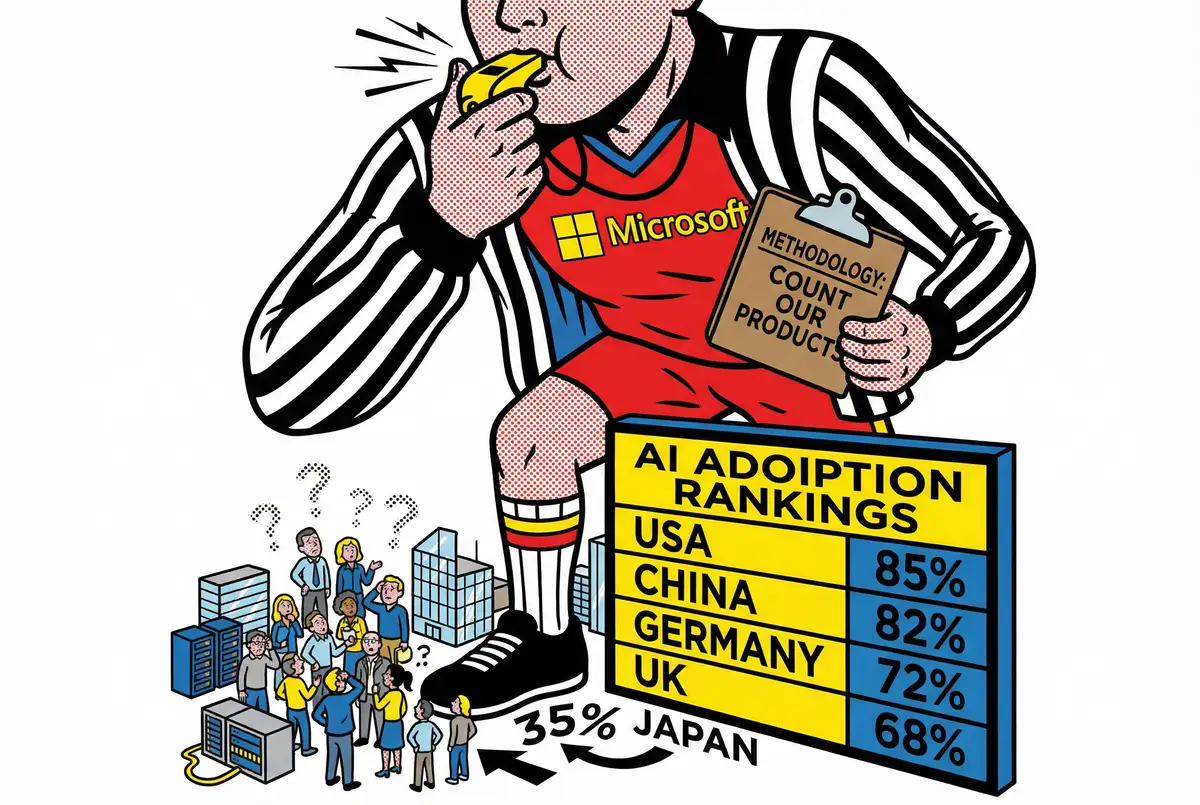
 Maria Garcia
 Marcus Schuler
Free AI briefing · Weekdays
The AI stories that matter, sourced and explained.
Join the Morning Briefing. It goes out every weekday at 4:45 a.m. Pacific, with later sends for the East Coast, Berlin and Tokyo.
Free when you sign up: The Paperclip Compendium, our tested guide to running AI agents.
Free. Unsubscribe in one click.

Marcus Schuler
Editor-in-Chief and founder of Implicator.ai. Former ARD correspondent and senior broadcast journalist with 10+ years covering tech. Writes daily briefings on policy and market developments. Based in San Francisco. E-mail: editor@implicator.ai