IMPLICATOR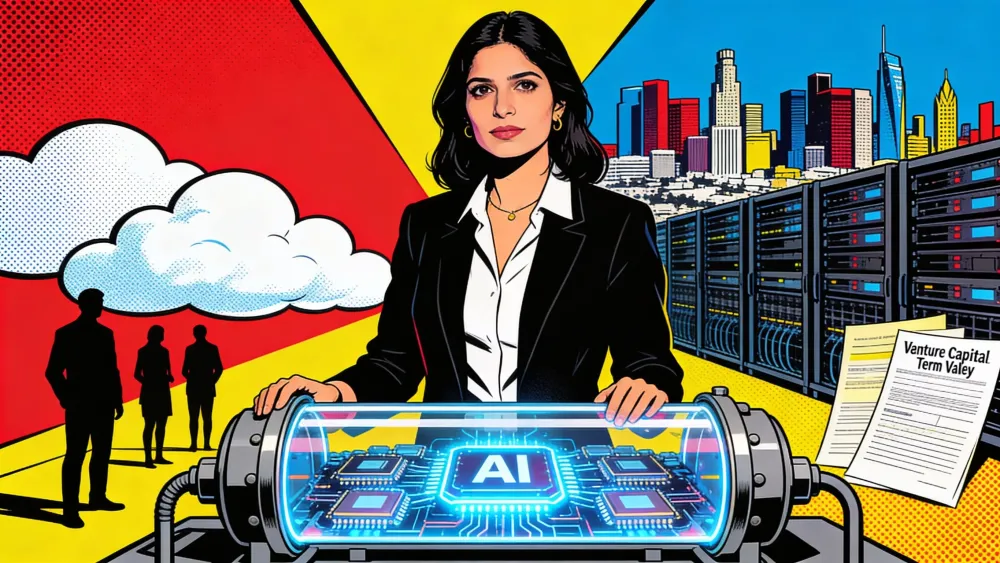
On April 22, Google Cloud put Mira Murati's 14-month-old company into a very small room. The room already held Google, Nvidia, Anthropic, Meta, OpenAI, and every investor trying to turn scarce chips into a claim on the next AI platform.
Thinking Machines Lab signed a multi-billion-dollar Google Cloud agreement for AI infrastructure built around Nvidia's GB300 systems. Google said the setup produced a 2x training and serving speedup in early testing. A month earlier, the company announced a gigawatt-scale Nvidia partnership for Vera Rubin systems targeted for early 2027.
That is the profile of Murati now. Not the "new strong woman of Silicon Valley," as the lazier version of the story would have it. That frame flatters the valley and shrinks the work. Murati's power is not symbolic. It is institutional. She is trying to build a pressure chamber where talent, capital, compute, and product discipline either fuse into a frontier lab or blow out through the seams.
The test is simple. Can one founder turn mystique into machinery before the people and chips around her become someone else's advantage?
Key Takeaways
- Murati's real test is institutional durability, not founder symbolism.
- Thinking Machines has one public product but compute commitments fit a frontier lab.
- Talent leaks to OpenAI and Meta turn the founding story into the main risk.
- The Google and Nvidia deals convert founder control into an expensive operating clock.
AI-generated summary, reviewed by an editor. More on our AI guidelines.
The biography is not the business
Murati arrived at Thinking Machines Lab with a biography that markets itself. She helped lead work around ChatGPT, DALL-E, and Codex at OpenAI. She briefly became interim CEO during the November 2023 governance crisis. Before that, she worked on Tesla's Model X and at Leap Motion. In Silicon Valley terms, that is almost too clean: cars, interfaces, frontier AI, boardroom fire.
But biography is a weak moat. It attracts capital first and competitors second. The launch team showed why. In the first launch stories, the headcount was still tiny: about 30 researchers and engineers. OpenAI names filled the roster. John Schulman became chief scientist. Barret Zoph became CTO. No finished model carried the pitch. The pitch was the room itself, full of people who knew how frontier research turns into a product millions use.
That explains the extraordinary financing. By July 2025, WIRED reported that Thinking Machines Lab had raised $2 billion at a $12 billion valuation. The Information separately reported unusual founder control terms, including supervoting shares and weighted board power. Investors were not buying revenue proof. They were buying Murati's ability to hold the center while an entire industry tried to price the future before it arrived.
Call it confidence. Call it institutional anxiety with a term sheet.
Her first product is a wedge, not a crown
Thinking Machines Lab's first product, Tinker, matters because it rejects the easiest founder myth. If Murati wanted only a grand entrance, she could have waited for an in-house model launch and staged the usual benchmark pageant. Instead, the company shipped a managed training and fine-tuning API for open-weight models.
The official Tinker announcement described a system that gives users control over data and algorithms while the lab handles distributed training. That split is the whole strategy in miniature. Thinking Machines Lab does not want to hide every detail from serious builders. It wants to remove the infrastructure pain that prevents them from shaping models in the first place.
That is a sharper move than a chatbot clone. Tinker puts Murati's company at the post-training bottleneck, where researchers and startups adapt open models for real work. It also forces the lab into customer contact, reliability work, documentation, pricing, support, and ugly production constraints. Those are not glamorous. They are useful.
Still, the wedge is not the crown. As of April 2026, Thinking Machines Lab has one public product line. Its own frontier models are not public. The company's hiring pages point toward pre-training science, supercomputing, native audio, frontier data partnerships, and research-product coordination. That tells you the ambition exceeds Tinker. It also shows how much remains unproven.
The pressure chamber is already hot. The product must teach the lab without trapping it inside a narrow infrastructure business.
Get Implicator.ai in your inbox
Strategic AI news from San Francisco. No hype, no "AI will change everything" throat clearing. Just what moved, who won, and why it matters. Daily at 6am PST.
No spam. Unsubscribe anytime.
Compute turns control into a bill
The Google and Nvidia deals make Murati's bet concrete. They convert founder control into future obligations.
Google says Thinking Machines Lab will use its AI Hypercomputer stack, A4X Max VMs with GB300 NVL72 systems, the Jupiter network, Kubernetes, Spanner, Cluster Director, and cloud storage services. The company framed the workloads as research, platform development, frontier model training, and reinforcement learning. TechCrunch reported the contract sits in the single-digit billions and is not exclusive.
The plain calculation is brutal. A company that began 2025 with about 30 people and had grown to roughly 130 by spring 2026 is now arranging infrastructure as if it belongs beside the largest frontier labs. One shipped fine-tuning product has to justify relationships measured in billions today and a gigawatt tomorrow.
That does not mean Murati is reckless. It means she understands the market's new sequence. In AI, companies no longer prove demand, raise capital, and then buy compute. They reserve compute early because without it the proof may never happen. The chip contract has become the audition.
Google has its own fear in this story. So does Nvidia. So do investors. Hyperscalers need labs that can fill their capacity. Chipmakers need credible challengers beyond the same incumbents. Venture firms need an OpenAI-shaped return without OpenAI's governance history. Murati sits at the intersection of their impatience.
That gives her power. It also gives everyone a reason to watch the seams.
The talent leaks are the real profile
Every profile of Murati should spend less time on aura and more time on leakage. Thinking Machines Lab's most serious risk is not that nobody believes in the company. It is that too many people do.
OpenAI regained Barret Zoph, Luke Metz, and Sam Schoenholz in January. TechCrunch and WIRED both reported the departures. Business Insider later reported that Meta had hired seven founding members from Thinking Machines Lab, including Joshua Gross, the engineer who built Tinker. Andrew Tulloch left for Meta in October on a package reportedly worth $1.5 billion over six years.
For a normal company, seven departures may be a staffing problem. For Thinking Machines Lab, they are a strategic signal because the team was the original product. Investors funded Murati's ability to assemble rare people. Rivals are now testing whether she can keep them once the compensation war turns absurd.
This is where the "strong woman" frame fails hardest. It turns a structural fight into a character sketch. Murati does not need to prove personal toughness to an industry that already gave her capital, control, and compute access. She needs to prove institutional toughness. Can the company survive when Meta buys pieces of the founding story? Can it keep researchers who joined for openness while building a private, capital-heavy lab? Can it move fast enough that lost people become replaceable rather than legendary?
Those questions carry envy, fear, and irritation across the valley. OpenAI does not want its alumni to build a rival culture. Meta does not want to miss another AI platform cycle. Google does not want to rent capacity to a company that fails to use it. Investors do not want a founder narrative without product proof.
Murati's job is to disappoint all of them just enough to remain independent.
Silicon Valley made her powerful for a reason
The deeper reason Murati matters is not representation, though representation matters. It is that she embodies a correction Silicon Valley quietly wants after the first ChatGPT cycle.
The first wave rewarded scale, speed, and secrecy. It also produced governance panic, safety fights, product confusion, compute shortages, and a talent market that now behaves like a sovereign debt auction. Thinking Machines Lab presents itself as a different configuration: frontier ambition paired with customization, collaboration, open technical work, and product contact.
That mix is not soft. It is a bid for a more durable form of power. The company publishes research on LoRA, deterministic inference, and post-training methods. It maintains public repositories. It describes its mission in hiring materials as advancing collaborative general intelligence. It is not escaping the frontier race. It is trying to reroute it through tools people can tune and systems researchers can inspect.
If you are a buyer, that distinction matters. For rivals, it matters more. The old frontier lab bargain asked users to trust the model. Murati's version asks users to trust the institution building around the model. That is a higher bar, and a slower one.
The next proof will not come from another profile or another financing leak. It will come when Thinking Machines Lab ships a second product, releases its own model line, or shows that Tinker can become a platform rather than a clever first move. Until then, Murati remains both powerful and exposed.
The woman is not the story. The institution she is trying to harden is.
Frequently Asked Questions
What is Thinking Machines Lab?
Thinking Machines Lab is Mira Murati's AI research and product company. It launched publicly in February 2025 and has positioned itself around customizable, collaborative AI systems, infrastructure quality, open technical work, and frontier model ambition.
What has Thinking Machines Lab shipped?
Its first public product is Tinker, a managed training and fine-tuning API for open-weight models. Tinker lets technical users control data and algorithms while Thinking Machines handles distributed training infrastructure.
Why does the Google Cloud deal matter?
The Google Cloud agreement gives Thinking Machines access to AI infrastructure built around Nvidia GB300 systems. It shows the company is reserving compute at a scale consistent with frontier-model training, not only a narrow fine-tuning API.
What is the biggest risk for Murati's company?
The biggest risk is institutional durability. Thinking Machines has raised enormous capital and secured compute, but it has also lost founding talent to OpenAI and Meta while its own frontier models remain unreleased.
Why is this a profile of Murati rather than only a company analysis?
Murati's control, recruiting power, and OpenAI record explain why investors and infrastructure partners moved early. But the article argues that her real test is whether that personal credibility can become a resilient institution.
AI-generated summary, reviewed by an editor. More on our AI guidelines.
Free AI briefing · Weekdays
The AI stories that matter, sourced and explained.
Join the Morning Briefing. It goes out every weekday at 4:45 a.m. Pacific, with later sends for the East Coast, Berlin and Tokyo.
Free when you sign up: The Paperclip Compendium, our tested guide to running AI agents.
Free. Unsubscribe in one click.

Marcus Schuler
Editor-in-Chief and founder of Implicator.ai. Former ARD correspondent and senior broadcast journalist with 10+ years covering tech. Writes daily briefings on policy and market developments. Based in San Francisco. E-mail: editor@implicator.ai