

Mistral AI just shipped a 123 billion parameter coding model that matches competitors five times its size. Devstral 2 scores 72.2% on SWE-bench Verified. DeepSeek V3.2 needs 685 billion parameters to hit similar numbers. Kimi K2 crosses a trillion. The French startup cracked something real about parameter efficiency.
Then they slapped a license on it that bars any company making over $20 million monthly from using it freely, called the whole package "open source," and waited for the press releases to write themselves.
This is the play. Ship impressive technology under a license that sounds permissive, harvest goodwill and free testing from developers who don't read the fine print, then charge enterprise rates to anyone who actually needs to deploy at scale. The model is genuinely good. The marketing is genuinely dishonest.
The Breakdown
• Devstral 2 (123B parameters) matches models 5-8x larger on coding benchmarks, scoring 72.2% on SWE-bench Verified
• The "modified MIT license" bars any company with over $20M monthly revenue from free use, contradicting open-source claims
• ASML's €1.3B investment frames Mistral as Europe's AI sovereignty play, but revenue caps exclude major European enterprises
• Mistral's own evaluations show Claude Sonnet 4.5 remains "significantly preferred" over Devstral 2 in human testing
The Weapon Works
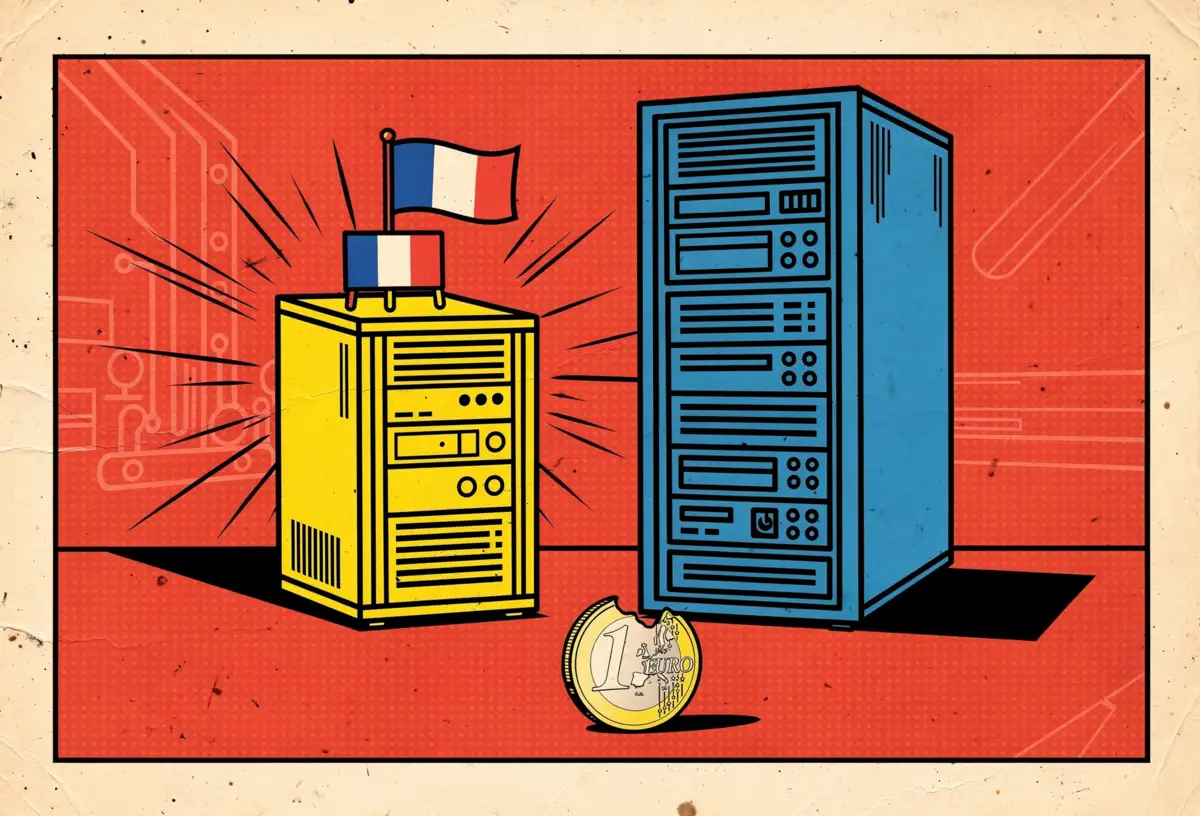
Picture two server racks. The first holds four H100 GPUs, maybe $120,000 worth of hardware, enough to run Devstral 2. The second rack stretches into a row, then a cluster. Thirty-two cards, sixty-four, more. That's what DeepSeek V3.2 demands. Kimi K2 needs its own wing of the data center.
Both setups solve the same coding problems at roughly the same accuracy. One fits in a closet. The other requires a facilities team.
Mistral built a dense 123B transformer that matches mixture-of-experts behemoths on coding benchmarks. The scaling laws said you needed more parameters, more compute, more everything. Mistral found a shortcut, or at least a more efficient path through the wilderness. Whatever they did to the architecture, it works.
The smaller variant matters more for most developers. Devstral Small 2 runs 24 billion parameters, scores 68.0% on SWE-bench, and fits on consumer hardware. A single GPU handles it. Even CPU-only setups work, though slowly. For developers who want local inference without renting cloud time, that's the product.
Both models support 256K token context windows. Enough to hold a medium-sized codebase in memory, track dependencies across files, reason about architectural decisions without losing the thread. Earlier coding models choked at 32K tokens. They'd forget the function signature by the time they reached the implementation.
The pricing undercuts everyone once the free period ends. Devstral 2 lands at $0.40 per million input tokens, $2.00 output. Devstral Small drops to $0.10 and $0.30. Claude Sonnet costs roughly seven times more per task, according to Mistral's benchmarks.
Efficient architecture. Reasonable prices. Extended context. Solid performance. The engineering delivered.
The License Tells the Truth
Now read section 2 of Devstral 2's "modified MIT license":
"You are not authorized to exercise any rights under this license if the global consolidated monthly revenue of your company (or that of your employer) exceeds $20 million."
Twenty million monthly. Two hundred forty million annually. That line excludes every bank, every insurance company, every manufacturer with more than a few hundred employees, every hospital system, every retailer, every telecom. It excludes most of the companies that would actually deploy a coding model at scale.
Devstral Small 2 ships under Apache 2.0. Genuinely permissive. No revenue caps. Use it however you want. But the small model isn't the one hitting 72.2% on SWE-bench. That's the big model, the one Mistral actually wants enterprises to pay for.
The structure is deliberate. Release the weaker model openly, let developers build familiarity and tooling, then charge for the version that actually competes with Claude. The open-source community does your QA. Your sales team does the monetization.
Hacker News caught this within hours. One commenter pulled the license text and asked how exactly "modified MIT" qualified as permissive. Another wondered why Chinese competition from DeepSeek, which ships genuinely open weights, hadn't pushed Mistral toward matching terms.
The Open Source Initiative has been clear for decades: licenses cannot discriminate against fields of endeavor or specific users. A revenue cap discriminates explicitly. Whatever Mistral is shipping, it isn't open source by any definition that existed before marketing departments got involved.
The Sovereignty Pitch Has a Hole
ASML wired €1.3 billion to Mistral in September. The Dutch semiconductor equipment maker, the company that builds the machines without which no advanced chip exists, decided the French AI startup deserved that kind of backing.
That's not a financial investment. That's a geopolitical statement. Europe wants AI capabilities that don't route through Mountain View or Beijing. Mistral is supposed to provide them.
Cédric O worked the phones to make this happen. France's former digital minister joined Mistral early, brought his contact book, smoothed paths through Brussels and Paris. The EU AI Act treats open-weight model providers gently. Mistral helped write those exemptions.
The pitch to European policymakers goes like this: American AI labs will eventually restrict access or raise prices or comply with American government requests that European interests don't align with. Chinese labs carry different risks. Europe needs its own capability. Mistral provides it.
But the pitch assumes Mistral actually ships open technology. If the revenue-gated license excludes every significant European enterprise, the sovereignty argument falls apart. Deutsche Bank still needs a commercial license. Siemens still needs a commercial license. Airbus, Carrefour, Unilever, all of them exceed the threshold. They're negotiating with Mistral the same way they'd negotiate with Anthropic.
Strategic independence requires alternatives that work for strategic industries. A license that excludes everyone above startup scale doesn't deliver independence. It delivers a different vendor.
The Vibe Thing
Mistral named their CLI tool "Vibe." Not an accident.
Vibe coding, the practice of describing what you want and letting AI generate it without careful review, has become the most polarizing idea in developer culture. Cursor raised $900 million riding the wave. Critics say it produces garbage that junior developers can't debug. Proponents say it works for prototypes and MVPs.
Mistral picked the provocative name to generate exactly this paragraph. Controversy is attention. Attention is adoption. Kilo Code reported 17 billion tokens processed in the first 24 hours. The marketing worked.
The tool itself looks competent. File manipulation, code search, Git integration, persistent history, configurable permissions. Standard features for agentic coding assistants. Nothing revolutionary, nothing broken.
But the branding tells you who Mistral wants using this. Not the senior engineer who reviews every line. The founder who needs a landing page by Tuesday. The agency shipping MVPs to clients who don't know better. The hobbyist who wants something that works without understanding why.
Those users won't read the license. They'll build on Devstral, tell their friends, maybe even get acquired. Then the acquirer's legal team will notice the revenue cap, and Mistral's sales team will take the call.
The Benchmark Gap Nobody Mentions
Buried in Mistral's announcement, a human evaluation study. Independent annotators compared Devstral 2 against DeepSeek V3.2 and Claude Sonnet 4.5 on real coding tasks, scaffolded through Cline.
Against DeepSeek, Devstral wins. 42.8% win rate versus 28.6% loss rate. Clear advantage.
Against Claude Sonnet 4.5, the verdict flips. Claude remains "significantly preferred." Mistral's words, not mine.
So the actual hierarchy runs: Claude at the top, Devstral in the middle, open-weight competitors below. The efficiency story is real, parameter count is down, but the performance gap with closed models persists.
Cline's quote in the press release is carefully worded: Devstral delivers "tool-calling success rate on par with the best closed models." Tool-calling. Not overall performance. Not code quality. The specific metric where Devstral matches.
Meanwhile, nobody can locate Mistral's SWE-bench results on the official leaderboards. The announcement provides no verification links. For a company marketing itself as the transparent alternative to black-box American labs, that's a strange omission.
What's Actually Happening Here
Mistral found a way to have it both ways. Ship technically impressive models. Claim the open-source mantle. Gate meaningful commercial use behind revenue caps. Harvest developer goodwill and free testing while preserving enterprise pricing power.
The 123B model really does match 600B+ competitors on benchmarks. The efficiency gains really do matter. The extended context really does solve practical problems. If you're a startup or a hobbyist, Devstral Small 2 under Apache 2.0 is a genuinely useful tool with genuinely permissive terms.
But the next time someone tells you Mistral is Europe's open-source answer to American AI dominance, ask them to read section 2 of the Devstral 2 license. Ask them which European enterprises can actually use it freely. Ask them how "modified MIT" differs from "commercial software with a generous free tier."
The answers tell you everything about who the product is actually for.
Why This Matters
- For developers under the revenue threshold: Devstral 2 and especially Devstral Small 2 offer competitive, locally deployable coding assistance at prices well below proprietary alternatives. The Apache 2.0 license on the small model is genuinely permissive.
- For enterprise buyers: Ignore the open-source marketing. Evaluate on performance and price against Claude and GPT-4, since you need commercial licenses regardless of what Mistral calls its model.
- For European AI policy: Mistral's revenue-gated licensing undercuts sovereignty arguments. Until genuinely open licenses cover frontier models, European strategic industries remain dependent on commercial negotiations with AI providers, French or otherwise.
❓ Frequently Asked Questions
Q: What hardware do I need to run Devstral locally?
A: Devstral 2 (123B) requires at least four H100-class GPUs, roughly $120,000+ in hardware. Devstral Small 2 (24B) runs on a single consumer GPU, including NVIDIA GeForce RTX cards and DGX Spark systems. It also works on CPU-only setups with no dedicated GPU, though inference will be slower.
Q: Does the $20M revenue cap apply if I work at a big company but use Devstral for personal projects?
A: The license language is ambiguous. It references "your company (or that of your employer)," which could restrict personal use by employees of large companies. Mistral hasn't clarified this. If your employer exceeds $240M annual revenue, consult their legal team before using Devstral 2 for any purpose.
Q: What does SWE-bench Verified actually test?
A: SWE-bench Verified measures whether AI models can resolve real GitHub issues from popular open-source projects. It's a curated subset of the original SWE-bench, designed to reduce gaming and ensure valid results. Models receive issue descriptions and must generate working code fixes. Devstral 2 scores 72.2%, Devstral Small 2 hits 68.0%.
Q: Can I fine-tune Devstral for my company's codebase?
A: Yes. Mistral says both models support custom fine-tuning to prioritize specific languages or optimize for enterprise codebases. Devstral Small 2 under Apache 2.0 allows unrestricted fine-tuning. Devstral 2's modified MIT license permits fine-tuning only if your company stays under the $20M monthly revenue threshold.
Q: Where exactly does Devstral lose to Claude?
A: Mistral's own human evaluations found Claude Sonnet 4.5 "significantly preferred" over Devstral 2 on real coding tasks. Devstral matches Claude's tool-calling success rate but falls short on overall code quality and task completion. Against open-weight competitors like DeepSeek V3.2, Devstral wins with a 42.8% to 28.6% margin.
 Marcus Schuler
 Maria Garcia
 Robert Brown