IMPLICATOR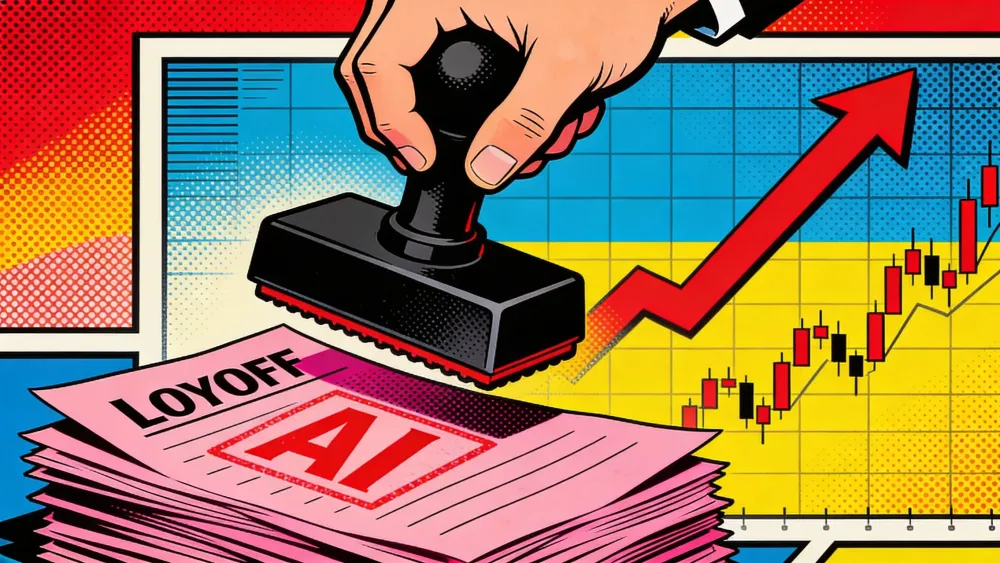
Jack Dorsey fired 4,000 people last week and blamed artificial intelligence. The same week, two economists at the European Central Bank published something inconvenient: data from 5,000 European firms showing that companies using AI the most are actually hiring more. Not less.
Block's stock jumped 24% on the news of those layoffs. The ECB paper barely made headlines.
That gap tells you everything about what's driving the AI-jobs conversation right now. Not the technology. Not the productivity gains. The incentive to lie about both.
The Breakdown
- ECB survey of 5,000 firms finds AI-intensive companies 4% more likely to hire, not fire workers
- U.S. companies attributed 55,000 job cuts to AI in 2025, twelve times more than two years earlier
- Oxford Economics and Revelio Labs economists suspect AI is pretext for cuts driven by overhiring
- EU AI Act classifies HR AI tools as "high risk" with mandatory human oversight before deployment
What Frankfurt found
The ECB's Survey on the Access to Finance of Enterprises tracked AI adoption and employment decisions across the euro area through the second and fourth quarters of 2025. The findings cut against the prevailing American narrative in three specific ways.
Companies making heavy use of AI were about 4% more likely to add staff than those that didn't use it at all. Firms actively investing in AI were 2% more likely to be hiring. And among the minority that used AI specifically to cut labor costs, only 15% of AI-using firms, the effects on employment were negative but far too small to offset the broader hiring trend.
"AI-intensive firms tend, on average, to hire rather than fire," the blog's authors, Laura Lebastard and David Sondermann, wrote.
The growth came from a specific place: firms using AI for research, development, and innovation. Not automation. They were building new capacity and needed people to staff it. The effect was driven by small firms, while AI stayed neutral for large companies' employment, a finding that echoes a European Investment Bank working paper published in January.
The alibi factory
Now cross the Atlantic.
In 2025, American companies attributed 55,000 job cuts directly to AI, according to outplacement firm Challenger, Gray & Christmas. Twelve times the number from two years earlier. Pinterest cited AI strategy. Dow cited automation. CrowdStrike tried "industry reshaping," which could mean anything. Amazon played it differently, cutting 16,000 workers in January and leaving AI completely out of the layoff notice. Jassy had tipped the hand months earlier, telling staff the company wanted fewer desk jobs. But the memo that actually fired people? Not a word about machines.
Then Dorsey went further than anyone. He slashed Block from 10,000 employees to just under 6,000 and credited AI. His words: "A significantly smaller team, using the tools we're building, can do more and do it better." The stock soared. Investors added roughly $8 billion in market value within hours.
What Dorsey didn't mention: Block had tripled its headcount during the pandemic. It carried massive Bitcoin exposure that had lost half its value in six months. Its share price had fallen 35% since October. The layoffs corrected overhiring, not technological displacement. But "we overhired during COVID and our Bitcoin bet went sideways" doesn't move stock prices. "AI made us more efficient" does.
Wall Street looked emboldened. Spend $450 to $500 million on severance, receive $8 billion in added market cap. That ratio would embarrass a payday lender.
Ben May, director of global macro research at Oxford Economics, didn't hedge. "We suspect some firms are trying to dress up layoffs as a good news story rather than a bad one, by pointing to technological change instead of past overhiring."
Lisa Simon, chief economist at Revelio Labs, reached the same conclusion from different data. "Companies want to get rid of departments that no longer serve them," she told CBS News. "And I think, for now, AI is a little bit of a front and an excuse." Simon argues the technology is having more impact on hiring freezes than on actual layoffs, with companies pulling back on new roles as they convince themselves they can do more with less.
Sam Altman calls this "AI washing." Under 1% of 2025 job losses actually traced to artificial intelligence, according to data he cited. Anthropic's own research, published this week, backs the skepticism. Computer programmers face 75% theoretical task coverage from language models, according to Anthropic's framework. Programmers should be the canary here. They face the highest theoretical exposure to language models. And yet their unemployment rate hasn't twitched since late 2022.
Neat alibi. Shame about the evidence.
Why Europe's numbers look different
You might assume the gap comes down to adoption speed. American companies further along in deploying AI, further along in cutting. Europe just behind the curve.
The ECB data says otherwise. Two out of three European firms already use AI. For companies above 250 employees? Nine in ten. Adoption is broad. Investment is narrow: only a quarter of firms actually spend money building or buying AI systems. Most just use the free tools already available online.
Stay ahead of the curve
Strategic AI news from San Francisco. No hype, no "AI will change everything" throat clearing. Just what moved, who won, and why it matters. Daily at 6am PST.
No spam. Unsubscribe anytime.
That distinction matters more than it sounds. Firms that merely use ChatGPT or Copilot haven't changed their production processes. The technology sits on top of existing workflows. Firms that invest are building something new, and building requires people.
But there's another variable the ECB doesn't measure directly. Call it incentive structure. European labor markets punish sudden mass layoffs through works councils, notice periods, and consultation requirements. Belgium still enforces a 1983 rule requiring employers to consult workers before deploying any technology with "significant collective consequences" for jobs. That rule was written for factory robots. Now it covers ChatGPT. The EU AI Act stamps "high risk" on any AI tool touching hiring or performance reviews. You want to automate candidate screening? Human oversight first. Transparency first. Brussels had planned full enforcement by August. The Commission's Digital Omnibus package got in the way, probably pushing deadlines to late 2027.
None of this prevents European companies from cutting workers. It prevents them from doing it theatrically for the benefit of investors. And that distinction shapes whether AI gets credit for job losses it didn't cause.
The ILO sees the friction differently. At a recent webinar in Geneva, Sher Verick, the organization's coordinator for digitalization and AI, put it in terms that would make a Silicon Valley CEO uncomfortable. AI will transform work, Verick said. That's settled. The question is "how to ensure that this transformation advances decent work and social justice." Translation: regulation doesn't stop change, it forces companies to prove the change is real before they act on it. American boards face no such burden of proof.
European regulators look vindicated. At least for now. The Ifo Institute found that more than a quarter of German firms expect AI to eliminate some positions within five years. That's a real concern with a real timeline. But it is not what's happening today. EY reported that organizations are losing up to 40% of AI's theoretical productivity gains because employees struggle to absorb new responsibilities on top of existing roles. The productivity revolution hasn't arrived. The layoff narrative got there first.
The template spreads
If you're a CEO watching Block's stock chart, the playbook writes itself. The market doesn't verify whether AI actually displaced workers. It verifies whether you said it did, confidently, alongside strong earnings.
The cascade has started. The numbers in January were ugly. 108,435 layoff notices across U.S. companies, more than double what the same month produced a year ago. Shopify now requires teams to prove they can't use AI before requesting new hires. Zuckerberg told Meta employees 2026 would be "the year that AI dramatically changes the way we work."
Klarna offers the cautionary version. CEO Sebastian Siemiatkowski said AI had replaced roughly 700 customer service agents. Markets cheered the 40% headcount reduction. Service quality declined badly enough that customers noticed. Eighteen months later, Klarna was quietly hiring back humans for the same jobs it had just axed. The market rewarded the cut and punished the consequences. Most boards won't study that cycle before copying the template.
And the template degrades as it travels. Block, to its credit, paid well on the way out. Twenty weeks of salary, tenure bonuses, six months of healthcare, equity vesting through May. Copycat versions at less profitable companies will skip those terms. The people hurt worst will be the ones working for CEOs who watched Dorsey's stock chart and drew the wrong lesson.
Who gets exposed
The ECB data doesn't prove AI creates jobs forever. Its authors acknowledge as much: "The longer-term impact of AI on employment remains less clear." Short-term job expansion before longer-term restructuring is a pattern as old as the loom. ATMs didn't kill bank tellers immediately either.
What the data proves right now: the companies deploying AI most aggressively in Europe are hiring. The companies firing most aggressively in America aren't doing it because AI forced their hand. They're doing it because investors pay a premium for the narrative.
The losers are obvious. Four thousand people at Block who lost their jobs to a stock-price play dressed up as technological progress. Workers at Amazon and Pinterest who got restructured so a CEO could claim efficiency gains that haven't materialized. Entry-level candidates facing tighter hiring because companies believe their own press releases.
Palantir CEO Alex Karp went furthest of all, arguing in January that AI will displace so many jobs it will eliminate the need for mass immigration. That claim treats speculation as settled economics. Frankfurt's regression tables say the opposite.
The winners are less obvious but more durable. European firms investing in AI for R&D are growing, hiring, building capacity. They aren't performing efficiency for the market. They are doing the work. And unlike the American template, their growth doesn't require someone else's severance package to make the stock chart move.
Frankfurt's regression tables vs. Wall Street's earnings calls
Block's stock has held its gains. The template is set. By summer, every earnings call in America will include an AI efficiency slide, complete with headcount targets and a confident CEO explaining how fewer humans means more intelligence.
The ECB's 5,000-firm dataset will sit in an economics blog that most investors never read. Somewhere in Frankfurt, Lebastard and Sondermann will update their regression tables for the next quarter. And the American layoff alibi will keep working. Not because the technology demands it. Because the stock market does.
Frequently Asked Questions
What did the ECB survey actually find about AI and employment?
The ECB's Survey on the Access to Finance of Enterprises, covering 5,000 euro area firms through Q2 and Q4 2025, found companies making heavy use of AI were 4% more likely to add staff. Firms investing in AI were 2% more likely to hire. Only 15% of AI-using firms cited labor cost reduction, and their negative effects were too small to offset the broader hiring trend.
How many U.S. job cuts were attributed to AI in 2025?
Outplacement firm Challenger, Gray & Christmas counted 55,000 AI-attributed job cuts in 2025, twelve times the figure from two years earlier. Of those, 51,000 were in the tech sector. Economists like Oxford Economics' Ben May suspect companies are dressing up layoffs as good news by citing AI instead of admitting to overhiring.
Why did Block's stock jump 24% after laying off 4,000 workers?
Block posted strong Q4 earnings alongside CEO Jack Dorsey's announcement cutting headcount from 10,000 to 6,000. Investors added $8 billion in market value. Critics note Block tripled headcount during COVID and carried Bitcoin exposure that lost half its value, suggesting cuts corrected overhiring rather than AI displacement.
What does the EU AI Act mean for companies using AI in hiring?
The EU AI Act classifies AI tools for hiring, performance reviews, and workforce monitoring as 'high risk,' requiring mandatory human oversight and transparency. Full enforcement was planned for August 2026 but may shift to late 2027 under the Digital Omnibus package. Belgium already enforces a 1983 rule requiring worker consultation before deploying consequential technology.
What happened when Klarna replaced customer service agents with AI?
Klarna's CEO said AI replaced roughly 700 customer service agents, and the market cheered the 40% headcount reduction. Service quality declined enough that customers noticed. Within 18 months, Klarna began rehiring humans for the same roles, illustrating the risk of copying AI-layoff templates without verifying AI can actually perform the work.



Marcus Schuler
Editor-in-Chief and founder of Implicator.ai. Former ARD correspondent and senior broadcast journalist with 10+ years covering tech. Writes daily briefings on policy and market developments. Based in San Francisco. E-mail: editor@implicator.ai