IMPLICATOR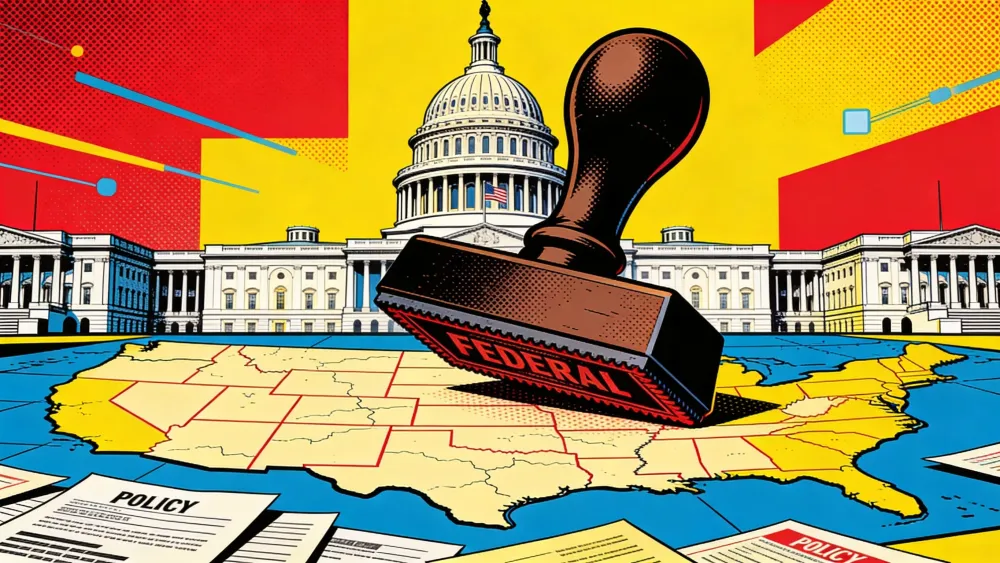
OpenAI on June 2 published a nine-page blueprint asking Congress to enact a single federal framework for frontier AI and to preempt state laws that regulate "the same frontier safety risks." The company calls the approach "reverse federalism": let states pioneer the rules, then have Washington absorb the consensus and switch off the parts that diverge. It arrived the same day President Trump signed a narrower, voluntary executive order on frontier-model security.
Read closely, the blueprint is less a safety proposal than a preemption proposal with safety attached. Its one hard, enforceable ask is federal: a national standard that caps and overrides state law. The institution it would build to police frontier models is designed to recommend rather than block, which leaves the binding half of the bargain on the states OpenAI wants overridden, not on OpenAI.
Key Takeaways
- OpenAI's June 2 blueprint asks Congress to enact one federal AI framework and preempt state safety laws, a move it calls 'reverse federalism.'
- OpenAI sought the same preemption in March 2025; its own footnote conceded only Congress can deliver it.
- The proposed CAISI safety institute would evaluate frontier models but recommend, not block, deployment, with a bypass if it runs short on capacity.
- The Senate killed a state-AI moratorium 99-1 in 2025; polling shows 80% want safety rules even if AI development slows.
AI-generated summary, reviewed by an editor. More on our AI guidelines.
OpenAI first asked for preemption in March 2025
The blueprint frames federal action as building on a fresh state consensus, but OpenAI made the preemption request fifteen months ago. In its March 13, 2025 submission to the White House Office of Science and Technology Policy, the company sought a "sandbox" for developers with "liability protections including preemption from state-based regulations." Footnote 5 on page 6 named the constitutional limit: "Federal preemption over existing or prospective state laws will require an act of Congress."
Congress has already weighed one version of that question. In July 2025 the Senate voted 99-1 to strip a 10-year moratorium on state AI laws from the budget bill. The "reverse federalism" pitch reaches the same destination by a softer road: federalize the consensus in California's SB 53, New York's RAISE Act, and Illinois's SB 315, now on the governor's desk, then preempt state laws covering the same risks. The White House made a parallel request in March, which Congress has not enacted.
The CAISI review comes with a written bypass
The blueprint wants the Center for AI Standards and Innovation, the Commerce Department body the Trump administration renamed from the US AI Safety Institute, made statutory and funded, given classified compute, and handed a "mandatory evaluation process" for the most capable models before release. Then it limits that process in its own words: "CAISI's role should be to conduct evaluations and recommend mitigations, not to approve or block deployments." Developers keep the deployment decision.
Get Implicator.ai in your inbox
Strategic AI news from San Francisco. No hype, no "AI will change everything" throat clearing. Just what moved, who won, and why it matters. Daily at 6am PST.
No spam. Unsubscribe anytime.
The mandatory review also carries an exit. "If CAISI fails to complete an evaluation within the defined time period due to bandwidth, hardware, personnel, or other constraints, developers should be permitted to deploy without penalty," the document states, a page after warning that policymakers should "be realistic about the challenges of building a new institution." OpenAI and Anthropic have shared models with CAISI since 2024; Google, Microsoft and xAI agreed to join this year.
Eighty percent want safety rules even if AI slows
OpenAI's framing is democratic. "Decisions about how society manages frontier AI risks should be made through representative government, not by private companies acting alone," the blueprint says. Its design still leaves the deployment call with the developer.
Know someone who'd find this useful? ✉️ Email it to a friend in one click, or they can subscribe free here.
The politics cut against the ask from both sides. Aalok Mehta of the Center for Strategic and International Studies, writing in December, called preempting state law before a federal framework exists putting "the cart before the horse", and cited polling in which 80% of adults want government to keep AI safety rules even if development slows, against 9% who prioritize faster capability. The resistance is not only on the left. Florida's Republican attorney general, James Uthmeier, sued OpenAI this week over ChatGPT and child safety, saying, "We're going to make them pay for hurting our kids." Child safety is one of the carve-outs the blueprint leaves to states, alongside "youth protection, electricity and environmental policy, and AI education and literacy."
OpenAI cites 'early signs' of recursive self-improvement
The urgency in the document rests on a claim about the technology. OpenAI writes that it sees "early signs of recursive self-improvement (RSI) in today's systems," and makes RSI, AI that accelerates its own development, the recurring reason to build CAISI now. The claim is both a safety argument and a capability signal from the company selling the capability.
The blueprint landed the same day Trump signed his executive order, which OpenAI chief global affairs officer Chris Lehane called "an important step forward." That order is voluntary: a 30-day window for pre-release review, down from the 90-day mandatory version Trump scrapped on May 21 over concern it "could dull America's edge." The blueprint asks Congress to make the federal layer permanent and binding where the order is neither.
OpenAI's blueprint says plainly it is "not intended to be the final word." Its first and hardest ask is the federal standard that would override state law; the pre-release evaluation that would bind OpenAI is left advisory, with a written bypass. The Senate voted 99-1 against a state-AI moratorium in July. Trump's order, signed the same day, gives agencies 60 days to define a "covered frontier model" and leaves participation optional. The binding version is the one OpenAI is asking Congress to write.
Frequently Asked Questions
What is OpenAI's "reverse federalism" proposal?
OpenAI wants Congress to build one federal frontier-AI framework modeled on state laws like California's SB 53, then preempt state laws that regulate the same safety risks. The company frames it as federalizing an emerging state consensus, but the operative move caps and overrides divergent state rules with a single national standard.
Could OpenAI's proposed safety institute block an AI model's release?
No. The blueprint says CAISI, the Commerce Department's Center for AI Standards and Innovation, should evaluate models and recommend mitigations, not approve or block deployments. Developers keep the deployment decision. The "mandatory" review also lets developers ship without penalty if CAISI runs short on bandwidth, hardware, or personnel.
Hasn't Congress already rejected AI preemption?
In July 2025 the Senate voted 99-1 to strip a 10-year moratorium on state AI laws from the budget bill. OpenAI's blueprint pursues a narrower path, federalizing the consensus in state laws first, but reaches the same destination: a federal standard that overrides state regulation of frontier safety risks.
What is recursive self-improvement, and why does OpenAI cite it?
Recursive self-improvement (RSI) is AI accelerating its own development. OpenAI says it sees "early signs" of RSI in today's systems and uses that to argue for building CAISI now. The claim doubles as a capability signal from a company that sells frontier models.
How does the blueprint relate to Trump's June 2 executive order?
Both landed the same day. Trump's order is voluntary, a 30-day pre-release review window, down from a 90-day mandatory version he scrapped on May 21. OpenAI's blueprint asks Congress to make the federal layer permanent and binding where the order is not. OpenAI's Chris Lehane called the order "an important step forward."
AI-generated summary, reviewed by an editor. More on our AI guidelines.


Free AI briefing · Weekdays
The AI stories that matter, sourced and explained.
Join the Morning Briefing. It goes out every weekday at 4:45 a.m. Pacific, with later sends for the East Coast, Berlin and Tokyo.
Free when you sign up: The Paperclip Compendium, our tested guide to running AI agents.
Free. Unsubscribe in one click.

Marcus Schuler
Editor-in-Chief and founder of Implicator.ai. Former ARD correspondent and senior broadcast journalist with 10+ years covering tech. Writes daily briefings on policy and market developments. Based in San Francisco. E-mail: editor@implicator.ai