Implicator
San Francisco | Friday, March 20, 2026
OpenAI just admitted its product strategy was broken. Fidji Simo confirmed the company will fold ChatGPT, Codex, and Atlas into a single desktop app after Anthropic's Claude Code triggered what one source called a "code red." Three products, three teams, one window. The superapp also puts OpenAI on a collision course with Microsoft.
Jeff Bezos spent weeks flying between Riyadh and Singapore pitching sovereign wealth funds on a $100 billion fund to buy manufacturers and retool them with AI. JPMorgan and Abu Dhabi are listening.
Meta reversed its Horizon Worlds shutdown in 24 hours. The playbook that burned $80 billion on the metaverse now backs $135 billion in AI spending.
Stay curious,
Marcus Schuler
OpenAI Merges ChatGPT, Codex, and Atlas Into One Desktop App to Counter Anthropic

OpenAI will fold its three flagship desktop products into a single application after CEO of Applications Fidji Simo admitted that product fragmentation was hurting quality. The real trigger sits outside the building.
Anthropic's Claude Code has gained developer traction fast enough to put OpenAI into what one insider described as "code red," The Information reported. Simo spelled out the reasoning in an internal memo: "We realised we were spreading our efforts across too many apps and stacks." Greg Brockman takes temporary charge of the product overhaul. No launch date has been set.
The consolidation reverses Sam Altman's "series of startups" expansion strategy that produced Atlas, Sora, Codex, e-commerce features, and a hardware device in a single year. Simo, who joined from Instacart ten months ago, is now reorganizing the entire desktop line ahead of a potential IPO.
The same day, OpenAI confirmed its acquisition of Astral, the Python tooling company behind uv and Ruff. Codex writes the code, Atlas handles browsing, ChatGPT manages conversation. Agentic capabilities let all three coordinate without constant human input.
The uncomfortable question: Microsoft invested $13 billion in OpenAI and holds exclusive commercialization rights in certain categories. A unified desktop app combining chat, coding, and browsing competes directly with Microsoft 365 and Copilot. The Financial Times reported this month that Microsoft was weighing legal action over a $50 billion Amazon-OpenAI cloud deal. Neither company seems eager to discuss the tension.
Why This Matters:
- Enterprise users who spend hours in desktop productivity tools now face a direct contest between OpenAI's superapp and Microsoft's Copilot ecosystem
- The last company to successfully build a desktop superapp people wanted to use was Microsoft, with Office, thirty years ago
Reality Check
What's confirmed: OpenAI merging ChatGPT, Codex, and Atlas into one desktop app. Simo's internal memo admitted fragmentation hurt quality. Brockman leads the overhaul.
What's implied (not proven): The consolidation is primarily a defensive response to Anthropic rather than planned product strategy.
What could go wrong: Three engineering cultures with three codebases fail to merge before Anthropic widens the developer gap.
What to watch next: Whether a launch date appears before IPO talks accelerate this summer.
The One Number
83% — Share of February 2026's record $189 billion in global venture capital that went to three companies: OpenAI ($110 billion), Anthropic ($30 billion), and Waymo ($16 billion). Remove those three deals, and the biggest startup funding month in history becomes an ordinary one. The AI boom produced a new asset class. It just happens to have three members.
Source: AI Funding Tracker
Bezos Seeks $100 Billion Fund to Buy Manufacturers and Retool Them With AI

Jeff Bezos is raising the largest manufacturing buyout fund ever attempted. He has spent weeks pitching sovereign wealth funds in the Middle East and Singapore on a vehicle that would acquire chipmakers, defense contractors, and aerospace firms, then overhaul them with AI.
The fund would operate alongside Project Prometheus, the AI startup where Bezos serves as co-CEO with physicist Vik Bajaj. Prometheus builds models that simulate physical systems, airflow around turbine blades, stress fractures in metal parts, heat dissipation across circuit boards. Not chatbots. Engineering simulation.
JPMorgan Chase is in preliminary talks through its $10 billion Security and Resiliency Initiative, led by former Berkshire Hathaway manager Todd Combs. The Abu Dhabi Investment Authority is also among prospective backers. At $100 billion, the fund would match SoftBank's Vision Fund in scale.
Prometheus raised $6.2 billion late last year and employs 120 people across San Francisco, London, and Zurich. Two of its founding advisors co-authored the 2017 "Attention Is All You Need" transformer paper. The company also absorbed General Agents, a startup that built autonomous computer agents using video-language-action models.
Senator Bernie Sanders responded within hours, noting Amazon already operates near a one-to-one robot-to-worker ratio in warehouses. The investor documents describe the fund in terms of efficiency and profitability, not headcount. But you don't raise $100 billion to inject AI into factories without someone on the shop floor losing a shift.
Why This Matters:
- Private equity firms specializing in industrial buyouts face a new competitor that offers acquisition targets proprietary AI technology, not just financial engineering
- The gap between announcement and execution in physical industries is measured in years; chipmaking infrastructure takes a decade to build
AI Image of the Day

Prompt: upper body portrait of a high-fashion Asian female model wearing eyeglasses, avant-garde styling, sleek hair tucked behind ears, statement makeup with glossy skin and defined lips, sharp jawline, confident and slightly cold expression, editorial pose, centered composition, full head visible with space above, clean pure white background, dramatic yet soft studio lighting, luxury fashion campaign style, ultra detailed, shot on 85mm lens, shallow depth of field, 4k, premium magazine quality, minimal but striking
Meta Spent $80 Billion on the Metaverse for 200,000 Users, Now Guides $135 Billion on AI

Meta reversed its Horizon Worlds VR shutdown in under 24 hours. CTO Andrew Bosworth recorded the reversal on his phone, talking into Instagram Stories. That told you everything about the metaverse era more cleanly than any corporate postmortem could.
Horizon Worlds peaked at roughly 200,000 monthly users. Roblox does over 100 million a day. Reality Labs spent $80 billion across the metaverse era on headsets, AR glasses, software, and content. Consumer spending through Horizon's mobile app totaled $1.1 million. About 1,500 Reality Labs positions disappeared in January.
Wall Street didn't just tolerate the losses. It actively rewarded Meta for walking away. Shares climbed 5.7% on metaverse cuts alone and nearly tripled from 2022 lows. The pattern creates a specific incentive structure: a CEO can deploy tens of billions chasing a vision that never finds users, absorb the losses, then pivot to the next vision while the stock rewards the correction.
Meta now guides $115 billion to $135 billion in AI capex this year. Zuckerberg mentioned "metaverse" twice at his last developer conference. He mentioned "AI" 23 times. The institutional pattern underneath, one leader's conviction driving capital allocation at a scale no competitor matches, internal skeptics reorganized or shown the door, is the same one that produced the metaverse.
Why This Matters:
- The structural question is whether one person's conviction about AI, deployed at over $100 billion a year with no meaningful governance check, produces better outcomes than the last time
- More than 10,000 worlds built by volunteer developers now exist in mobile-only limbo after Meta pulled back from VR

🧰 AI Toolbox
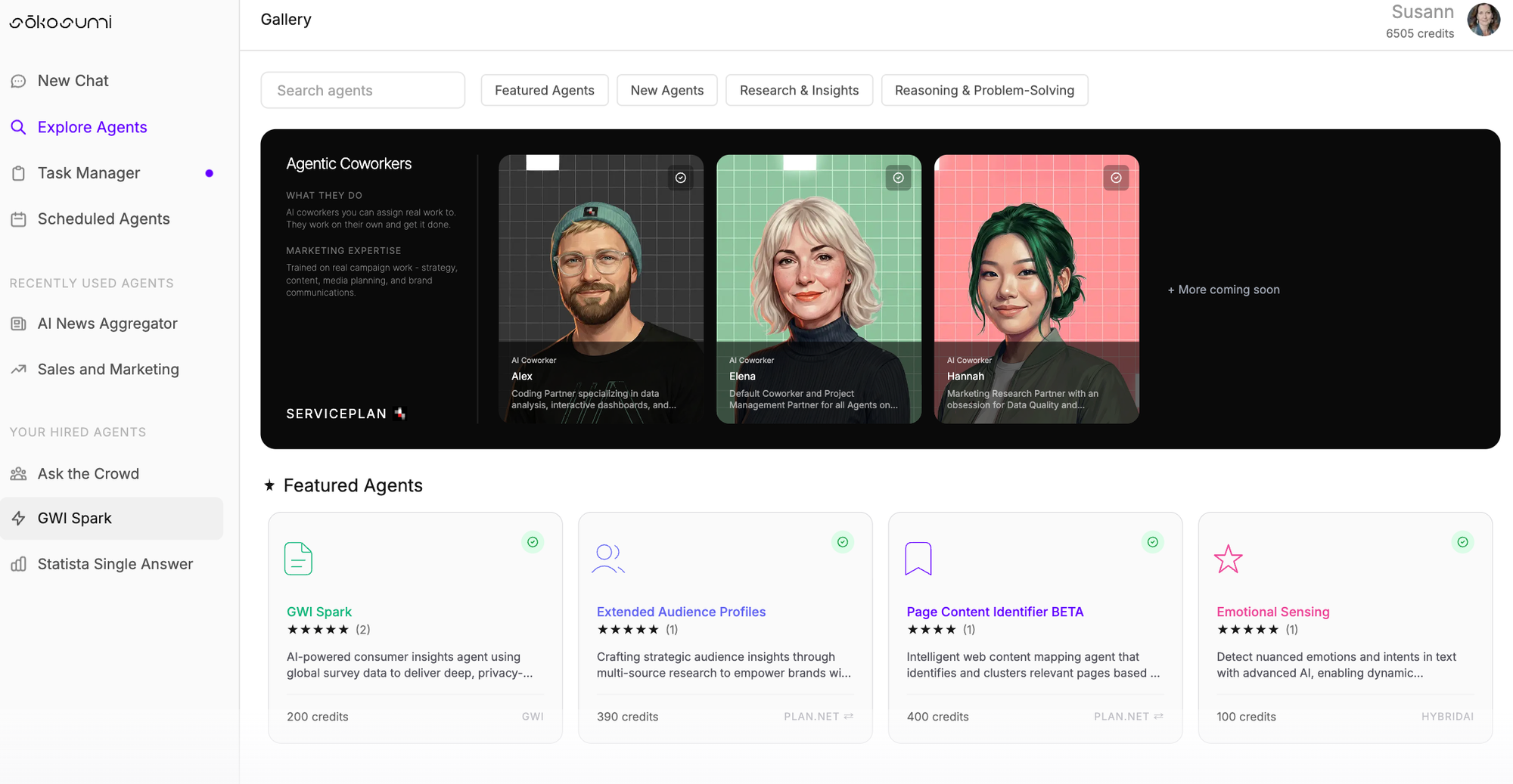
How to Delegate Marketing Tasks to AI Coworkers That Work Autonomously Using Sokosumi
Sokosumi gives marketing teams AI coworkers that take ownership of tasks and deliver finished work. Assign a brief to Hannah (market research), Elena (project management), or Alex (data analysis) and they execute autonomously while you track progress on a Kanban board. The agents collaborate with each other and with partner data sources like GWI and Statista. GDPR-compliant with full audit trails. Free $30 in credits to start, then pay-per-task. Over 500 companies use it.
Tutorial:
- Go to sokosumi.com and sign in with Google to claim $30 in free credits
- Meet your AI coworkers: Hannah handles research, Elena manages operations, Alex runs data analysis
- Create a task on the Kanban board or assign work directly through chat
- The assigned agent executes autonomously, moving the task through Backlog, In Progress, and Complete
- Review outputs before shipping and provide feedback so the agent adjusts
- Add partner agents like GWI Spark for consumer survey data or Statista for market statistics
- Track all completed jobs in the history tab with full reasoning logs and timestamps
What To Watch Next (24-72 hours)
- RSA Conference: The world's largest cybersecurity event opens Monday at Moscone Center in San Francisco and runs through Thursday. AI-powered security tools dominate the agenda after a year of AI-assisted attacks and the Super Micro chip smuggling indictment. With 44,000+ attendees and every major vendor announcing products, this week sets the cybersecurity spending narrative for the rest of 2026.
- Y Combinator Demo Day: The W26 batch presents Tuesday at Computer History Museum in San Francisco. 196 companies, over half in AI and machine learning, pitch to roughly 1,000 investors. This is the first Demo Day since Nvidia GTC's inference-cost announcements and OpenAI's Astral acquisition. Batch composition reveals which AI sub-verticals YC partners believe are investable, not just interesting.
- Super Micro fallout: Shares dropped 12% after hours Thursday following the federal indictment of co-founder Steve Liaw and two others for allegedly smuggling $2.5 billion in Nvidia AI servers to China through fake paperwork and dummy servers. Monday's trading session tests whether the market treats this as an isolated compliance failure or a broader export-control credibility crisis for the AI hardware supply chain.
🛠️ 5-Minute Skill: Turn a Product Changelog Into a Customer-Facing Release Note
Your engineering team ships a changelog every two weeks. It reads like commit messages because it is commit messages. The customer success team needs something they can send to clients without a glossary. You have the raw changelog and five minutes before the email goes out.
Your raw input:
v4.2.0 Release Notes — March 18, 2026

- feat: implement RBAC scoping for workspace-level API keys (PROJ-4401)
- feat: add batch export endpoint for analytics (PROJ-4389)
- fix: resolve race condition in concurrent webhook delivery (PROJ-4412)
- fix: correct timezone offset calculation for APAC region reports (PROJ-4395)
- perf: reduce p99 latency on dashboard queries from 2.8s to 340ms (PROJ-4407)
- chore: upgrade to Node 22 LTS, deprecate Node 18 support
- breaking: remove legacy v1 authentication endpoint (deprecated since v3.8)
The prompt:
You are a senior product marketer writing a release note email
for customers of a B2B SaaS platform. Your audience is operations
managers and team leads, not engineers.

From this changelog, produce:
1. A one-sentence lead: what this release does for the customer
   (not what changed technically)
2. Three highlights: translate each into a customer benefit with
   a before/after where possible
3. One "heads up" section for breaking changes, with action
   required and deadline
4. Skip anything that only matters to the engineering team

Changelog:
[paste changelog here]

Rules:
- No jargon. "RBAC" becomes "team-level permissions."
- Benefits before features. "Your dashboards load 8x faster"
  beats "reduced p99 latency."
- The breaking change must include a specific action and a date.
- Keep the entire note under 150 words. This goes in an email
  that competes with 47 others.
What you get back:
What's new in v4.2
This release makes your dashboards faster, your reports accurate across time zones, and your API keys more secure by team.
Highlights
- Dashboard speed: Pages that took nearly 3 seconds now load in under half a second. No action needed.
- Team-level API keys: Admins can now scope API keys to specific workspaces, so each team controls its own integrations without sharing credentials.
- APAC reporting fix: Reports for Asia-Pacific teams were showing timestamps shifted by several hours. Fixed. Historical data is unaffected.
Heads up
The legacy login endpoint (v1) is being removed. If your team uses the v1 authentication URL, switch to v2 by April 15 or logins will fail. Guide: [link]
Why this works
The prompt separates audience from author. Engineers write changelogs for engineers. Customers read release notes for business impact. Requiring "before/after" forces the AI to quantify the improvement instead of describing the patch. The 150-word cap kills the instinct to document everything, which is exactly what makes internal changelogs unreadable to customers.
Where people get it wrong: Pasting a changelog and asking to "make this customer-friendly." You'll get a polished version of the same technical language. The translation requires a different persona: product marketer, not engineer.
What to use
Claude (claude.ai): Best at separating what matters to customers from what matters to engineers. Won't inflate improvements beyond what the data supports. Watch out for: May include too many items. Remind it to skip internal changes.
ChatGPT: Strong at punchy email formatting and benefit-first language. Watch out for: Tends to oversell incremental fixes as major features. Verify that "8x faster" is actually what the numbers show.
AI & Tech News
Nvidia Signs Deal to Sell 1 Million GPUs to Amazon by End of 2027
Nvidia will supply one million GPUs and a broad mix of chips, including its new Groq processors, to Amazon Web Services by the end of 2027. Financial terms were not disclosed, but the deal signals continued surging demand for AI computing infrastructure as cloud providers race to expand capacity.
Super Micro Co-Founder Charged With Smuggling $2.5 Billion in Nvidia Chips to China
Federal prosecutors charged three individuals affiliated with Super Micro Computer, including co-founder Steve Liaw, with illegally exporting Nvidia AI servers to China through fake paperwork and dummy servers. SMCI shares dropped nearly 12% in after-hours trading.
White House Prepares Sweeping Federal AI Regulation Framework for Congress
The White House plans to present Congress with a proposed federal framework for AI regulation on Friday, covering preemption of state laws, child safety, creator rights, and censorship rules. The move would establish a unified national approach, potentially overriding a growing patchwork of state regulations.
DOJ Dismantles Four Botnets Behind Record 31.4 Tbps DDoS Attack
The Department of Justice disrupted four interconnected botnets that had compromised more than three million devices worldwide. The Aisuru and Kimwolf botnets powered a record-shattering 31.4 terabits-per-second DDoS attack in December 2025.
Alibaba and Tencent Shed $66 Billion in Market Value Over Unclear AI Monetization
Investors wiped $66 billion from Alibaba and Tencent in roughly 24 hours after both companies failed to present convincing strategies for turning AI spending into revenue. The sell-off raises questions about near-term returns on China's largest tech companies' AI commitments.
Blue Origin Files for 52,000-Satellite Constellation to Build Data Centers in Space
Jeff Bezos's rocket company filed with the FCC to deploy nearly 52,000 satellites for an orbital AI data center system called "Project Sunrise." The filing puts Blue Origin in direct competition with SpaceX and Starcloud for space-based computing infrastructure.
Anthropic Briefs House Homeland Security Committee on Export Controls and Model Distillation
Anthropic met privately with House Homeland Security members to discuss export controls and model distillation, the challenge of compressing powerful AI into smaller versions. The company's ongoing Pentagon dispute was only briefly addressed.
Man Pleads Guilty in First US Criminal Case for AI Streaming Fraud
A defendant pleaded guilty to wire fraud conspiracy after using bot accounts to artificially stream hundreds of thousands of AI-generated songs billions of times across music platforms. He collected approximately $8 million in fraudulent royalties.
MiniMax Releases M2.7, a Self-Evolving AI Model That Optimizes Its Own Training
Chinese AI startup MiniMax released M2.7, a proprietary model described as "self-evolving" that the company used to build, monitor, and optimize its own reinforcement learning systems. The release marks a step toward AI that improves its own training processes.
Microsoft Launches MAI-Image-2, Ranking Third Globally in Text-to-Image Generation
Microsoft's AI Superintelligence team released MAI-Image-2, a text-to-image model that secured third place on the text-to-image Arena leaderboard behind Google and OpenAI. The release signals Microsoft's push to build in-house image generation rather than relying on partners.
🚀 AI Profiles: The Companies Defining Tomorrow
AMI Labs

AMI Labs is betting that the entire AI industry is building on the wrong foundation. Yann LeCun's Paris-based startup raised the largest European seed round in history to develop "world models" that understand physical reality instead of predicting the next word. 🧠
Founders
Yann LeCun co-founded AMI Labs and serves as chairman. LeCun won the Turing Award in 2018 for his work on neural networks and spent over a decade running Meta's AI research division (FAIR) before departing in late 2025. CEO Alexandre LeBrun previously founded AI healthcare startup Nabla. Laurent Solly, Meta's former VP for Europe, serves as COO. Chief science officer Saining Xie came from Google DeepMind. The team operates from Paris, New York, Montreal, and Singapore.
Product
AMI builds AI systems using Joint Embedding Predictive Architecture (JEPA), a framework LeCun developed at Meta that learns by predicting abstract representations of the world rather than generating pixels or tokens. The company targets organizations operating complex systems: manufacturers, automakers, aerospace firms, and pharmaceutical companies. LeCun told Reuters the goal is to build AI that can reason and plan in real-world settings, something he argues large language models fundamentally cannot do. Near-term applications center on robotics, industrial automation, and biomedical simulation. AMI will publish research papers as it goes.
Competition
The "world model" category barely existed before AMI launched. Physical Intelligence raised $400 million for robot foundation models. Google DeepMind and Meta both maintain internal world model research programs. OpenAI and Anthropic dominate the LLM approach AMI explicitly rejects. The risk: LeCun has been arguing against the LLM approach for years while LLMs kept getting better. AMI's CEO predicted "world models" will become a buzzword within six months, with every startup rebranding itself one.
Financing 💰
$1.03 billion seed round (approximately €890 million), the largest seed ever for a European company. Investors include Cathay Innovation, Greycroft, and Hiro Capital. Valued at $3.5 billion pre-money. LeCun told Zuckerberg he could build this "faster, cheaper, and better outside of Meta." Zuckerberg agreed to collaborate, though Meta is not an investor.
Future ⭐⭐⭐
A Turing Award winner raising a billion dollars to prove the entire AI industry wrong is either the most important company of the decade or a very expensive vindication tour. LeCun spent years telling anyone who would listen that large language models are a dead end. Now he has the money to test it. The team reads like a Meta alumni reunion with a DeepMind defector. Four offices across three continents before shipping a product. The question is the same one it has always been: can world models do something useful before the LLM companies LeCun criticized absorb the concept into their own stacks? Meta already pivoted away from world model research to chase LLMs. AMI is the bet that Meta was wrong to follow the crowd. 🇫🇷
🔥 Yeah, But...
OpenAI announced Thursday that it will acquire Astral, the company behind uv, Ruff, and ty, three open-source Python tools with a combined 305 million monthly downloads. The tools handle dependency management, linting, and type checking for millions of developers. Astral's team will join OpenAI's Codex group, which has tripled to 2 million users since January. OpenAI said the tools "will remain open source, free, and community-driven." Developer Simon Willison wrote: "One bad version of this deal would be if OpenAI start using their ownership of uv as leverage in their competition with Anthropic."
Sources: OpenAI, March 19, 2026 | Simon Willison, March 19, 2026
Our take: OpenAI started as an open-source research lab, went closed, built a $840 billion company, and just bought the open-source tools that Python developers can't function without. The announcement said everything will stay open, free, and community-driven. That is what every acquirer says.
Google said it about Android. Oracle said it about MySQL. IBM said it about Red Hat. Sometimes it's true.
The difference is that uv and Ruff are not products with revenue. They are plumbing. They sit between every Python developer and their code the way a package manager sits between a phone and its apps. Codex has two million users writing Python with AI. Now the same company owns the tools those users need whether they choose Codex or not. OpenAI did not buy a competitor. It bought the ground the competitors stand on.

Marcus Schuler
Tech translator with German roots who fled to Silicon Valley chaos. Decodes startup noise from San Francisco. Launched implicator.ai to slice through AI's daily madness—crisp, clear, with Teutonic precision and sarcasm. E-Mail: [email protected]