IMPLICATOR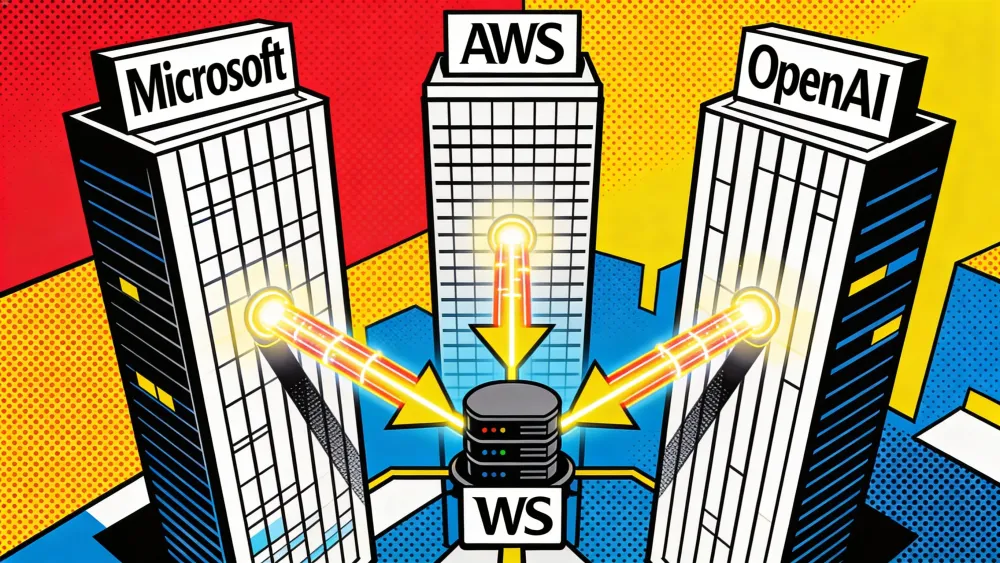
Matt Garman walked on stage in San Francisco on Tuesday morning to announce that OpenAI's models would soon run on Amazon's cloud. Sam Altman was supposed to be standing next to him. Instead, Altman appeared on a screen, in a prerecorded video, because he was in federal court across the bay in Oakland, defending OpenAI in a civil lawsuit brought by Elon Musk. The deal Garman was unveiling had been embargoed for days. Microsoft had blown a hole in the embargo by amending its own OpenAI agreement twenty-four hours earlier, dropping the Azure exclusivity that had defined the partnership.
OpenAI formally gained the right to go multi-cloud on Tuesday. It used that freedom first, and most visibly, with AWS. Microsoft's exclusive on selling OpenAI models is gone, but the strategically most interesting product, a jointly built agent runtime called Bedrock Managed Agents, is exclusive to AWS. The company that had just escaped Azure exclusivity was already moving another strategic layer into an AWS-only channel.
The terms, posted Monday by both companies, tell the story. Microsoft drops its revenue-share payments to OpenAI, while OpenAI keeps paying Microsoft 20 percent of revenue through 2030, subject to an undisclosed cap. Microsoft's IP license runs to 2032 and is no longer exclusive. On the AWS side, the existing $38 billion cloud-spend agreement signed in November 2025 is being expanded by a further $100 billion over eight years, separate from Amazon's $50 billion equity investment in OpenAI in February 2026. Anthropic, on a separate Amazon agreement announced April 20, committed more than $100 billion to AWS over ten years.
Key Takeaways
- AWS announced OpenAI's models on Amazon Bedrock one day after Microsoft and OpenAI dropped Azure's exclusivity from their amended partnership.
- Microsoft stops paying OpenAI a revenue share; OpenAI keeps paying Microsoft 20 percent of revenue through 2030, capped at an undisclosed total.
- Bedrock Managed Agents, a jointly built agent runtime, is exclusive to AWS by design — Altman confirmed the exclusive on Stratechery.
- The strategically most interesting product is the agent runtime, not raw model access — OpenAI customers on Azure and elsewhere can still buy the models.
AI-generated summary, reviewed by an editor. More on our AI guidelines.
What Microsoft actually gave up
The Azure exclusivity was Microsoft's only real product differentiator in the AI cloud market. Anthropic was already on AWS and Google Cloud. Meta's models were on AWS. OpenAI was the lone holdout, and that was Microsoft's competitive moat. Garman told Bloomberg Television that AWS customers had asked for OpenAI access "for a really long time."
The most powerful GPT models will arrive on Bedrock "in the next couple of weeks," Garman told Bloomberg. GPT-5.4 went live in preview on Tuesday. Codex went live the same day. AWS says four million people use Codex weekly. None of them, until Tuesday, could call it through an AWS account.
Microsoft kept the revenue-share payments from OpenAI. It lost the only thing enterprise buyers cared about.
Why OpenAI paid for the right to leave
OpenAI gave up money to gain distribution. Under the previous deal, Microsoft paid OpenAI a revenue share. That payment is gone. The original Microsoft-OpenAI agreement also contained an AGI clause that would have voided Microsoft's IP rights once OpenAI's board declared AGI achieved. The Information reported that the clause is gone too. The revised agreement runs to 2032 regardless of model capability.
The trade makes sense in Altman's framing. "I no longer think of the harness and the model as these entirely separable things," he told Stratechery in an interview recorded last Friday. The harness is the runtime around the model: identity, permissions, memory, evals. Bedrock Managed Agents is exactly that, sitting inside the AWS environment customers already use.
Altman was asked directly whether the managed-agent product would extend to other clouds. "We're doing this exclusively with Amazon," he said.
Get Implicator.ai in your inbox
Strategic AI news from San Francisco. No hype, no "AI will change everything" throat clearing. Just what moved, who won, and why it matters. Daily at 6am PST.
No spam. Unsubscribe anytime.
The IPO calculus
Wedbush analyst Dan Ives told investors the agreement puts OpenAI on a stronger path to an initial public offering by giving the company a clearer cloud opportunity and reducing barriers from the original Microsoft partnership. Both OpenAI and Anthropic are aiming for IPOs as soon as this year, Axios reported. Multi-cloud distribution is a precondition for the revenue story those filings will need to tell.
OpenAI's chief revenue officer Denise Dresser said at the AWS event that business customers "want those models in a trusted environment that they know, and in a trusted infrastructure." The Implicator covered the structural pressure that brought OpenAI here, including its first non-Microsoft data center in Texas and Anthropic's earlier success with multi-cloud distribution.
The same Tuesday that OpenAI announced the AWS expansion, the Wall Street Journal reported that an OpenAI leader had privately expressed worries about missing internal revenue and user targets. OpenAI's Steve Sharpe told NBC News the company was "on an extremely steep growth curve across consumer, enterprise and developers." OpenAI told Bloomberg it was "firing on all cylinders."
What AWS gets that Azure no longer has
Bedrock Managed Agents is the asymmetric piece of the deal. Anyone can buy OpenAI tokens. Only AWS customers can buy a managed agent runtime that authenticates inside their VPC, runs OpenAI inference on Bedrock, and inherits AWS IAM, PrivateLink, CloudTrail and guardrails without integration work. The agent has its own identity. Every action gets logged. Customer data stays within the AWS and Bedrock environment, processed under AWS controls.
Garman said the product was built on AgentCore, AWS's open platform layer for agent runtime, with OpenAI's models and agent harness layered on. Bedrock Managed Agents is the packaged, OpenAI-optimized version, and it is AWS-only. Asked why exclusive, Altman told Stratechery, "Spiritually, we want to do this as a joint effort between our companies."
That is the trade. OpenAI gave Microsoft non-exclusivity on the commodity layer in exchange for distribution. It gave AWS exclusivity on the integration layer in exchange for a place in every AWS sales conversation about agents.
A day before the announcement, Azure's moat was exclusive access to OpenAI. A day after, AWS had the more interesting enterprise story: OpenAI agents embedded inside the cloud where many customers already run their data, identity and workflows.
Frequently Asked Questions
What changed in the Microsoft-OpenAI agreement on Monday?
Microsoft dropped its exclusive right to sell OpenAI models on Azure and stopped paying OpenAI a revenue share. OpenAI continues paying Microsoft 20 percent of revenue through 2030, subject to an undisclosed cap. Microsoft's IP license now runs through 2032 but is non-exclusive. Microsoft remains OpenAI's primary cloud partner and a major shareholder.
What is Bedrock Managed Agents, powered by OpenAI?
A jointly built agent runtime that pairs OpenAI's frontier models and agent harness with AWS infrastructure. It runs inside customer VPCs with AWS IAM, PrivateLink, CloudTrail and guardrails. Each agent has its own identity and logs every action. Sam Altman told Stratechery the product is exclusive to AWS.
Why give AWS an exclusive after just ending Microsoft's?
The exclusive is on the integration layer, not the commodity layer. OpenAI traded one for the other. Multi-cloud distribution of models broadens OpenAI's revenue ahead of a possible IPO; the AWS-only managed runtime secures premium positioning in the largest enterprise cloud and creates a product Azure cannot match.
How big are the AWS investment numbers tied to OpenAI?
The original $38 billion AWS-OpenAI cloud agreement (November 2025) is being expanded by a further $100 billion over eight years. Separate from that cloud commitment, Amazon made a $50 billion equity investment in OpenAI in February 2026. Anthropic's own $100 billion-plus AWS commitment over ten years was announced April 20 on a separate Amazon agreement.
Did Microsoft keep anything from the original deal?
Yes. OpenAI continues paying Microsoft 20 percent of revenue through 2030, capped at an undisclosed total. Microsoft's IP license to OpenAI models and products runs through 2032. Microsoft remains a major shareholder. OpenAI products will ship first on Azure unless Microsoft cannot support the capability.
AI-generated summary, reviewed by an editor. More on our AI guidelines.



Free AI briefing · Weekdays
The AI stories that matter, sourced and explained.
Join the Morning Briefing. It goes out every weekday at 4:45 a.m. Pacific, with later sends for the East Coast, Berlin and Tokyo.
Free when you sign up: The Paperclip Compendium, our tested guide to running AI agents.
Free. Unsubscribe in one click.

Marcus Schuler
Editor-in-Chief and founder of Implicator.ai. Former ARD correspondent and senior broadcast journalist with 10+ years covering tech. Writes daily briefings on policy and market developments. Based in San Francisco. E-mail: editor@implicator.ai