IMPLICATOR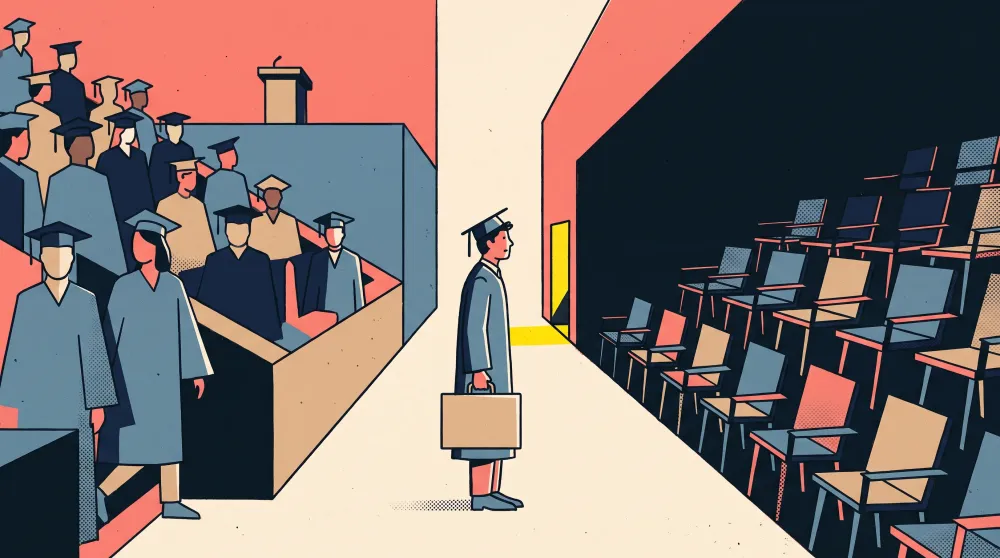
Sami Wargo entered Marquette University’s May 2026 commencement caught between two instructions. She had majored in digital media and minored in advertising, yet her classes had largely barred artificial intelligence while job listings told applicants to work with it. A petition by Marquette students sought a different speaker after the university chose an AI advocate. When the petition failed, Wargo joined other graduates in booing.
By August, a national survey had measured the same unease.
A Pew Research Center survey released Aug. 18 found that 55% of U.S. adults under 30 were more concerned than excited about AI, the first majority since Pew began asking the question in 2021. The result places a number on the friction facing graduates who are told to prepare for AI while receiving little agreement about what preparation means.
What Changed
- In June 2026, 55% of U.S. adults under 30 said they were more concerned than excited about AI, up from 31% in 2021.
- Seventy-three percent of adults under 30 expected AI to result in fewer U.S. jobs over the next 20 years, up from 61% in 2024.
- A Stanford payroll study found no widespread economy-wide displacement, but workers ages 22-25 in highly AI-exposed occupations had a 19% employment shortfall relative to less-exposed peers.
- The Stanford result is descriptive, not causal, and was larger in the ADP payroll sample than in national benchmarks.
AI-generated summary, reviewed by an editor. More on our AI guidelines.
The survey shift
Concern among adults ages 18-29 rose from 31% in 2021 to 55% in June 2026. Excitement moved the other way: 11% were more excited than concerned in 2026, down from 25% in 2021. The job question produced a still larger majority. In June 2026, 73% expected AI to result in fewer U.S. jobs over the next 20 years, up from 61% in 2024.
Older Americans have also become more worried. Across all ages, 52% were more concerned than excited in June 2026, compared with 37% in 2021. The increase was present in every age group Pew tracked.
The survey covered 3,488 adults from June 22 through June 28, 2026. Its under-30 result rests on 569 respondents and carries a margin of sampling error of plus or minus 4.7 percentage points. The response rate among invited panel members was 86%, but the cumulative response rate, including recruitment and attrition, was 3%. The survey measures opinion; it does not establish why views changed or whether AI caused job losses.
The campus response
Wargo’s problem was immediate. The new graduate had applied for about 30 jobs by May 2026 without receiving an offer.
The conflict surfaced at other ceremonies. Olivia Malone, a 22-year-old University of Arizona graduate headed to law school, objected after students had been penalized for using AI while the commencement speaker promoted it. Former Google CEO Eric Schmidt was addressing about 10,000 graduates in May 2026 when the audience repeatedly booed. Schmidt acknowledged their fear that jobs were disappearing, but his assurance that graduates could shape the technology did not settle the dispute.
The protests do not establish what AI is doing to employment. They show how the labor question reaches students before many have entered full-time work, through course rules, job descriptions and speaker choices.
Get Implicator.ai in your inbox
Strategic AI news from San Francisco. No hype, no "AI will change everything" throat clearing. Just what moved, who won, and why it matters. Daily at 6am PST.
No spam. Unsubscribe anytime.
A second sentiment measure
An independent July 2026 survey pointed in the same direction. Among adults ages 18-29, 47% said AI did more harm than good, up from 36% in 2025. Trust in businesses to use AI responsibly fell to 20% in 2026 from 30% a year earlier.
That survey found 75% of young adults expected AI to reduce U.S. jobs over the next decade, up from 62% in 2025. Pew asked about the next 20 years, so the two job figures are not directly comparable. Together, they show that growing concern is not confined to one panel or one wording of the question.
Know someone who'd find this useful? ✉️ Email it to a friend in one click, or they can subscribe free here.
What payrolls show
Torsten Sløk, Apollo’s chief economist, supplied a counterweight in June 2026. Pointing to ADP payroll records, he said there was “zero evidence of job losses because of AI”. Firms were also hiring AI implementation specialists, he said, while data-center construction increased demand for equipment, energy and technical labor.
An updated Stanford Digital Economy Lab study using ADP records through June 2026 also found no widespread, economy-wide displacement. The study did, however, find a gap for people at the start of their careers. Employment among workers ages 22-25 in highly AI-exposed occupations stood 19% below where it would have been had it kept pace with less-exposed peers.
AI-exposed occupations are jobs containing tasks that language models can perform or assist. The label measures what the software could do, not whether an employer adopted it or used it in a hiring decision.
The shortfall appeared mainly through reduced hiring, not increased separations. Yet the study is descriptive and does not show that AI caused the gap. The result weakened when researchers controlled for education, some divergence predated generative AI, and the effect was larger in the ADP sample than in national benchmarks. Its 22-25 age group is also narrower than Pew’s 18-29 group, and the underlying payroll records cannot be released publicly.
For Wargo, the uncertainty was written into the listings she was reading. “I don’t know what that means,” she said.
Frequently Asked Questions
How many young adults are more concerned than excited about AI?
Fifty-five percent of U.S. adults ages 18-29 said they were more concerned than excited in June 2026, compared with 31% in 2021.
How many young adults expect AI to reduce U.S. jobs?
Seventy-three percent of adults under 30 expected AI to result in fewer U.S. jobs over the next 20 years in June 2026, up from 61% in 2024.
Does the Stanford study prove that AI caused young workers to lose jobs?
No. The study found a descriptive employment gap for workers ages 22-25 in AI-exposed occupations, mainly through reduced hiring, but it did not establish that AI caused the gap.
What is an AI-exposed occupation?
It is a job containing tasks that language models can perform or assist. Exposure measures what the software could do, not whether an employer adopted AI or used it in a hiring decision.
How large was the Pew survey?
The June 22-28, 2026 survey covered 3,488 U.S. adults. Its 18-29 subgroup included 569 respondents and had a margin of sampling error of plus or minus 4.7 percentage points.
AI-generated summary, reviewed by an editor. More on our AI guidelines.


Free AI briefing · Weekdays
The AI stories that matter, sourced and explained.
Join the Morning Briefing. It goes out every weekday at 4:45 a.m. Pacific, with later sends for the East Coast, Berlin and Tokyo.
Free when you sign up: The Paperclip Compendium, our tested guide to running AI agents.
Free. Unsubscribe in one click.

Marcus Schuler
Editor-in-Chief and founder of Implicator.ai. Former ARD correspondent and senior broadcast journalist with 10+ years covering tech. Writes daily briefings on policy and market developments. Based in San Francisco. E-mail: editor@implicator.ai