Implicator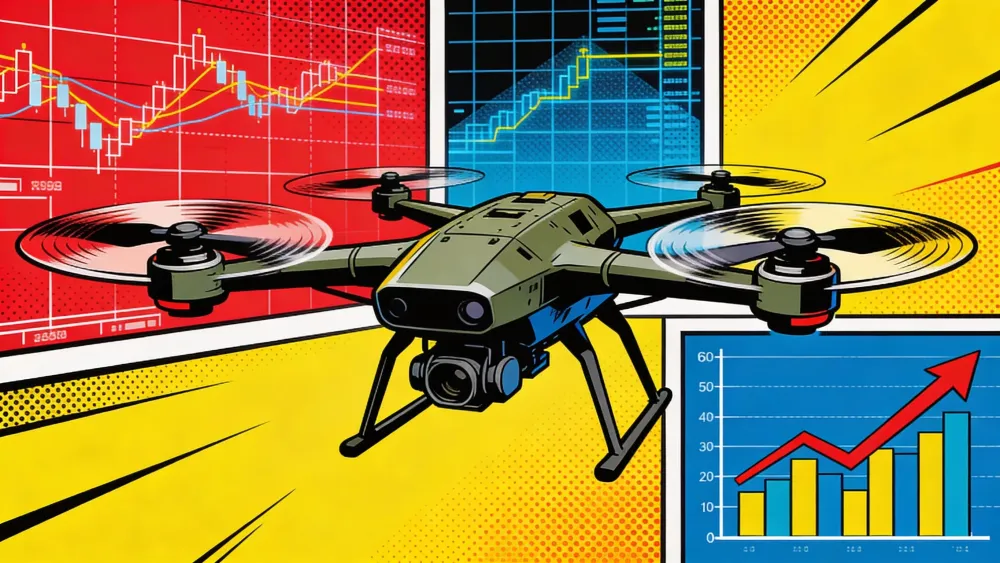
Shield AI said Thursday it raised two billion dollars in fresh capital, a figure that values the autonomous drone maker at $12.7 billion, according to the company and the New York Times. That is more than double the $5.3 billion investors assigned it a year ago. Part of the money will go toward buying Aechelon Technology, a smaller firm whose simulation software powers the Pentagon's Joint Simulation Environment, the testing ground where the U.S. military validates next-generation autonomous systems and combat aircraft.
The round has two pieces. Series G equity of $1.5 billion, led by Advent International and co-led by JPMorganChase's Security and Resiliency Initiative. Then $500 million in preferred equity from funds managed by Blackstone, plus a $250 million delayed draw facility for future growth. Few private defense technology companies have pulled in this much in a single round. The deal arrives as autonomous weapons move from experimental programs to active battlefield deployment.
Key Takeaways
- Shield AI raises $2 billion in Series G equity and Blackstone preferred, valued at $12.7 billion
- Proceeds partly fund the acquisition of Aechelon Technology, whose simulation platform runs the Pentagon's JSE
- V-BAT drone has logged 130-plus combat sorties in Ukraine and just won a 12-unit Netherlands Navy order
- Hivemind autonomy software now operates on 26 vehicle classes including Anduril's Fury CCA
Private equity plants a flag in defense tech
Advent International isn't tiptoeing. The firm announced alongside the Shield AI investment a broader commitment to deploy up to $1 billion in next-generation defense technology companies, building on more than $15 billion it has put into the global defense sector since 2020. That portfolio already includes Cobham, Ultra Electronics, Vantor, and Attalon.
David Mussafer, Advent's chairman, will join Shield AI's board. "V-BAT is rapidly scaling and delivering outcomes for militaries around the world," Mussafer said, adding that X-BAT represents "a huge opportunity to redefine air power in the fighter jet market."
JPMorganChase came in through its Security and Resiliency Initiative, which backs what the bank calls critical U.S. industries. Todd Combs, who runs the initiative's direct-investment arm, gets a board observer seat. Blackstone structured its piece as preferred equity with delayed draw, a financing instrument you see in late-stage pre-IPO companies, not early venture rounds.
Look at the capital stack. Private equity firms managing over $100 billion in assets. A systemically important bank. Preferred equity tranches. Andreessen Horowitz wrote checks in earlier rounds. So did L3Harris and Hanwha Aerospace. Try finding another startup worth under six billion dollars a year ago with this kind of backing. The Pentagon wants $13.4 billion for autonomous weapons in fiscal year 2026. Counter-drone sits at the top of that list. Institutional money reads budget documents and moves accordingly.
V-BAT earns its reputation under fire
Shield AI's pitch rests on what its drones have done in actual combat. Not demos. Not simulations. Hostile, jammed airspace where Russian electronic warfare knocks most American drones out of the sky.
The V-BAT takes off vertically, flies at up to 18,000 feet for 13 hours, and has logged more than 130 sorties in Ukraine as of April 2025, according to Breaking Defense. Ukrainian forces flew it through active jamming to locate surface-to-air missile systems, military headquarters, and barracks housing FPV drone operators. One mission pushed a V-BAT 80 kilometers into Russian-held territory south of Zaporizhzhia over two days. It identified two command positions. Ukrainian forces struck both.
Moscow noticed. Two Shahed 136 missiles hit a Kyiv hangar in April 2025 where 30 Shield AI employees had been running R&D just two weeks earlier, Fortune reported. James Lythgoe, the company's head of Ukrainian operations and a former U.K. Royal Marine, had already moved the team out after intelligence flagged Russian awareness of V-BAT activity. The missiles turned the building into twisted metal. Nobody from Shield AI was inside.
That combat record is now converting into contracts. The Netherlands ordered 12 V-BATs earlier this month for Royal Navy operations, with control systems going onto eight ships. The Dutch are buying through a NATO procurement channel, which speeds delivery, Austrian defense publication Militär Aktuell reported. Each drone costs roughly $1 million, though pricing shifts by configuration and volume.
CEO Gary Steele told the Times that more than half of the company's revenue this year will come from international customers in Europe and Asia. He described "hundreds of millions" in new contracts across those regions. Sales have started flowing to the Netherlands, Ukraine, and Egypt, with interest building in Eastern Europe and the Balkans.
Hivemind spreads beyond Shield AI's own aircraft
Hardware grabs the headlines. Software makes the margins.
Get Implicator.ai in your inbox
Strategic AI news from San Francisco. No hype, no "AI will change everything" throat clearing. Just what moved, who won, and why it matters. Daily at 6am PST.
No spam. Unsubscribe anytime.
Hivemind, Shield AI's AI-powered autonomy system, has now piloted 26 classes of vehicles. F-16s, jet-powered UAVs, helicopters, drone boats, ground vehicles. The U.S. Air Force picked it as a mission autonomy provider for Collaborative Combat Aircraft, and Shield AI is flight-testing Hivemind aboard Anduril's YFQ-44A Fury, which entered mass production this week at Anduril's Arsenal-1 facility in Ohio.
That pairing matters beyond a single airframe. Anduril's Senior VP of Engineering Jason Levin said flights with two AI agents running at once, Hivemind alongside Anduril's Lattice, worked because both adopted the government's Autonomous-Government Reference Architecture early. Washington wants autonomy software that works across vendors, not dependence on one. Shield AI landing a seat on Anduril's flagship CCA validates that pitch. The math is straightforward: if one autonomy layer can fly every airframe, nobody gets locked out.
Mitsubishi Heavy Industries ran flight demonstrations of its ARMD prototype with Hivemind Enterprise in Japan late last year, Janes reported. Separately, Shield AI and Swiss startup Destinus spent two months in Segovia, Spain, testing the Destinus Hornet counter-drone interceptor on Hivemind. The software rerouted the Hornet around geofenced areas altered mid-flight. No human input required.
Right now Hivemind accounts for about 30% of revenue. Steele wants that number at half by 2028. General Atomics, Kratos, Airbus, and five other top-25 Pentagon contractors are already running integrations. Prove the software on enough third-party platforms and the whole business model flips. You stop selling individual aircraft and start licensing an autonomy layer across entire fleets. Different business entirely.
What Aechelon brings to the table
Aechelon Technology makes the simulated worlds where militaries test aircraft and validate autonomous systems before they ever leave the ground. Think flight simulator at industrial scale. Its Synthetic Reality platform powers the Pentagon's Joint Simulation Environment, where combat aircraft and autonomous systems get stress-tested across every major service branch.
Sagewind Capital, the defense-focused PE firm selling Aechelon, pointed to three decades of accumulated simulation capability. Co-founder Raj Kanodia said the company has built tools with "direct applications to the emerging autonomous pilot and real-time virtual intelligence, surveillance, and reconnaissance markets."
For Shield AI, the buy plugs into its Hivemind Foundation Model for Defense, a domain-specific AI model trained in simulation and refined through real-world operations. Better simulation means faster training when Hivemind integrates onto new vehicle types. More synthetic data means a more capable AI pilot. The loop is deliberate: fly, collect data, simulate, improve, fly again. Aechelon hands Shield AI control over the simulation step.
Co-founder Nacho Sanz-Pastor keeps the CEO title, reports to Steele, and runs the business on his own terms. The deal still needs regulatory sign-off and should close in the spring.
The distance between valuation and revenue
Here's where it gets uncomfortable.
Shield AI brought in roughly $300 million for its fiscal year ending March 2025, Fortune reported. A hundred million below where the company wanted to be. The shortfall left leadership anxious to rebuild momentum. Part of the miss traced to a 2024 incident during a U.S. Navy test where a V-BAT tipped over and a servicemember lost the tips of three fingers trying to catch the propeller. The Navy grounded all V-BATs for two weeks. Contract decisions stalled across multiple programs.
Steele replaced co-founder Ryan Tseng as CEO last May. His target: grow revenue 70% to 100% every year until Shield AI crosses a billion dollars, which he pegs to the fiscal year ending March 2028. The factory, Shield AI's 200,000-square-foot "Batcave" near Dallas, builds 200 V-BATs a year. A new India production deal with manufacturer JSW should push that number higher.
And there is X-BAT, an autonomous fighter jet with a 2,000-nautical-mile range and vertical takeoff. Fortune reported in December that Shield AI was targeting a first test flight in 2026, with production planned for 2029. Some of the new capital goes straight toward that program.
None of this happens in a political vacuum. The Times noted the Pentagon's recent dispute with Anthropic, which objected to its AI being used for mass surveillance of Americans or autonomous lethal weapons. Shield AI board member Doug Philippone told the Times he favors keeping humans in the final decision loop. Steele said the company follows Pentagon rules on AI use.
Philippone also said Shield AI has "a definitive path to going public." You can draw a line from V-BAT's combat record in Ukraine to a $12.7 billion valuation. But getting from three hundred million in revenue to a viable public offering requires compounding execution over multiple consecutive quarters, not just a good story. Anduril already cleared a billion in 2024 and operates at a scale Shield AI hasn't touched. Forty-two times trailing revenue. That's the multiple investors are paying right now. There is no cushion in it.
Shield AI brings things most competitors can't match. Autonomy software with 26 vehicle classes under its belt. A drone with actual combat sorties logged in a real war. And now, through Aechelon, the simulation infrastructure to train its AI faster than rivals can build theirs from scratch. What it does not have is the revenue to match. Eighteen months from now, the answer will be in the order book.
Frequently Asked Questions
How much did Shield AI raise and at what valuation?
Shield AI raised $2 billion total: $1.5 billion in Series G equity led by Advent International and $500 million in preferred equity from Blackstone. The post-money valuation is $12.7 billion, more than double the $5.3 billion from one year ago.
What is Aechelon Technology and why is Shield AI acquiring it?
Aechelon builds high-fidelity military simulation software, including the Pentagon's Joint Simulation Environment. Shield AI will integrate Aechelon's simulation capabilities into its Hivemind AI pilot training pipeline to speed up autonomy development across new vehicle platforms.
Where has Shield AI's V-BAT drone been deployed?
V-BAT has flown more than 130 sorties in Ukraine through active Russian electronic warfare. The Netherlands, Egypt, and Ukraine have purchased V-BATs, with growing interest in Eastern Europe and the Balkans.
What is Hivemind and how many vehicles can it operate?
Hivemind is Shield AI's AI-powered autonomy software that pilots aircraft and other vehicles without human control. It has operated 26 vehicle classes including F-16s, helicopters, drone boats, and ground vehicles. The U.S. Air Force selected it for Collaborative Combat Aircraft.
When does Shield AI plan to go public?
Board member Doug Philippone said Shield AI has a definitive path to going public but no specific timeline was announced. The company targets $1 billion in annual revenue by fiscal year ending March 2028, which could set the stage for an IPO.

Harkaram Grewal
Maps the India–Germany–U.S. AI triangle from New Delhi. Background in cross-market operations and business development. Writes about supply chains, enterprise adoption, and talent—the unsexy forces that actually move global AI.