IMPLICATOR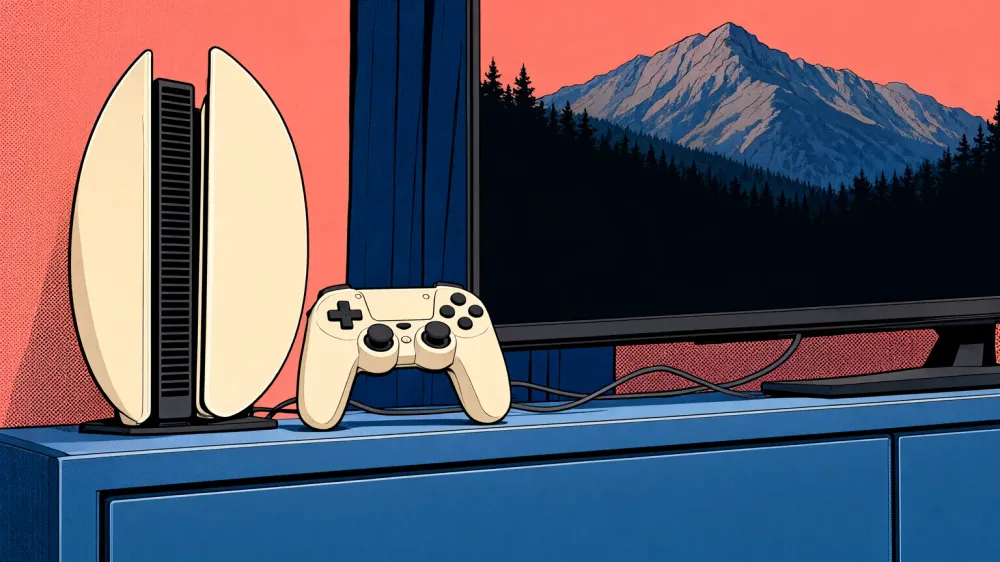
Sony announced AI upscaling for the standard PS5 on Thursday, with Marvel’s Wolverine and Ghost of Yotei receiving patches as the two launch games. Quick Spectral Super Resolution, or QSSR, adapts the image reconstruction used on PS5 Pro to run on the older console’s hardware. Owners can get clearer pictures in supported games without replacing their console, although developers must add the technology to each title.
The new system comes from Sony and AMD’s Project Amethyst collaboration, using a streamlined neural network and an implementation tuned for the standard PS5. An independent hands-on published Thursday found clearer detail, with the size of the improvement varying by game.
Daniel Craig, Sony’s principal engineer for graphics research and development, explained in the accompanying interview that developers must choose rendering and output resolutions to fit each game’s graphics mode. The independent hands-on covered about six hours with the two launch games a couple of weeks before its October 1 publication. It does not establish how QSSR will perform across the wider PS5 library.
QSSR support and tradeoffs
- QSSR launches on standard PS5 with patches for Marvel’s Wolverine and Ghost of Yotei.
- Early testing found larger image-quality gains in Wolverine. The two-game test does not establish results across the wider PS5 library.
- Developers must implement QSSR for each game. PSSR on PS5 Pro remains the higher-quality option.
AI-generated summary, reviewed by an editor. More on our AI guidelines.
Reconstruction on older hardware
Upscaling starts with a game image drawn at a lower resolution and rebuilds it for a higher-resolution display. AI guides the reconstruction of fine detail, helping produce a clearer and more stable image.
Fine detail held together better, and moving foliage produced fewer visual errors in the test. The early image improvements were larger in Wolverine. Ghost of Yotei, which already had relatively good image quality, showed smaller gains.
FREE · ABOUT FIVE MINUTES
Follow future QSSR game patches
Implicator cuts the flood to the developments worth your attention, with concise reporting on what changed and why it matters. Delivered every weekday at 4:45 a.m. Pacific, 7:45 a.m. Eastern.
From San Francisco. No spam. Unsubscribe anytime.
PlayStation Spectral Super Resolution, or PSSR, remains the higher-quality option on PS5 Pro. That console has dedicated machine-learning hardware and can handle higher rendering and reconstructed output resolutions. QSSR does not remove those hardware advantages.
The processing cost
In the October hands-on, a Wolverine performance-mode cutscene ran uncapped with variable refresh rate, reconstructing an 864p image to 1440p. QSSR added approximately 1.5 to 1.8 milliseconds per frame compared with Insomniac’s existing upscaler. The difference amounted to eight to ten frames per second in that test.
That measurement is an additional processing cost against the existing upscaler, not QSSR’s total running time. It is also specific to the tested scene and settings, rather than a general frame-rate penalty for supported games.
In the hands-on, Wolverine’s dynamic resolution lowered its internal rendering resolution to accommodate QSSR at a 60Hz target. The output frame rate stayed similar while image quality improved.
The uncapped fidelity-mode test, targeting 2160p output, showed a larger additional cost of roughly 4.4 milliseconds per frame. Reconstructing to 1440p is a more natural target for QSSR, but it is not a hard ceiling. Developers must also choose rendering and output resolutions to fit each game’s graphics mode. “It’s not a one size fits all solution,” Craig said.
Know someone who'd find this useful? ✉️ Email it to a friend in one click, or they can subscribe free here.
Yotei’s uncapped performance mode produced similar frame rates with QSSR and AMD’s existing FSR 3 upscaler. The testers had not yet confirmed matching input and output resolutions, so that result does not establish equal efficiency.
Developers must add support
Sony estimates that games already using PSSR can take QSSR as a drop-in replacement, with perhaps a few days of settings adjustments. That integration work has not been independently timed. Some teams may need to change how they load textures so higher-quality versions are available.
Sony plans to offer QSSR broadly to PlayStation developers. Existing games require implementation work.
“It’s great to be improving the PS5 this far into the generation, enabling developers to make even better-looking games,” Craig said.
Frequently Asked Questions
What is QSSR?
Quick Spectral Super Resolution is Sony’s AI upscaling system for the standard PS5. Developed through Sony and AMD’s Project Amethyst collaboration, it uses a streamlined neural network to reconstruct a lower-resolution game image for a higher-resolution display.
Which games are getting QSSR first?
Marvel’s Wolverine and Ghost of Yotei are the two launch games receiving patches. Sony plans to offer QSSR broadly to PlayStation developers, but existing games need implementation work.
What did the early image-quality tests show?
About six hours of testing across the two launch games found clearer detail, including fewer visual errors in moving foliage. Wolverine showed larger improvements. Ghost of Yotei showed smaller gains. These tests do not establish performance across the wider PS5 library.
Does QSSR have a performance cost?
In the tested Wolverine performance-mode cutscene, QSSR added processing time compared with the existing upscaler. That result was specific to the scene and settings. In the hands-on test, at a 60Hz target, Wolverine lowered its internal rendering resolution to accommodate QSSR while keeping output frame rates similar.
How long might developers need to add QSSR?
Sony estimates that games already using PSSR could adopt QSSR as a drop-in replacement with perhaps a few days of settings adjustments. That estimate is not independently measured development time. Some teams may also need to change texture loading.
AI-generated summary, reviewed by an editor. More on our AI guidelines.
Related stories
Free AI briefing · Weekdays
The AI stories that matter, sourced and explained.
Join the Morning Briefing. It goes out every weekday at 4:45 a.m. Pacific, with later sends for the East Coast, Berlin and Tokyo.
Free when you sign up: The Paperclip Compendium, our tested guide to running AI agents.
Free. Unsubscribe in one click.

Marcus Schuler
Editor-in-Chief and founder of Implicator.ai. Former ARD correspondent and senior broadcast journalist with 10+ years covering tech. Writes daily briefings on policy and market developments. Based in San Francisco. E-mail: editor@implicator.ai