 IMPLICATOR
Implicator PRO Briefing / 2 Jun 2026
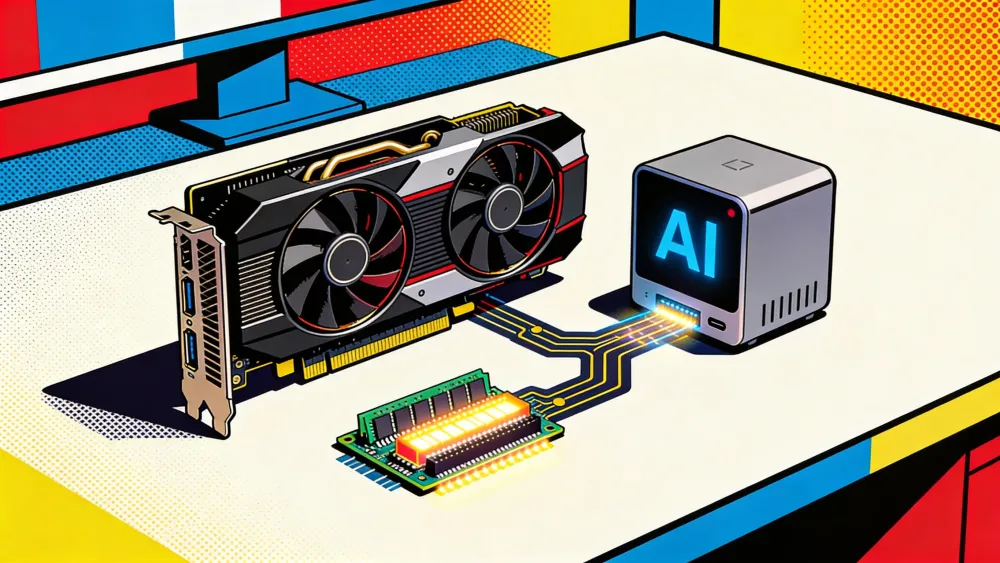
NVIDIA used its GTC Taipei keynote at Computex 2026 on Monday to announce RTX Spark, a Blackwell-based Windows PC platform co-developed with MediaTek that pairs the full CUDA software stack with up to 128GB of unified memory. NVIDIA says the platform carries 6,144 CUDA cores, fifth-generation Tensor Cores and up to one petaflop of FP4 compute, and that ASUS, Dell, HP, Lenovo, Microsoft Surface and MSI will ship laptops and compact desktops built on it in the fall. TrendForce reported that the processor is a MediaTek-co-designed N1X part built on TSMC's 3-nanometer process, the first time NVIDIA has pushed its own silicon into the mainstream consumer PC market.
For anyone weighing whether to spend money on local AI hardware this year, the announcement does not make the choice easier. It widens a split that was already forming. The old answer to "what should I buy to run models locally" was simple: buy the largest NVIDIA card you can afford. That rule no longer holds, replaced by a conditional decision that depends less on a buyer's budget than on which constraint breaks first when real work hits the machine.
NVIDIA priced none of the RTX Spark systems on Monday, and the gap is deliberate on our side as well as theirs. The interesting question is not what a new box costs. It is whether a buyer should spend on raw memory bandwidth, on memory capacity, or on nothing at all and rent instead. Those are three different machines and three different bills, and the right one is set by the workload, not by the spec sheet.
This piece works through that decision for the two buyers who keep asking it: the very ambitious individual who wants serious local models on a personal budget, and the small startup deciding whether to own hardware or keep paying an API. The hardware menu is the same for both. What they should buy is not.
The Breakdown
- NVIDIA's RTX Spark, unveiled at Computex 2026, puts CUDA plus up to 128GB of unified memory into mainstream Windows PCs shipping this fall.
- The local-AI buy now splits in two: fast discrete VRAM when the model fits, large unified memory when capacity is the blocker.
- At June 2026 street prices, a used 24GB RTX 3090 still beats the $3,600-plus RTX 5090 on value for serious local work.
- For startups, APIs and rented GPUs usually win below roughly 100-256 million frontier-model tokens a month.
AI-generated summary, reviewed by an editor. More on our AI guidelines.
What changed under the buyer's feet
VRAM has always been the first gate for local AI, and it remains an on-off switch rather than a dial. If a model's weights, key-value cache and runtime overhead do not fit in the card's memory, the model does not load and no amount of shader throughput rescues it."If your model doesn't fit in your video RAM, it physically fails to load and your performance completely collapses, period, end of story," said Thorsten Meyer in a video walkthrough on picking a card for local AI. The same point shows up in vendor language. The Register, reviewing NVIDIA's DGX Spark last October, put it plainly: "all the FLOPS and memory bandwidth in the world won't do you much good if you don't have enough VRAM to get the job done."
What changed in 2026 is that capacity stopped being the only axis that matters. A second number, memory bandwidth, now decides how a machine behaves once the model does fit. Discrete consumer cards and unified-memory systems sit at opposite ends of that axis. An RTX 5090 moves data across its 512-bit GDDR7 bus at roughly 1,792 gigabytes per second, per ASUS board specifications; an RTX 4090 runs near one terabyte per second; NVIDIA's DGX Spark, with 128GB of LPDDR5X unified memory, moves about 273 gigabytes per second. The 5090's memory path is therefore about six and a half times wider than the Spark's. Every generated token streams the model's weights through memory, so that gap surfaces directly in tokens per second.
The result is two product categories that look similar on a marketing slide and behave nothing alike. Discrete GPUs are speed boxes: they win when the model fits in 16 to 32 gigabytes and the buyer cares about fast generation, image throughput, local fine-tuning or CUDA compatibility. Unified-memory systems are capacity boxes: they win when the model, the context window or a stack of co-resident models will not fit in a consumer card, and the buyer can tolerate slower per-token speed. NVIDIA's own framing of the Spark line concedes the trade. The pitch is local agents and large models, not peak speed.
Discrete GPUs
- Win when the model fits in 16 to 32GB.
- Fast generation, image workflows, local fine-tuning.
- Mature CUDA tooling (AMD trades dollars for software friction).
Unified memory
- Win when the model, context, or model stack will not fit a consumer card.
- Run big models and long context; slower per token.
- Local agents over private data, not high-concurrency serving.
RTX Spark sharpens the split because it drops a capacity box into mainstream Windows hardware with CUDA attached. That combination did not exist at scale before Monday. It is not a reason to stop buying discrete GPUs. It is a reason to stop overpaying for today's 32GB cards if the actual requirement is a portable CUDA machine with a large memory pool that ships in the fall.
I — MEMORY
Why VRAM decides before anything else
Start with the floor, because buyers consistently overestimate it. Spheron's VRAM analysis puts a 7-to-8-billion-parameter model around 6 to 7 gigabytes at INT4 quantization after runtime overhead, which means an 8GB card can run one, with little room left for long context or a second resident model. A 13-to-14-billion-parameter model is comfortable on 16GB. These are the workhorses of local AI: private summarization, small coding assistants, retrieval over a personal document store, embeddings. None of them needs an expensive card.
The picture changes at 30 billion parameters. A 30-to-34-billion-parameter dense model fits at 4-bit on a 24GB card, but context growth, higher-quality quantization and speculative decoding all push toward 32GB. This is the reason a used 24GB card matters more for local AI than many newer 16GB cards: the extra eight gigabytes change the class of model a buyer can run, not just the speed.
The 70-billion-parameter tier is where consumer hardware stops being a clean fit. Spheron estimates Llama 3.3 70B at about 46GB at INT4 including overhead, and about 84GB at INT8. A 24GB card can touch a 70B model only through lower quantization, CPU offload, short context or layer splitting, all of which are fine for experiments and painful for daily use. A developer named Alex Ziskind demonstrated the gap in a video that has become a reference point: a small box running Meta's 70B Llama 3 at 1.43 tokens per second. "It's not fast by any means," he told viewers, "but what's impressive is that this tiny little box can run a 70 billion parameter LLM." Can-run and should-buy are different statements, and the distance between them is most of this decision.
Context is the constraint buyers forget. Spheron's figures show that a 128,000-token request against a 70B model can add roughly 40 gigabytes of key-value cache for that single request. Agentic workflows, which hold tool descriptions, retrieval snippets, scratchpad state and sometimes several models in memory at once, exhaust capacity faster than any model-size table implies. BentoML's engineering writeup frames the full set of consequences: "VRAM capacity and bandwidth influence throughput, latency, maximum context length, and how many concurrent requests you can serve." A card has to hold the model and everything the model touches while it runs: the context window, the tool definitions, the embeddings and any second model kept resident.
Bandwidth governs what happens after the fit is secured. "Bandwidth is the number that matters most, once you have sufficient compute," wrote the author of Bay41, a buyer who documented purchasing a $4,000 DGX Spark and then selling it. "Any modern GPU has enough TOPS to handle inference." His point reframes the whole spec-sheet conversation: teraflops rarely bind a single-user inference workload, and the cards that win on dollars-per-token are the ones with the most memory bandwidth relative to price, not the ones with the highest compute ceiling.
Bandwidth is the number that matters most, once you have sufficient compute. Any modern GPU has enough TOPS to handle inference.
Bay41, "I Bought NVIDIA's $4,000 AI Supercomputer. Then I Sold It."
II — PRICES
What the June 2026 price sheet actually says
Pricing is where the rational buy diverges hardest from the aspirational one. The RTX 5090 launched at a $1,999 US suggested price, but tracker data in late spring showed US listings starting around $3,658 to $4,130 and German listings near €3,759 for some models. At MSRP the 5090 would be a clear premium local-AI card, with 32GB of GDDR7 and 21,760 CUDA cores the strongest consumer part in this set. At street price it is technically excellent and economically weak.
Run the speed against the bill. CraftRigs' 2026 benchmark table clocked an 8-billion-parameter model at Q4 and 4K context at 84 tokens per second on an RTX 3090, 142 on a 4090, and 192 on a 5090. The 5090 is therefore about 2.3 times faster than a used 3090 on that workload. Its street price runs roughly four times a used 3090's. A buyer paying current prices is spending about four times the money for a bit more than twice the speed, on the same model, with eight extra gigabytes of headroom. On a 70B model the same table put the 5090 at 18.2 tokens per second against the 3090's 10.9, a 1.7x gain. The flagship is fast, but not four-times-the-money fast at June 2026 pricing.
The 16GB tier shows the opposite failure. The RTX 5060 Ti 16GB sells for roughly $559 to $599 in visible Newegg offers, with German 16GB listings starting in the mid-€500s; the cheaper €319-class entries on the same trackers are the 8GB variant, not the 16GB card a local-AI buyer wants. The 5070 Ti 16GB and 5080 16GB climb from there. All three are easy to buy, and all three stop at a 16GB ceiling that blocks 30B-class models with usable context and most 70B work. The 16GB cards are the right entry for 7B-to-14B models, embeddings, SDXL and quantized FLUX. They are not a serious large-model tier, and no discount changes that, because the limit is capacity, not price.
The most rational discrete value remains used 24GB hardware. A used RTX 3090 delivers 24GB at roughly $700 to $1,100 in the listings reviewed, with the standing caveat that used cards demand thermal, warranty and seller-credibility due diligence. The RTX 4090 is the same memory class, faster and more power-efficient, commonly above the 3090 used and around €2,989 new in German listings. The 4090 buys speed, not a new model-size tier, because it still holds 24GB. AMD's RX 7900 XTX offers 24GB near $750 to $900, or about €939 to €949 in Germany, and lands among the best dollar-per-token cards for single-user inference, with the cost paid in software friction rather than dollars.
The workstation tier is narrower still. NVIDIA's RTX 6000 Ada carries 48GB of ECC GDDR6 at 960 gigabytes per second and appears around €7,249 and up in German listings. The RTX PRO 6000 Blackwell doubles capacity to 96GB of GDDR7 ECC, listed near $9,699.99 at one US Micro Center and roughly €12,188 to €13,240 in German trackers, and draws 600 watts. AMD's Radeon PRO W7900, a $3,499-to-$3,999-class 48GB card running €3,679 to €4,714 in Germany, is the cheapest 48GB professional option for buyers who can verify the software path. The 48GB cards are rational for paid 70B work at Q4 or Q5, confidential customer data and ECC-stable single-card workflows where multi-GPU complexity costs more than the card. The 96GB RTX PRO 6000 Blackwell is the tier above that, for teams running 120B-class local inference or large-context professional work on one card. Neither is a rational curiosity purchase. The price sheet's one-line verdict: 16GB is cheap but bounded, 24GB is the personal sweet spot, 32GB is attractive only at sane pricing, and 48 to 96GB is professional territory.
The 2026 local-AI hardware menu
| System | VRAM | ~Street price, Jun 2026 | 8B Q4 t/s | Class and best use |
|---|---|---|---|---|
| Speed boxes: discrete GPUs, fast when the model fits | ||||
| RTX 5060 Ti 16GB | 16GB | ~$559 to 599 | n/a | Entry tier: 7B to 14B, embeddings, SDXL. 16GB ceiling blocks 30B+. |
| RTX 3090 (used) | 24GB | ~$700 to 1,100 | 84 | Personal sweet spot and best value; unlocks 30B-class. Inspect used cards. |
| RTX 4090 | 24GB | ~€2,989 new | 142 | Faster, same 24GB model tier as the 3090. |
| RTX 5090 | 32GB | ~$3,658 to 4,130 | 192 | Fast, but about 4x a used 3090's price at street rates. |
| AMD RX 7900 XTX | 24GB | ~$750 to 900 | n/a | Top dollar-per-token; cost is paid in ROCm software friction. |
| RTX 6000 Ada | 48GB | ~€7,249+ | n/a | Paid 70B work at Q4/Q5, confidential data, ECC stability. |
| RTX PRO 6000 Blackwell | 96GB | ~$9,699 | n/a | 120B-class on one card; draws 600W. Professional only. |
| AMD Radeon PRO W7900 | 48GB | ~$3,499 to 3,999 | n/a | Cheapest 48GB pro card if you can verify the software path. |
| Capacity boxes: unified memory, win when the model will not fit | ||||
| NVIDIA DGX Spark | 128GB unified | $3,999 to 4,699 | n/a | CUDA capacity box; ~273 GB/s bandwidth caps token speed. |
| NVIDIA RTX Spark | up to 128GB unified | unpriced, fall 2026 | n/a | CUDA plus a large unified pool in mainstream Windows OEM PCs. |
| Apple M3 Ultra Mac Studio | up to 256GB (512GB BTO) | varies | n/a | 819 GB/s; runs 600B+ models on device. |
| AMD Ryzen AI Max+ 395 | up to 128GB unified | varies | n/a | Strix Halo; up to 96GB to graphics, capacity over speed. |
III — CAPACITY
The capacity boxes and what they give up
The unified-memory machines now crowding the market are not one product. Apple's M3 Ultra Mac Studio is a desktop workstation with 819 gigabytes per second of memory bandwidth and configurations to 256GB of unified memory on Apple's current support pages in standard trims, rising to a build-to-order 512GB top end, with launch materials citing on-device models above 600 billion parameters. AMD's Ryzen AI Max+ 395, the Strix Halo part, offers up to 128GB of unified memory with as much as 96GB convertible to graphics memory. NVIDIA's DGX Spark, which shipped last October, uses 128GB of coherent unified memory at roughly 273 gigabytes per second. RTX Spark now brings a related design to Windows OEMs.
Their shared advantage is capacity. A 128GB pool loads model configurations a 24GB or 32GB consumer card cannot hold, especially with 4-bit, FP4 or mixture-of-experts formats. The Register captured the appeal in one sentence: the Spark and the wave of similar systems "can do is run models the 5090 or any other consumer graphics card on the market today simply can't." Software developer Simon Willison, reviewing the DGX Spark, described it without the marketing gloss as "an ARM64 device with 128GB of memory that's available to both the GPU and the 20 CPU cores at the same time, strapped onto a 4TB NVMe SSD," aimed squarely at AI researchers.
Their shared weakness is bandwidth, and the third-party reviews keep returning to it. LMSYS's in-depth DGX Spark review identified the limited LPDDR5X memory path as the performance bottleneck even while crediting the 128GB pool for loading models a desktop GPU cannot. Independent video reviewers found the same wall from the other side. Bijan Bowen ran OpenAI's GPT-OSS 120B model on a Strix Halo machine at 13.77 tokens per second; a larger dual-GPU box he tested hit 46.9 on the same model. The capacity box runs the big model. The speed box, when the model fits, runs it more than three times faster.
There is a thermal asterisk on the most-hyped capacity box. John Carmack, the id Software founder, posted that his DGX Spark appeared to max out around 100 watts of power draw against a rated 240, delivering roughly half the quoted performance and running hot, a claim picked up by PC Gamer and Tom's Hardware. That is throttling at about 42 percent of rated power. The caveat matters: replies on NVIDIA's developer forum framed the 240-watt figure as a system or power-supply peak rather than sustained GPU draw, so the post is a flag for buyers to check sustained thermals, not settled proof of a design defect. Tom's Hardware's own review landed on a balanced read: the Spark is "a well-rounded toolkit for local AI" but "a pricey platform if you don't intend to use its features to the fullest."
Bay41's reviewer drew the line that should govern the purchase. For his original workload, he wrote, "everything fit. Everything ran. For that specific workload shape, the machine earned its price tag." Then he sold it, because his other work was bandwidth-bound and the box was capacity-first. That is the capacity-box decision in one anecdote. The machine is right or wrong depending on whether the buyer is memory-capacity-bound, and almost nothing else.
A capacity box is right or wrong depending on whether the buyer is memory-capacity-bound, and almost nothing else.
The cost of being capacity-bound is also rising for an external reason. Tom's Hardware reported that the DGX Spark Founders Edition climbed from $3,999 to $4,699, an 18 percent increase of $700, as memory shortages bit. That pressure is the same one driving the broader memory squeeze we have tracked since December, where high-bandwidth memory demand from data centers is consuming capacity and pushing consumer prices up through 2027. A buyer waiting on unified memory is also betting on a memory market that is moving the wrong way.
Get Implicator.ai in your inbox
Strategic AI news from San Francisco. No hype, no "AI will change everything" throat clearing. Just what moved, who won, and why it matters. Daily at 6am PST.
No spam. Unsubscribe anytime.
IV — BUDGET
Where the spending stops paying off for a person
A personal buyer should decide one thing first: whether the goal is learning and control, or large-model capability. If the goal is local coding help, private summarization of small documents, SDXL images, embeddings and experimentation, a 16GB card such as the RTX 5060 Ti is enough, and spending $3,000 on a flagship before proving those workloads need it is the most common mistake in the category.
If the goal is serious local models, 24GB becomes the practical floor. "24 GB is really the enthusiast baseline right now," Meyer said in the same video. "Step up to 32 GB and that opens up massive 70 billion parameter models without having to rely on offloading." His ceiling claim oversells the math: Spheron's baseline puts Llama 3.3 70B near 46 gigabytes even at INT4, so a 32GB card runs a 70B model only at lower quantization or with some offload, not as a comfortable tier. A used RTX 3090 is the most defensible first serious card because it unlocks 30B-class models and modern image workflows at the lowest cost, provided the buyer can inspect the card. The 4090 is the speed upgrade in the same memory class.
The RTX 5090 is the genuine special case. Its 32GB is the first meaningful consumer step above 24GB, useful for 32B models with headroom, long-context 14B and 30B workflows, and FLUX experiments in BF16. At $1,999 it would be an easy recommendation. At $3,658 and up it is a poor personal value unless the buyer monetizes the speed or refuses cloud services on privacy grounds. The advice that travels furthest is Meyer's blunt warning: "whatever you do, do not base your purchase on raw gaming benchmarks." The gaming number and the local-AI number diverge, and the divergence widens at the top of the stack.
So the personal ceiling is sharp. A hobbyist should usually stop around $700 to $1,100 for a used 3090, $1,500 to $2,400 for a discounted 4090-class machine, or about $2,500 for a 5090 only if pricing normalizes. Above that line, unified-memory systems and cloud rentals deserve first consideration, not a bigger discrete card. A 48GB workstation card can make sense for a researcher who specifically needs single-card 70B inference at higher quality, longer context or ECC stability, and the Radeon PRO W7900 is the cheapest route there for someone confident in AMD's stack. A 96GB RTX PRO 6000 Blackwell at five-figure pricing is almost never a personal purchase. The exception is a solo consultant or creator whose revenue depends on local high-memory work and who can bill the card against projects.
Image generation is the cleanest personal case for 24GB, because iteration speed and privacy have obvious value to creators. Spheron's ComfyUI guide puts SDXL base around 8 to 10 gigabytes, FLUX.1 Dev at FP8 around 18 to 23, and FLUX.1 Dev at BF16 around 30 to 33. That makes 12GB a floor, 16GB workable, 24GB the comfortable creator tier, and 32GB the premium for BF16 and heavy extension stacks. A used 3090 or 4090 runs the modern diffusion workflow today, which is a far more concrete payoff than chasing a 70B chatbot that the card cannot comfortably hold.
V — STARTUPS
What a startup should measure before buying
A startup has three jobs before it buys anything: measure usage, evaluate open-model quality, and classify data sensitivity. If the product needs frontier reasoning or state-of-the-art coding, an API remains the default, because owning hardware does not close a model-quality gap. If the workload touches confidential data that cannot leave company-controlled infrastructure, local hardware becomes part of the compliance design rather than a cost optimization. Those two facts decide most cases before a card is priced.
The economics favor renting for longer than founders expect. Synpix's 2026 cloud comparison lists a rented RTX 4090 around $0.34 per hour and a Lambda H100 PCIe at $3.29 per hour. Against those rates, a purchased workstation has to beat not just the hourly meter but idle time, operations labor, depreciation, cooling and opportunity cost. The arithmetic is unforgiving on the high end: a $9,699 RTX PRO 6000 Blackwell buys roughly 2,950 hours of Lambda H100 time at $3.29, about four months of nonstop rental, before a single watt of the owner's power bill is counted. Hardware that sits idle loses that comparison badly.
The break-even on token volume is the number to model, and the honest version of it is high. OpenAI's GPT-5.5 short-context pricing runs $5 per million input tokens and $30 per million output, so a 50-50 blended workload costs about $17.50 per million tokens before caching effects. A $5,000 local box amortized over 24 months, plus power and maintenance, costs somewhere around $250 to $350 a month before any engineering time, which crosses a $17.50-per-million API bill at roughly 14 to 20 million tokens a month. That sounds reachable until the hidden costs land. Marka Development's analysis places the frontier self-host-versus-API break-even closer to 100 to 256 million tokens a month, and finds that self-hosting often costs three to five times raw GPU rental once idle capacity, engineering and operations are counted. Rene Zander's framework reaches the same conclusion from a different direction: APIs win for most production workloads, and the daily break-even depends heavily on whether the comparison is a frontier model or a cheaper hosted tier.
Know someone who'd find this useful? ✉️ Email it to a friend in one click, or they can subscribe free here.
Production serving is also a harder problem than single-user benchmarks suggest, which is the trap behind every impressive tokens-per-second demo. SemiAnalysis frames the production reality: "the fundamental trade-off that comes with serving LLMs at scale is that of throughput versus interactivity, measured in units of tokens per second per user." A box that streams 50 tokens a second for one developer can collapse under ten concurrent users, and that failure mode never shows up in a YouTube unboxing.
So the staged buy follows the data, not the excitement. The first tier is one shared 24GB development workstation, a used 3090 or 4090, treated as a developer tool that shortens iteration loops and keeps prototypes off the cloud-spend line item, not as production infrastructure. The second tier is a single local inference box for a stable internal workload, justified only when the team has a predictable load, an open model that passes its evals, and someone responsible for drivers, runtimes, monitoring and updates. The third tier, a 96GB-plus card, is defensible when the team repeatedly runs 70B or 120B inference, handles regulated data, or needs predictable on-prem latency for customer work. It is not defensible for occasional fine-tunes or a vague plan to run agents later.
There is a positive counterweight worth naming, because the capacity box is not useless for builders. LMSYS and the SGLang team, optimizing GPT-OSS on the DGX Spark, reported around 70 tokens per second on the 20B model and 50 on the 120B, enough that they called "running a local coding agent on the DGX Spark fully viable." For a startup whose constraint is a private coding agent over proprietary code rather than high-concurrency serving, a capacity box can be the right tool. The point is that the workload picks the box.
VI — TRADEOFFS
The tradeoffs nobody puts on the spec sheet
Multi-GPU rigs look efficient on a spreadsheet, where two 24GB cards read as 48GB, and that is not how most local-AI software behaves by default. VRAM is not pooled like ordinary system memory. Model parallelism, tensor parallelism and layer splitting can spread a model across cards, but consumer Blackwell and Ada cards dropped the simple NVLink bridge that made 3090-era dual builds straightforward, leaving cross-GPU communication an engineering project. PCIe 5.0 helps and does not erase the cost.
Quantization lowers the memory floor and charges for it in quality. Modal's fine-tuning estimates show why 4-bit weights are transformative: a 70B model fits a QLoRA run around 46GB instead of the roughly 672GB a full fine-tune of the same model would demand, and full 7B fine-tuning still runs about 67GB. The same compression that makes a model fit can degrade math, coding edge cases, tool use, multilingual robustness and long-context stability. Many chat and summarization tasks tolerate 4-bit cleanly; retrieval, function-calling and safety-sensitive work often do not. A buyer should test the exact model, quantization and prompt shape before buying a card sized around it.
Power and heat read differently in Europe than in most US-centric buying guides. A single 4090-class workstation can pull several hundred watts under sustained inference; a 600-watt RTX PRO 6000 Blackwell needs a serious supply and real airflow; a multi-GPU build becomes a space heater. At German household electricity rates, running a rig around the clock erases part of the apparent savings from buying used. At US rates the pain is smaller but still shows up on a continuous workload. The card's sticker is the start of the cost, not the end.
Software maturity remains NVIDIA's largest non-hardware advantage, and it is the reason the cheaper AMD card is not automatically the better buy. AMD's ROCm is a real AI stack, and RX 7900 XTX and W7900 cards are viable for local inference through ROCm and Vulkan paths. CUDA still owns the broader ecosystem: TensorRT-LLM, custom kernels, the long tail of ComfyUI extensions, fine-tuning recipes and production-serving documentation. AMD is the better purchase for a buyer willing to debug the stack and a worse one for a team that needs predictable onboarding. The dollar-per-token math and the hours-per-week math point in opposite directions, and only the buyer knows which is scarcer.
Depreciation is the cost that closes the case for renting expensive hardware. Consumer GPUs can lose value quickly when a new generation changes memory capacity or model formats, exactly the kind of shift RTX Spark represents. Data-center cards hold value longer but trade in a volatile market sensitive to cloud pricing, export controls, hyperscaler refresh cycles and memory supply. The safest financial posture is to rent the expensive tier until a workload proves it deserves owned silicon, then buy against measured utilization rather than a forecast.
VII — VERDICT
What the split means for the buyer
The market has divided into speed boxes and capacity boxes, and the division is more useful than any single VRAM number. RTX 3090, 4090 and 5090 systems are speed boxes, best when the model fits in their memory and the buyer wants fast generation, strong image workflows, CUDA compatibility and mature tooling. Strix Halo, Apple Silicon, DGX Spark and now RTX Spark are capacity boxes, best when a model, a long context or a multi-agent environment needs a large addressable pool and can tolerate lower bandwidth. The old "buy more VRAM" rule failed because VRAM size alone hides the bandwidth, the software ecosystem and the utilization that actually determine value.
Bottom line: what to actually buy
The ambitious individual
A used RTX 3090, $700 to 1,100. 24GB unlocks 30B-class models and modern image work. Stop around 32GB unless you monetize the speed or refuse the cloud on privacy grounds. A street-price 5090 is poor value at about 4x the money for a bit more than twice the speed.
The small startup
Rent first. Below roughly 100 to 256 million frontier-model tokens a month, APIs and rented GPUs win once idle time, ops labor and depreciation are counted. Start with one shared 24GB dev box; buy production hardware only against measured utilization.
RTX Spark makes the middle of the market more interesting, because CUDA plus a large unified pool in mainstream Windows form factors is a genuinely new option. It does not repeal the speed-versus-capacity trade, and the discipline that trade demands is unchanged. A buyer who names the binding constraint before shopping will spend well in 2026. The buyer who shops the spec sheet keeps paying roughly four times the price for a bit more than twice the speed.
VIII — SIGNALS
What to watch
Confirmed OEM street prices, sustained thermals and real-world tokens-per-second from ASUS, Dell, HP, Lenovo, Microsoft and MSI systems when they ship in fall 2026. The platform is a market signal until it is a priced, benchmarked SKU.
Whether high-bandwidth and LPDDR5X memory prices keep climbing through 2027, since DGX Spark already took a $700 increase on memory shortages and unified-memory boxes are the most exposed to it.
Whether the ROCm and Vulkan software path narrows the gap with CUDA for fine-tuning recipes, ComfyUI extensions and production serving, the only thing standing between AMD's strong dollar-per-token cards and a broader recommendation.
Whether open-weight 70B and 120B models close enough of the frontier gap that the API-versus-local break-even shifts in favor of owning, the single variable that moves the startup math most.
Whether rented H100 and 4090 hourly prices fall further, because every drop raises the utilization a buyer must prove before owned hardware pays off.
Frequently Asked Questions
What is the difference between RTX Spark and DGX Spark?
DGX Spark is NVIDIA's existing GB10 desktop box with 128GB of unified memory, shipped in October 2025. RTX Spark, announced at Computex 2026, is a new Windows PC platform co-developed with MediaTek that brings CUDA and up to 128GB of unified memory to laptops and compact desktops from major OEMs, due in fall 2026.
How much VRAM do I need to run local AI models?
Spheron's estimates put 7-8B models around 6-7GB at INT4, 13-14B comfortable on 16GB, 30B-class at 24GB, and Llama 3.3 70B near 46GB at INT4. Long context adds more: a 128K request on a 70B model can add roughly 40GB of key-value cache.
Is a used RTX 3090 still worth buying in 2026?
For serious local AI on a personal budget, yes. At roughly $700 to $1,100 it delivers 24GB, enough for 30B-class models and modern image workflows, at far better value than a street-price RTX 5090. The caveats are thermal, warranty and seller due diligence on used cards.
When should a startup buy GPUs instead of using an API?
After it measures steady utilization, confirms an open model passes its evals, and has a data-control reason to run locally. Below roughly 100 to 256 million frontier-model tokens a month, APIs or rented GPUs usually win once idle capacity, engineering time and depreciation are counted.
Why do unified-memory systems run large models slowly?
They trade bandwidth for capacity. DGX Spark's 128GB pool loads models a 24GB card cannot, but its LPDDR5X memory moves about 273GB/s against roughly 1,792GB/s on an RTX 5090. Since every token streams weights through memory, the lower bandwidth caps token speed even when the model fits.
AI-generated summary, reviewed by an editor. More on our AI guidelines.

Sources & Further Reading
Primary Sources
- NVIDIA at COMPUTEX 2026: RTX Spark, DLSS 4.5, RTX Updates -- NVIDIA, June 2026
- NVIDIA DGX Spark: AI Supercomputer on Your Desk -- NVIDIA, 2026
- API Pricing -- OpenAI, 2026
- Apple reveals M3 Ultra, taking Apple silicon to a new extreme -- Apple, March 2025
- AMD Ryzen AI Max 395 Processor: Breakthrough AI Performance -- AMD, 2025
Research & Analysis
- NVIDIA DGX Spark In-Depth Review -- LMSYS, October 2025
- GPU Memory Requirements for LLMs: VRAM Calculator -- Spheron, 2026
- How much VRAM do I need for LLM model fine-tuning? -- Modal, 2026
- Consumer GPU LLM Benchmark Table 2026 -- CraftRigs, 2026
- Self-hosted LLM vs API Cost 2026 -- Marka Development, 2026
- Nvidia DGX Spark gets $700 price hike as memory shortages bite -- Tom's Hardware, 2026
Further Reading
- DGX Spark, Nvidia's tiniest supercomputer, tackles large models at solid speeds -- The Register, October 2025
- NVIDIA DGX Spark: great hardware, early days for the ecosystem -- Simon Willison, October 2025
- I Bought NVIDIA's $4,000 AI Supercomputer. Then I Sold It. -- Bay41, 2026
- Used RTX 3090 in 2026: Still the AI Value King, or Time to Move On? -- RunAIHome, 2026
Free AI briefing · Weekdays
The AI stories that matter, sourced and explained.
Join the Morning Briefing. It goes out every weekday at 4:45 a.m. Pacific, with later sends for the East Coast, Berlin and Tokyo.
Free when you sign up: The Paperclip Compendium, our tested guide to running AI agents.
Free. Unsubscribe in one click.

Marcus Schuler
Editor-in-Chief and founder of Implicator.ai. Former ARD correspondent and senior broadcast journalist with 10+ years covering tech. Writes daily briefings on policy and market developments. Based in San Francisco. E-mail: editor@implicator.ai