IMPLICATOR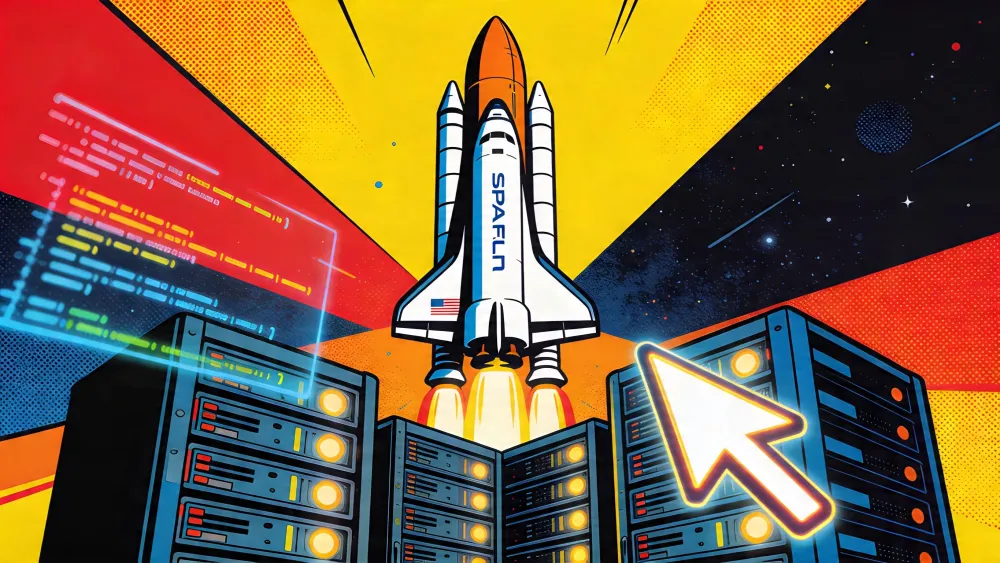
SpaceX said Tuesday it has obtained the right to acquire artificial intelligence coding startup Cursor for $60 billion later this year, or pay $10 billion for the partnership the companies now share. The arrangement routes Cursor's developer base into SpaceX's Colossus training cluster, described by the company as equivalent to one million Nvidia H100 GPUs, and hands Elon Musk's rocket and satellite maker a code-generation product weeks before its planned public offering. The company disclosed the deal in a post on X, confirming what investors had watched build since SpaceX's February absorption of xAI and the hiring of two Cursor engineering leads in March.
Key Takeaways
- SpaceX can acquire Cursor for $60 billion by year-end or pay $10 billion to keep the current AI coding partnership.
- Cursor's own funding round two days earlier valued it above $50 billion pre-money, making the option only a modest premium.
- xAI was already renting GPUs to Cursor and had hired its top two engineering leads in March.
- The move strengthens SpaceX's AI narrative weeks before an IPO targeting a valuation up to $1.75 trillion.
AI-generated summary, reviewed by an editor. More on our AI guidelines.
A two-track price tag
The structure is unusual. SpaceX can either close an acquisition at $60 billion before year-end or pay a $10 billion fee "for our work together," per the company's statement. Breakup fees happen in every serious merger agreement. Branding one as payment for a working partnership does not.
The math already looks priced. Cursor is closing a $2 billion funding round at a pre-money valuation over $50 billion, CNBC reported two days before the SpaceX announcement. Andreessen Horowitz is co-leading with Nvidia and Thrive Capital, all returning backers. Battery Ventures is joining as a new investor. The round is oversubscribed.
That puts SpaceX's $60 billion option at a modest premium over where the venture market was pricing Cursor last weekend. For a company whose annualized revenue jumped from $1 billion in November to $2 billion in February, and which projects a $6 billion run rate by year-end, the premium looks restrained.
Compute pulls in product
This is not a cold acquisition. It is the end of a courtship.
xAI already sits inside SpaceX after a $1.25 trillion merger in February, and xAI has been renting GPU capacity to Cursor for training Composer 2.5, Business Insider reported last week. Andrew Milich and Jason Ginsberg, the two engineering heads who took Cursor from product-market fit to $2 billion ARR, joined SpaceX in March. Milich and Ginsberg now report to Musk and xAI president Michael Nicolls.
The AI deals that actually matter, delivered daily
Strategic AI news from San Francisco. No hype, no "AI will change everything" throat clearing. Just what moved, who won, and why it matters. Daily at 6am PST.
No spam. Unsubscribe anytime.
So the compute, the talent pipeline, and the training pipeline were already pointing the same direction before Tuesday. What changed is the pricing mechanism. Cursor's senior team has been draining into Musk's orbit. Its model training now runs on chips SpaceX owns. The $60 billion option and the $10 billion fee simply put a number on which direction the rest of the company walks.
Cursor's zero-marketing growth into a professional-developer fixture gave it room to run through most of 2025. That room is closing fast.
Racing Claude and Codex into enterprise code
The pressure on Cursor is not financial. It is competitive.
OpenAI shipped Codex and Anthropic shipped Claude Code. Google is pushing Gemini coding tools into enterprise accounts. All three bundle code generation into existing cloud and productivity relationships that Cursor has to win one customer at a time. Anthropic is reported to have pulled ahead of OpenAI on annualized revenue this month, with agentic coding workloads a big driver of that shift.
Cursor's own numbers tell the same story the competitive picture does. Enterprise accounts now generate positive gross margins. Individual developer subscriptions still do not. The company's path to defensible profits requires compute it does not own and distribution into accounts it does not yet touch. SpaceX has the first. xAI's enterprise push is trying to build the second.
IPO math under one roof
Musk's timing is the subtext. SpaceX filed confidentially in March and is targeting a June listing at a valuation above $1 trillion. Reuters, citing excerpts from the IPO filing, reported this week that the company is marketing up to $1.75 trillion with a $75 billion raise, and that Musk and insiders will keep super-voting control after the offering.
An AI coding acquisition strengthens the prospectus in a specific way. Starlink funds the present. Orbital data centers are the pitch for 2028. Cursor is the AI story investors can read on Tuesday. With it on the balance sheet, SpaceX goes public as an applied-AI company with launch capacity, not just a launch company with an AI subsidiary. If you are an enterprise software buyer, that is the story.
The question Cursor's founders face is whether their four-year-old MIT side project gets absorbed into a $1.75 trillion public company, or collects $10 billion and tries to hold the line alone against Anthropic and OpenAI while xAI builds in-house. The decision probably resolves after the IPO pricing window closes, not before. What is already fixed: Cursor no longer controls its own compute.
When Musk welcomed the two Cursor engineering leads to SpaceX in March, he framed their future work in one line: "Orbital space centers and mass drivers on the Moon will be incredible." The code they ship now will get written for that horizon.
Frequently Asked Questions
What did SpaceX actually announce about Cursor?
SpaceX obtained a contractual option, not a closed deal. It can acquire the AI coding startup Cursor for $60 billion later in 2026, or pay $10 billion as a fee for what it calls 'our work together' if it chooses not to exercise. Cursor has agreed. SpaceX disclosed the arrangement in a post on X on Tuesday, April 21, 2026.
How does this compare to Cursor's current market valuation?
Cursor is closing a $2 billion funding round at a pre-money valuation above $50 billion, CNBC reported two days before SpaceX's announcement. The $60 billion option therefore sits only modestly above where venture investors, including Andreessen Horowitz, Nvidia, and Thrive Capital, are currently pricing the company. Cursor was valued at $29.3 billion as recently as November 2025.
Why is SpaceX, a rocket company, buying an AI coding startup?
SpaceX absorbed Elon Musk's AI startup xAI in February 2026 in a $1.25 trillion deal. Musk is repositioning the combined entity around AI and orbital data centers. Cursor brings a live enterprise coding product, developer distribution, and an engineering team that has already been migrating into xAI. It also strengthens the AI story ahead of a planned June IPO.
What happens to Cursor if SpaceX does not exercise the option?
Cursor receives $10 billion as a fee for current joint work and continues operating independently. But its independence is already strained: its top two product engineering leads, Andrew Milich and Jason Ginsberg, joined SpaceX in March, and xAI has been renting GPU capacity to train Cursor's next coding model. Holding ground against Anthropic, OpenAI, and Google gets harder without that support.
When could the acquisition close, and how does it affect the SpaceX IPO?
The option window runs through late 2026. SpaceX filed confidentially in March and is targeting a June listing. Reuters reported the company is marketing a valuation up to $1.75 trillion with a $75 billion raise. If SpaceX closes on Cursor before pricing, the prospectus gains a live AI coding revenue stream. If after, the option reads as forward-looking. Either path strengthens the offering.
AI-generated summary, reviewed by an editor. More on our AI guidelines.


Free AI briefing · Weekdays
The AI stories that matter, sourced and explained.
Join the Morning Briefing. It goes out every weekday at 4:45 a.m. Pacific, with later sends for the East Coast, Berlin and Tokyo.
Free when you sign up: The Paperclip Compendium, our tested guide to running AI agents.
Free. Unsubscribe in one click.

Marcus Schuler
Editor-in-Chief and founder of Implicator.ai. Former ARD correspondent and senior broadcast journalist with 10+ years covering tech. Writes daily briefings on policy and market developments. Based in San Francisco. E-mail: editor@implicator.ai