Implicator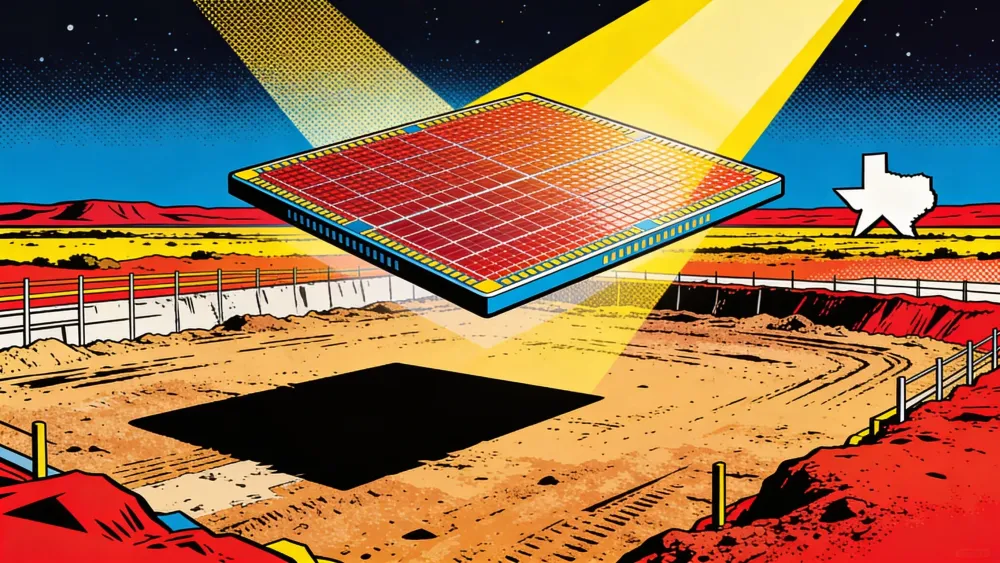
Elon Musk announced Saturday that Tesla and SpaceX will pursue a $20 to $25 billion chip fabrication project beginning with an advanced technology facility in Austin, Texas, Reuters reported. The project, which Musk calls "Terafab," would target 2-nanometer process technology and, at full scale, produce one terawatt of annual computing capacity. No construction timeline or production date was given during the March 21 event at a defunct power plant in downtown Austin.
In practice, Terafab would amount to the first joint hardware venture combining Tesla, SpaceX, and xAI, the artificial intelligence company that SpaceX absorbed in an all-stock deal last month. SpaceX is also preparing for what Bloomberg says could be a $1.75 trillion IPO this summer. Draw your own conclusions about the timing.
The Breakdown
- Tesla, SpaceX, and xAI plan a $20-25B "Terafab" chip fab starting with an Austin design facility, targeting 2nm chips and one terawatt of annual compute.
- No construction timeline, production date, or funded capex plan was provided at the March 21 announcement.
- Musk estimates 80% of Terafab's compute output would go to space-based orbital AI satellites, not terrestrial applications.
- Tesla has never run a chip fab. AI5 and AI6 still rely on TSMC and Samsung foundries that haven't finished ramping.
What Terafab actually entails
Musk walked through plans for two types of fabrication lines. The first would churn out inference chips for Tesla vehicles and Optimus humanoid robots. Think of it as the next step from AI4, the processor behind Tesla's current full self-driving software. Musk estimated that robot production volumes would eventually run 10 to 100 times higher than current car output.
A second line would produce a space-hardened processor designed for orbital AI satellites that Musk wants to deploy as part of SpaceX's constellation. He told the audience that roughly 80 percent of Terafab's eventual compute output would go to space-based workloads, by his estimate. Only 20 percent for Earth.
Musk wants 100,000 wafer starts per month to begin with, according to Reuters. His stated ambition is to eventually reach one million. If achieved, that would represent about 70 percent of what TSMC produces globally. TSMC spent decades and more than $165 billion building that capability across dozens of facilities and thousands of engineers with deep process expertise. Tesla has never operated its own chip fab.
"We either build the Terafab or we don't have the chips," Musk said. He claimed that all of Earth's current AI-compute output amounts to roughly 2 percent of what his companies would eventually need. Samsung and TSMC, both cautious about overbuilding into a potential demand slowdown, are expanding at a pace Musk considers too slow.
The gap between presentation and production
Morgan Stanley's semiconductor analysts called the idea of building a chip fab from scratch "herculean" in a recent note. That word understates it. The semiconductor industry split into fabless designers and contract foundries for a reason, and combining chip design, lithography, memory production, advanced packaging, and testing under a single roof at 2nm is something no company on Earth currently does at scale.
TSMC is only now beginning to ramp 2nm output. Its Arizona expansion, announced as the largest foreign manufacturing investment in U.S. history, will not reach 2nm production until 2029. A single 2nm fab capable of 50,000 wafer starts per month costs around twenty-eight billion dollars and takes approximately 38 months to build in the United States, according to industry estimates.
Tesla's own next-generation chip plans depend on outside foundries that are still ramping up. AI5 is expected in small numbers in 2026, with high-volume production projected for 2027 via TSMC and Samsung. AI6 production is contracted to Samsung's Taylor, Texas facility under a $16.5 billion agreement, with mass production targeted for the second half of 2027. Those are long timelines for a company pitching vertical integration as the answer.
Tesla plans roughly $20 billion in capital expenditure for 2026, Reuters reported, and CFO Vaibhav Taneja said the company has $44 billion in cash plus access to debt and other financing tools. How Terafab's $20 to $25 billion price tag fits into that plan has not been publicly clarified. The math does not obviously work without new financing.
Battery Day with a different costume
Investors who sat through Tesla's Battery Day in September 2020 know this feeling. Musk stood on stage and promised a manufacturing revolution with the 4680 cell. Ten gigawatt-hours within twelve months, he said. Three terawatt-hours by the end of the decade. Dry electrode processing that would slash costs by half.
Stay ahead of the curve
Strategic AI news from San Francisco. No hype, no "AI will change everything" throat clearing. Just what moved, who won, and why it matters. Daily at 6am PST.
No spam. Unsubscribe anytime.
Tesla sits, five and a half years on, well short of those targets. The dry electrode process required multiple revisions. CATL chairman Robin Zeng publicly said Musk does not know how to make battery cells.
Battery manufacturing is hard. Leading-edge chip fabrication operates at a different order of difficulty. Tolerances are measured in atoms. Vibrations from nearby machinery, even traffic on adjacent highways, can ruin wafers mid-exposure. Giga Texas's stamping machines shake the ground with each press cycle. Any fab built near that campus would face the same vibration problem that existing fabs spend hundreds of millions of dollars solving.
SpaceX as financial gravity
SpaceX's inclusion rewrites the financial story around Terafab. The rocket company is preparing for what could be a record-setting IPO this summer, with Bloomberg reporting a potential fifty billion dollar raise at a valuation exceeding $1.75 trillion. Attaching Terafab to SpaceX rather than Tesla alone gives the project a financial sponsor whose trajectory runs opposite to Tesla's declining auto sales.
Tesla's unit deliveries shrank for the second straight year in 2025, with European numbers falling off a cliff. Tying a massive new capital commitment to SpaceX borrows credibility from a separate balance sheet, one whose value keeps climbing.
Whether that represents genuine operational convergence or financial positioning ahead of an IPO is something regulators will be watching closely. Some Tesla shareholders pushed back on an earlier $2 billion investment into xAI. Their argument: the deal enriched Musk's private holdings at their expense. Terafab, structured as a joint venture between companies Musk controls, raises the same questions at ten times the dollar amount.
Constellation Research analyst Holger Mueller told SiliconANGLE that if Musk delivers, "it will be really bad news for AI chipmakers," not because they lose a customer, but because it encourages other large buyers to build their own fabs. Nvidia, AMD, Intel, Qualcomm, all of them would feel it. That "if" is doing a lot of work, though. Mueller conceded that betting against Musk has burned people before. Others in the semiconductor industry are less impressed. Chip fabs are not rockets. Vertical integration in silicon has a cautionary history of its own, and Intel's long, expensive struggle with in-house manufacturing is the example nobody wants to repeat.
What the missing timeline tells you
Musk offered no date for groundbreaking. No date for first silicon either, and nothing resembling a production ramp schedule. He showed a concept render of a mini AI satellite rated at 100 kilowatts and predicted future models would reach the megawatt range. He talked about lunar mass drivers and petawatts of space-based compute. He compared his own presentation to "the opening of Idiocracy."
Tesla's existing chip roadmap depends on Samsung and TSMC factories that are still being built or not yet running at target nodes. High-bandwidth memory prices jumped 50 to 100 percent over the past year because of the global AI shortage, and analysts expect the squeeze to last through 2027. Every link in the semiconductor supply chain is stretched thin right now. A newcomer that has never run a fab does not loosen any of it. Not soon.
Searchlights from the Seaholm Power Plant cut across downtown Austin on Saturday night. Musk was up there talking about galactic civilizations. Greg Abbott was there. By Sunday morning, Tesla's careers page already listed Terafab job openings in both Austin and Palo Alto.
Searchlights were visible from miles away. The chips are not.
Frequently Asked Questions
What is Terafab?
A joint chip venture between Tesla, SpaceX, and xAI beginning with a design facility in Austin. Musk wants to consolidate chip design, lithography, memory, packaging, and testing under one roof at 2nm. Price tag: $20 to $25 billion by his estimate.
What chips will Terafab produce?
Two types. An inference chip for Tesla vehicles and Optimus humanoid robots, building on the current AI4 architecture. And a space-hardened processor for orbital AI satellites. Musk estimated 80 percent of output would serve space-based workloads.
When will Terafab start producing chips?
No timeline was provided. Musk gave no date for groundbreaking or first silicon. Tesla's existing chip roadmap depends on outside foundries still ramping up, with AI5 volume production projected for 2027 and AI6 contracted to Samsung's Taylor, Texas facility.
How does Terafab compare to TSMC?
At full capacity, Terafab targets one million wafer starts per month, roughly 70 percent of TSMC's total global output. TSMC spent decades and over $165 billion building that capacity. A single 2nm fab costs about $28 billion and takes 38 months to build.
Why is SpaceX involved in a chip factory?
SpaceX absorbed xAI in an all-stock deal last month. A potential IPO at $1.75 trillion is in the works. Terafab hitches a $25B chip project to that financial momentum while Tesla's car sales shrink. Shareholders have already pushed back on a prior $2B xAI deal.
Harkaram Grewal
Maps the India–Germany–U.S. AI triangle from New Delhi. Background in cross-market operations and business development. Writes about supply chains, enterprise adoption, and talent—the unsexy forces that actually move global AI.