
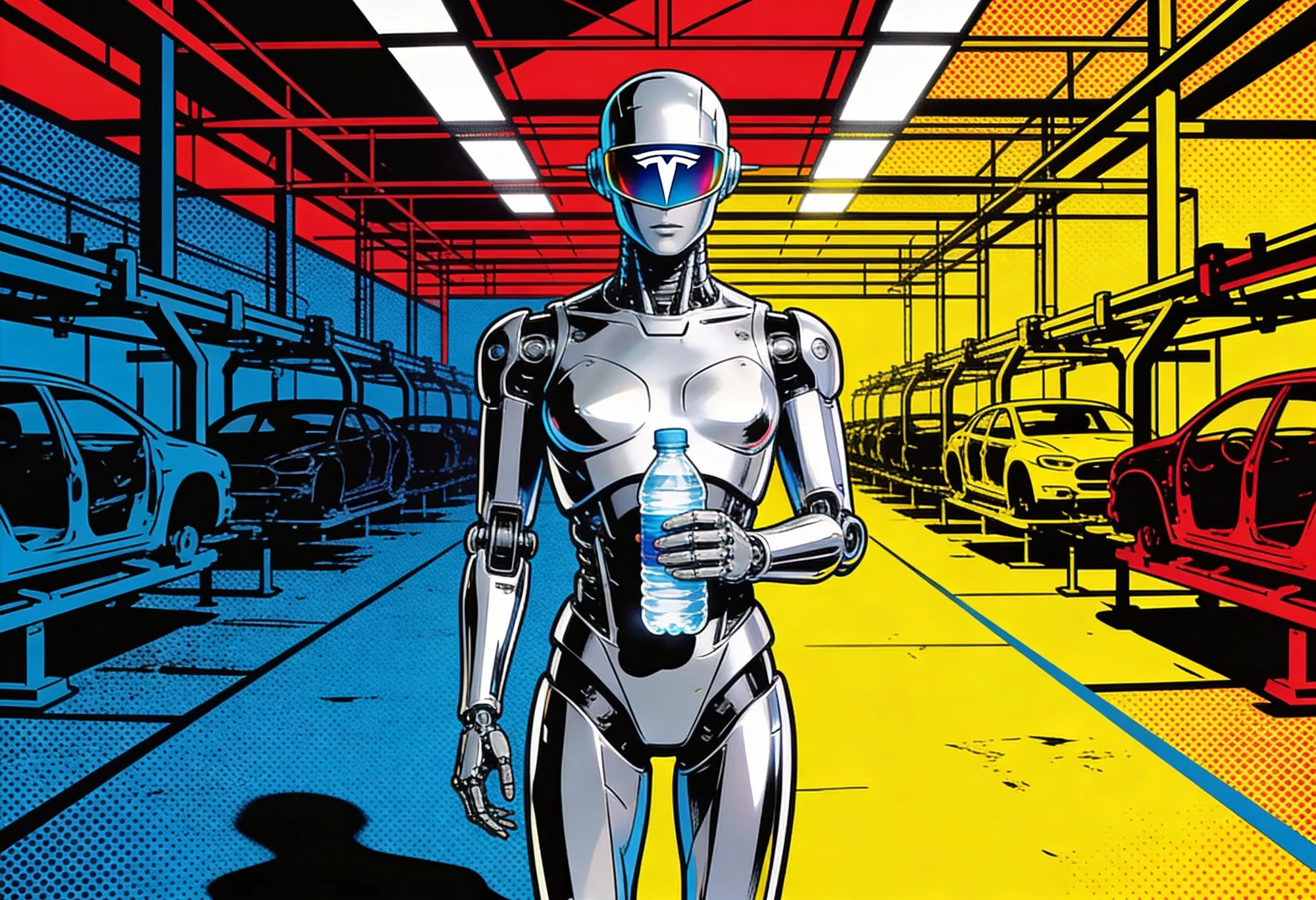
Elon Musk stood before investors on Wednesday and delivered a eulogy for two vehicles that built his company. The Model S and Model X, Tesla's original premium vehicles, are done. Production ends this quarter. What replaces them on the Fremont factory floor? A humanoid robot that, by Musk's own admission, isn't doing useful work anywhere.
The announcement arrived on an earnings call where Tesla reported its first annual revenue decline ever. Profits dropped 46% for the year. BYD outsold them globally, a first. Musk's response? Double down on robots. The same robot program that has missed every deadline he's announced for it.
This playbook isn't new. Tesla sits cornered, cars moving slower, and Musk responds by pointing at something shiny on the horizon. The horizon keeps moving. Musk called it an "honorable discharge" for the S and X. He added, almost as an afterthought, that anyone wanting one should order now.
The factory math doesn't add up
Fremont sits in the East Bay flats, a 5.3-million-square-foot sprawl of white buildings and parking lots that GM and Toyota abandoned. Tesla picked it up for forty-two million dollars back in 2010, when the factory sat empty and nobody else was bidding. First Model S came off that line two years later. Then the Model X, those gull-wing doors catching sunlight in the parking lot, looking like a promise of what electric vehicles could become.
The Breakdown
• Tesla discontinuing Model S and X production this quarter, converting Fremont to build Optimus robots
• Musk admitted zero Optimus robots are doing useful work in factories, despite promising thousands
• Company plans $20+ billion capex including proposed 'TeraFab' chip factory with no location or timeline
• Tesla invested $2 billion in Musk's xAI, raising conflict-of-interest questions
Together, the S and X accounted for just three percent of 1.59 million deliveries last year. When your entry-level Model 3 costs thirty-seven thousand dollars and your premium SUV runs nearly triple that, a price-sensitive market tells you what it wants. Tesla moved about fifty thousand units across the S, X, and Cybertruck combined last year. Down forty percent from the year before, if you're keeping score.
So shuttering these lines makes business sense. What doesn't track is the replacement plan.
Musk wants Fremont to become a robot factory. One million Optimus units per year, he says. Let that number sit for a moment. One million. For a robot that, as of Wednesday, exists primarily as a demonstration piece that hands out water bottles at corporate events. Building the stadium before the team shows up. Clearing the field before anyone writes the rules.
The credibility problem walks on two legs
The promises are public, sitting right there on Tesla's Twitter feed. Two Optimus bots were supposedly performing factory tasks autonomously, the company said in mid-2024. Musk went further at the shareholder meeting, floating numbers like a thousand or two thousand robots working in his factories within a year. Then came January 2025 and he raised the stakes. Ten thousand units built during the year, he said. "Several thousand" doing useful work by December.
What actually happened? Zero. On Wednesday's call, Musk sounded defensive. "It's not in usage in our factories in a material way," he admitted. "We are still very much at the early stages of Optimus. It's still in the R&D phase."
The robots exist. Videos show them walking, bending, picking up objects. YouTube demos look impressive until you learn the robots rely heavily on human teleoperation. Useful work at scale sits somewhere between two and three years away, maybe longer. A third-generation Optimus is supposed to debut this quarter, Tesla's first version designed for mass production. Actual production? Late 2026, according to the company.
This script has run before, same lines, same delays. Musk told investors European regulators would approve Tesla's self-driving software early last year. Still waiting on that one. He promised a strong sales revival by mid-2025. Never showed up. The robotaxi program crept forward slowly, with safety drivers sitting in the vehicles until just recently in Austin.
Twenty billion dollars and a chip factory
Join 10,000+ AI professionals
Strategic AI news from San Francisco. No hype, no "AI will change everything" throat clearing. Just what moved, who won, and why it matters. Daily at 6am PST.
No spam. Unsubscribe anytime.
Tesla's capital expenditure plans for 2026 exceed $20 billion. More than double what the company spent in prior years. Some of that funds the Optimus program. Some goes toward the Cybercab, the steering-wheel-free robotaxi Musk has been promising since 2016. And some, apparently, will build what Musk calls a "TeraFab."
A chip factory. According to Musk, Samsung and TSMC and Micron can't supply semiconductors at the volume Tesla needs. "We're going to hit a chip wall if we don't do the fab," he told a podcast recently. So Tesla will apparently build its own fabrication plant.
Cutting-edge chip fabrication costs tens of billions. You need complex machines from ASML, the Dutch company that dominates lithography. You need years to bring facilities online. Intel has thrown money at this problem for the better part of a decade, trying to catch TSMC. Still trails.
Nobody has said where Tesla would build such a factory. How will it fund construction? Chief Financial Officer Vaibhav Taneja mentioned $44 billion in cash and investments, conversations with banks, possibly more debt. "We will have to look at a little bit more in terms of how we fund it," he said. Not exactly a detailed blueprint.
The pattern that investors keep ignoring
Tesla shares rose slightly after earnings. They're up 9% over the past year. Wall Street analyst Dan Ives predicts robotaxis in 30 cities by year's end and Tesla capturing 70% of the global self-driving market within a decade.
Believe those timelines and you're betting against the company's own history. Tesla demoed autonomous driving eight years ago. Full self-driving? Still not shipping. Roadster deposits went in five years ago. Those customers are still waiting. The million robotaxis he promised for 2020? Nobody brings that one up anymore, for good reason. That prediction aged about as well as you'd expect. Given what Tesla has actually shipped versus what Musk has announced, the Optimus timelines look shaky at best. Musk has never shipped a major product on the schedule he announced.
"They've got aging product that is less and less competitive as other manufacturers come out with new models," said Telemetry analyst Sam Abuelsamid. "Then there is the general brand destruction. Musk's involvement in politics has turned off customers."
Gross margins did jump, twenty percent last quarter versus sixteen percent a year ago. The energy storage business pulled in $3.8 billion, up a quarter from last year, as data centers hungry for power placed orders. Those are real bright spots, and investors noticed.
But the core business is shrinking. Vehicle deliveries last quarter fell below investor forecasts. Revenue dropped year over year in three of the past four quarters. And the response from leadership is to abandon two vehicle lines for a robot program that, by admission, remains in R&D.
The two-billion-dollar side deal
Buried under the robot news: Tesla put $2 billion into xAI, Musk's AI company. You might know xAI from Grok, the chatbot that has a habit of echoing Musk's political views. Grok recently landed in hot water for churning out deepfake images, which tells you something about the guardrails.
Musk holds big stakes in both Tesla and xAI. So this investment looks a lot like cash moving from one pocket to another. Tesla's shareholders are now bankrolling a separate Musk project, and nobody asked their permission. Nobody asked them. The stated reason? Integration between Tesla's AI and its physical products, whatever that means in practice.
Daily at 6am PST
Don't miss tomorrow's analysis
No breathless headlines. No "everything is changing" filler. Just who moved, what broke, and why it matters.
Free. No spam. Unsubscribe anytime.
What that integration looks like in practice, nobody specified.
A factory floor cleared for something that doesn't exist
By summer, the Fremont production lines that once built the Model S and Model X will go dark. The robotic arms that welded body panels will stop moving. Optimus robots are supposed to fill that space. A million per year, eventually.
Musk has shifted Tesla's identity from automaker to what executives now call a "physical AI company." Robotaxis. Humanoid robots. A chip factory to feed the machine-learning models that power both. The vision hangs together, even sounds audacious. But it also sounds like a company trying to change the subject. Tesla sits exposed here, its core business contracting while Musk points toward products that won't generate revenue for years.
Look at what Tesla has actually delivered. Hardware arrives before the software works. Deadlines get announced before capacity exists. Press releases before products.
Tesla's annual profit sits at its lowest point since the pandemic. The company no longer leads global EV sales. Its founder splits attention between car manufacturing, rocket launches, a government cost-cutting role in Washington, and a potential SpaceX IPO that could make him a trillionaire.
Investors buying the stock today are betting that this time, the timelines hold. That the Optimus robot goes from R&D curiosity to million-unit production. That the chip factory gets built. That the robotaxis spread from Austin to 30 cities.
They're betting on the promise, not the product. That's worked before. Whether it works again depends on a factory in Fremont and a robot that, for now, mostly hands out water bottles.
Frequently Asked Questions
Q: Why is Tesla discontinuing the Model S and Model X?
A: The two models accounted for just 3% of Tesla's 1.59 million deliveries last year. Sales dropped 40% year-over-year. Musk says he's clearing factory space for Optimus robot production, targeting one million units annually. The premium vehicles couldn't compete in a price-sensitive market where Model 3 costs $37,000 versus Model X at nearly $100,000.
Q: How many Optimus robots are currently working in Tesla factories?
A: Zero, by Musk's own admission. On the earnings call, he said the program is 'still in the R&D phase' and robots are 'not in usage in our factories in a material way.' This contradicts earlier claims of thousands of robots doing useful work by end of 2025.
Q: What is Tesla's TeraFab?
A: Musk's proposed semiconductor fabrication plant to manufacture chips domestically. He says Samsung, TSMC, and Micron can't supply Tesla's needs. Building cutting-edge chip fabs typically costs tens of billions and takes years. Tesla hasn't specified location, timeline, or detailed funding beyond mentioning $44 billion in cash and possible bank financing.
Q: Why did Tesla invest $2 billion in xAI?
A: Tesla claims it's for 'integration between Tesla's AI and its physical products,' though specifics weren't provided. Musk owns large stakes in both companies, raising conflict-of-interest concerns since Tesla shareholders are effectively funding a separate Musk venture without direct approval.
Q: When will Tesla's robotaxi service expand beyond Austin?
A: Tesla says first half of 2026 for Houston, Miami, and five other cities. The Cybercab production is also planned for first half of 2026. However, Tesla's track record on autonomous driving timelines is poor. Full self-driving was demoed in 2016 and still isn't shipping. Musk promised a million robotaxis by 2020.