OpenAI, Anthropic, and Block just handed their competing agent protocols to a new Linux Foundation project. This isn't about technical maturity. It's about building walls before Chinese alternatives arrive.
The Breakdown
• Anthropic, OpenAI, and Block donated MCP, AGENTS.md, and Goose to a new Linux Foundation project backed by AWS, Google, Microsoft, and 40+ companies.
• MCP is 12 months old with unresolved OAuth issues. Kubernetes and PyTorch spent years in production before foundation governance—MCP skipped that phase.
• Chinese open-weight models trail US frontier labs by 3-6 months. The foundation locks in American-controlled standards before alternatives emerge.
• 65% of organizations pilot agentic AI but only 5% report meaningful returns. Infrastructure is being standardized before the value case materializes.
The Game Zemlin Gave Away
Jim Zemlin stood on a stage in Tokyo one day before the announcement and told the real story. The Linux Foundation's executive director didn't talk about code quality or developer ergonomics. He talked about money bleeding out of American companies.
Open-weight models from China, DeepSeek chief among them, have closed the performance gap with proprietary American systems. Zemlin cited analysis showing these models run three to six months behind frontier labs. For most commercial applications, that gap is meaningless. His economist calculated the damage: $24.8 billion in annual overspending on proprietary systems while cheaper alternatives eat market share.
Then, the next morning, December 9th, Anthropic announced it would donate Model Context Protocol to the newly formed Agentic AI Foundation. Block contributed Goose. OpenAI added AGENTS.md. The platinum membership list read like a defensive treaty: AWS, Google, Microsoft, Bloomberg, Cloudflare. Forty-plus companies signed before the press release went out.
The formation of AAIF isn't about open governance. It's a perimeter. If American labs wait for agentic protocols to mature organically, a standard from Shenzhen might beat them to the commit.
Viral Load Is Not Maturity
Model Context Protocol is one year old. In that time, it secured 10,000 servers and adoption from ChatGPT, Cursor, Gemini, and Microsoft Copilot. Ninety-seven million monthly SDK downloads.
That isn't maturity. That's viral load.
Mature standards spent years in the trenches before anyone thought to laminate them with governance charters. Kubernetes ran as Borg inside Google for over a decade. PyTorch accumulated six years of production failures at Facebook before the Linux Foundation touched it. These technologies graduated to neutral stewardship because their architectural decisions had proven themselves under diverse conditions.
MCP is being rushed to the altar while engineers are still arguing over how OAuth should work. The November 25th specification release introduced asynchronous operations, statelessness, and server identity. These are not refinements. They are foundational features that suggest the core architecture is still being discovered.
One Hacker News commenter captured it: "I'd put it into the 'sandbox' category... I would have much preferred for Anthropic and a small strike team of engaged developers to move fast and fix a lot of the issues... vs. it getting donated and slowing to a crawl."
Foundation governance trades velocity for consensus. Technical steering committees, election cycles, domain ownership transfers. These mechanisms prevent hijacking of mature ecosystems. Applied to an immature protocol, they calcify decisions that should remain fluid.
Anthropic knows this. They donated anyway.
The Platinum Roster Is a Cartel Meeting
AWS, Google, and Microsoft didn't sign up to play nice. They signed up because standards bodies have steering committees, and steering committees decide which pull requests get merged and which die in purgatory.
Controlling the commit access to a standard is cheaper than fighting a format war against a rival who moves faster.
The membership fees fund Linux Foundation operations, events, and staff. Platinum members receive governance privileges that general contributors lack. The MCP Dev Summit, previously run by Obot.ai, has already been absorbed into AAIF. The next summit happens in New York in April 2026. Speaking slots, sponsorships, and registration opened immediately.
Events create recruitment pipelines. Certification programs create credential markets. Technical steering committees create decision hierarchies. None of these existed when MCP was simply Anthropic's open-source project. All of them materialize under foundation governance.
The founding members are uniformly American. Anthropic, OpenAI, and Block in San Francisco. AWS and Microsoft in Seattle. Google in Mountain View. Bloomberg in New York. The "neutral governance" consolidates agent protocol development among competitors who share nationality, regulatory environment, and one common threat.
The Window That's Closing
Chinese companies have not established competing agent infrastructure standards. MCP has no Beijing equivalent. AGENTS.md emerged from OpenAI without a Shenzhen counterpart. Goose originated at Block, not ByteDance.
This absence won't last.
DeepSeek, Alibaba's Qwen, Moonshot AI, and Z.ai released strong open-weight models that gained global traction. The capability gap narrowed faster than American labs expected. The pricing gap never existed. Chinese models compete on performance while demolishing the unit economics of frontier labs.
But capability alone doesn't determine infrastructure dominance. Protocols accumulate switching costs and network effects that make displacement exponentially harder as adoption grows. Ten thousand MCP servers create integration dependencies. Sixty thousand AGENTS.md repositories create toolchain expectations. Foundation governance creates institutional legitimacy.
First-mover advantage in protocol design differs from first-mover advantage in products. Products can be displaced by better products. Protocols entrench.
The AAIF formation makes strategic sense only if you believe Chinese alternatives will emerge during any organic maturation period. Formalizing now, even with an immature protocol, establishes the governance structures that determine whose voices matter when standards evolve.
Mike Krieger, Anthropic's chief product officer, described MCP's origin: "MCP started as an internal project to solve a problem our own teams were facing."
Thirteen months from internal tool to foundation governance. The compression tells you everything about what Anthropic fears.
The Value Gap No One Mentions
A UiPath report found 65% of organizations piloting or deploying agentic systems by mid-2025. Nine out of ten executives plan increased investment through 2026. The enthusiasm is real.
A recent MIT study found only 5% of companies have realized meaningful financial returns from AI efforts. The profits are imaginary.
Into this gap between experimentation and value, the Agentic AI Foundation proposes to standardize connective tissue. The embedded assumption: bad plumbing, not bad logic, is what limits agentic AI adoption.
The evidence for that assumption remains thin. But the assumption serves the founders' interests regardless of its validity. If agents eventually deliver value, the founding members control the protocols they run on. If agents remain expensive experiments, the foundation still exists as a defensive structure against alternative standards.
Heads they win. Tails they don't lose.
The Roads Get Poured Now
WIRED's coverage noted the geopolitical stakes explicitly: "Open standards may be technologically neutral, but if these agentic tools become globally dominant they could confer the US companies behind them considerable influence."
The comparison to ICANN and W3C is apt. The organizations that defined HTTP, DNS, and HTML shaped how billions of people interact with information. Technical neutrality coexisted with American institutional control. The internet's governance structures emerged from American universities, American companies, and American regulatory frameworks.
The AAIF founding members are positioning for the same outcome in agentic AI. The protocols that connect agents to tools, data, and each other will determine whose infrastructure agents depend on. AWS, Google Cloud, and Azure already dominate cloud computing. MCP's remote server architecture fits neatly into that dominance.
Foundation membership doesn't buy influence. It buys insurance. For the platinum members paying the fees, AAIF ensures that when the agentic standard solidifies, it solidifies around their APIs, their cloud structures, and their regulatory frameworks.
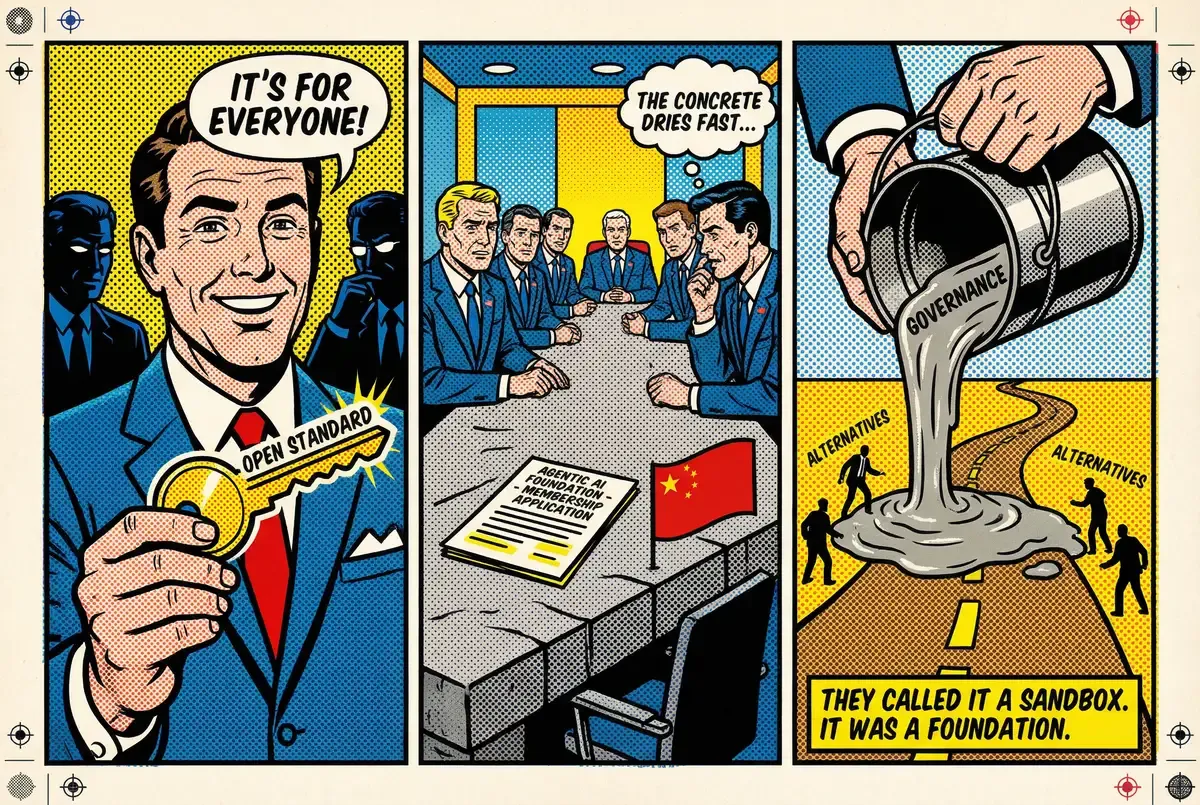
They aren't building a sandbox for innovation. They are pouring concrete to ensure that whatever comes next has to drive on their roads.
Why This Matters
- For developers building on MCP: The protocol will evolve more slowly under foundation governance. Current capabilities are what you're buying. Evaluate whether OAuth ambiguity and authentication gaps block your production timeline before committing infrastructure.
- For Chinese AI companies: Eighteen months, maybe less, before MCP becomes the default that alternatives must justify displacing. The window for establishing competing agent protocols closes with every new platinum member.
- For enterprise buyers: The 5% financial return figure from MIT matters more than any interoperability standard. Don't let infrastructure decisions outpace the value case. The switching costs you create today will outlast the hype cycle.
❓ Frequently Asked Questions
Q: What does Model Context Protocol actually do?
A: MCP connects AI models to external tools and data sources. Think of it as a universal adapter. An AI agent using MCP can access your calendar, query a database, or trigger actions in other applications through a standardized interface. Before MCP, developers built custom integrations for each tool. MCP provides one protocol that works across platforms.
Q: Why does foundation governance slow down protocol development?
A: Foundations require consensus. Changes need approval from technical steering committees representing multiple companies with competing interests. A small team at Anthropic could ship a fix in days. Under AAIF governance, that same fix requires proposals, reviews, voting cycles, and documentation. The process prevents any single company from hijacking the standard, but it adds months to decisions.
Q: What's the unresolved OAuth problem with MCP?
A: MCP servers need to authenticate users and authorize access to sensitive data. OAuth is the standard way to do this on the web. But MCP's specification doesn't define how OAuth should work across different server implementations. Each MCP server handles authentication differently, creating security inconsistencies and integration headaches for developers building production systems.
Q: What do platinum members get that regular contributors don't?
A: Platinum members pay the highest fees and receive seats on governing boards and technical steering committees. These bodies control which proposals advance, which pull requests merge, and which features become part of the official specification. General contributors can submit code and participate in discussions, but platinum members vote on what ships.
Q: How long did Kubernetes wait before joining a foundation?
A: Google ran Kubernetes' predecessor, Borg, internally for over a decade. Kubernetes itself launched as open source in 2014 and joined CNCF in 2016, after two years of external community development. PyTorch followed a similar path: six years from Facebook's 2016 release to Linux Foundation governance in 2022. MCP made the jump in 13 months.
 Marcus Schuler
 Robert Brown
 Marcus Schuler