IMPLICATOR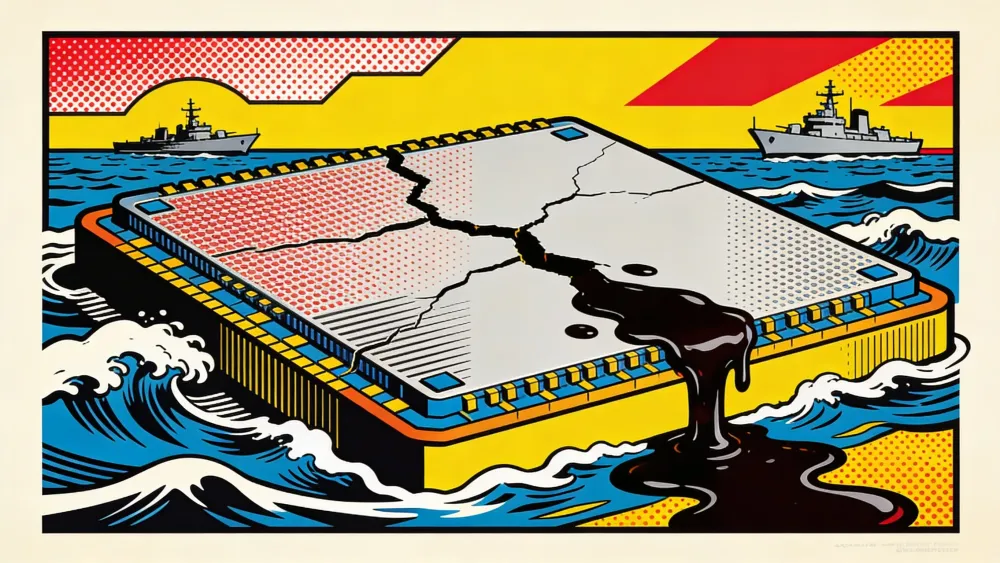
It took eighty-seven days. Washington grabbed a sitting head of state, then launched a full-scale air war against a nuclear-threshold power. The strait through which a fifth of the world's oil moves is now effectively closed.
The Pentagon treats them as separate operations. Operation Absolute Resolve seized Nicolás Maduro from his compound in Caracas on January 3 and deposited him in a Brooklyn detention center to face narcoterrorism charges. Operation Epic Fury hit Tehran, Isfahan, and Bushehr with coordinated U.S.-Israeli strikes on February 28. Khamenei was killed in the opening hours. The IRGC declared Hormuz closed by March 2, and tanker traffic vanished. Major insurers pulled coverage.
Two campaigns separated by 8,000 miles of ocean and two months of calendar. But they share one consequence. Both terminated China's largest sources of discounted crude oil in the same quarter. Venezuelan exports to Asia collapsed 67% in February. Iranian supply now faces physical interdiction in an active war zone. And the real fallout is building not in the Persian Gulf or Caracas but in the boardrooms of Santa Clara County, where companies have collectively committed $690 billion to an AI infrastructure buildout that depends on chips manufactured 100 miles off the Chinese coast.
Oil and military posture pressing on semiconductor supply. Each vector has been covered as its own story. They are not separate stories. They are one geological system, and the fault line runs through TSMC's fabs in Hsinchu.
The Breakdown
- U.S. operations in Iran and Venezuela cut off 22% of China's crude imports from sanctioned sources in 87 days
- China holds roughly four months of oil reserves, but bypass pipeline capacity caps at 2.6 million bpd
- Hyperscalers committed $635-690 billion in 2026 capex, all dependent on TSMC chips from Taiwan
- China controls 90%+ of rare earth refining; suspended export controls can be revoked at any time
The oil arithmetic doesn't lie
China imported a record 11.6 million barrels per day in 2025. More than a fifth of it was fiction.
Of that total, at least 2.6 million bpd came from sanctioned sources, something like a fifth of China's entire import bill. Iran made up the largest piece at about 1.38 million barrels a day. The rest split between Venezuelan heavy crude and Russian tankers under sanction, another 1.2 million bpd combined, all of it tracked by satellite and left alone. Official Chinese customs data recorded none of it. The Iranian barrels showed up labeled "Malaysian" or "Indonesian" after changing hands off the coast of Southeast Asia. The accounting was absurd on its face. Erica Downs at Columbia CGEP found that China was importing 1.3 million barrels per day of so-called Malaysian crude in 2025, roughly two and a half times what Malaysia actually produces. Everyone knew. The buyers were teapot refineries clustered in Shandong province, grabbing Iranian crude at $8 to $10 below ICE Brent.
Both supply lines broke within weeks of each other. Venezuelan exports to Asia cratered to 48,000 bpd in February, down from over 600,000 bpd. That collapse started the moment Trafigura and Vitol took marketing control under OFAC supervision. Oil still moves out of Venezuela. February hit 788,000 bpd. But it moves west now. Not to Shandong.
The Strait of Hormuz made it worse. It carries roughly 20% of global oil supply and 20% of global LNG. Beyond Iranian crude, Iraq is shutting in an estimated 1.5 million bpd because its southern Basra terminals face the same waterway. Columbia CGEP estimates that 45 to 50% of China's total crude imports transit Hormuz. Brent crude surged past $80 within days of the strikes. Helima Croft of RBC Capital Markets called it "what looks like the biggest energy crisis since the oil embargo in the 1970s."
Beijing saw this coming. Beijing spent twelve straight months packing crude into storage at five times the 2024 rate, filling strategic reserves with roughly 430,000 barrels every day. Kpler counted about 1.2 billion barrels sitting in onshore tanks by early January. That's about 104 days of net imports, or four months in Wood Mackenzie's assessment.
But four months assumes total cessation. Nobody expects that. The real question is whether a prolonged partial disruption erodes reserves faster than alternatives can fill the gap. OPEC's spare capacity of 3.5 million bpd sounds reassuring until you realize most of it must exit through the same strait that is now a war zone, or rely on bypass pipelines capped at roughly 2.6 million bpd of realistic throughput. Russia cannot fill the hole either. Russia's ESPO pipeline caps out around 600,000 to 700,000 bpd, and total Russian deliveries to China actually dropped 150,000 bpd last year. Going backward, not forward.
The squeeze isn't existential. It's economic. China's marginal barrel just became more expensive and less predictable. It also became politically conditioned. Exactly when Beijing might want maximum flexibility for other purposes.
The carrier problem nobody wants to name
Washington was busy on two continents. Beijing noticed. What the PLA ran around Taiwan hadn't been seen since the mid-1990s.
2025 brought three operations. Each one bigger than the one before. An unannounced February drill with 32 aircraft and live fire off Kaohsiung. Strait Thunder-2025A in April, deploying 135 aircraft, 38 naval vessels, and the Shandong carrier strike group. And the capstone, Justice Mission-2025, which the Global Taiwan Institute assessed as the largest exercise since the Pelosi-visit drills of August 2022.
December deserves close attention. Over two days, the PLA flew 130 aircraft sorties, 90 crossing the median line. Fourteen warships. Fourteen coast guard vessels. Twenty-seven rockets from PHL-16 launchers in Fujian Province, ten of which landed within Taiwan's 24-nautical-mile contiguous zone. The closest PLA projectiles have ever struck to Taiwan's coast. Four amphibious assault ships sat 85 kilometers off Taiwan's east coast. The newest, the Type 075 LHA Hubei, had never deployed in an exercise this large.
Taiwan's digital infrastructure took hits too. The island reported a 1,000% spike in cyber attacks against energy systems. Hospitals saw a 54% jump. Cognitive warfare, designed to erode public confidence before a single shot lands.
Here is the connection Washington doesn't want to discuss. The USS Abraham Lincoln had been patrolling the Philippine Sea during Justice Mission-2025. It got pulled to the Middle East. Fourth carrier to make that trip in under a year. "The U.S. Navy is stretched thin," Bryan Clark at the Hudson Institute said. "The fleet is not sufficient to keep a steady presence in every theater." The anxiety was already spreading across the region. Yun Sun of the Stimson Center argued in Foreign Affairs that Trump's transactional posture, Taiwan's omission from the January 2026 National Defense Strategy, and the operational demands of two active campaigns have created a perception in Beijing that a "window of opportunity" may be opening. The 2026 NDS does not mention Taiwan by name.
Deterrence advocates push back hard. CSIS concluded the Venezuela operation doesn't translate to Taiwan. Different target, different terrain, professional military of 170,000. Nicholas Burns put it differently. The former U.S. ambassador said Chinese-supplied defense systems in Iran had failed badly, "proving [China] to be a feckless friend for its authoritarian allies."
Japan changes the equation considerably. Prime Minister Sanae Takaichi declared that a PRC invasion could constitute "a survival-threatening situation for Japan" potentially justifying force. The most explicit statement of its kind from a sitting Japanese leader. Nearly 49% of the Japanese public now supports collective self-defense in a Taiwan contingency.
Most analysts agree invasion is not the likely near-term outcome. But miscalculation risk has risen materially. China approaches its 2027 military readiness deadline, the date Xi Jinping set for PLA capability to take Taiwan, with a more anxious leadership, depleted oil buffers, and an adversary whose attention is visibly divided.
Join 10,000+ AI professionals
Strategic AI news from San Francisco. No hype, no "AI will change everything" throat clearing. Just what moved, who won, and why it matters. Daily at 6am PST.
No spam. Unsubscribe anytime.
$690 billion chasing chips from a single island
Every one of those geopolitical threads terminates at a single point. TSMC's foundry market share reached 70.2% in Q2 2025, with approximately 90% share in the most advanced nodes. Nvidia, now TSMC's largest customer at 19% of revenue, depends on TSMC for every H100, H200, and B200 GPU it ships. So do AMD, Qualcomm, Apple, Google, and Amazon. There is no second source for the world's most advanced AI chips.
The dollar figure is jarring. A U.S.-Taiwan Business Council study pegged the exposure at $1.6 trillion in annual GDP, about 8% of the American economy. That exceeds the 2008 financial crisis and COVID lockdowns. Bloomberg Economics modeled full-scale conflict at roughly $10 trillion in global damage. A blockade alone would hit $2.7 trillion.
The hyperscalers responded the only way they know how. They threw money at it. Add up Amazon, Alphabet, Microsoft, and Meta and their 2026 capex runs between $635 and $690 billion, some 60 to 74% above 2025's already-record $381 billion. Amazon alone plans $200 billion. Alphabet quadrupled its long-term debt to $46.5 billion. Microsoft sits on $80 billion in Azure orders it can't fill. Not enough power.
Nvidia's fiscal 2026 revenue hit $215.9 billion, sixty-five percent higher than the year before and still climbing. CFO Colette Kress told analysts the company has visibility to $500 billion in revenue from Blackwell and Rubin platforms through end of calendar 2026. But those numbers depend on an uninterrupted supply chain from Hsinchu, through TSMC's advanced packaging lines, through shipping lanes that pass within range of PLA missile batteries.
The cash burn tells you how stretched the system already is. Alphabet's free cash flow is projected to drop roughly 90% in 2026, to $8.2 billion from $73.3 billion. Amazon expects negative free cash flow of $17 to $28 billion. These companies are collectively destroying cash on the bet that AI infrastructure justifies it, and that the chips will keep coming.
Beijing's counterpunch sits right behind this bet. China produces 94 to 99% of global refined gallium, 60 to 83% of germanium, roughly 55% of antimony, and 90% of all rare earth refining. October 2025 export controls introduced China's first extraterritorial Foreign Direct Product Rule with a 0.1% de minimis threshold. Foreign companies must now obtain Chinese licenses to export products containing Chinese-origin rare earths, even between third countries. Those controls were suspended until November 2026 following a Xi-Trump agreement.
That suspension can be revoked any morning Beijing decides to pick up the phone. The weapon hasn't disappeared. It has been holstered.
TSMC's geographic diversification is real but insufficient. Arizona Fab 1 started making 4nm chips and turned profitable last year with $6.6 billion in CHIPS Act funding behind it. Phase 2 is aiming for volume 3nm production by late 2027. C.C. Wei told investors the full six-fab Arizona cluster will eventually handle roughly 30% of TSMC's 2nm-and-below production. Full completion is still four years away, at best. And Arizona chips still cost at least half again as much as Taiwan production. And TrendForce projects Taiwan will still hold 54% of global advanced IC capacity in 2027, barely a year from now.
And the gap nobody talks about is packaging. Nvidia grabbed more than half of TSMC's CoWoS packaging capacity through 2027. Google had to cut its 2026 TPU target from four million to three million units because of it. The United States can fabricate advanced wafers at home now. It still cannot package them into the multi-die modules that power AI systems.
You can build the fab. You can secure the funding. Without packaging, the chip doesn't ship.
The coupling is the story
Oil, Taiwan, chips. Stop treating them as three crises. That framing misses the mechanism.
Oil pressure changes Beijing's tolerance for risk. A China paying full price for every barrel, burning through strategic reserves, watching teapot refiners face margin collapse, is a China with diminished cushion for military confrontation. It is also a China that feels cornered, emboldened to reach for the instruments it still controls.
Now add Taiwan. Even a gray-zone escalation, extended blockade drills, quarantine lines, selective port closures, would spike maritime insurance premiums for vessels calling at Taiwanese ports. No shots need to be fired. Insurance markets do the damage. And the damage lands directly on semiconductor supply.
When GPUs get scarcer and more expensive, the pain moves downstream fast. Hyperscaler margins take the first hit. Then it reaches everyone who rents compute: model startups, enterprise AI vendors, the entire tail of venture-backed companies betting that GPU time will get cheaper. Scarcity flips that assumption overnight.
And rare earth controls sit at the intersection. Beijing can tighten licensing on permanent magnets, sputtering targets, and gallium compounds without firing a missile or closing a port. The processing monopoly, not the mining, is what gives Beijing the choke point. Beijing has summoned its top state-backed producers to a March 25 policy briefing at the Commerce Ministry. The agenda points toward something more permanent than episodic controls. The Pentagon's emergency RFP for 13 critical minerals is due March 20. Five days before Beijing's meeting. That timing tells you the defense establishment reads the same signals.
Step back and look at what's on the table. The $690 billion annual capex cycle assumes uninterrupted chip supply. That supply depends on a single island 100 miles off the Chinese coast. China just lost its two cheapest oil suppliers. American carriers rotate between the Gulf and the Philippine Sea, never quite enough in either place. And the rare earth suspension exists only at Beijing's discretion.
Defense-tech money confirms the market sees the coupling. Defense technology venture capital reached $49.1 billion in 2025, nearly doubling from the prior year. Ten new unicorns in a single year. Anduril raised at $30.5 billion, then began seeking $60 billion nine months later. The FY2026 defense budget crossed $1.01 trillion. For the first time, it breaks out AI and autonomy as their own line worth $13.4 billion. The money isn't spreading out. It's stacking up around the fault line.
What four months of runway really buys
What's unfolding as of March 7, 2026, has the shape of a reconfiguration, not a crisis. The ground is shifting under the entire system.
Washington demonstrated in a single quarter the willingness to remove a head of state and wage a major air campaign against a nuclear-threshold power. In the process, it reshaped global energy flows through kinetic action. Beijing responded with the largest Taiwan exercises in a generation, extraterritorial rare earth controls, and strategic stockpiling that suggests it has been gaming these scenarios for years.
Whether the threads are connected is no longer a question worth debating. They are connected. What matters now is whether this trajectory represents a managed transition toward a new equilibrium, backed by $640 billion in CHIPS Act-catalyzed private investment, growing allied defense commitments, and Chinese strategic patience. Or the opening chapter of a repricing the global economy has not modeled.
Four months of oil reserves. Fifty-four percent of advanced chip capacity still concentrated in Taiwan through 2027. A PLA readiness deadline eighteen months away.
Not much margin on any side.
Don't watch the speeches. Watch the shipping lanes. Watch the MOFCOM licensing notices. Watch whether hyperscalers start talking about allocation instead of expansion. That's the tell.
Along a fault line, timelines mean nothing. Pressure is the only variable that matters.
Frequently Asked Questions
How much of China's oil came from sanctioned sources?
About 2.6 million barrels per day, roughly 22% of China's total imports. Iran supplied 1.38 million bpd, with Venezuela and sanctioned Russian tankers making up the rest. Most Iranian crude entered China relabeled as Malaysian or Indonesian origin.
Can China survive without Iranian and Venezuelan oil?
Short-term, yes. Beijing stockpiled roughly 1.2 billion barrels in strategic reserves, about four months of net imports. But OPEC spare capacity mostly exits through the now-contested Strait of Hormuz, and Russia's ESPO pipeline caps at 700,000 bpd. The cushion shrinks fast under sustained disruption.
Why does the Taiwan Strait matter for AI chips?
TSMC manufactures over 90% of the world's most advanced semiconductors on the island of Taiwan. Every major AI chip from Nvidia, AMD, Google, and Amazon depends on TSMC fabs in Hsinchu. Taiwan sits 100 miles off China's coast, within range of PLA missile systems tested in recent exercises.
What are China's rare earth export controls?
China produces 90-99% of refined gallium and controls 90% of rare earth processing. In October 2025, Beijing introduced extraterritorial controls requiring Chinese licenses for products containing Chinese-origin rare earths, even between third countries. Those controls were suspended until November 2026 but can be reinstated at any time.
How much are tech companies spending on AI infrastructure?
Amazon, Alphabet, Microsoft, and Meta collectively plan $635 to $690 billion in capital expenditure for 2026, up 60-74% from the prior year's $381 billion. Amazon alone budgeted $200 billion. Alphabet's free cash flow is projected to drop roughly 90% as a result.
Related stories
Free AI briefing · Weekdays
The AI stories that matter, sourced and explained.
Join the Morning Briefing. It goes out every weekday at 4:45 a.m. Pacific, with later sends for the East Coast, Berlin and Tokyo.
Free when you sign up: The Paperclip Compendium, our tested guide to running AI agents.
Free. Unsubscribe in one click.

Marcus Schuler
Editor-in-Chief and founder of Implicator.ai. Former ARD correspondent and senior broadcast journalist with 10+ years covering tech. Writes daily briefings on policy and market developments. Based in San Francisco. E-mail: editor@implicator.ai