IMPLICATOR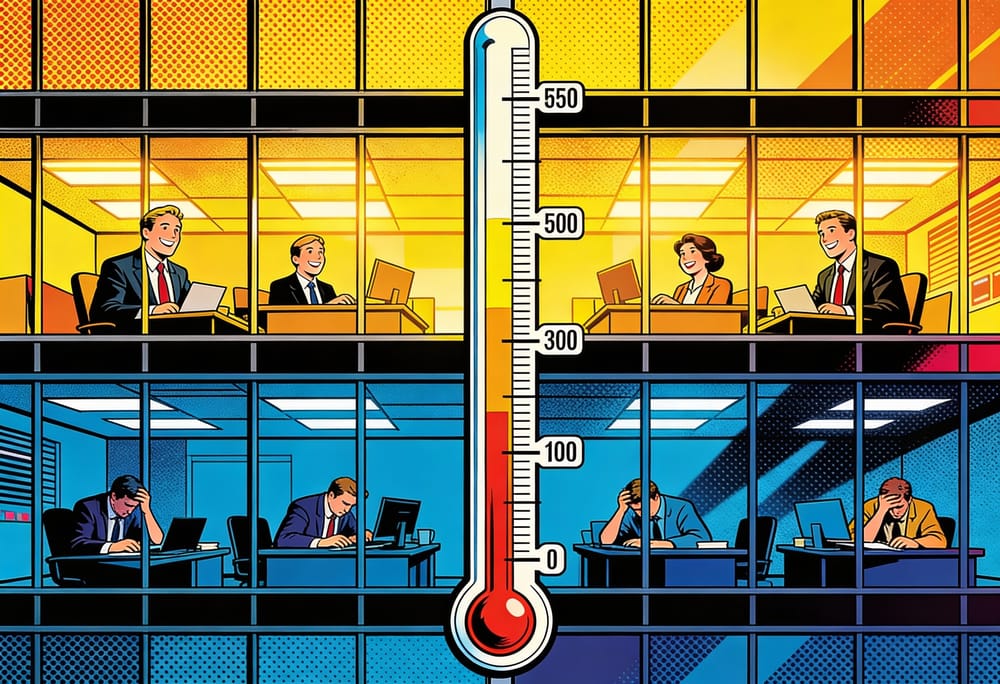
Ask C-suite executives how they feel about AI and nearly three-quarters say excited. The people doing the actual work? Different answer entirely. Anxious. Overwhelmed. That's what almost 70% of non-management employees told researchers. We know which group is closer to reality.
You sense this if you work in a large company. Same building, different weather depending on the floor. Up in the corner offices, AI saves time. Down where the actual work happens, AI creates more of it. Two new surveys, one from Section covering 5,000 white-collar workers and another from Workday polling 1,600, confirm what cubicle dwellers already suspected: the productivity miracle lives mostly in executive imagination.
Key Takeaways
• Two-thirds of workers save less than 2 hours weekly with AI; 40% of executives claim 8+ hours saved
• Only 12% of 4,500 CEOs at Davos report AI delivering both cost savings and revenue growth
• 53-point perception gap: 81% of executives say they have an AI strategy vs. 28% of workers
• Individual contributors get 32% tool access vs. 80% for C-suite, inverting where resources should flow
The numbers don't lie
Two-thirds of non-management staff say AI saves them less than two hours per week. Some say it saves nothing at all. Executives tell a different story. More than 40% claim eight hours of weekly savings. A full workday that nobody downstairs is experiencing.
The gap goes beyond hours. Section, an AI training vendor and OpenAI services partner, surveyed workers and found that 97% are either using AI badly or avoiding it entirely. Just 15% have found what researchers call "value-driving use cases," applications that might actually affect the bottom line. What's the most common use? Replacing Google searches. Worth noting: Section sells AI training, so they benefit when companies invest more. But Workday and PwC data tells the same story.
Steve McGarvey designs user experiences in Raleigh, North Carolina. He's 53, and part of what he does involves making websites work for visually impaired users. He's tried getting help from large language models.
"I can't count the number of times that I've sought a solution for a problem, asked an LLM, and it gave me a solution to an accessibility problem that was completely wrong," McGarvey said.
So now he spends hours arguing with the AI, walking it through why its suggestions break accessibility standards. The tool meant to speed him up has slowed him down. That's the pattern nobody talks about in the pitch meetings.
The estimation problem
Here's what rarely makes it into the AI pitch decks: unpredictability is its own kind of tax.
Dan Hiester works as a user-experience engineer in Seattle. He's 44. One summer afternoon, he asked an LLM to fix a coding problem. Should have taken thirty minutes. Took his entire afternoon instead. But a different task, something that would have eaten days before AI? Done in twenty minutes.
"It's done a complete reset of my understanding of how to estimate the time it takes to do something," Hiester said. That line deserves a pause. Project management runs on estimation. So do deadlines. So does your credibility with your boss. AI doesn't just change how long things take. It wrecks your ability to guess. Thirty minutes might stay thirty minutes. Might become four hours. You won't know which until you're already committed.
Workday calls the broader problem the "AI tax." Their survey found 85% of employees claiming one to seven hours of weekly time savings. Sounds good until you look closer. Much of that time went straight back into fixing AI mistakes and rewriting AI drafts. Savings on paper. Gone in practice.
The use case desert
Section's research found a problem that more training won't fix. They named it the "Use Case Desert."
You've learned to prompt. You understand the interface. You sat through the training, watched the slides, maybe got a certificate. Then you go back to your desk and realize you have no idea what to actually use AI for. Twenty-six percent of workers in the survey admitted they don't have a single work-related use case. Another 60% said their applications stay at beginner level.
The data shows the consequences. Almost a quarter of workers, 24%, save zero time with AI. Another 21% save less than two hours weekly. Add those up: 45% of the workforce getting nothing or close to it.
Most organizations need ten-plus hours saved per employee per week to justify their AI spending. Almost nobody is getting there.
Stay ahead of the AI curve
Strategic AI news from San Francisco. No hype, no "AI will change everything" throat clearing. Just what moved, who won, and why it matters. Daily at 6am PST.
No spam. Unsubscribe anytime.
The view from the top floor
Walk into an executive AI briefing and you'll see confidence. Charts pointing up. Stories from teams that got it working. Buzzwords about transformation. Easy to feel optimistic when that's the air you breathe.
Section asked C-suite respondents about their AI strategies. Eighty-one percent said their company has a formal one. Eighty percent said tools exist with clear access. Seventy-one percent described widespread adoption and open sharing of what works.
Individual contributors answered differently. Only 28% thought their company has a formal AI strategy. Just 32% said tools exist with clear access. And 8%, not a typo, said they've seen widespread adoption and best-practice sharing.
Fifty-three points of difference. Same company, same AI tools, completely different understanding of what's happening.
The emotional split runs deeper. Ninety-four percent of executives trust what AI produces. They use it daily. Only 2% avoid it for work. From the top floor, AI is an obvious success.
On the lower floors, people are struggling. Forty percent of all respondents said they'd be fine never touching AI again. That's not fear of the new. That's a judgment about whether the thing works. And when these numbers finally reach the boardroom, watch for defensiveness. Watch for doubling down. Organizations that bet this big on transformation don't reverse course easily.
When the pitch meets payroll
Cautionary tales have piled up. Klarna told the world in 2024 that AI would handle customer service. Hundreds of outsourced agents, gone. Press releases celebrated. Then the future got messy. Routine-looking customer questions kept needing human judgment. Klarna brought back about a dozen gig workers, quietly, to handle what the machines couldn't.
Duolingo's CEO Luis von Ahn sent a memo: the company would "gradually stop using contractors to do work that AI can handle." A year later, headcount was up 14%. The automation meant to cut labor ended up working alongside more humans. Von Ahn adjusted his message on LinkedIn, saying AI would "accelerate what we do" instead of replace who does it.
Call these failures if you want. I'd call them corrections. Companies learning that AI handles some things brilliantly and other things terribly, with the line between those categories moving around constantly.
The bottom line stays flat
PwC showed up to Davos this week with sobering numbers. They'd surveyed 4,500 CEOs across the globe and asked about AI results. Twelve percent, that's all, said they'd gotten both cost savings and revenue growth from AI.
More than half? No significant financial benefit at all.
Billions invested. Transformation promised. Still not showing up where it counts: margins, efficiency gains, the numbers accountants actually put in reports. Your company keeps announcing AI initiatives while your workload stays the same? That's why.
The training trap
Companies have a default response to AI disappointment: train more people. Section found that 44% of employees have received company AI training. Trained workers do score higher on proficiency tests. But even after training, average scores sit at 40 out of 100. These employees remain stuck in the "experimenter" category, using AI for basics without moving to anything more substantial.
Organizations react to these numbers with frustration, then more of the same. Another module, another workshop. What they haven't faced: the problem isn't prompting. Training programs focus on safety rules and prompt structure when workers actually need help figuring out which parts of their specific jobs AI can improve.
Fifty-four percent of engineers don't use AI to write or debug code. Eighty-seven percent of product managers don't use it for prototypes. The obvious applications for each role sit untouched. People learn the tool and then have nowhere to point it.
Daily at 6am PST
Don't miss tomorrow's analysis
No breathless headlines. No "everything is changing" filler. Just who moved, what broke, and why it matters.
Free. No spam. Unsubscribe anytime.
Individual contributors left behind
The people who would gain most from AI productivity, individual contributors grinding through repetitive tasks, have the least support for using it. Only 32% have clear tool access, versus 80% of executives. Only 27% have received company training, versus 81% of the C-suite. Only 7% get reimbursed for AI tools, versus 63% at the top.
In most companies, resources go where the work is. AI inverts that. The people doing tasks that AI might actually automate get the least help. The people in strategy meetings get premium access to tools they barely need.
Individual contributors have noticed. Manager support for AI experimentation dropped 11% since May 2025. Only a third get encouragement to try new things. The organizational message, intended or not, comes through clearly: AI is for leadership.
What happens next
Senator Mark Kelly spoke at a workforce event in Washington recently and said it plainly: "People are skeptical."
He argued for broad-based training to build trust. Maybe that works. But the data points somewhere else. Workers have tried AI. They've seen its limits up close. Watched it produce wrong accessibility guidance and broken code and drafts that need complete rewrites.
Their skepticism comes from experience. It's earned.
The companies that solve this will stop counting adoption rates, the number that flatters executives, and start counting time saved per person and actual business results. They'll build use-case libraries specific to each role instead of generic prompt courses. They'll give individual contributors the access that currently flows upward.
The companies that don't will keep announcing AI transformations while workers quietly return to doing things the old way. Leadership stays warm with optimism. Everyone else stays cold with the same workload they had before. And the productivity revolution remains what it's always been: a forecast that reads differently depending on which floor you're standing on.
Frequently Asked Questions
Q: What is the "AI tax" that Workday identified?
A: The AI tax refers to time lost correcting AI errors and reworking AI-generated content. Workday found that while 85% of employees reported saving 1-7 hours weekly with AI, much of that time was consumed fixing mistakes, making the net productivity gain much smaller than it appears.
Q: Why do executives report such different AI experiences than workers?
A: Executives have 80% tool access versus 32% for individual contributors, plus more training and reimbursement. They also use AI for different tasks, like summarizing reports and drafting communications, rather than specialized technical work where AI errors become more costly.
Q: What is the "Use Case Desert" problem?
A: Section's research found that 26% of workers have no work-related AI use case at all, and 60% say their applications remain beginner-level. Workers complete training but return to their desks unable to identify which specific tasks AI could improve.
Q: How did Klarna and Duolingo's AI plans change?
A: Klarna announced AI would replace hundreds of customer service agents in 2024, then quietly rehired human gig workers when complex queries needed judgment. Duolingo announced contractor reductions but saw headcount grow 14% year over year as AI supplemented rather than replaced workers.
Q: What ROI are companies actually seeing from AI?
A: PwC surveyed 4,500 CEOs at Davos and found only 12% reported AI delivering both cost savings and revenue growth. More than half said they've seen no significant financial benefit. Most organizations need 10+ hours saved per employee weekly to justify AI spending, but 45% of workers save two hours or less.
Related Stories


Free AI briefing · Weekdays
The AI stories that matter, sourced and explained.
Join the Morning Briefing. It goes out every weekday at 4:45 a.m. Pacific, with later sends for the East Coast, Berlin and Tokyo.
Free when you sign up: The Paperclip Compendium, our tested guide to running AI agents.
Free. Unsubscribe in one click.

Marcus Schuler
Editor-in-Chief and founder of Implicator.ai. Former ARD correspondent and senior broadcast journalist with 10+ years covering tech. Writes daily briefings on policy and market developments. Based in San Francisco. E-mail: editor@implicator.ai